
EDITOR’S NOTE: Call to Earth is a CNN editorial series committed to reporting on the environmental challenges facing our planet, together with the solutions. Rolex’s Perpetual Planet Initiative has partnered with CNN to drive awareness and education around key sustainability issues and to inspire positive action.
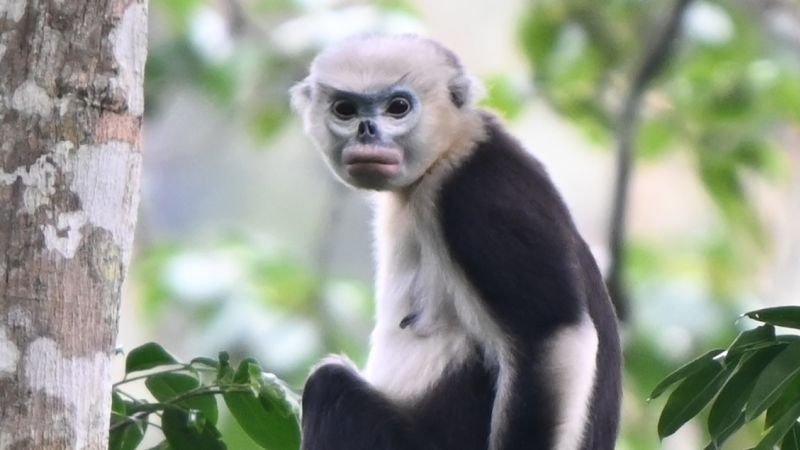
Between the branches of broad-leaf evergreens, a pair of blue-ringed eyes stare across the treetops of Khau Ca’s limestone forest.
It’s a rare glimpse of one of the world’s most endangered monkeys — and one that field conservationist Canh Xuan Chu relishes.
Tonkin snub-nosed monkeys are endemic to Vietnam, and only found in fragmented patches of forest in two of the country’s northernmost provinces, bordering China.
A population of just 50 was discovered in Khau Ca in 2002, adding to the handful of locations where the species was rediscovered in the late 1980s and 1990s, after being presumed extinct.
Today, the monkeys have all but disappeared from these other habitats. But a new census from conservation non-profit Fauna & Flora International found that Khau Ca’s population has more than tripled since 2002, with 160 of the critically endangered monkeys — an estimated 80% of the entire species — now living in the reserve.
“It’s one of our most successful surveys,” says Chu, the project manager for Fauna & Flora’s Tonkin snub-nosed monkey program.
The survey’s findings are giving the fragile species a hope for survival — and could be a model for other forests in Vietnam to restore their populations of Tonkin snub-nosed monkeys.
Despite their outlandish facial markings, these monkeys are shy and reserved, avoiding humans and often disappearing at any unusual sounds, says Chu.
It’s part of what makes them so difficult to count, a problem that goes back decades.
Hunted extensively for use in traditional medicine, and sometimes bushmeat, Tonkin’s snub-nosed monkeys were so rarely seen that by the 1980s, many thought they were extinct.
Shortly after discovering the population at Khau Ca, Fauna & Flora set up a conservation field station, and established community conservation teams to protect and patrol the forest, helping to remove snares and report signs of illegal deforestation or hunting.
To support communities that would typically make their income from farming or foraging in the forest, the project also creates new income streams, like the patrol groups. Other conservation partners, like the New Nature Foundation and Denver Zoo, are also working to reduce demands on the forest, distributing fuel-efficient stoves that cut firewood needs by 50%.
Tran Van On, a member of Fauna & Flora’s community conservation team, has observed a “significant increase” in community awareness around the conservation of the Tonkin snub-nosed monkey.
“People are now not only more conscious about protecting this endemic species of Vietnam, but also more aware of the importance of safeguarding forest habitats and other wildlife species,” said On, in a written statement.
The recent survey, conducted in October and November 2025, is the most comprehensive and complete to date, says Chu.
More than 30 people from the conservation unit and local community divided into 10 groups, camping in the forest for 10 days to conduct the survey across the park’s 1,000-hectare area.
This is part of a new methodology, explains Chu: with the reserve map divided into sections, each group is responsible for one “cell,” to help avoid duplication and improve efficiency.
The teams also utilized thermal imaging drones, camera traps, and audiomoths, a smart acoustics sensor used to monitor wildlife and helpful to detect the monkey’s unique calls.
For Chu, though, who has worked on the project for seven years, it is easy to spot the individual monkeys: “They’re so different: you see the coloring, you see the tail; and the other thing is, their calls to each other are different, so it’s very clear.”
Khau Ca’s recent survey stands in stark contrast to one conducted in Quan Ba, previously home to the second-largest population.
According to Chu, patrollers in Quan Ba haven’t seen the species since 2020, and in its most recent survey in 2024, they found no sign of the monkeys.
The biggest problem, says Chu, is cardamom farming in the forest. Cardamom, a prized spice for food and medicine, can provide a good income. But its cultivation involves clearing trees to reduce the dense canopy cover and cutting trees for firewood to dry the fruits after harvest, degrading the forest ecosystem that species like the Tonkin snub-nosed monkey need to survive.
When a strong population was first found there in 2007, Fauna & Flora established three community conservation teams in the area to help with protection and patrols, says Chu. But unlike Khau Ca, Quan Ba is not a formally protected area, which limits what organizations can do in terms of long-term habitat management and protective restrictions.
But Fauna & Flora hasn’t given up on Quan Ba: it still maintains one patrol group there, because “the area is so big, that the chance to see them is very low — so we think they have not 100% disappeared,” says Chu.
Currently, the non-profit is creating wildlife corridors from Khau Ca, which it hopes will one day connect with Quan Ba.
“The biodiversity is very rich there, especially related to amphibian and reptiles,” says Chu.
“But one thing is for sure — if we consider it as the second area (for the monkeys), we have to put more action on protection, and try to reduce the presence of the people inside the forest.”




Responses