
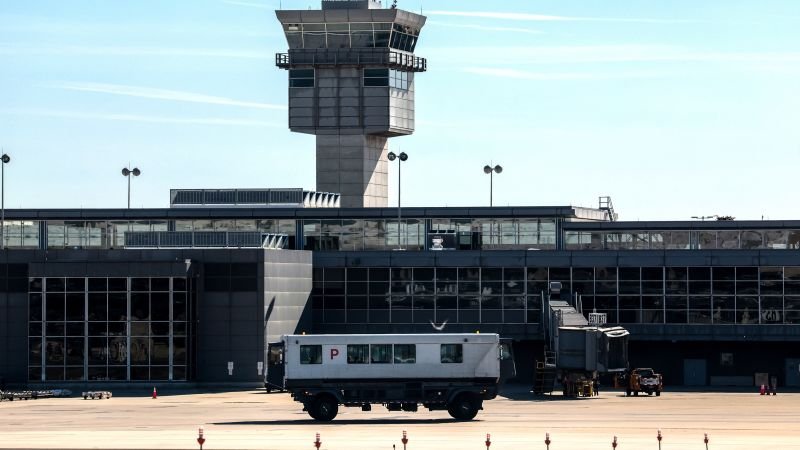
- US-bound flights carrying passengers who recently visited an Ebola-affected region of Africa must now land at Dulles International Airport for health screening.
- The CDC invoked Title 42 to restrict entry for non-citizens from the Democratic Republic of Congo, South Sudan and Uganda for at least 30 days.
- Nearly 600 suspected Ebola cases and nearly 150 deaths have been reported across the DRC and Uganda, according to the World Health Organization.
AI-generated summary was reviewed by a CNN editor.
US-bound flights carrying passengers who were recently in an Ebola-affected region of Africa must land at Dulles International Airport in Virginia, where they will undergo health screening.
“The Dulles requirement applies to all passengers, including U.S. citizens and [lawful permanent residents], who were present” in the Democratic Republic of Congo, South Sudan and Uganda, the US Department of State said in a travel advisory.
At least 10 staffers with the US Centers for Disease Control and Prevention are being sent to Dulles to help with screening of arriving passengers amid the Ebola outbreak, a person at CDC with knowledge of the plan told CNN.
The CDC has invoked Title 42 – a public health law that restricts entry into the US during outbreaks of communicable diseases – for at least 30 days starting Monday. The move includes entry restrictions on non-citizens who have been in the Democratic Republic of Congo, Uganda, or South Sudan, which borders both affected countries, in the previous 21 days, as well as screening and monitoring of people arriving from these countries.
The Department of Homeland Security said Customs and Border Protection “is continuing to coordinate with airlines, international partners, and port-of-entry officials to identify and manage travelers who may have been exposed to the Ebola virus.”
“The Airports Authority is working with federal partners to support efforts led by the Centers for Disease Control affecting various international flights arriving at Dulles Airport. This includes providing staff and public safety resources as needed. We are not expecting any significant impacts on airport customers,” a Dulles spokesperson said Wednesday.
An Air France flight bound for Detroit from Paris’ Charles de Gaulle Airport was briefly diverted to Montreal on Wednesday afternoon because a Congolese passenger was denied entry to the US, the airline said. “Under new regulations, passengers arriving from certain countries … may only enter U.S. territory via Washington (IAD) Airport.”
CPB said the passenger had boarded “in error” and the flight was prohibited from landing in Detroit. “CBP, in coordination with CDC, is taking the necessary measures to protect public health and reduce the risk of Ebola disease introduction into the United States.”
Mark Johnson, a spokesperson for Public Health Agency of Canada, said in a statement that an agency quarantine officer “assessed the traveller and determined they were asymptomatic. The traveller has departed back to Paris.” The flight and other passengers continued to Detroit.
There are nearly 600 suspected Ebola cases and nearly 150 deaths across the DRC and Uganda, according to the World Health Organization. The CDC emphasized Wednesday that the outbreak is of low risk to the general public, “but we will continue to evaluate the evolving situation and may adjust public health measures as additional information becomes available.”
One American, Dr. Peter Stafford, tested positive for Ebola while working in the DRC and has been hospitalized in Germany. His wife, Dr. Rebekah Stafford, is asymptomatic and being monitored in a separate portion of the hospital in Germany, as are the couple’s four children.
The Stafford family was stationed with the international charity Serge at a hospital in the Democratic Republic of the Congo (DRC), when the UN’s World Health Organization declared Ebola a public health emergency.
Dr. Stafford’s symptoms included fever, dizziness, light headedness and nausea, according to Matt Allison, the executive director of Serge.
“He’s in a state of mind and of health that he’s able to communicate with us,” Allison told CNN on Wednesday. “He continues to have a fever, dizziness, light headedness , and some nausea, which are fairly typical symptoms for Ebola. But he’s getting a monoclonal antibody treatment.”
Within the space of a day, Dr. Stafford’s health had improved. “He needed assistance to even walk,” the executive director said. “(We’ve seen) some progress and we’re really encouraged.”
In an update on Thursday, Serge said Peter shared, “Before I was evacuated I was feeling really concerned I wasn’t going to make it. And now I’m cautiously optimistic.”
Another US doctor who was working in DRC, Dr. Patrick LaRochelle, has arrived at a hospital in the Czech Republic for monitoring. He is in quarantine and is asymptomatic, Serge said Thursday.
Czech authorities have stressed there is no risk to the public after the country agreed to accept the patient.
“Only two countries were asked for help — Germany and the Czech Republic,” Czech Health Minister Adam Vojtěch said Wednesday.
“When we asked why, we were told that the Czech Republic has a very good reputation when it comes to handling infectious diseases,” Vojtěch added.
Dr. Hana Roháčová, the chief of the Infectious Diseases Clinic at the Bulovka Hospital in Prague, said her team hadn’t received much “concrete information” about the patient and the nature and time of his contact with infected people.
If asymptomatic, “he will be under observation and we will not be doing any tests or investigations — because no tests can prove if the patient is (infected and) inside the incubation period when there are no symptoms,” she said.
Vojtěch added that the treatment would not be a “cheap undertaking,” but the entire medical and transport bill will be picked up by the US.





Responses