
• US strikes: The US launched strikes against Iran in response to the downing of an Army Apache helicopter off the coast of Oman, according to a statement from US Central Command. President Donald Trump called the response “very strong, very powerful.”
• Tehran responds: Iran has launched missiles and drones toward US targets in the region, the Islamic Revolutionary Guard Corps said in a social media post.
• Impact in Iran: Local residents heard a “number of explosions” in the coastal city of Sirik, according to Iran’s semi-official Mehr News Agency. Explosions were also heard in Bandar Abbas and Qeshm, which border the Strait of Hormuz, Mehr reported.
• How downing happened: Two US officials said the helicopter was brought down by an Iranian drone, with a separate source telling CNN it was a Shahed drone. One of the officials said it was unclear whether the helicopter was intentionally targeted.
32 Posts
Iranian Foreign Minister Abbas Araghchi has said that no attack from the United States will be left “unanswered” after the US launched a new wave of retaliatory strikes on Iran following the downing of a military helicopter.
“Leave our region if you want to be safe,” the foreign minister warned.
The statement came after the US carried out initial strikes targeting Iranian air defense and radar systems around the Strait of Hormuz, two sources told CNN.
Iran has launched missiles and drones toward US targets in the region, the Islamic Revolutionary Guard Corps (IRGC) said in a Telegram post early Wednesday local time.
The statement came after the US said it was carrying out retaliatory strikes on Iran for the downing of a US Army helicopter. Explosions were heard in the Iranian cities of Sirik and Minab and on Qeshm Island, the semi-official Tasnim News Agency reported.
The governor of Minab clarified in a subsequent update that “no attack on the city has been reported,” according to Iran’s semi-official Mehr News Agency. Sounds of blasts heard in the inland city originated from the coastal strip bordering the Strait of Hormuz and not from Minab County itself, Mehr reported.
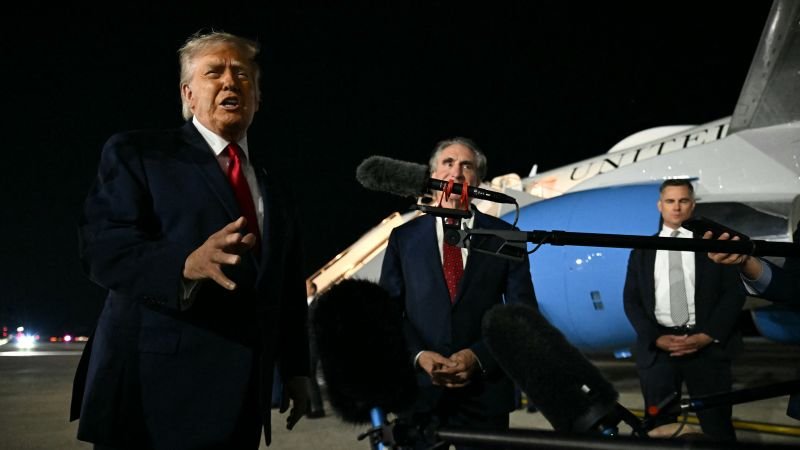
President Donald Trump said the US response to Iran downing a US helicopter is “very strong, very powerful.”
“This is a response to what they did, they did with our helicopter last night, and I believe the response should be very strong, very powerful, and that’s what this one is.”
The two pilots involved are uninjured, Trump said on Truth Social earlier. “Nevertheless, the United States must, of necessity, respond to this attack,” he said.
Explosions have been heard in the Iranian coastal city of Sirik, Iran’s semi-official Mehr News Agency reported, citing local residents who heard a “number of explosions in the area.”
Explosions were also heard in Bandar Abbas and Qeshm Island, which border the Strait of Hormuz, according to Mehr.
The news of explosions came as the US said it had launched a new wave of strikes against Iran at 5 p.m. Tuesday Eastern Time (12:30 a.m. Wednesday in Iran) in retaliation for the downing of a US Army helicopter Monday.
This post has been updated with additional information.
The US launched a new wave of strikes against Iran on Tuesday evening, according to a US Central Command social media post.
The strikes began at 5 p.m. EDT, according to the post, and are “in response to yesterday’s downing of a US Army Apache helicopter” off the coast of Oman. The command characterized the attacks as “self-defense strikes.”
A US official told CNN that the new strikes are intended as a warning shot at Iran and that the US believes they won’t hinder negotiations to end the war. The Central Command post described them as a “proportional response to unjustified Iranian aggression.”
Two sources told CNN initial strikes targeted air defense and radar systems around the Strait of Hormuz. One of the sources said that additional strikes are expected.
A source familiar with the downing of the US helicopter said an Iranian Shahed drone struck the aircraft on Monday. A US official told CNN that it was unclear whether the drone had targeted the Apache intentionally or if it was an inadvertent take down.
The helicopter’s two pilots were uninjured, according to a post by President Donald Trump, and an uncrewed US drone boat rescued them.
Apache attack helicopters, which are used by the US and other involved countries like the UAE and Saudi Arabia, are armed with a 30 millimeter chain gun and relatively cheap rockets that have made them a valuable and cost-efficient asset in fending off Iranian drones during the conflict.
Vice President JD Vance said the administration is “very close” on achieving a deal with Iran, but exactly how close remains to be seen, telling “CBS Sunday Morning” it could be within the week — or months away.
“Look, I think that the deal could happen in the next week, but the deal could also happen months from now,” Vance told Robert Costa in an interview taped Tuesday morning and airing Sunday.
He was confident, however, a deal would be reached before the November midterm elections. “Oh, absolutely,” Vance said. “I think we’re going to know a lot before the midterm elections.”
On Monday, President Donald Trump said a deal aimed at ending the war would be reached over the next two weeks. Tuesday morning, he told reporters it could be “in two or three days,” before announcing that Iran had downed an Apache helicopter and vowing to respond.
Vance projected optimism about the US reaching an agreement that holds for the long term, even if there’s more work to do to get there.
“Right now, I feel that we are in a position to get a deal that is good for the United States economically and that really does deal with the Iranian nuclear program, not just now, not just while Donald Trump is president, but for the long term,’” Vance told CBS.
“That’s the goal of the policy. And I think we’re very close to achieving that goal. But we still got some wood to chop. We’re going to keep doing it,” he added.
Iranian Foreign Minister Abbas Araghchi has urged foreign forces to leave the Strait of Hormuz or be “at constant risk,” after US President Donald Trump accused Iran of downing an Army Apache helicopter off the coast of Oman.
“To reduce risk, the best solution is for foreign forces to exit, as soon as possible, an environment which will never be hospitable to a hostile presence,” he added.
The Iranian foreign minister added that while Tehran prefers “the language of diplomacy … as our brave warriors have shown to the world, we know how to speak other languages too,” echoing a similar statement earlier from Iran’s top negotiator, Mohammad Bagher Ghalibaf.
The foreign minister said the Strait of Hormuz is not considered international waters but is shared by Iran and Oman. He vowed that Iran’s military is on constant alert for “any violation of Iran’s airspace, territory or territorial waters.”
While the strait lies within the territorial waters of Iran and Oman, it is nevertheless considered an international strait under the UN Convention on the Law of the Sea (UNCLOS), meaning that foreign vessels, including warships, have the right of unrestricted “transit passage” through it. Neither Iran nor the United States has ratified UNCLOS, and Tehran rejects the transit passage provision.
Some context: Aragchi made the statement after Trump said the US “must, of necessity, respond to this attack.”
In Trump’s social media post announcing that Iran “shot down” an Army Apache helicopter, one sentence stands out.
After noting that the pilots have been recovered safe and uninjured, Trump adds: “Nevertheless, the United States must, of necessity, respond to this attack.”
It sounds almost begrudging — as if this retaliation must be carried out, even though Trump doesn’t want to do it. This despite Trump saying Iran has literally attacked Americans during a ceasefire. That’s a very muted response.
And he downplayed further in a phone call with the Wall Street Journal, saying it “wasn’t a big deal” and that “the pilot is fine.”
It’s certainly a far cry from Trump’s previous bluster, when he threatened to strike Iranian infrastructure and end its civilization if it didn’t capitulate. It depicts a president who really doesn’t want to go back to largescale hostilities — and isn’t hiding that fact.
For many weeks now, Trump has made it pretty clear that he’s intent on avoiding going back to war, and he views provocations during the ceasefire as impediments to the deal he wants to cut to get out of Iran.
Repeatedly as those provocations and potential ceasefire violations keep coming, he and his administration have downplayed them or tried to smooth things over — as he did when Iran and Israel began striking each other over the weekend.
But there’s a downside to that approach: Iran knowing he doesn’t want to go back to war reduces his negotiating leverage.
From Washington to Tehran, all eyes are on Lebanon.
That’s because the future of the Iran war — and the prospects for a deal to end it — could now hinge on what happens in Lebanon, where a secondary front in this regional war is taking center stage. That new reality is the result of Iran’s relentless efforts to link the fate of both conflicts, and of the increasingly diverging priorities of the US president and the Israeli prime minister.
The 12-hour exchange of fire between Israel and Iran had barely ended on Monday when Lebanon’s key role was brought to the fore once again.
In the same breath that Iran’s Revolutionary Guard Corps said it would cease fire against Israel, it threatened to resume those strikes unless Israel halted its attacks on both Iran and Lebanon, where Tehran’s most powerful regional proxy, Hezbollah, is based.
“It is emphasized that should the aggressions and hostile acts continue — including in southern Lebanon — far more severe and crushing measures than before will be forthcoming,” the Khatam al-Anbiya Central Headquarters, a key command center for the Iranian army and Revolutionary Guard, said in a statement Monday.
If Iran makes good on that threat, Israel and Iran could soon be back at war. Israel has already carried out multiple new airstrikes in southern Lebanon as top Israeli officials rejected Iran’s efforts to link the two fronts and vowed to intensify attacks on Hezbollah.
Read more about why Lebanon is key to US-Iran negotiations here.
Two US officials said the Army helicopter downed off the coast of Oman was brought down by an Iranian drone.
A separate source familiar with the incident said an Iranian Shahed drone struck the US helicopter. One of the US officials said that it was unclear whether the drone had targeted the Apache intentionally or if it was an inadvertent take down.
The helicopter’s two crew members were rescued by an uncrewed drone boat, the US military said earlier Tuesday.
President Donald Trump posted on social media that the US military informed him that Iran shot down an Army Apache helicopter and that the US “must” respond.
Iran’s one-way Shahed drones are known to fly low and slow — a feature that makes them more able to evade air defenses than ballistic missiles.
Mohammad Bagher Ghalibaf, the speaker of Iran’s parliament, warned the US against breaking its commitments and threatened escalation if diplomatic efforts collapse.
The post came just minutes before US President Donald Trump said his country “must respond” after the military informed him that Iran shot down an Army Apache helicopter that went down off the coast of Oman.
US President Donald Trump said the US military informed him that Iran shot down an Army Apache helicopter that went down off the coast of Oman, adding that the US “must, of necessity, respond to this attack.”
“I have just been informed by our Great Military that last night the Iranians shot down one of our highly sophisticated Apache Helicopters while patrolling over the Strait of Hormuz. There were two pilots involved, both are safe and uninjured. Nevertheless, the United States must, of necessity, respond to this attack,” he said in a post on Truth Social Tuesday.
A US uncrewed drone boat rescued two crew members of the helicopter. The incident marked the first loss of an Apache since the conflict with Iran began.
Two members of Iran’s air defense unit were killed Monday in an Israeli attack, the state-run Islamic Republic of Iran Broadcasting (IRIB) reported Tuesday.
The two men were “killed while carrying out a mission to defend the country’s airspace,” IRIB said.
A Tehran municipality employee was also killed in the attack, the semi-official Fars News Agency reported, bringing the confirmed death toll in Iran to three.
Israel and Iran have restored a ceasefire following an exchange of missiles on Sunday and Monday that threatened a major escalation in the conflict. Tehran has warned it will resume attacks if Israeli strikes in southern Lebanon continue.
Meanwhile, US President Donald Trump told reporters early Tuesday that a deal with Iran could be reached “in two or three days.” He claimed the deal would stop Iran from having a nuclear weapon and lead to the immediate reopening of the Strait of Hormuz.
This post has been updated.
CNN’s Frederik Pleitgen is on the ground in Tehran and has been speaking to locals about the economic fallout of the US and Israel’s war against Iran.
“The market is really collapsed now,” Roya, an Iranian woman on the streets of Tehran, told Pleitgen.
Iran’s economy was already in a dire state before the conflict. National income per person had fallen from about $8,000 in 2012 to $5,000 in 2024, ravaged by inflation, corruption and sanctions. The outlook now is even worse. Up to 4.1 million more people could fall into poverty due to the conflict, according to the United Nations Development Program (UNDP).
Prices of basic goods have skyrocketed, pushing the Iranian economy to the edge as Washington and Tehran try to find a way to end the conflict. Mehrnaz, another Iranian citizen, told CNN that “inflation has made prices increase hundreds of times more.”
Not everyone has given up, however, with some still trying to make ends meet amid the uncertainty.
Israel and Iran have restored a ceasefire following an exchange of missiles on Sunday and Monday that threatened a major escalation in the conflict. Though Tehran has warned it will resume attacks if Israeli strikes in southern Lebanon continue.
Meanwhile, US President Donald Trump told reporters early Tuesday that a deal with Iran could be reached “in two or three days.” He claimed the deal would stop Iran from having a nuclear weapon and lead to the immediate reopening of the Strait of Hormuz.
Sahra, an Iranian woman, is resigned to the tragic reality that surrounds her. “It’s the consequences of war. We cannot do anything,” she said.
Editor’s Note: CNN operates in Iran only with the permission of the government but maintains full editorial control of its reports.
France has barred far-right Israeli Finance Minister Bezalel Smotrich from its territory, French Foreign Minister Jean-Noël Barrot said on Tuesday.
The ban will also apply to four leaders of Israeli settler organizations and 21 other individuals, Barrot said. Last month, France barred far-right National Security Minister Itamar Ben Gvir over his treatment of detained foreign activists who participated in the Global Summud Flotilla that attempted to break Israel’s siege of Gaza.
Italy has also put Ben Gvir under investigation on suspicion of torture and kidnapping of Italians who were among the activists.
Israel’s Foreign Ministry criticized the moves. “Israel firmly rejects the disgraceful measures adopted by foreign governments against Israeli citizens, entities, and a government minister,” it said.
Separately, France, The United Kingdom, Canada, Australia, New Zealand and Norway announced on Tuesday new sanctions targeting six entities and one individual accused of financing, enabling and carrying out settler violence in the occupied West Bank.
The UK also announced that its updated overseas guidance will explicitly advise businesses against economic and financial activity in West Bank settlements.
A US Navy surface drone “found and rescued” two US crew members after a US Army Apache helicopter went down off the coast of Oman “while patrolling regional waters,” the US military said early Tuesday.
US Central Command spokesperson Capt. Timothy Hawkins said, “A U.S. Navy surface drone found and rescued the crew from the water. U.S. 5th Fleet’s Task Force 59 is the Navy’s first operational AI and drone task force.”
Task Force 59, which was launched in 2021, includes unmanned vessels and drones. It’s the first Navy task force of its kind.
“The Soldiers were safely rescued within approximately two hours and are in stable condition. The cause of the incident is under investigation,” US Central Command, the military branch responsible for operations in the Middle East, said in a post on X.
Earlier, President Donald Trump told reporters, “The pilots are fine, nobody injured.”
The loss of the aircraft marks the first loss of an Apache since the conflict with Iran began.
CNN’s Zachary Cohen contributed to this report.
One of the biggest mysteries of the global economy is why the oil market has remained so calm during one of the greatest supply shocks in history.
The Strait of Hormuz has been paralyzed by three months of war – a nightmare scenario that few thought was possible before the war with Iran started. Visible traffic through the Strait of Hormuz remains sparse, estimated at just 15% of pre-war levels, according to JPMorgan.
Yet oil futures have not skyrocketed to the dangerous levels forecasters feared – at least not yet.
One theory is that a surprisingly large amount of crude is escaping the double blockade of the Strait of Hormuz, helping the global energy system absorb the historic shock. Tankers carrying these so-called “clandestine flows” may be dodging the blockade by turning off transponders to avoid detection, experts told CNN.
Meanwhile, Piper Sandler estimates that about 4.5 million barrels of crude per day have left the Persian Gulf through other means, mostly via the East-West Pipeline that connects Saudi oilfields to the Red Sea port of Yanbu.
And even more importantly, China has slashed its crude imports, turning instead to massive stockpiles.
Lebanon’s President Joseph Aoun speaks with CNN’s Christiane Amanpour about negotiations with Israel and his efforts to disarm Iran-backed Hezbollah.
Iran’s ticket allocation for the upcoming World Cup has been withdrawn a week before its opening game, the country’s soccer federation (FFIRI) said in a statement Tuesday, via state media.
Under regulations set out by FIFA, the sport’s global governing body, roughly 8% of the tickets to every World Cup match were reserved for each team competing in it so that national federations could sell them to their fans.
Iran is scheduled to play all three of its group games in the United States later this month, facing New Zealand and Belgium in Los Angeles, and Egypt in Seattle. Iranian public support for the national team cuts through social, regional and political faultlines, making it a powerful uniting force.
However, the FFIRI said Tuesday that its ticket allocation had been withdrawn, “and under current circumstances the federation is unable to provide even a single ticket to supporters of the national team.” It did not specify who pulled the allocation.
“This comes despite the fact that many Iranian football fans had already made travel and attendance plans based on the officially announced process,” it added.
CNN has contacted FIFA for comment. Iran’s soccer team touched down in Mexico’s northwestern city of Tijuana on Sunday – right next to the US border – as Tehran criticized Washington over its visa restrictions for the team, which will limit the time the team spends in the US.
This is the first time since the World Cup’s inception in 1930 in which a host nation will receive a country it is actively at war with, according to Reuters.
More than 100 days of war in Iran have left ordinary Iranians both devastated and detached from what has become a brutal reality at home.
This moment is particularly precarious, with Iran and Israel halting attacks on each other after trading fresh strikes Sunday and Monday – though Tehran warned it would resume attacks if Israeli strikes in southern Lebanon continue.
CNN talked to Iranians living through the war. They all spoke on the condition of anonymity for security reasons.
A 45-year-old man from Tehran said it was “unfortunate” to have been born in this country.
“Honestly, the only thing I can think about is how unfortunate we are to have been born here, and how everything we have here is going to waste,” he said.
Crestfallen by waves of attacks, some Iranians say they no longer feel the deep sadness borne at the beginning of the war. Now, they say, they are numb.
“I’m not worried. I am past worrying. At first these scenes were shocking, terrifying, but over time, a kind of emotional numbness developed,” said a 35-year-old Iranian woman from Tehran.
Quoting the Austrian writer Victor Frankl, she said that “man gets used to everything.”
“But don’t ask how,” she said, adding that it is a way to survive.
• US strikes: The US launched strikes against Iran in response to the downing of an Army Apache helicopter off the coast of Oman, according to a statement from US Central Command. President Donald Trump called the response “very strong, very powerful.”
• Tehran responds: Iran has launched missiles and drones toward US targets in the region, the Islamic Revolutionary Guard Corps said in a social media post.
• Impact in Iran: Local residents heard a “number of explosions” in the coastal city of Sirik, according to Iran’s semi-official Mehr News Agency. Explosions were also heard in Bandar Abbas and Qeshm, which border the Strait of Hormuz, Mehr reported.
• How downing happened: Two US officials said the helicopter was brought down by an Iranian drone, with a separate source telling CNN it was a Shahed drone. One of the officials said it was unclear whether the helicopter was intentionally targeted.
Iranian Foreign Minister Abbas Araghchi has said that no attack from the United States will be left “unanswered” after the US launched a new wave of retaliatory strikes on Iran following the downing of a military helicopter.
“Leave our region if you want to be safe,” the foreign minister warned.
The statement came after the US carried out initial strikes targeting Iranian air defense and radar systems around the Strait of Hormuz, two sources told CNN.
Iran has launched missiles and drones toward US targets in the region, the Islamic Revolutionary Guard Corps (IRGC) said in a Telegram post early Wednesday local time.
The statement came after the US said it was carrying out retaliatory strikes on Iran for the downing of a US Army helicopter. Explosions were heard in the Iranian cities of Sirik and Minab and on Qeshm Island, the semi-official Tasnim News Agency reported.
The governor of Minab clarified in a subsequent update that “no attack on the city has been reported,” according to Iran’s semi-official Mehr News Agency. Sounds of blasts heard in the inland city originated from the coastal strip bordering the Strait of Hormuz and not from Minab County itself, Mehr reported.
President Donald Trump said the US response to Iran downing a US helicopter is “very strong, very powerful.”
“This is a response to what they did, they did with our helicopter last night, and I believe the response should be very strong, very powerful, and that’s what this one is.”
The two pilots involved are uninjured, Trump said on Truth Social earlier. “Nevertheless, the United States must, of necessity, respond to this attack,” he said.
Explosions have been heard in the Iranian coastal city of Sirik, Iran’s semi-official Mehr News Agency reported, citing local residents who heard a “number of explosions in the area.”
Explosions were also heard in Bandar Abbas and Qeshm Island, which border the Strait of Hormuz, according to Mehr.
The news of explosions came as the US said it had launched a new wave of strikes against Iran at 5 p.m. Tuesday Eastern Time (12:30 a.m. Wednesday in Iran) in retaliation for the downing of a US Army helicopter Monday.
This post has been updated with additional information.
The US launched a new wave of strikes against Iran on Tuesday evening, according to a US Central Command social media post.
The strikes began at 5 p.m. EDT, according to the post, and are “in response to yesterday’s downing of a US Army Apache helicopter” off the coast of Oman. The command characterized the attacks as “self-defense strikes.”
A US official told CNN that the new strikes are intended as a warning shot at Iran and that the US believes they won’t hinder negotiations to end the war. The Central Command post described them as a “proportional response to unjustified Iranian aggression.”
Two sources told CNN initial strikes targeted air defense and radar systems around the Strait of Hormuz. One of the sources said that additional strikes are expected.
A source familiar with the downing of the US helicopter said an Iranian Shahed drone struck the aircraft on Monday. A US official told CNN that it was unclear whether the drone had targeted the Apache intentionally or if it was an inadvertent take down.
The helicopter’s two pilots were uninjured, according to a post by President Donald Trump, and an uncrewed US drone boat rescued them.
Apache attack helicopters, which are used by the US and other involved countries like the UAE and Saudi Arabia, are armed with a 30 millimeter chain gun and relatively cheap rockets that have made them a valuable and cost-efficient asset in fending off Iranian drones during the conflict.
Vice President JD Vance said the administration is “very close” on achieving a deal with Iran, but exactly how close remains to be seen, telling “CBS Sunday Morning” it could be within the week — or months away.
“Look, I think that the deal could happen in the next week, but the deal could also happen months from now,” Vance told Robert Costa in an interview taped Tuesday morning and airing Sunday.
He was confident, however, a deal would be reached before the November midterm elections. “Oh, absolutely,” Vance said. “I think we’re going to know a lot before the midterm elections.”
On Monday, President Donald Trump said a deal aimed at ending the war would be reached over the next two weeks. Tuesday morning, he told reporters it could be “in two or three days,” before announcing that Iran had downed an Apache helicopter and vowing to respond.
Vance projected optimism about the US reaching an agreement that holds for the long term, even if there’s more work to do to get there.
“Right now, I feel that we are in a position to get a deal that is good for the United States economically and that really does deal with the Iranian nuclear program, not just now, not just while Donald Trump is president, but for the long term,’” Vance told CBS.
“That’s the goal of the policy. And I think we’re very close to achieving that goal. But we still got some wood to chop. We’re going to keep doing it,” he added.
Iranian Foreign Minister Abbas Araghchi has urged foreign forces to leave the Strait of Hormuz or be “at constant risk,” after US President Donald Trump accused Iran of downing an Army Apache helicopter off the coast of Oman.
“To reduce risk, the best solution is for foreign forces to exit, as soon as possible, an environment which will never be hospitable to a hostile presence,” he added.
The Iranian foreign minister added that while Tehran prefers “the language of diplomacy … as our brave warriors have shown to the world, we know how to speak other languages too,” echoing a similar statement earlier from Iran’s top negotiator, Mohammad Bagher Ghalibaf.
The foreign minister said the Strait of Hormuz is not considered international waters but is shared by Iran and Oman. He vowed that Iran’s military is on constant alert for “any violation of Iran’s airspace, territory or territorial waters.”
While the strait lies within the territorial waters of Iran and Oman, it is nevertheless considered an international strait under the UN Convention on the Law of the Sea (UNCLOS), meaning that foreign vessels, including warships, have the right of unrestricted “transit passage” through it. Neither Iran nor the United States has ratified UNCLOS, and Tehran rejects the transit passage provision.
Some context: Aragchi made the statement after Trump said the US “must, of necessity, respond to this attack.”
In Trump’s social media post announcing that Iran “shot down” an Army Apache helicopter, one sentence stands out.
After noting that the pilots have been recovered safe and uninjured, Trump adds: “Nevertheless, the United States must, of necessity, respond to this attack.”
It sounds almost begrudging — as if this retaliation must be carried out, even though Trump doesn’t want to do it. This despite Trump saying Iran has literally attacked Americans during a ceasefire. That’s a very muted response.
And he downplayed further in a phone call with the Wall Street Journal, saying it “wasn’t a big deal” and that “the pilot is fine.”
It’s certainly a far cry from Trump’s previous bluster, when he threatened to strike Iranian infrastructure and end its civilization if it didn’t capitulate. It depicts a president who really doesn’t want to go back to largescale hostilities — and isn’t hiding that fact.
For many weeks now, Trump has made it pretty clear that he’s intent on avoiding going back to war, and he views provocations during the ceasefire as impediments to the deal he wants to cut to get out of Iran.
Repeatedly as those provocations and potential ceasefire violations keep coming, he and his administration have downplayed them or tried to smooth things over — as he did when Iran and Israel began striking each other over the weekend.
But there’s a downside to that approach: Iran knowing he doesn’t want to go back to war reduces his negotiating leverage.
From Washington to Tehran, all eyes are on Lebanon.
That’s because the future of the Iran war — and the prospects for a deal to end it — could now hinge on what happens in Lebanon, where a secondary front in this regional war is taking center stage. That new reality is the result of Iran’s relentless efforts to link the fate of both conflicts, and of the increasingly diverging priorities of the US president and the Israeli prime minister.
The 12-hour exchange of fire between Israel and Iran had barely ended on Monday when Lebanon’s key role was brought to the fore once again.
In the same breath that Iran’s Revolutionary Guard Corps said it would cease fire against Israel, it threatened to resume those strikes unless Israel halted its attacks on both Iran and Lebanon, where Tehran’s most powerful regional proxy, Hezbollah, is based.
“It is emphasized that should the aggressions and hostile acts continue — including in southern Lebanon — far more severe and crushing measures than before will be forthcoming,” the Khatam al-Anbiya Central Headquarters, a key command center for the Iranian army and Revolutionary Guard, said in a statement Monday.
If Iran makes good on that threat, Israel and Iran could soon be back at war. Israel has already carried out multiple new airstrikes in southern Lebanon as top Israeli officials rejected Iran’s efforts to link the two fronts and vowed to intensify attacks on Hezbollah.
Read more about why Lebanon is key to US-Iran negotiations here.
Two US officials said the Army helicopter downed off the coast of Oman was brought down by an Iranian drone.
A separate source familiar with the incident said an Iranian Shahed drone struck the US helicopter. One of the US officials said that it was unclear whether the drone had targeted the Apache intentionally or if it was an inadvertent take down.
The helicopter’s two crew members were rescued by an uncrewed drone boat, the US military said earlier Tuesday.
President Donald Trump posted on social media that the US military informed him that Iran shot down an Army Apache helicopter and that the US “must” respond.
Iran’s one-way Shahed drones are known to fly low and slow — a feature that makes them more able to evade air defenses than ballistic missiles.
Mohammad Bagher Ghalibaf, the speaker of Iran’s parliament, warned the US against breaking its commitments and threatened escalation if diplomatic efforts collapse.
The post came just minutes before US President Donald Trump said his country “must respond” after the military informed him that Iran shot down an Army Apache helicopter that went down off the coast of Oman.
US President Donald Trump said the US military informed him that Iran shot down an Army Apache helicopter that went down off the coast of Oman, adding that the US “must, of necessity, respond to this attack.”
“I have just been informed by our Great Military that last night the Iranians shot down one of our highly sophisticated Apache Helicopters while patrolling over the Strait of Hormuz. There were two pilots involved, both are safe and uninjured. Nevertheless, the United States must, of necessity, respond to this attack,” he said in a post on Truth Social Tuesday.
A US uncrewed drone boat rescued two crew members of the helicopter. The incident marked the first loss of an Apache since the conflict with Iran began.
Two members of Iran’s air defense unit were killed Monday in an Israeli attack, the state-run Islamic Republic of Iran Broadcasting (IRIB) reported Tuesday.
The two men were “killed while carrying out a mission to defend the country’s airspace,” IRIB said.
A Tehran municipality employee was also killed in the attack, the semi-official Fars News Agency reported, bringing the confirmed death toll in Iran to three.
Israel and Iran have restored a ceasefire following an exchange of missiles on Sunday and Monday that threatened a major escalation in the conflict. Tehran has warned it will resume attacks if Israeli strikes in southern Lebanon continue.
Meanwhile, US President Donald Trump told reporters early Tuesday that a deal with Iran could be reached “in two or three days.” He claimed the deal would stop Iran from having a nuclear weapon and lead to the immediate reopening of the Strait of Hormuz.
This post has been updated.
CNN’s Frederik Pleitgen is on the ground in Tehran and has been speaking to locals about the economic fallout of the US and Israel’s war against Iran.
“The market is really collapsed now,” Roya, an Iranian woman on the streets of Tehran, told Pleitgen.
Iran’s economy was already in a dire state before the conflict. National income per person had fallen from about $8,000 in 2012 to $5,000 in 2024, ravaged by inflation, corruption and sanctions. The outlook now is even worse. Up to 4.1 million more people could fall into poverty due to the conflict, according to the United Nations Development Program (UNDP).
Prices of basic goods have skyrocketed, pushing the Iranian economy to the edge as Washington and Tehran try to find a way to end the conflict. Mehrnaz, another Iranian citizen, told CNN that “inflation has made prices increase hundreds of times more.”
Not everyone has given up, however, with some still trying to make ends meet amid the uncertainty.
Israel and Iran have restored a ceasefire following an exchange of missiles on Sunday and Monday that threatened a major escalation in the conflict. Though Tehran has warned it will resume attacks if Israeli strikes in southern Lebanon continue.
Meanwhile, US President Donald Trump told reporters early Tuesday that a deal with Iran could be reached “in two or three days.” He claimed the deal would stop Iran from having a nuclear weapon and lead to the immediate reopening of the Strait of Hormuz.
Sahra, an Iranian woman, is resigned to the tragic reality that surrounds her. “It’s the consequences of war. We cannot do anything,” she said.
Editor’s Note: CNN operates in Iran only with the permission of the government but maintains full editorial control of its reports.
France has barred far-right Israeli Finance Minister Bezalel Smotrich from its territory, French Foreign Minister Jean-Noël Barrot said on Tuesday.
The ban will also apply to four leaders of Israeli settler organizations and 21 other individuals, Barrot said. Last month, France barred far-right National Security Minister Itamar Ben Gvir over his treatment of detained foreign activists who participated in the Global Summud Flotilla that attempted to break Israel’s siege of Gaza.
Italy has also put Ben Gvir under investigation on suspicion of torture and kidnapping of Italians who were among the activists.
Israel’s Foreign Ministry criticized the moves. “Israel firmly rejects the disgraceful measures adopted by foreign governments against Israeli citizens, entities, and a government minister,” it said.
Separately, France, The United Kingdom, Canada, Australia, New Zealand and Norway announced on Tuesday new sanctions targeting six entities and one individual accused of financing, enabling and carrying out settler violence in the occupied West Bank.
The UK also announced that its updated overseas guidance will explicitly advise businesses against economic and financial activity in West Bank settlements.
A US Navy surface drone “found and rescued” two US crew members after a US Army Apache helicopter went down off the coast of Oman “while patrolling regional waters,” the US military said early Tuesday.
US Central Command spokesperson Capt. Timothy Hawkins said, “A U.S. Navy surface drone found and rescued the crew from the water. U.S. 5th Fleet’s Task Force 59 is the Navy’s first operational AI and drone task force.”
Task Force 59, which was launched in 2021, includes unmanned vessels and drones. It’s the first Navy task force of its kind.
“The Soldiers were safely rescued within approximately two hours and are in stable condition. The cause of the incident is under investigation,” US Central Command, the military branch responsible for operations in the Middle East, said in a post on X.
Earlier, President Donald Trump told reporters, “The pilots are fine, nobody injured.”
The loss of the aircraft marks the first loss of an Apache since the conflict with Iran began.
CNN’s Zachary Cohen contributed to this report.
One of the biggest mysteries of the global economy is why the oil market has remained so calm during one of the greatest supply shocks in history.
The Strait of Hormuz has been paralyzed by three months of war – a nightmare scenario that few thought was possible before the war with Iran started. Visible traffic through the Strait of Hormuz remains sparse, estimated at just 15% of pre-war levels, according to JPMorgan.
Yet oil futures have not skyrocketed to the dangerous levels forecasters feared – at least not yet.
One theory is that a surprisingly large amount of crude is escaping the double blockade of the Strait of Hormuz, helping the global energy system absorb the historic shock. Tankers carrying these so-called “clandestine flows” may be dodging the blockade by turning off transponders to avoid detection, experts told CNN.
Meanwhile, Piper Sandler estimates that about 4.5 million barrels of crude per day have left the Persian Gulf through other means, mostly via the East-West Pipeline that connects Saudi oilfields to the Red Sea port of Yanbu.
And even more importantly, China has slashed its crude imports, turning instead to massive stockpiles.
Lebanon’s President Joseph Aoun speaks with CNN’s Christiane Amanpour about negotiations with Israel and his efforts to disarm Iran-backed Hezbollah.
Iran’s ticket allocation for the upcoming World Cup has been withdrawn a week before its opening game, the country’s soccer federation (FFIRI) said in a statement Tuesday, via state media.
Under regulations set out by FIFA, the sport’s global governing body, roughly 8% of the tickets to every World Cup match were reserved for each team competing in it so that national federations could sell them to their fans.
Iran is scheduled to play all three of its group games in the United States later this month, facing New Zealand and Belgium in Los Angeles, and Egypt in Seattle. Iranian public support for the national team cuts through social, regional and political faultlines, making it a powerful uniting force.
However, the FFIRI said Tuesday that its ticket allocation had been withdrawn, “and under current circumstances the federation is unable to provide even a single ticket to supporters of the national team.” It did not specify who pulled the allocation.
“This comes despite the fact that many Iranian football fans had already made travel and attendance plans based on the officially announced process,” it added.
CNN has contacted FIFA for comment. Iran’s soccer team touched down in Mexico’s northwestern city of Tijuana on Sunday – right next to the US border – as Tehran criticized Washington over its visa restrictions for the team, which will limit the time the team spends in the US.
This is the first time since the World Cup’s inception in 1930 in which a host nation will receive a country it is actively at war with, according to Reuters.
More than 100 days of war in Iran have left ordinary Iranians both devastated and detached from what has become a brutal reality at home.
This moment is particularly precarious, with Iran and Israel halting attacks on each other after trading fresh strikes Sunday and Monday – though Tehran warned it would resume attacks if Israeli strikes in southern Lebanon continue.
CNN talked to Iranians living through the war. They all spoke on the condition of anonymity for security reasons.
A 45-year-old man from Tehran said it was “unfortunate” to have been born in this country.
“Honestly, the only thing I can think about is how unfortunate we are to have been born here, and how everything we have here is going to waste,” he said.
Crestfallen by waves of attacks, some Iranians say they no longer feel the deep sadness borne at the beginning of the war. Now, they say, they are numb.
“I’m not worried. I am past worrying. At first these scenes were shocking, terrifying, but over time, a kind of emotional numbness developed,” said a 35-year-old Iranian woman from Tehran.
Quoting the Austrian writer Victor Frankl, she said that “man gets used to everything.”
“But don’t ask how,” she said, adding that it is a way to survive.




Responses