
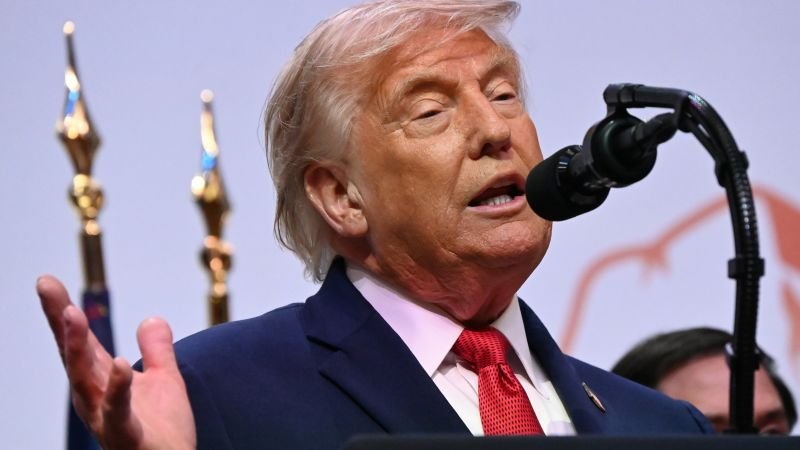
• Agreement signed: President Donald Trump signed a copy of the US-Iran agreement tonight at the Palace of Versailles in France. “It’s signed,” Trump told reporters after a dinner hosted by President Emmanuel Macron. The US then sent a photograph of the signed agreement to the Iranians, a US official told CNN. Read the full document, annotated.
• What comes next: The agreement says the US will issue waivers so Iran will be able to export oil and spells out provisions for reopening the critical Strait of Hormuz. It also states Tehran will “not procure or develop nuclear weapons” and commits the US and regional partners to developing a $300 billion reconstruction fund for Iran that will be implemented in the next phase of negotiations.
• In Lebanon: The text of the agreement ends the war on all fronts, including in Lebanon, where Israel has continued to carry out strikes.
67 Posts
Pakistan, which has played a mediation role in US-Iran talks, has endorsed the newly signed memorandum, Prime Minister Shehbaz Sharif posted to X.
The Pakistani prime minister said his country, along with co-mediator Qatar, will host the official ceremony set for Friday in Switzerland “to commemorate this landmark event and commence with the technical level talks.”
“The signing of this agreement at the highest level of the respective governments demonstrates the commitment of both sides to a diplomatic resolution of the conflict,” Sharif said.
President Donald Trump has had an eventful night in France after attending the final day of the G7 summit. He toured the Palace of Versailles with his hosts — French President Emmanuel Macron and his wife Brigitte Macron — and during dinner, he officially signed a copy of the US-Iran agreement, according to two US officials.
The US then sent a photograph of the signed agreement to the Iranians, one of the officials said.
The memorandum was “officially finalized” after being signed in both English and Farsi upon Iran’s insistence for the purposes of transparency, Iran’s Foreign Ministry spokesperson Esmail Baghaei said, according to state broadcaster IRIB.
Earlier in the day, Trump said that US forces would remain in the Persian Gulf region “for a little while” following an agreement.
Several Democratic senators criticized the agreement, saying it is a good deal for Iran but not the US.
Separately, Ukrainian President Volodymyr Zelensky said on social media he spoke to both Trump and Macron about the outcomes of their discussions at the G7 summit.
Alejandra Jaramillo, Hira Humayun, Aida Karimi, Kristen Holmes, Annie Grayer, Kevin Liptak Camila DeChalus, Morgan Rimmer and Lauren Fox contributed to this report.
President Donald Trump told reporters as he departed the Palace of Versailles tonight that he had signed a copy of the US-Iran agreement.
CNN reported earlier that Trump signed a hard copy of the agreement during dinner.
The US-Iran memorandum was signed in both English and Farsi upon Iran’s insistence for the purposes of transparency, Iran’s Foreign Ministry spokesperson Esmail Baghaei said in an interview with state broadcaster IRIB.
Baghaei said the Farsi text corresponds accurately to the English version and that Iran considers it “fully authoritative and valid.”
The memorandum of understanding between Iran and the United States is “officially finalized” after being digitally signed by both countries, Iran’s Foreign Ministry spokesman Esmail Baghaei said in an interview with state broadcaster IRIB.
“It was agreed that the Iran–U.S. memorandum of understanding would be signed digitally,” Baghaei told IRIB, adding that while there are plans for negotiating teams to be in Geneva, there would be no signing ceremony in Switzerland. Earlier, a US official said a formal signing ceremony would take place on Friday with US Vice President JD Vance in attendance.
According to the ministry spokesman, violating the memorandum will “carry a greater cost” once signed by both presidents.
Baghaei said that if the text is now reviewed, there would not be anything in it that wasn’t already discussed.
“We have, more or less, stated all of these points before,” Baghaei said.
The memorandum, he said, emphasizes that the 60-day negotiations will be solely focused on the nuclear issue and sanctions relief.
“The wise decision of the Islamic Republic was not to negotiate the nuclear issue at this stage,” Baghaei told the broadcaster. “It was decided that the focus should be on ending the war, and we accomplished that.”
Iranian parliamentary speaker Mohammad Bagher Ghalibaf has said the negotiations with the US are continuing and that a possible memorandum of understanding could take shape at Friday’s meeting in Geneva.
In an interview with the Iranian state broadcaster, the speaker said the memorandum of understanding represented a “record of America’s failure.”
“The people will see it and judge for themselves,” he said.
He also said the Strait of Hormuz was part of the understandings reached with the United States, and that passage-related service fees had been formalized in the memorandum of understanding under discussion.
“Payment of service fees for passage through the Strait of Hormuz has been formalized in the memorandum of understanding,” he added.
Ghalibaf repeatedly said Lebanon was one of the main topics tied to the negotiations. “We told the mediator that the issue of Lebanon and the blocked/frozen funds were among the main axes of the negotiations,” he said.
He said discussions over Lebanon affected the pace and direction of the talks, particularly after an attack on Beirut’s southern suburbs.
Referring to remarks by US Vice President JD Vance during the early negotiations in Pakistan that suggested excluding Lebanon, Ghalibaf said, “When I saw JD Vance’s remarks while he was boarding the plane, in which he spoke about Lebanon, I posted on X … that we would not begin negotiations until Lebanon’s situation was clarified,” he said.
Vance has since suggested Lebanon would be part of a broader regional arrangement. In an interview on The Megyn Kelly Show on Tuesday, Vance said, “It is a regional peace deal. It’s going to include the Gulf. It’s going to include Israel. It’s going to include Lebanon. The idea is this is a true regional peace deal.”
President Donald Trump was hosted by French President Emmanuel Macron and his wife Brigitte Macron at the Palace of Versailles on Wednesday, where the leaders toured the historic residence together.
Macron and his wife greeted Trump on the steps of the palace before the three posed for photographs ahead of the private visit. “It’s beautiful,” Trump said.
Reporters were not permitted to join the tour, but a photographer captured Trump walking through the ornate halls, which featured historic artwork, decorated ceilings, chandeliers, and gilded sculptures.
Earlier this week, Trump said he accepted Macron’s invitation to dine at Versailles because he was “a fan of beautiful places.”
Some background: Dripping with gilt and marble, the colossal palace was the singular vision of Louis XIV, aka the almighty Sun King, whose lavish, lusty lifestyle mirrored his global ambitions for France in the 17th century. The monarch recruited the finest craftsmen of the day for his Pharaonic project: transforming his father’s simple hunting lodge into a party pad to house the 6,000-person royal court. The numbers are dizzying: 700 rooms, 27 acres of roof, 67 staircases. Read more details here:
See more pictures from Trump’s visit:
President Donald Trump officially signed a copy of the US-Iran agreement during tonight’s dinner at the Palace of Versailles, according to two US officials.
The US then sent a photograph of the signed agreement to the Iranians, one of the officials said.
A different senior US administration official said earlier this week that Trump and Vice President JD Vance had previously both virtually signed the Memorandum of Understanding with Iran, and Iran’s Parliament Speaker Mohammad Bagher Ghalibaf signed the document virtually for the Iranian side.
But a US official said Wednesday that Trump has now signed a hard copy, and also suggested he had not signed digitally before, but rather, “witnessed” the signing by Vance.
“On Sunday, the MOU was signed digitally by Vice President Vance and Speaker Ghalibaf and witnessed by President Trump. Now, it has been signed by President Trump and President (Masoud) Pezeshkian,” that official said.
The US official said a formal signing ceremony with Vance is still expected to occur Friday. But Esmail Baghaei, a spokesperson for Iran’s Foreign Ministry, told Iranian state media IRIB, that the memo was signed digitally and no signing ceremony would be held in Switzerland.
This post has been updated with additional reporting.
Several Democratic senators criticized the Iran agreement on Wednesday, saying it is a good deal for Iran but not the US.
The United States on Wednesday released the official text of the memorandum of understanding reached over the weekend with Iran. The memorandum is due to be formally signed Friday, triggering a 60-day-window to negotiate the final terms of a deal.
“This will be regarded as one of the biggest American disasters, and it’s because Trump started this war. He didn’t know how to finish it, and it looks like in too many ways he has just capitulated to the Iranians,” Senate Minority Leader Chuck Schumer said.
“I understand how the Iranians win in this MOU, but I sure don’t see how this helps one single American family,” Sen. Elizabeth Warren told reporters on Capitol Hill. “President Trump could never explain why we got into this war, but boy, the costs have become clear.”
California Democratic Sen. Adam Schiff told reporters this deal was not good for the US.
“This looks like a great deal for Iran and a terrible deal for the United States of America. It’s an agreement to reach an agreement on things in the future, but little incentive for Iran to actually come to agreement on those terms,” he said.
US President Donald Trump will enjoy a simple and understated French menu tonight at a dinner hosted by French President Emmanuel Macron at the Palace of Versailles.
Here’s what they’ll be eating, according to a menu provided by CNN affiliate BFMTV :
• Bigorre black pork as an appetizer
• Loire Valley asparagus
• Bourbonnais poultry
• Cheese platter “from our regions”
• Chocolate tart
President Donald Trump said Wednesday that US forces would remain in the Persian Gulf region “for a little while” following an agreement with Iran.
Asked how long he’d leave the US military in the gulf, Trump told reporters in Paris: “It’s a good question. We haven’t thought of it.” He added: “Probably a while. It’s a good place to stay.”
He then said: “I would say a little while. See how it all goes. I think it’s going to go well, but we’ll see.”
The United States on Wednesday released the official text of the memorandum of understanding reached over the weekend with Iran.
CNN’s Nic Robertson reports on some of the key details of the MOU:
President Donald Trump downplayed the importance of destroying Iran’s stockpile of highly enriched uranium, arguing that it’s less important than preventing Tehran from obtaining a nuclear weapon.
“It’s much less important, because it’s very hard to get at that,” Trump told reporters in Paris on Wednesday when asked about the importance of resolving “the nuclear dust.”
Trump continued: “I don’t think anybody could get it — we could get at it with great work and a lot of time.” He went on to tout the US strikes against Iran’s nuclear facilities last summer, saying, “The B2 bombers and those great pilots, now you understand, they did their job.”
“So much less important than not having a nuclear weapon,” Trump added.
The official text of the agreement with Iran released by US officials earlier Wednesday specifies a “minimum methodology” of down-blending the near-bomb-grade uranium with lower grade material under supervision from the International Atomic Energy Agency, the UN nuclear watchdog.
President Donald Trump said Wednesday that he does not view the 60-day negotiating window for technical negotiations — as outlined in the initial agreement — between the United States and Iran as a firm deadline.
“I don’t view it as hard, no,” Trump told reporters. “Just as long as they’re behaving, I really don’t care that much.”
The comments came after the United States released the official text of the memorandum of understanding, which is expected to be formally signed by both sides Friday.
The signing ceremony would trigger a 60-day period for negotiators to work toward the final terms of a broader agreement, according to that text.
Lebanese President Joseph Aoun said Wednesday he welcomes help from “any state” in securing a ceasefire as the Israeli military carried out strikes on southern Lebanon.
In a post on X, Aoun said Lebanon is “certainly in favor of a ceasefire and with any state that helps us, including Iran among them.” He emphasized that the Lebanese government will make official decisions for the state.
“Any settlement will be made through us, not at our expense,” Aoun said in an apparent reference to Iran and Hezbollah.
Israel carried out a series of strikes near the city of Nabatieh in southern Lebanon on Wednesday, according to Lebanon’s official National News Agency (NNA).
The Israel Defense Forces hit the area of Ali al-Taher with “violent artillery strikes,” NNA reported, as well as an airstrike on the outskirts of nearby Kfar Tebnit.
On Monday, the IDF chief of staff, Lt. Gen. Eyal Zamir, said the military was operating against Hezbollah in the area near the Beaufort fortress.
“The findings, both above ground and below ground, testify to the importance of the infrastructure that was exposed and on the centrality of the Beaufort area and the Ali al-Taher ridge for the organization in its attempts to entrench itself and harm the residents of (northern Israel),” he said.
According to the IDF, five Israeli soldiers were wounded in a Hezbollah drone attack in southern Lebanon on Wednesday, including one who was severely injured. The military later said in a statement that it struck a rocket launcher that had fired toward Israeli soldiers.
This post has been updated with additional details.
Although the technical details regarding the fate of Iran’s enriched uranium remain to be worked out, experts warned that the “minimum” agreement to dilute Iran’s stockpile would require vigorous monitoring to block weapons development.
Kelsey Davenport, who heads nonproliferation policy work for the Arms Control Association, wrote on X that in the years since President Donald Trump withdrew the US from the 2015 nuclear deal, “Iran has gained irreversible knowledge about enrichment [and] the production of centrifuges.”
Eric Brewer of the Nuclear Threat Initiative nonprofit has argued that “allowing Iran to hold on to even 5% enriched material” — a low enrichment level that could be a target for stock dilution — “is more dangerous now … because of all of … [Iran’s] expertise.”
If Iran is allowed to keep downblended enriched uranium, the key to preventing a covert bomb program is intense monitoring.
“An effective agreement in 2026 needs to … ensure that any move to divert material or deviate from a deal’s limits will be quickly detected,” Davenport wrote on X.
But even that will only be able to slow the Iranians if they renege on the deal and someday go for the bomb, Davenport said. “Even starting from zero — no enriched uranium, no centrifuges — Iran’s breakout would likely be less than 12 months.”
Davis Winkie’s work at CNN is supported by a partnership between Outrider Foundation and Journalism Funding Partners (JFP). CNN retains full editorial control of the reporting.
GOP Sen. Bill Cassidy, who lost his primary last month after President Donald Trump backed a challenger, said in a post on X , “This is the worst foreign policy blunder in decades.”
“Reagan is rolling over in his grave,” Cassidy said in the post on Wednesday. “Iran’s nuclear ambitions were not curbed, and they have learned that threatening the Strait of Hormuz works and will undoubtedly leverage it in the future. Now, Iran gets to build brand-new infrastructure under this deal.”
“Before the war, the strait was open, Iran was being crushed by sanctions, and 13 service members were still alive. Now, 13 Americans are dead, families have paid billions at the pump, sanctions will be lifted, and the bombing has stopped. This is the worst foreign policy blunder in decades,” he said.
The United States on Wednesday released the official text of the memorandum of understanding – or MOU – reached over the weekend with Iran. The memorandum is due to be formally signed Friday, triggering a 60-day-window to negotiate the final terms of a deal.
Sen. Lindsey Graham, a top GOP hawk, said in a post on X that he had a “very lengthy and productive discussion” with Middle East envoy Steve Witkoff and believes that signing the Iran agreement “will be beneficial to the United States, in as much as the Strait of Hormuz will begin to open, and the hostilities with Iran will stop.”
Graham went on to say, “Whether or not the United States can reach an acceptable, verifiable deal with Iran regarding its nuclear program and other issues is yet to be determined, but I see little downside to trying. The economic stability that comes from opening up the Strait and the cessation of hostilities could create a pathway to peace well beyond the Iranian conflict.”
The United States on Wednesday released the official text of the memorandum of understanding – or MOU – reached over the weekend with Iran. The memorandum is due to be formally signed Friday, triggering a 60-day-window to negotiate the final terms of a deal.
Graham said on X, “The expansion of the Abraham Accords and normalizing relations between Saudi Arabia and Israel is President Trump’s and my ultimate goal. I think that is best achieved by creating economic stability for the United States, the region and the world, as well as the cessation of hostilities. The signing of the MOU is an essential step to make that happen and thus it is worthwhile.”
US President Donald Trump spoke to journalists about the agreement with Iran on the final day of the G7 summit in Évian-les-Bains, France.
He offered that he “didn’t want to see economic catastrophe,” which was a risk in a scenario where the war continued.
Here’s a quick recap of what he said:
If an agreement wasn’t reached with Iran, the US could have continued the war for up to another two years. He also said that if Iran doesn’t adhere to the agreement, the US will return to bombing it.
Continuing the war might have had severe economic repercussions, Trump said, because it would “ruin the world market.” That “would have been the wrong thing to do,” he said.
He supports Iran having access to “some” conventional ballistic missiles, which he said was one of the issues the Persian Gulf’s Arab nations would help to address.
The US has now sent Israel a copy of the agreement to end the war.
The US blockade against Iranian ships in the Strait of Hormuz was “more impactful” than its military offensive against Iran.
Trump expressed some leniency on sanctions against Iran, provided it complies with the terms of the agreement. He also said regarding frozen Iranian funds: “I guess we’re going to have to give it back.”
He does not plan on holding anyone in the administration accountable for a deadly strike on an Iranian school during the first day of the war. “Mistakes are made,” he said. The strike killed at least 168 children and 14 teachers, Iranian state media has reported.
Trump praised Chinese President Xi Jinping and Russian President Vladimir Putin for remaining neutral while the US negotiated with Iran.
CNN’s Alejandra Jaramillo, Kaanita Iyer, Christina Sierra, Kit Maher and Maureen Chowdhury contributed to this report.
A senior US official said either side could walk away from the US-Iran technical talks that will take place over the next 60 days, during which the two countries will attempt to broker a final deal.
The official described having secured a “gentleman’s agreement” with Iran about certain aspects of the negotiations.
“I think we have a lot of understandings in our discussions, and that’s what I call a gentleman’s agreement,” the senior US official said. “We will get in this weekend and try to see what that means, and if we’re able to come to a good place, and we’ll continue the discussion, so they could break off at any time.”
The official said Trump and his aides would be willing to exit negotiations if they believed the Iranians were not talking in good faith.
“If we think that they’re just dragging us along and bullsh*tting us, we’ll be very quick to pull the plug on it and go back to tightening the screws on them very, very aggressively,” the official said.
• Agreement signed: President Donald Trump signed a copy of the US-Iran agreement tonight at the Palace of Versailles in France. “It’s signed,” Trump told reporters after a dinner hosted by President Emmanuel Macron. The US then sent a photograph of the signed agreement to the Iranians, a US official told CNN. Read the full document, annotated.
• What comes next: The agreement says the US will issue waivers so Iran will be able to export oil and spells out provisions for reopening the critical Strait of Hormuz. It also states Tehran will “not procure or develop nuclear weapons” and commits the US and regional partners to developing a $300 billion reconstruction fund for Iran that will be implemented in the next phase of negotiations.
• In Lebanon: The text of the agreement ends the war on all fronts, including in Lebanon, where Israel has continued to carry out strikes.
Pakistan, which has played a mediation role in US-Iran talks, has endorsed the newly signed memorandum, Prime Minister Shehbaz Sharif posted to X.
The Pakistani prime minister said his country, along with co-mediator Qatar, will host the official ceremony set for Friday in Switzerland “to commemorate this landmark event and commence with the technical level talks.”
“The signing of this agreement at the highest level of the respective governments demonstrates the commitment of both sides to a diplomatic resolution of the conflict,” Sharif said.
President Donald Trump has had an eventful night in France after attending the final day of the G7 summit. He toured the Palace of Versailles with his hosts — French President Emmanuel Macron and his wife Brigitte Macron — and during dinner, he officially signed a copy of the US-Iran agreement, according to two US officials.
The US then sent a photograph of the signed agreement to the Iranians, one of the officials said.
The memorandum was “officially finalized” after being signed in both English and Farsi upon Iran’s insistence for the purposes of transparency, Iran’s Foreign Ministry spokesperson Esmail Baghaei said, according to state broadcaster IRIB.
Earlier in the day, Trump said that US forces would remain in the Persian Gulf region “for a little while” following an agreement.
Several Democratic senators criticized the agreement, saying it is a good deal for Iran but not the US.
Separately, Ukrainian President Volodymyr Zelensky said on social media he spoke to both Trump and Macron about the outcomes of their discussions at the G7 summit.
Alejandra Jaramillo, Hira Humayun, Aida Karimi, Kristen Holmes, Annie Grayer, Kevin Liptak Camila DeChalus, Morgan Rimmer and Lauren Fox contributed to this report.
President Donald Trump told reporters as he departed the Palace of Versailles tonight that he had signed a copy of the US-Iran agreement.
CNN reported earlier that Trump signed a hard copy of the agreement during dinner.
The US-Iran memorandum was signed in both English and Farsi upon Iran’s insistence for the purposes of transparency, Iran’s Foreign Ministry spokesperson Esmail Baghaei said in an interview with state broadcaster IRIB.
Baghaei said the Farsi text corresponds accurately to the English version and that Iran considers it “fully authoritative and valid.”
The memorandum of understanding between Iran and the United States is “officially finalized” after being digitally signed by both countries, Iran’s Foreign Ministry spokesman Esmail Baghaei said in an interview with state broadcaster IRIB.
“It was agreed that the Iran–U.S. memorandum of understanding would be signed digitally,” Baghaei told IRIB, adding that while there are plans for negotiating teams to be in Geneva, there would be no signing ceremony in Switzerland. Earlier, a US official said a formal signing ceremony would take place on Friday with US Vice President JD Vance in attendance.
According to the ministry spokesman, violating the memorandum will “carry a greater cost” once signed by both presidents.
Baghaei said that if the text is now reviewed, there would not be anything in it that wasn’t already discussed.
“We have, more or less, stated all of these points before,” Baghaei said.
The memorandum, he said, emphasizes that the 60-day negotiations will be solely focused on the nuclear issue and sanctions relief.
“The wise decision of the Islamic Republic was not to negotiate the nuclear issue at this stage,” Baghaei told the broadcaster. “It was decided that the focus should be on ending the war, and we accomplished that.”
Iranian parliamentary speaker Mohammad Bagher Ghalibaf has said the negotiations with the US are continuing and that a possible memorandum of understanding could take shape at Friday’s meeting in Geneva.
In an interview with the Iranian state broadcaster, the speaker said the memorandum of understanding represented a “record of America’s failure.”
“The people will see it and judge for themselves,” he said.
He also said the Strait of Hormuz was part of the understandings reached with the United States, and that passage-related service fees had been formalized in the memorandum of understanding under discussion.
“Payment of service fees for passage through the Strait of Hormuz has been formalized in the memorandum of understanding,” he added.
Ghalibaf repeatedly said Lebanon was one of the main topics tied to the negotiations. “We told the mediator that the issue of Lebanon and the blocked/frozen funds were among the main axes of the negotiations,” he said.
He said discussions over Lebanon affected the pace and direction of the talks, particularly after an attack on Beirut’s southern suburbs.
Referring to remarks by US Vice President JD Vance during the early negotiations in Pakistan that suggested excluding Lebanon, Ghalibaf said, “When I saw JD Vance’s remarks while he was boarding the plane, in which he spoke about Lebanon, I posted on X … that we would not begin negotiations until Lebanon’s situation was clarified,” he said.
Vance has since suggested Lebanon would be part of a broader regional arrangement. In an interview on The Megyn Kelly Show on Tuesday, Vance said, “It is a regional peace deal. It’s going to include the Gulf. It’s going to include Israel. It’s going to include Lebanon. The idea is this is a true regional peace deal.”
President Donald Trump was hosted by French President Emmanuel Macron and his wife Brigitte Macron at the Palace of Versailles on Wednesday, where the leaders toured the historic residence together.
Macron and his wife greeted Trump on the steps of the palace before the three posed for photographs ahead of the private visit. “It’s beautiful,” Trump said.
Reporters were not permitted to join the tour, but a photographer captured Trump walking through the ornate halls, which featured historic artwork, decorated ceilings, chandeliers, and gilded sculptures.
Earlier this week, Trump said he accepted Macron’s invitation to dine at Versailles because he was “a fan of beautiful places.”
Some background: Dripping with gilt and marble, the colossal palace was the singular vision of Louis XIV, aka the almighty Sun King, whose lavish, lusty lifestyle mirrored his global ambitions for France in the 17th century. The monarch recruited the finest craftsmen of the day for his Pharaonic project: transforming his father’s simple hunting lodge into a party pad to house the 6,000-person royal court. The numbers are dizzying: 700 rooms, 27 acres of roof, 67 staircases. Read more details here:
See more pictures from Trump’s visit:
President Donald Trump officially signed a copy of the US-Iran agreement during tonight’s dinner at the Palace of Versailles, according to two US officials.
The US then sent a photograph of the signed agreement to the Iranians, one of the officials said.
A different senior US administration official said earlier this week that Trump and Vice President JD Vance had previously both virtually signed the Memorandum of Understanding with Iran, and Iran’s Parliament Speaker Mohammad Bagher Ghalibaf signed the document virtually for the Iranian side.
But a US official said Wednesday that Trump has now signed a hard copy, and also suggested he had not signed digitally before, but rather, “witnessed” the signing by Vance.
“On Sunday, the MOU was signed digitally by Vice President Vance and Speaker Ghalibaf and witnessed by President Trump. Now, it has been signed by President Trump and President (Masoud) Pezeshkian,” that official said.
The US official said a formal signing ceremony with Vance is still expected to occur Friday. But Esmail Baghaei, a spokesperson for Iran’s Foreign Ministry, told Iranian state media IRIB, that the memo was signed digitally and no signing ceremony would be held in Switzerland.
This post has been updated with additional reporting.
Several Democratic senators criticized the Iran agreement on Wednesday, saying it is a good deal for Iran but not the US.
The United States on Wednesday released the official text of the memorandum of understanding reached over the weekend with Iran. The memorandum is due to be formally signed Friday, triggering a 60-day-window to negotiate the final terms of a deal.
“This will be regarded as one of the biggest American disasters, and it’s because Trump started this war. He didn’t know how to finish it, and it looks like in too many ways he has just capitulated to the Iranians,” Senate Minority Leader Chuck Schumer said.
“I understand how the Iranians win in this MOU, but I sure don’t see how this helps one single American family,” Sen. Elizabeth Warren told reporters on Capitol Hill. “President Trump could never explain why we got into this war, but boy, the costs have become clear.”
California Democratic Sen. Adam Schiff told reporters this deal was not good for the US.
“This looks like a great deal for Iran and a terrible deal for the United States of America. It’s an agreement to reach an agreement on things in the future, but little incentive for Iran to actually come to agreement on those terms,” he said.
US President Donald Trump will enjoy a simple and understated French menu tonight at a dinner hosted by French President Emmanuel Macron at the Palace of Versailles.
Here’s what they’ll be eating, according to a menu provided by CNN affiliate BFMTV :
• Bigorre black pork as an appetizer
• Loire Valley asparagus
• Bourbonnais poultry
• Cheese platter “from our regions”
• Chocolate tart
President Donald Trump said Wednesday that US forces would remain in the Persian Gulf region “for a little while” following an agreement with Iran.
Asked how long he’d leave the US military in the gulf, Trump told reporters in Paris: “It’s a good question. We haven’t thought of it.” He added: “Probably a while. It’s a good place to stay.”
He then said: “I would say a little while. See how it all goes. I think it’s going to go well, but we’ll see.”
The United States on Wednesday released the official text of the memorandum of understanding reached over the weekend with Iran.
CNN’s Nic Robertson reports on some of the key details of the MOU:
President Donald Trump downplayed the importance of destroying Iran’s stockpile of highly enriched uranium, arguing that it’s less important than preventing Tehran from obtaining a nuclear weapon.
“It’s much less important, because it’s very hard to get at that,” Trump told reporters in Paris on Wednesday when asked about the importance of resolving “the nuclear dust.”
Trump continued: “I don’t think anybody could get it — we could get at it with great work and a lot of time.” He went on to tout the US strikes against Iran’s nuclear facilities last summer, saying, “The B2 bombers and those great pilots, now you understand, they did their job.”
“So much less important than not having a nuclear weapon,” Trump added.
The official text of the agreement with Iran released by US officials earlier Wednesday specifies a “minimum methodology” of down-blending the near-bomb-grade uranium with lower grade material under supervision from the International Atomic Energy Agency, the UN nuclear watchdog.
President Donald Trump said Wednesday that he does not view the 60-day negotiating window for technical negotiations — as outlined in the initial agreement — between the United States and Iran as a firm deadline.
“I don’t view it as hard, no,” Trump told reporters. “Just as long as they’re behaving, I really don’t care that much.”
The comments came after the United States released the official text of the memorandum of understanding, which is expected to be formally signed by both sides Friday.
The signing ceremony would trigger a 60-day period for negotiators to work toward the final terms of a broader agreement, according to that text.
Lebanese President Joseph Aoun said Wednesday he welcomes help from “any state” in securing a ceasefire as the Israeli military carried out strikes on southern Lebanon.
In a post on X, Aoun said Lebanon is “certainly in favor of a ceasefire and with any state that helps us, including Iran among them.” He emphasized that the Lebanese government will make official decisions for the state.
“Any settlement will be made through us, not at our expense,” Aoun said in an apparent reference to Iran and Hezbollah.
Israel carried out a series of strikes near the city of Nabatieh in southern Lebanon on Wednesday, according to Lebanon’s official National News Agency (NNA).
The Israel Defense Forces hit the area of Ali al-Taher with “violent artillery strikes,” NNA reported, as well as an airstrike on the outskirts of nearby Kfar Tebnit.
On Monday, the IDF chief of staff, Lt. Gen. Eyal Zamir, said the military was operating against Hezbollah in the area near the Beaufort fortress.
“The findings, both above ground and below ground, testify to the importance of the infrastructure that was exposed and on the centrality of the Beaufort area and the Ali al-Taher ridge for the organization in its attempts to entrench itself and harm the residents of (northern Israel),” he said.
According to the IDF, five Israeli soldiers were wounded in a Hezbollah drone attack in southern Lebanon on Wednesday, including one who was severely injured. The military later said in a statement that it struck a rocket launcher that had fired toward Israeli soldiers.
This post has been updated with additional details.
Although the technical details regarding the fate of Iran’s enriched uranium remain to be worked out, experts warned that the “minimum” agreement to dilute Iran’s stockpile would require vigorous monitoring to block weapons development.
Kelsey Davenport, who heads nonproliferation policy work for the Arms Control Association, wrote on X that in the years since President Donald Trump withdrew the US from the 2015 nuclear deal, “Iran has gained irreversible knowledge about enrichment [and] the production of centrifuges.”
Eric Brewer of the Nuclear Threat Initiative nonprofit has argued that “allowing Iran to hold on to even 5% enriched material” — a low enrichment level that could be a target for stock dilution — “is more dangerous now … because of all of … [Iran’s] expertise.”
If Iran is allowed to keep downblended enriched uranium, the key to preventing a covert bomb program is intense monitoring.
“An effective agreement in 2026 needs to … ensure that any move to divert material or deviate from a deal’s limits will be quickly detected,” Davenport wrote on X.
But even that will only be able to slow the Iranians if they renege on the deal and someday go for the bomb, Davenport said. “Even starting from zero — no enriched uranium, no centrifuges — Iran’s breakout would likely be less than 12 months.”
Davis Winkie’s work at CNN is supported by a partnership between Outrider Foundation and Journalism Funding Partners (JFP). CNN retains full editorial control of the reporting.
GOP Sen. Bill Cassidy, who lost his primary last month after President Donald Trump backed a challenger, said in a post on X , “This is the worst foreign policy blunder in decades.”
“Reagan is rolling over in his grave,” Cassidy said in the post on Wednesday. “Iran’s nuclear ambitions were not curbed, and they have learned that threatening the Strait of Hormuz works and will undoubtedly leverage it in the future. Now, Iran gets to build brand-new infrastructure under this deal.”
“Before the war, the strait was open, Iran was being crushed by sanctions, and 13 service members were still alive. Now, 13 Americans are dead, families have paid billions at the pump, sanctions will be lifted, and the bombing has stopped. This is the worst foreign policy blunder in decades,” he said.
The United States on Wednesday released the official text of the memorandum of understanding – or MOU – reached over the weekend with Iran. The memorandum is due to be formally signed Friday, triggering a 60-day-window to negotiate the final terms of a deal.
Sen. Lindsey Graham, a top GOP hawk, said in a post on X that he had a “very lengthy and productive discussion” with Middle East envoy Steve Witkoff and believes that signing the Iran agreement “will be beneficial to the United States, in as much as the Strait of Hormuz will begin to open, and the hostilities with Iran will stop.”
Graham went on to say, “Whether or not the United States can reach an acceptable, verifiable deal with Iran regarding its nuclear program and other issues is yet to be determined, but I see little downside to trying. The economic stability that comes from opening up the Strait and the cessation of hostilities could create a pathway to peace well beyond the Iranian conflict.”
The United States on Wednesday released the official text of the memorandum of understanding – or MOU – reached over the weekend with Iran. The memorandum is due to be formally signed Friday, triggering a 60-day-window to negotiate the final terms of a deal.
Graham said on X, “The expansion of the Abraham Accords and normalizing relations between Saudi Arabia and Israel is President Trump’s and my ultimate goal. I think that is best achieved by creating economic stability for the United States, the region and the world, as well as the cessation of hostilities. The signing of the MOU is an essential step to make that happen and thus it is worthwhile.”
US President Donald Trump spoke to journalists about the agreement with Iran on the final day of the G7 summit in Évian-les-Bains, France.
He offered that he “didn’t want to see economic catastrophe,” which was a risk in a scenario where the war continued.
Here’s a quick recap of what he said:
If an agreement wasn’t reached with Iran, the US could have continued the war for up to another two years. He also said that if Iran doesn’t adhere to the agreement, the US will return to bombing it.
Continuing the war might have had severe economic repercussions, Trump said, because it would “ruin the world market.” That “would have been the wrong thing to do,” he said.
He supports Iran having access to “some” conventional ballistic missiles, which he said was one of the issues the Persian Gulf’s Arab nations would help to address.
The US has now sent Israel a copy of the agreement to end the war.
The US blockade against Iranian ships in the Strait of Hormuz was “more impactful” than its military offensive against Iran.
Trump expressed some leniency on sanctions against Iran, provided it complies with the terms of the agreement. He also said regarding frozen Iranian funds: “I guess we’re going to have to give it back.”
He does not plan on holding anyone in the administration accountable for a deadly strike on an Iranian school during the first day of the war. “Mistakes are made,” he said. The strike killed at least 168 children and 14 teachers, Iranian state media has reported.
Trump praised Chinese President Xi Jinping and Russian President Vladimir Putin for remaining neutral while the US negotiated with Iran.
CNN’s Alejandra Jaramillo, Kaanita Iyer, Christina Sierra, Kit Maher and Maureen Chowdhury contributed to this report.
A senior US official said either side could walk away from the US-Iran technical talks that will take place over the next 60 days, during which the two countries will attempt to broker a final deal.
The official described having secured a “gentleman’s agreement” with Iran about certain aspects of the negotiations.
“I think we have a lot of understandings in our discussions, and that’s what I call a gentleman’s agreement,” the senior US official said. “We will get in this weekend and try to see what that means, and if we’re able to come to a good place, and we’ll continue the discussion, so they could break off at any time.”
The official said Trump and his aides would be willing to exit negotiations if they believed the Iranians were not talking in good faith.
“If we think that they’re just dragging us along and bullsh*tting us, we’ll be very quick to pull the plug on it and go back to tightening the screws on them very, very aggressively,” the official said.



Responses