
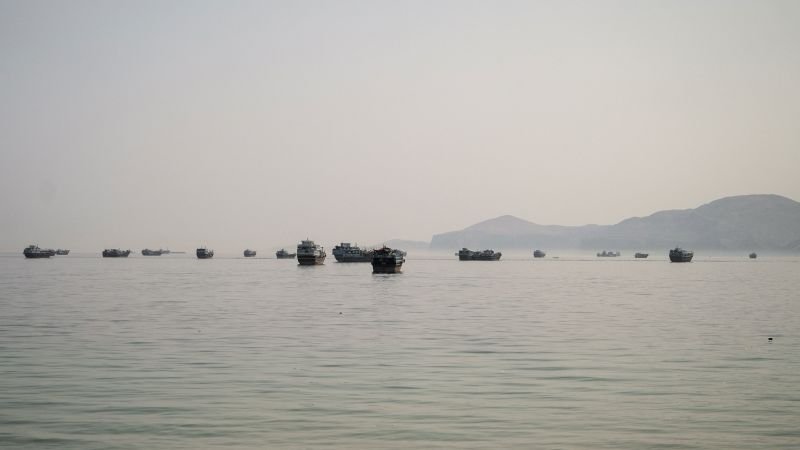
• Strait of Hormuz: Iran said it is closing the vital waterway in response to renewed Israeli strikes in Lebanon. The US military denied Iran’s claim to control the strait, and President Donald Trump threatened to impose US tolls in the shipping lane if a deal with Tehran is not ultimately reached.
• Talks set for Sunday: Vice President JD Vance is on his way to Switzerland, where he said the US will set up the structure of negotiations with Iran and potentially start to make progress on nuclear issues. A delegation from Tehran is already on the ground and has warned that talks won’t advance without first addressing Lebanon.
• On the ground: Despite a stated truce in Lebanon, Israel continues to exchange fire with Hezbollah, the Iran-backed militant group. Dozens of people have been killed by Israeli strikes in Lebanon over the past two days, marking some of the worst bloodshed of the current conflict.
45 Posts
US Vice President JD Vance is en route to Switzerland and a delegation from Tehran is already on the ground ahead of talks that are scheduled to take place Sunday even as persistent fighting in Lebanon threatens to derail the diplomatic process.
Should direct meetings take place this weekend, it will mark the first face-to-face discussions between Washington and Tehran since a 14-point memorandum of understanding was signed by both parties.
Here are some of the topics that will likely be under discussion:
Fighting in Lebanon: Iran has repeatedly insisted that it will not go further in talks with the US if Israel continues its deadly bombardment of Lebanon, where a conflict with the Iran-backed militant group Hezbollah is still raging. An Iranian official told CNN this is the number one issue for the delegation, and that Tehran does not consider the next phase of negotiations started until Lebanon is addressed.
Strait of Hormuz: On Saturday, Iran’s military command said it will close the Strait of Hormuz, citing the Lebanon issue. Traffic had only just begun to pick up in the strait. The US military denied Iran’s claim to control the channel, and President Donald Trump threatened to impose US tolls in the shipping lane if a deal with Tehran is not ultimately reached. Mediators will be keen to smooth these issues over and keep shipments flowing through the strait.
Nuclear issues: If negotiators can get there, the next stage of talks will likely center closely on Iran’s nuclear program. Vance told reporters as he departed Saturday that he hopes to make some progress on the issue this weekend. In the initial framework, Tehran agreed that it “shall not procure or develop nuclear weapons.” But the sides agreed to wait on deciding what to do with Tehran’s stockpile of enriched nuclear material until they entered a designated 60-day window to negotiate final terms. That time has arrived. What happens to this stockpile has been one of the primary sticking points in negotiations previously, so it’s no small hurdle.
CNN’s Sophia Saifi, Adam Pourahmadi and Kaanita Iyer contributed to this reporting.
US Vice President JD Vance said his top priorities in negotiations with Iran are to set up the structure of the talks, “make progress” on the nuclear issues and achieve a ceasefire in Lebanon.
The vice president said he would be able to stay in Switzerland only for a “day or two” but hoped he would make advancements on negotiations surrounding the handling of Iran’s nuclear materials.
Vance said one priority is to make progress on a ceasefire in Lebanon, which has again come under missile fire from Israel. Vance said the situation is one “we’re just going to have to continuously manage.”
“Those are the two big things we’re going to be focused on. I’m sure the Iranians are going to have issues they’d like to discuss as well,” he said.
Iran’s delegation has landed in Zurich, Switzerland, for talks with the US, Iranian state media reported Saturday.
The talks are set to be held in the Swiss mountain resort of Bürgenstock.
The delegation is led by Iran’s head negotiator, Mohammad Bagher Ghalibaf.
US Vice President JD Vance departed late Saturday afternoon from Joint Base Andrews for Lucerne, Switzerland, where he’s set to participate in negotiations with Iran.
US envoy Steve Witkoff and President Donald Trump’s son-in-law Jared Kushner are already on the ground dealing with technical elements of the negotiations.
Vance said earlier Saturday that the plans for his travel, which have changed over the past week, are a “delicate coordination dance” where “diplomatic protocols” must be considered.
Iran’s lead negotiator, Mohammad Bagher Ghalibaf, will head the country’s delegation to engage in talks with the US in Switzerland, Iranian media outlet Saberin News reported Saturday.
Ghalibaf, speaker of the Iranian parliament, has played a central role throughout Iran’s series of negotiations for an end to the conflict.
Foreign Minister Abbas Araghchi and Foreign Ministry spokesperson Esmaeil Baghaei are also in the delegation with several other officials, including banking and oil leaders, the outlet reported.
US President Donald Trump threatened to impose tolls on the Strait of Hormuz if a final deal with Iran isn’t reached, claiming the fees would be “for services rendered as the Guardian Angel” to the Middle East.
He added the tolls would be “for services rendered as the Guardian Angel to the countries of the Middle East for purposes of both past, present, and future reimbursement of costs.”
Some context: Left unaddressed in the US-Iran memorandum of understanding is whether Tehran will ultimately retain control over the strait. Ships will be able to travel toll-free for “60 days only” while Iran and its Gulf neighbors work out a new arrangement for the strait — meaning Tehran could be allowed to impose fees.
Trump insisted this week that the strait would be open “toll-free during the first 60 days and thereafter.”
Ending the conflict in Lebanon is “the most important item on the Iranian delegation’s agenda” as it heads to Switzerland for negotiations with the US, an Iranian official told CNN on Saturday.
The official said that the talks are not considered a part of the official negotiations outlined in the memorandum of understanding between the US and Iran because other provisions have not been fulfilled, notably Clause 1 of the agreement, which includes an end to the war in Lebanon.
An Israeli soldier was killed in Hezbollah attack in southern Lebanon early Saturday, the Israeli military said in a statement.
The Israel Defense Forces (IDF) identified the soldier as Sgt. 1st Class Nir Ben Ari. The IDF said Ben Ari was killed when a barrage of rockets and explosive drones struck a military position near the village of Kfar Tebnit in southern Lebanon, where the IDF has been operating.
In addition, two soldiers were severely injured in the attack, and one was moderately injured, the IDF said. Ben Ari’s death is the fifth such Israeli fatality since a US-Iran deal was reached to end the war.
The IDF said Hezbollah launched more than 50 rockets targeting Israeli soldiers in southern Lebanon overnight into Saturday despite a ceasefire that supposedly took effect on Friday at 4 p.m. local time.
A total of 36 Israeli soldiers have been killed in southern Lebanon and northern Israel since the beginning of the conflict with the Iranian-backed Lebanese militia in early March. More than 4,000 Lebanese have been killed in Israeli strikes since then, according to the Lebanese Health Ministry, which does not distinguish between civilians and combatants in its tolls.
US and Iranian delegations are both coming to talks in Switzerland on the next steps in their tentative truce. Tehran will arrive carrying a big diplomatic stick — the closure of the Strait of Hormuz.
Accusing Israel of violating the ceasefire in Lebanon, Iran balked at attending talks planned Friday, the first since the Iranian and US presidents signed the 14-clause memorandum of understanding (MoU) earlier in the week.
Despite a truce agreed between Israel and Lebanon’s Iranian-backed Hezbollah militia, violence there has continued, with the death toll among Lebanese civilians growing Saturday.
One of Pakistan’s top mediators flew to Tehran to persuade Iranian negotiators to reconsider and come to the talks in the Swiss mountains.
The threat to close the key waterway seems to be leverage to secure a full ceasefire in Lebanon.
Iran’s Tasnim News Agency, which is aligned with Iran’s powerful Revolutionary Guard Corps, warned one of its top negotiators, Foreign Minister Abbas Araghchi, against going to the talks empty-handed. It said that since the MoU had been violated in Lebanon, Iran had no obligation to keep the Strait of Hormuz open.
Iranian negotiators have been clear: President Donald Trump signed the MoU; therefore if he cannot ensure the ceasefire in Lebanon, then the rest of the MoU is in question.
By carrying a diplomatic stick into the talks, Iranian negotiators ensure not only that they keep their hard-liners onside, but they also have something to trade to get what they want.
The Iranians’ ability to stymie global trade in the strait is their new superpower, and they clearly intend to use it.
Pakistani Prime Minister Shehbaz Sharif will travel to Switzerland, where diplomatic discussions between the US and Iran are unfolding, official sources told CNN on Saturday.
Pakistan has operated as a key mediator in US-Iran talks since a ceasefire was first announced.
The talks include US Vice President JD Vance, Jared Kushner and the US special envoy to the Middle East, Steve Witkoff. They are scheduled to engage with an Iranian delegation.
Pakistan and Qatar are participating as mediators.
The naval division of the Islamic Revolutionary Guard Corps (IRGC) warned vessels not to approach the Strait of Hormuz after Iran declared the waterway closed on Saturday.
A reporter for the state-run Islamic Republic of Iran Broadcasting (IRIB) said that the IRGC navy broadcast a warning message and directly contacted vessels in the area. It cautioned that vessels attempting to cross the strait could encounter mines or be targeted by navy forces.
The IRIB reporter highlighted that traffic in the Persian Gulf was “even lighter” than a few hours before.
Dozens of people have been killed by Israeli strikes in Lebanon over the last two days, according to the Lebanese Health Ministry. Israel says it is targeting Hezbollah strongholds in the country and retaliating against the Iran-backed militant group for attacks on its forces.
The conflict in Lebanon is also imperiling US-Iran peace efforts, with Tehran saying progress toward a final deal to end the war cannot be reached without assurances that Israel will halt its strikes.
These photos show the situation on the ground in Lebanon:
A Lebanese conservationist who spent her life protecting endangered turtles along the country’s southern coast has died after she was injured by an Israeli attack earlier this month, according to local nonprofits.
Mona Khalil, an ecologist in her 70s, “died from injuries sustained in an Israeli strike on her home on the Mansouri beach,” a local nonprofit, Green Southerners, posted on Instagram on Friday. Her assistant was also wounded in the June 4 attack, the nonprofit said.
The Israeli military claimed to CNN that Khalil “was not a target” of the Israel Defense Forces. “There is no known IDF strike in which she was injured,” the military said in a statement Saturday. “However, strikes were conducted in the area after the IDF issued evacuation warnings.”
After seeking refuge in the Netherlands from the Lebanese civil war, Khalil returned to the city of Tyre in 2000, having inherited a piece of land from her grandmother.
That same year, she established The Orange House Project, a conservation initiative to safeguard the eggs of endangered green turtles and loggerhead sea turtles during hatching season. Khalil painted her house orange to symbolize the safe haven the Netherlands had provided her with.
Nearly a decade ago, CNN wrote a profile of Khalil, in which she said she “refused” to leave her land and the turtles, even when hostilities escalated between Israel and Hezbollah in 2006.
“This project was my dream since I was a child. I loved the beach and the land here,” Khalil said at the time.
The Israeli campaign in Lebanon, launched after Hezbollah fired projectiles into northern Israel earlier this year, has killed 4,057 people since March 2, according to the Lebanese Ministry of Public Health.
CNN’s Chris Giles and Eugenia Yosef contributed reporting.
Mohammad Mokhber, an aide and adviser to both the current and former Iranian supreme leader, suggested Saturday that resuming oil tanker traffic through the Strait of Hormuz depends on fully implementing the US-Iran memorandum of understanding.
“The Americans understand the language of economics and cost-benefit better than anything else,” Mokhber said in a Farsi-language post on X. The adviser to Supreme Leader Mojtaba Khamenei added that “as long as the agreement remains only on paper, energy flows in the Middle East will also remain halted.”
Iran claimed Saturday that it is closing the strait, citing alleged ceasefire violations. US Central Command said the waterway is open and that Iran does not control it.
Although the primarily Pakistani-mediated US-Iran memorandum has been signed virtually by all parties involved, the actual negotiations it stipulates between US and Iranian officials have yet to commence. US Vice President JD Vance is set to depart for Geneva on Saturday to participate in the talks after having called off similar plans two days prior.
Iran’s military will close the Strait of Hormuz in response to “ongoing” Israeli violations of the ceasefire in Lebanon, as well as the United States “failing to implement” the first clause of the tentative agreement to end the war, Iranian state media reported Saturday.
That first clause of the framework stipulated the “immediate and permanent termination of military operations on all fronts, including in Lebanon.” But fighting has continued there between Israel and Hezbollah, the Iran-backed militant group.
For its part, the US military has denied Iran’s claim to control the strait and said it would ensure traffic continues to flow.
This all comes during a 60-day period to reach a final agreement between the United States and Iran, and as delegations from Washington and Tehran meet in Switzerland for talks.
Here’s what else you need to know:
Vance heads up US delegation: Vice President JD Vance confirmed that peace talks are underway in Switzerland as of Saturday morning. He is set to travel to Switzerland today. He’ll join US envoy Steve Witkoff and President Donald Trump’s son-in-law Jared Kushner, who are already on the ground trying to address the latest complications in the negotiations.
Tehran is also attending: Even as the country announced its plans to close the strait, Iran confirmed it is sending a delegation to Switzerland for direct talks with the US. Foreign Ministry spokesperson Esmaeil Baghaei said Iran will “follow up on and demand the implementation of the other side’s commitments,” in light of the diplomatic back-and-forth over Israel’s conflict with Hezbollah.
Regional mediators: Pakistan’s Foreign Ministry said Pakistan and Qatar will attend the Swiss talks in their ongoing role as mediators.
On the ground in Lebanon: At least 16 people were killed today in renewed Israeli airstrikes in the country’s south. Israel said it was retaliating for ongoing Hezbollah attacks on its forces.
CNN’s Adam Pourahmadi, Alayna Treene, Julia Benbrook, Tatyana Masters, Catherine Nicholls, Sophia Saifi, Zachary B. Wolf, Abbaas Al Lawati, Lou Robinson, Annette Choi, Charbel Mallo and Oren Liebermann contributed to this report.
US Central Command said Iran doesn’t control the Strait of Hormuz and that commercial vessels are continuing to pass, despite Iran’s claim that it is closing the critical waterway, raising serious questions about the status of an agreement between the two countries.
“Iran does not control the Strait of Hormuz,” said Capt. Tim Hawkins, a Central Command spokesperson. “Traffic continues to flow, and U.S. forces are monitoring the situation to ensure this remains the case.”
His comments came after the command, in a post on X, touted the passage of commercial vessels through the strait — shortly after Iran said it’s closing it.
“Safe passage through the international waterway remained intact today as 55 merchant ships transited, moving large amounts of cargo and more than 17 million barrels of oil to global markets,” CENTCOM said in the post.
It added: “U.S. forces remain present and vigilant to ensure all aspects of the agreement with Iran are adhered to, obeyed, and in full force and effect.”
About an hour earlier, Iranian state media reported that Iran’s military command said it will close the Strait of Hormuz due to Israel’s alleged violations of the ceasefire in Lebanon and the US “failing to implement” the first clause of the tentative agreement to end the war.
CNN’s Zachary Cohen contributed to this report.
The United States is working with Qatar to potentially make $6 billion in frozen Iranian funds available for use for humanitarian purchases, a source familiar with the matter told CNN.
The administration has stressed that Iran’s access to such funds, as well as sanctions relief, is conditional. However, the plan to make available the $6 billion in assets could serve as an early financial incentive for Tehran.
Such nearer-term incentives for early compliance have been floated by administration officials, and White House talking points from shortly after the MOU was signed described frozen funds as “the money Iran can access in the near term.”
The plan for the potential availability of the funds for humanitarian goods and medicine, if put into use, seems similar to a mechanism included in an agreement under President Joe Biden, when those funds were moved from restricted accounts in South Korea as part of a September 2023 deal to release five Americans who had been detained in Iran. CNN has reached out to the White House about the similarity.
Iran was only going to be permitted to use the money for specific humanitarian purchases like food, agricultural products, and medicine, and Biden administration officials stressed each transaction using the funds would be monitored by the US Treasury Department. The $6 billion in Iranian assets came from oil sales that were allowed and placed into accounts set up under the first Trump administration.
“We are implementing this arrangement through the establishment of what we are calling the humanitarian channel in Qatar,” which is designed to protect against money laundering and misuse of the funds, a senior administration official said at the time.
Moreover, the process for Iran to be able to spend the funds was expected to take months, if not years, “given the due diligence involved and the complexity of what have to be specific humanitarian transactions through this channel,” a senior State Department official told CNN at the time.
After the October 7, 2023 Hamas attack on Israel, the US and Qatar reached a “quiet understanding” not to allow Iran to access any of the $6 billion in funds. They were never disbursed.
Iran would “certainly take the necessary measures” if the US doesn’t uphold its obligations under an initial agreement between the countries, Foreign Ministry spokesperson Esmaeil Baghaei told state-run broadcaster IRIB.
Iran’s Foreign Minister Abbas Araghchi spent today with Pakistan’s Interior Minister Mohsin Naqvi, who sought to convince Iran that it can remain at the negotiating table because there is enough US pressure on Israel to cease strikes in Lebanon. The Lebanon conflict has emerged as a key obstacle in the early stages of a 60-day period for the sides to reach a final deal.
Watch Baghaei’s comments in the video above.
Vice President JD Vance is expected to travel to Switzerland today as preparations begin for talks with Iran, according to a US official. Timing for his departure was not immediately available.
US envoy Steve Witkoff and President Donald Trump’s son-in-law Jared Kushner are already on the ground dealing with technical elements of the negotiation that were thrown into uncertainty by persistent fighting between Israeli forces and Hezbollah in Lebanon.
“We’ll plan the talks when the principals from the Iranian government, also the Qatari and the Pakistani government, arrive,” Vance said in an interview with Fox News Saturday morning when pressed on his schedule. “That may happen as soon as tomorrow, but these things are always a little bit in flux.”
Vance said the plans for his travel, which have changed over the past week, are a “delicate coordination dance” where “diplomatic protocols” must be considered.
Pakistan and Qatar will attend talks between the US and Iran in Switzerland tomorrow, the Pakistani Foreign Ministry announced.
The “technical-level talks” are set to be held in the Swiss mountain resort of Bürgenstock, the ministry said, adding that officials from Pakistan and Qatar will participate in the discussions as mediators.
“Pakistan will continue to facilitate the process in its role as mediator, with a view to advancing the understandings reached under the Islamabad Memorandum of Understanding,” the Foreign Ministry said in its statement.
Iran and the US have confirmed they are sending delegations to the Swiss talks, even as persistent fighting in Lebanon threatens to derail the diplomatic process.
• Strait of Hormuz: Iran said it is closing the vital waterway in response to renewed Israeli strikes in Lebanon. The US military denied Iran’s claim to control the strait, and President Donald Trump threatened to impose US tolls in the shipping lane if a deal with Tehran is not ultimately reached.
• Talks set for Sunday: Vice President JD Vance is on his way to Switzerland, where he said the US will set up the structure of negotiations with Iran and potentially start to make progress on nuclear issues. A delegation from Tehran is already on the ground and has warned that talks won’t advance without first addressing Lebanon.
• On the ground: Despite a stated truce in Lebanon, Israel continues to exchange fire with Hezbollah, the Iran-backed militant group. Dozens of people have been killed by Israeli strikes in Lebanon over the past two days, marking some of the worst bloodshed of the current conflict.
US Vice President JD Vance is en route to Switzerland and a delegation from Tehran is already on the ground ahead of talks that are scheduled to take place Sunday even as persistent fighting in Lebanon threatens to derail the diplomatic process.
Should direct meetings take place this weekend, it will mark the first face-to-face discussions between Washington and Tehran since a 14-point memorandum of understanding was signed by both parties.
Here are some of the topics that will likely be under discussion:
Fighting in Lebanon: Iran has repeatedly insisted that it will not go further in talks with the US if Israel continues its deadly bombardment of Lebanon, where a conflict with the Iran-backed militant group Hezbollah is still raging. An Iranian official told CNN this is the number one issue for the delegation, and that Tehran does not consider the next phase of negotiations started until Lebanon is addressed.
Strait of Hormuz: On Saturday, Iran’s military command said it will close the Strait of Hormuz, citing the Lebanon issue. Traffic had only just begun to pick up in the strait. The US military denied Iran’s claim to control the channel, and President Donald Trump threatened to impose US tolls in the shipping lane if a deal with Tehran is not ultimately reached. Mediators will be keen to smooth these issues over and keep shipments flowing through the strait.
Nuclear issues: If negotiators can get there, the next stage of talks will likely center closely on Iran’s nuclear program. Vance told reporters as he departed Saturday that he hopes to make some progress on the issue this weekend. In the initial framework, Tehran agreed that it “shall not procure or develop nuclear weapons.” But the sides agreed to wait on deciding what to do with Tehran’s stockpile of enriched nuclear material until they entered a designated 60-day window to negotiate final terms. That time has arrived. What happens to this stockpile has been one of the primary sticking points in negotiations previously, so it’s no small hurdle.
CNN’s Sophia Saifi, Adam Pourahmadi and Kaanita Iyer contributed to this reporting.
US Vice President JD Vance said his top priorities in negotiations with Iran are to set up the structure of the talks, “make progress” on the nuclear issues and achieve a ceasefire in Lebanon.
The vice president said he would be able to stay in Switzerland only for a “day or two” but hoped he would make advancements on negotiations surrounding the handling of Iran’s nuclear materials.
Vance said one priority is to make progress on a ceasefire in Lebanon, which has again come under missile fire from Israel. Vance said the situation is one “we’re just going to have to continuously manage.”
“Those are the two big things we’re going to be focused on. I’m sure the Iranians are going to have issues they’d like to discuss as well,” he said.
Iran’s delegation has landed in Zurich, Switzerland, for talks with the US, Iranian state media reported Saturday.
The talks are set to be held in the Swiss mountain resort of Bürgenstock.
The delegation is led by Iran’s head negotiator, Mohammad Bagher Ghalibaf.
US Vice President JD Vance departed late Saturday afternoon from Joint Base Andrews for Lucerne, Switzerland, where he’s set to participate in negotiations with Iran.
US envoy Steve Witkoff and President Donald Trump’s son-in-law Jared Kushner are already on the ground dealing with technical elements of the negotiations.
Vance said earlier Saturday that the plans for his travel, which have changed over the past week, are a “delicate coordination dance” where “diplomatic protocols” must be considered.
Iran’s lead negotiator, Mohammad Bagher Ghalibaf, will head the country’s delegation to engage in talks with the US in Switzerland, Iranian media outlet Saberin News reported Saturday.
Ghalibaf, speaker of the Iranian parliament, has played a central role throughout Iran’s series of negotiations for an end to the conflict.
Foreign Minister Abbas Araghchi and Foreign Ministry spokesperson Esmaeil Baghaei are also in the delegation with several other officials, including banking and oil leaders, the outlet reported.
US President Donald Trump threatened to impose tolls on the Strait of Hormuz if a final deal with Iran isn’t reached, claiming the fees would be “for services rendered as the Guardian Angel” to the Middle East.
He added the tolls would be “for services rendered as the Guardian Angel to the countries of the Middle East for purposes of both past, present, and future reimbursement of costs.”
Some context: Left unaddressed in the US-Iran memorandum of understanding is whether Tehran will ultimately retain control over the strait. Ships will be able to travel toll-free for “60 days only” while Iran and its Gulf neighbors work out a new arrangement for the strait — meaning Tehran could be allowed to impose fees.
Trump insisted this week that the strait would be open “toll-free during the first 60 days and thereafter.”
Ending the conflict in Lebanon is “the most important item on the Iranian delegation’s agenda” as it heads to Switzerland for negotiations with the US, an Iranian official told CNN on Saturday.
The official said that the talks are not considered a part of the official negotiations outlined in the memorandum of understanding between the US and Iran because other provisions have not been fulfilled, notably Clause 1 of the agreement, which includes an end to the war in Lebanon.
An Israeli soldier was killed in Hezbollah attack in southern Lebanon early Saturday, the Israeli military said in a statement.
The Israel Defense Forces (IDF) identified the soldier as Sgt. 1st Class Nir Ben Ari. The IDF said Ben Ari was killed when a barrage of rockets and explosive drones struck a military position near the village of Kfar Tebnit in southern Lebanon, where the IDF has been operating.
In addition, two soldiers were severely injured in the attack, and one was moderately injured, the IDF said. Ben Ari’s death is the fifth such Israeli fatality since a US-Iran deal was reached to end the war.
The IDF said Hezbollah launched more than 50 rockets targeting Israeli soldiers in southern Lebanon overnight into Saturday despite a ceasefire that supposedly took effect on Friday at 4 p.m. local time.
A total of 36 Israeli soldiers have been killed in southern Lebanon and northern Israel since the beginning of the conflict with the Iranian-backed Lebanese militia in early March. More than 4,000 Lebanese have been killed in Israeli strikes since then, according to the Lebanese Health Ministry, which does not distinguish between civilians and combatants in its tolls.
US and Iranian delegations are both coming to talks in Switzerland on the next steps in their tentative truce. Tehran will arrive carrying a big diplomatic stick — the closure of the Strait of Hormuz.
Accusing Israel of violating the ceasefire in Lebanon, Iran balked at attending talks planned Friday, the first since the Iranian and US presidents signed the 14-clause memorandum of understanding (MoU) earlier in the week.
Despite a truce agreed between Israel and Lebanon’s Iranian-backed Hezbollah militia, violence there has continued, with the death toll among Lebanese civilians growing Saturday.
One of Pakistan’s top mediators flew to Tehran to persuade Iranian negotiators to reconsider and come to the talks in the Swiss mountains.
The threat to close the key waterway seems to be leverage to secure a full ceasefire in Lebanon.
Iran’s Tasnim News Agency, which is aligned with Iran’s powerful Revolutionary Guard Corps, warned one of its top negotiators, Foreign Minister Abbas Araghchi, against going to the talks empty-handed. It said that since the MoU had been violated in Lebanon, Iran had no obligation to keep the Strait of Hormuz open.
Iranian negotiators have been clear: President Donald Trump signed the MoU; therefore if he cannot ensure the ceasefire in Lebanon, then the rest of the MoU is in question.
By carrying a diplomatic stick into the talks, Iranian negotiators ensure not only that they keep their hard-liners onside, but they also have something to trade to get what they want.
The Iranians’ ability to stymie global trade in the strait is their new superpower, and they clearly intend to use it.
Pakistani Prime Minister Shehbaz Sharif will travel to Switzerland, where diplomatic discussions between the US and Iran are unfolding, official sources told CNN on Saturday.
Pakistan has operated as a key mediator in US-Iran talks since a ceasefire was first announced.
The talks include US Vice President JD Vance, Jared Kushner and the US special envoy to the Middle East, Steve Witkoff. They are scheduled to engage with an Iranian delegation.
Pakistan and Qatar are participating as mediators.
The naval division of the Islamic Revolutionary Guard Corps (IRGC) warned vessels not to approach the Strait of Hormuz after Iran declared the waterway closed on Saturday.
A reporter for the state-run Islamic Republic of Iran Broadcasting (IRIB) said that the IRGC navy broadcast a warning message and directly contacted vessels in the area. It cautioned that vessels attempting to cross the strait could encounter mines or be targeted by navy forces.
The IRIB reporter highlighted that traffic in the Persian Gulf was “even lighter” than a few hours before.
Dozens of people have been killed by Israeli strikes in Lebanon over the last two days, according to the Lebanese Health Ministry. Israel says it is targeting Hezbollah strongholds in the country and retaliating against the Iran-backed militant group for attacks on its forces.
The conflict in Lebanon is also imperiling US-Iran peace efforts, with Tehran saying progress toward a final deal to end the war cannot be reached without assurances that Israel will halt its strikes.
These photos show the situation on the ground in Lebanon:
A Lebanese conservationist who spent her life protecting endangered turtles along the country’s southern coast has died after she was injured by an Israeli attack earlier this month, according to local nonprofits.
Mona Khalil, an ecologist in her 70s, “died from injuries sustained in an Israeli strike on her home on the Mansouri beach,” a local nonprofit, Green Southerners, posted on Instagram on Friday. Her assistant was also wounded in the June 4 attack, the nonprofit said.
The Israeli military claimed to CNN that Khalil “was not a target” of the Israel Defense Forces. “There is no known IDF strike in which she was injured,” the military said in a statement Saturday. “However, strikes were conducted in the area after the IDF issued evacuation warnings.”
After seeking refuge in the Netherlands from the Lebanese civil war, Khalil returned to the city of Tyre in 2000, having inherited a piece of land from her grandmother.
That same year, she established The Orange House Project, a conservation initiative to safeguard the eggs of endangered green turtles and loggerhead sea turtles during hatching season. Khalil painted her house orange to symbolize the safe haven the Netherlands had provided her with.
Nearly a decade ago, CNN wrote a profile of Khalil, in which she said she “refused” to leave her land and the turtles, even when hostilities escalated between Israel and Hezbollah in 2006.
“This project was my dream since I was a child. I loved the beach and the land here,” Khalil said at the time.
The Israeli campaign in Lebanon, launched after Hezbollah fired projectiles into northern Israel earlier this year, has killed 4,057 people since March 2, according to the Lebanese Ministry of Public Health.
CNN’s Chris Giles and Eugenia Yosef contributed reporting.
Mohammad Mokhber, an aide and adviser to both the current and former Iranian supreme leader, suggested Saturday that resuming oil tanker traffic through the Strait of Hormuz depends on fully implementing the US-Iran memorandum of understanding.
“The Americans understand the language of economics and cost-benefit better than anything else,” Mokhber said in a Farsi-language post on X. The adviser to Supreme Leader Mojtaba Khamenei added that “as long as the agreement remains only on paper, energy flows in the Middle East will also remain halted.”
Iran claimed Saturday that it is closing the strait, citing alleged ceasefire violations. US Central Command said the waterway is open and that Iran does not control it.
Although the primarily Pakistani-mediated US-Iran memorandum has been signed virtually by all parties involved, the actual negotiations it stipulates between US and Iranian officials have yet to commence. US Vice President JD Vance is set to depart for Geneva on Saturday to participate in the talks after having called off similar plans two days prior.
Iran’s military will close the Strait of Hormuz in response to “ongoing” Israeli violations of the ceasefire in Lebanon, as well as the United States “failing to implement” the first clause of the tentative agreement to end the war, Iranian state media reported Saturday.
That first clause of the framework stipulated the “immediate and permanent termination of military operations on all fronts, including in Lebanon.” But fighting has continued there between Israel and Hezbollah, the Iran-backed militant group.
For its part, the US military has denied Iran’s claim to control the strait and said it would ensure traffic continues to flow.
This all comes during a 60-day period to reach a final agreement between the United States and Iran, and as delegations from Washington and Tehran meet in Switzerland for talks.
Here’s what else you need to know:
Vance heads up US delegation: Vice President JD Vance confirmed that peace talks are underway in Switzerland as of Saturday morning. He is set to travel to Switzerland today. He’ll join US envoy Steve Witkoff and President Donald Trump’s son-in-law Jared Kushner, who are already on the ground trying to address the latest complications in the negotiations.
Tehran is also attending: Even as the country announced its plans to close the strait, Iran confirmed it is sending a delegation to Switzerland for direct talks with the US. Foreign Ministry spokesperson Esmaeil Baghaei said Iran will “follow up on and demand the implementation of the other side’s commitments,” in light of the diplomatic back-and-forth over Israel’s conflict with Hezbollah.
Regional mediators: Pakistan’s Foreign Ministry said Pakistan and Qatar will attend the Swiss talks in their ongoing role as mediators.
On the ground in Lebanon: At least 16 people were killed today in renewed Israeli airstrikes in the country’s south. Israel said it was retaliating for ongoing Hezbollah attacks on its forces.
CNN’s Adam Pourahmadi, Alayna Treene, Julia Benbrook, Tatyana Masters, Catherine Nicholls, Sophia Saifi, Zachary B. Wolf, Abbaas Al Lawati, Lou Robinson, Annette Choi, Charbel Mallo and Oren Liebermann contributed to this report.
US Central Command said Iran doesn’t control the Strait of Hormuz and that commercial vessels are continuing to pass, despite Iran’s claim that it is closing the critical waterway, raising serious questions about the status of an agreement between the two countries.
“Iran does not control the Strait of Hormuz,” said Capt. Tim Hawkins, a Central Command spokesperson. “Traffic continues to flow, and U.S. forces are monitoring the situation to ensure this remains the case.”
His comments came after the command, in a post on X, touted the passage of commercial vessels through the strait — shortly after Iran said it’s closing it.
“Safe passage through the international waterway remained intact today as 55 merchant ships transited, moving large amounts of cargo and more than 17 million barrels of oil to global markets,” CENTCOM said in the post.
It added: “U.S. forces remain present and vigilant to ensure all aspects of the agreement with Iran are adhered to, obeyed, and in full force and effect.”
About an hour earlier, Iranian state media reported that Iran’s military command said it will close the Strait of Hormuz due to Israel’s alleged violations of the ceasefire in Lebanon and the US “failing to implement” the first clause of the tentative agreement to end the war.
CNN’s Zachary Cohen contributed to this report.
The United States is working with Qatar to potentially make $6 billion in frozen Iranian funds available for use for humanitarian purchases, a source familiar with the matter told CNN.
The administration has stressed that Iran’s access to such funds, as well as sanctions relief, is conditional. However, the plan to make available the $6 billion in assets could serve as an early financial incentive for Tehran.
Such nearer-term incentives for early compliance have been floated by administration officials, and White House talking points from shortly after the MOU was signed described frozen funds as “the money Iran can access in the near term.”
The plan for the potential availability of the funds for humanitarian goods and medicine, if put into use, seems similar to a mechanism included in an agreement under President Joe Biden, when those funds were moved from restricted accounts in South Korea as part of a September 2023 deal to release five Americans who had been detained in Iran. CNN has reached out to the White House about the similarity.
Iran was only going to be permitted to use the money for specific humanitarian purchases like food, agricultural products, and medicine, and Biden administration officials stressed each transaction using the funds would be monitored by the US Treasury Department. The $6 billion in Iranian assets came from oil sales that were allowed and placed into accounts set up under the first Trump administration.
“We are implementing this arrangement through the establishment of what we are calling the humanitarian channel in Qatar,” which is designed to protect against money laundering and misuse of the funds, a senior administration official said at the time.
Moreover, the process for Iran to be able to spend the funds was expected to take months, if not years, “given the due diligence involved and the complexity of what have to be specific humanitarian transactions through this channel,” a senior State Department official told CNN at the time.
After the October 7, 2023 Hamas attack on Israel, the US and Qatar reached a “quiet understanding” not to allow Iran to access any of the $6 billion in funds. They were never disbursed.
Iran would “certainly take the necessary measures” if the US doesn’t uphold its obligations under an initial agreement between the countries, Foreign Ministry spokesperson Esmaeil Baghaei told state-run broadcaster IRIB.
Iran’s Foreign Minister Abbas Araghchi spent today with Pakistan’s Interior Minister Mohsin Naqvi, who sought to convince Iran that it can remain at the negotiating table because there is enough US pressure on Israel to cease strikes in Lebanon. The Lebanon conflict has emerged as a key obstacle in the early stages of a 60-day period for the sides to reach a final deal.
Watch Baghaei’s comments in the video above.
Vice President JD Vance is expected to travel to Switzerland today as preparations begin for talks with Iran, according to a US official. Timing for his departure was not immediately available.
US envoy Steve Witkoff and President Donald Trump’s son-in-law Jared Kushner are already on the ground dealing with technical elements of the negotiation that were thrown into uncertainty by persistent fighting between Israeli forces and Hezbollah in Lebanon.
“We’ll plan the talks when the principals from the Iranian government, also the Qatari and the Pakistani government, arrive,” Vance said in an interview with Fox News Saturday morning when pressed on his schedule. “That may happen as soon as tomorrow, but these things are always a little bit in flux.”
Vance said the plans for his travel, which have changed over the past week, are a “delicate coordination dance” where “diplomatic protocols” must be considered.
Pakistan and Qatar will attend talks between the US and Iran in Switzerland tomorrow, the Pakistani Foreign Ministry announced.
The “technical-level talks” are set to be held in the Swiss mountain resort of Bürgenstock, the ministry said, adding that officials from Pakistan and Qatar will participate in the discussions as mediators.
“Pakistan will continue to facilitate the process in its role as mediator, with a view to advancing the understandings reached under the Islamabad Memorandum of Understanding,” the Foreign Ministry said in its statement.
Iran and the US have confirmed they are sending delegations to the Swiss talks, even as persistent fighting in Lebanon threatens to derail the diplomatic process.





Responses