
- Private members’ clubs charging thousands in annual fees are booming in London and New York despite an affordability crisis.
- More clubs have opened in the last five years than the previous 30 years, according to an industry expert.
- Many clubs are shedding their old party image by adding gyms and wellness facilities to attract younger members.
AI-generated summary was reviewed by a CNN editor.
London —
If the walls of The Sloane Club could talk, they probably wouldn’t stop. The private members’ club, founded in 1922 by one of Queen Victoria’s daughters, has witnessed a great deal of history in London’s ritzy Chelsea district.
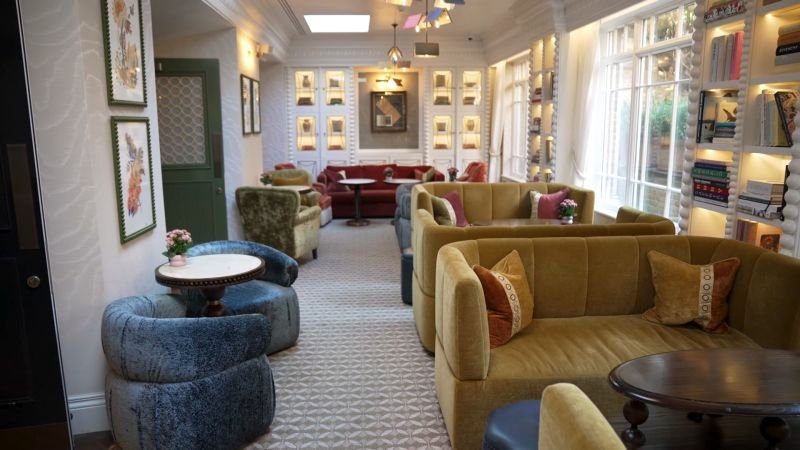
Behind its doors, a warren of rooms: A hallway leads to a restaurant to a library to a bar, where six tasseled stools stand to attention. In the adjoining dining room, an oil painting of an opulently dressed blonde woman presides over the hushed comings and goings.
The club opened in the wake of World War I to accommodate women who had served in the military. It began admitting men some five decades later. These days, after a costly refurbishment, the club is trying to attract a younger crowd — but only if they can pass the interview.
“We do give a preferential rate for our under-35s community,” Neena Jivraj Stevenson, the club’s managing director, told CNN. “That’s £1,700 ($2,264) a year, with a lower joining fee” of £450 ($602). Over 35? Sorry, that’s at least £2,300 ($3,065) a year plus a £950 ($1,271) joining fee.
The Sloane Club is trying to ride the tidal wave of money and interest flowing toward members-only clubs — businesses charging hefty annual fees for access to exclusive plush bars, restaurants and other amenities. The boom is global, with London and New York as epicenters.
“More clubs have opened in the last five years than the previous 30 years,” said Matt Hobbs, the founder and chief executive of Copper Beech, a London-based advisory firm to the industry.
London is the birthplace of this sort of tightly guarded establishment, with White’s Club, which opened in 1693, widely cited as the oldest. Firm numbers are hard to come by, but industry insiders estimate that London has more than 130 private clubs.
New York, a minnow by comparison, has a few dozen, but its post-pandemic boom has been far more extreme.
In the past couple of years, the city has added as many as 10 new clubs, according to Hobbs, including Maxime’s, Chez Margaux and British offshoot The Twenty Two. Of the clubs opening in the past five years, membership fees range from around $3,000 to $15,000 a year, Hobbs said, noting that many charge initiation fees between $1,000 and a gobsmacking $200,000.
Hobbs said he thinks the pandemic turbocharged people’s need to connect, pushing them toward private clubs where they can find a “sense of belonging” in a “curated space for like-minded people.”
But what else explains this tiny, thriving island of industry in cities where the majority are struggling to afford daily necessities?
For investors, clubs can be a lucrative bet.
Membership fees are high and waitlists can be long – a reassuring sign to investors that their club will stay in demand.
Jamie Caring, a London-based hospitality industry consultant, told CNN that in 2019, he probably received a couple of inquiries every month from prospective clients looking to open a club. Now, he gets about a dozen a month. That’s partly attributable to a greater awareness of his business, Caring says, but more so a statement about the growth of luxury hospitality.
Caring said real estate developers increasingly see clubs as the “jewel in the crown” of multipurpose complexes that can also host apartments, offices and restaurants. The presence of a private club can boost the cachet of the entire development, he said.
“They’re thinking, ‘Well, (clubs are) the highest echelon of belonging… How can I add something that makes (the complex) more PR-worthy, have a bigger draw, or creates more desire and creates more prestige?’” Caring said.
This elite slice of city life is thriving as many bars, pubs and nightclubs come under strain. According to Britain’s Night Time Industries Association (NTIA), there are 16% fewer nightlife venues in London since the pandemic.
“These high-end environments (are) flourishing, because a lot of (their customers) are making really strong money,” said Michael Kill, the NTIA’s chief executive. “People who are doing sort of everyday jobs that want to go to the pubs, bars, restaurants… just can’t afford it.”
It’s been a similar dynamic in New York since the pandemic, said Andrew Rigie, executive director at the New York City Hospitality Alliance, an association representing thousands of businesses.
“There are thousands upon thousands of neighborhood restaurants and pubs that are really struggling,” he told CNN. “Their customer base is more price-sensitive and the cost to run a small business in New York City continues to skyrocket.”
Modernizing often means attracting a younger crowd. And, for that, private clubs needed a rebrand.
The face of the industry has evolved from smoke-filled rooms of men swilling brandy, captured in black-and-white sketches, to celebrities falling out of The Groucho Club in the ’90s, captured in paparazzi shots. Such hedonism won’t fly in 2026, industry analysts told CNN.
Instead, today’s clubs are in detox, adding gyms, saunas and spas.
“We’re being more (health conscious)… and being more proactive about our wellbeing,” Caring said. “These days, it’s increasingly become almost mandatory for social clubs to have wellness (facilities).”
Even Tramp, a legendary party spot for rock stars, supermodels and socialites, got the memo.
The 57-year-old club opened a separate location last month — Tramp Health — offering members yoga and pilates classes, as well as IV-drip therapy, which delivers vitamins, minerals and antioxidants to a person’s bloodstream and red light therapy, which aims to reduce wrinkles.
A couple of tube stops south, at The Sloane Club, member Andy Jordan uses the on-site gym every day. He told CNN he often spends entire days in the club for exercising, hosting client meetings and socializing.
Jordan, the co-founder and creative director of clothing brand Jam Industries, gained attention in the early 2010s as a cast member on the reality TV show “Made In Chelsea.”
He’s visited other members-only clubs, including Soho House, the club with arguably the biggest transatlantic profile. In 2003, it opened a New York location, which even “Sex and the City” high-flyer Samantha Jones famously couldn’t talk her way into.
But Jordan said he found Soho House in London too busy. (In 2024, Soho House paused new memberships at its London, New York and Los Angeles locations to prevent overcrowding). The company has 48 locations across 19 countries, according to its website.
“First time I went there, someone asked me for a picture. So I was, like, ‘No way am I coming back,’” said Jordan. But The Sloane Club, he explained, has an altogether different vibe.
“It feels like a sort of quiet enclave of safety.”





Responses