
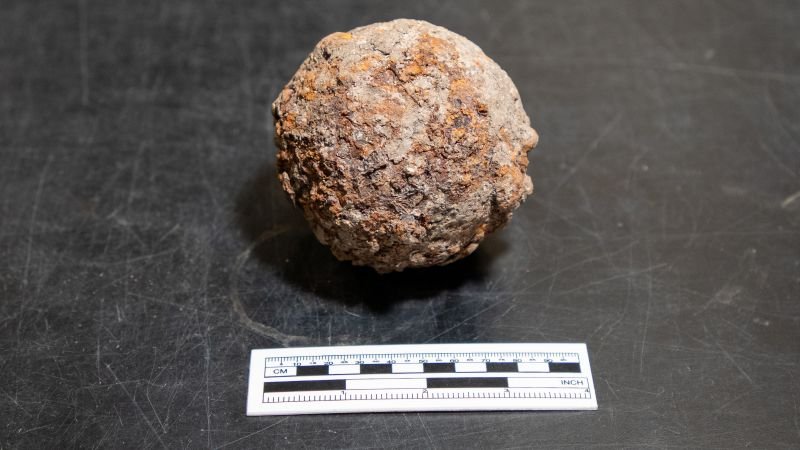
An iron cannonball that may have played a role in the 1836 Battle of the Alamo has been unearthed in Texas, according to researchers. It’s only the second artifact of its kind ever found intact at the site.
Archaeologists were digging beneath undisturbed soil layers in June near the Alamo Church in San Antonio when they discovered an undamaged cannonball likely fired from a 6-pound (2.7-kilogram) cannon just 3 feet (nearly 1 meter) below ground. The same team of researchers spotted the first intact cannonball in the area, a 4-pound (1.8-kilogram) bronze relic, about 6 feet (1.8 meters) away in March, a day before the 190th anniversary of the battle.
The Battle of the Alamo was one of the most monumental conflicts of the Texas Revolution, a rebellion that ended in Texas becoming independent from Mexico and establishing itself as a republic for nearly a decade before US statehood. Texians, Anglo-American colonists who settled in Texas, and Tejanos, Mexican Americans born in Texas, fought side by side against the Mexican army and defended Texas for 13 days before their defeat at the battle, immortalizing the phrase “Remember the Alamo!”
After the Battle of the Alamo, the Mexican army ransacked the site and salvaged all the leftover artillery for future military use, ridding the battleground of most of its weaponry.
Dr. Tiffany Lindley, director of archaeology at the Alamo Trust, led both recent excavations and explained the rare nature of the discoveries.
“What’s so amazing about this find is that one, they were missed by the Mexican army,” Lindley said of the recently discovered artifacts. “And then two, they remained untouched for 190 years. And then there they are, they’re still there.”
The researchers studied both cannonballs, noting the different metals, and relied on their historical knowledge of the artillery involved in the battle to assess which cannonball belonged to each side. They believe the bronze one belonged to the Mexican army, while the Texians likely used the iron one, according to Lindley.
Areas of the site remain untouched, Lindley said, despite usage, construction and excavations over the years.
“Whenever there’s a new artifact discovered from whatever era of that mission, it’s exciting. Not only to the descendants, but everyone else because it highlights our local history,” said Lee Spencer-White, founder and president of the Alamo Defenders Descendants Association.
For some Texans, learning about the history of the Alamo helps them honor their ancestors. The sacrifices made during the battle and the values fought for continue to carry a meaningful impact to this day.
After the Battle of the Alamo, the Mexican army “essentially wiped clean” the site, according to Lindley.
“The army went through, and they don’t have the privilege we have today of just going to the store and buying new ammunition,” Lindley said. “They’re going and they were picking up everything that can be salvaged”
The two cannonballs recently found were undetected for nearly two centuries. Later construction on the site left these areas unexplored until this year.
Today, the legacy of the Battle of the Alamo continues to live on. The Alamo Trust, a nonprofit that manages the restoration site, announced a $700 million renovation project to preserve the standing original buildings of the Alamo — the Alamo Church and the Long Barrack — and the battleground. In addition, the site will undergo construction of a new visitor center and museum.
“We might not be able to preserve all of the artifacts,” Lindley said. “But we’re able to preserve that knowledge and make sure that the voices of the past are still being spoken today.”
The museum and visitor center are expected to open in the spring of 2028 and feature artifacts from the Battle of the Alamo. The Alamo stands as one of five missions known as the San Antonio Missions that are part of a UNESCO World Heritage site, an honor that signifies the cultural and historical importance of the landmark.
“Discoveries like this validate, they reinforce the consciousness of the battle,” said Dr. Andrés Tijerina, professor of history emeritus at Austin Community College.
For many Texans, the rallying cry “Remember the Alamo” is more than just a phrase, but a call to action to learn and immerse themselves in the history of the battle.
“Being in the Alamo Chapel, people actually record and report that they have a sort of spiritual feeling, a sense of actually feeling the souls, the spirit of the men and women who were engaged in the battle,” Tijerina added. “They can actually feel the drama of the battle. That’s what these artifacts do.”
Sign up for CNN’s Wonder Theory science newsletter. Explore the universe with news on fascinating discoveries, scientific advancements and more.





Responses