
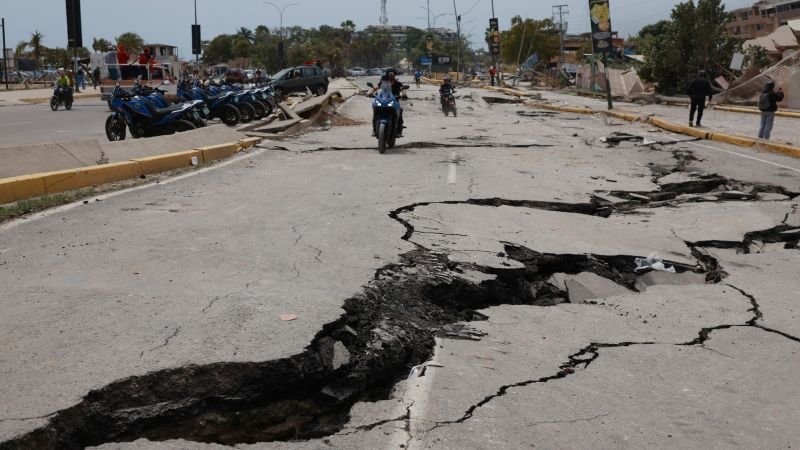
• Death toll soars: At least 920 people are dead and over 3,000 have been injured after this week’s devastating earthquakes in Venezuela, according to the country’s top lawmaker. Rescuers are racing to reach survivors beneath the rubble before the “golden” window of time closes. Many displaced families have nowhere to go in Caracas, La Guaira and surrounding areas.
• Mounting frustration: Venezuela was already mired in political and financial crisis. Some residents are calling for civilian volunteers to help clear debris, saying the emergency response is insufficient. Doctors say chronic underfunding left the healthcare system unequipped to treat the surge of patients.
• Global response: The US military is on the ground for rescue efforts in Venezuela — where, earlier this year, special forces conducted a deadly raid to seize then-President Nicolás Maduro. A wave of machinery, supplies and international aid workers is heading toward hard-hit areas.
• Here’s how you can help earthquake victims.
• Sigue nuestra cobertura en español.
64 Posts
US Southern Command “stands with the people of Venezuela” it said after its personnel and the US Chargé d’Affaires in the country met Venezuela’s acting president Delcy Rodríguez.
Southern Command, which oversees US military activities in Latin America and the Caribbean, posted a photo of the meeting on X on Friday local time. The US is “rapidly surging critical capabilities to support earthquake relief operations and help save lives,” at the request of Venezuela, it added.
A statement from Venezuela’s Presidency said the purpose of the meeting was to discuss rescue operations for survivors and the channeling of humanitarian aid.
Central Command previously said it was “surging” forces into the region at the interim government’s request.
The military cooperation is a stark illustration of the recent reversal in the relationship between the US and Venezuela. Barely six months ago, US special forces seized Venezuelan President Nicolás Maduro from Caracas in a daring and deadly raid.
Mauricio Torres contributed reporting.
A mother displaced by the Venezuelan earthquakes described the turmoil her family faced as they fled their home, fearing it would collapse around them.
“My daughters were saying to me, ‘Mom, get me out of here, we do not want to die here,’” Luz Marina Marcano told Reuters on Friday as she sat in a tent with her family.
“I did not want to leave my house alone because criminals were breaking into homes… So my partner, who is a public servant, told me to come here and camp with my daughters because they would be safer here.”
Reuters footage showed dozens of people receiving plastic bags packed with clothes, shoes and sheets at a shelter for displaced people in Caracas’ Ali Primera Park.
Displaced resident Sandra Caballero expressed gratitude to those that have provided aid and said while those in shelters may be cold, they “do not lack food.”
“We are grateful. We are truly being looked after very well,” Caballero told Reuters.
She added: “There are still people alive under that rubble. Here we are, and we cannot complain.”
Volunteer Julie Garcia said what the shelter now needs is cleaning products, wet wipes, diapers, mats and sheets to cover people at night.
“These are going to be long days. This is just the beginning, everyone,” she told Reuters.
Hospital Domingo Luciani in eastern Caracas saw a high influx of patients and people bringing various donations on Friday after Wednesday’s devastating earthquakes, CNN has confirmed.
Inside the hospital, a constant flow of medical personnel was observed tending to injured people as well as workers with materials to repair the damage caused by the seismic activity.
Hospital Domingo Luciani, which belongs to the public sector, is located in Petare, a parish neighborhood in the state of Miranda.
In the latest update on the aftermath of Wednesday’s earthquakes, the president of Venezuela’s National Assembly, Jorge Rodríguez, said that 13 hospitals were damaged across the country.
Venezuela’s acting president, Delcy Rodríguez, announced Wednesday night that she had ordered the entire hospital network, including both public and private facilities, to coordinate efforts to treat the injured.
According to the latest figures, 3,360 people were injured in the disaster. The government has also reported at least 920 deaths nationwide, most of them in La Guaira, the hardest-hit state.
Rescuers from El Salvador have located a 15-year-old girl trapped on the ninth floor of a collapsed building in the city of Catia La Mar, La Guaira state, according to Salvadoran officials.
“We have found Camila Sofía Medina Rivas alive, a 15-year-old girl trapped along with her pet on the ninth floor of a collapsed building,” Salvadoran President Nayib Bukele posted to X “Her mother is waiting for her downstairs with part of our team.”
Bukele said rescuers still need to “break through several walls” to get to her but that teams have the tools, machinery and personnel needed to clear the way.
Bukele shared an audio clip said to be of the conversation between the rescuer and the teenager.
“We are here to help you, to get you out as soon as possible and we want you to stay strong always,” the rescuer is heard saying, and asks her what she is able to do in the small space she is in.
“I can only move my legs, stretch them,” the girl says.
Rescue efforts are underway to find people trapped under rubble after back-to-back earthquakes in Venezuela killed more than 900 people on Wednesday. More than 3,000 others were injured, the country’s top lawmaker said earlier today.
Here’s the latest:
Several Venezuelan soccer players were among those killed in the earthquakes, the Venezuelan national team and the Venezuelan Football Federation (FVF) said Friday. The partner of another player, Héctor Bello, died while protecting their toddler, he said on social media.
At least 172 people remain trapped under the rubble of collapsed buildings, National Assembly President Jorge Rodríguez said. The tremors have affected at least 383 buildings, 13 hospitals, 25 shopping centers and 1,002 other structures, he added.
La Guaira, the hardest-hit area, is fully militarized as officials urge the public not to travel there. Eyewitness video shows survivors being pulled from the rubble in the Caraballeda area of La Guaira state. Satellite imagery illustrates the devastation in coastal cities, showing collapsed buildings and people living outside.
Médecins Sans Frontières (MSF), also known as Doctors Without Borders, said it donated emergency trauma kits to hospitals in Caracas and La Guaira. Hospitals are facing a shortage of crucial supplies like water, antibiotics, IV solution, anesthetics and paper bed sheets, Caracas pediatrician Dr. Huniades Urbina-Medina told CNN.
The response to the earthquakes in Venezuela will take months, not weeks, said Elinor Raikes, the vice president and head of program delivery at the International Rescue Committee (IRC). Mobilizing aid is a challenge given the state of infrastructure in Venezuela, she said.
Venezuela’s interim president Delcy Rodríguez said official volunteer registrations will begin Friday evening local time at the Poliedro de Caracas, an event venue located in the south of the capital.
Rodríguez also said she received a call from US President Donald Trump and Secretary of State Marco Rubio, and that both “reaffirmed the support” of the US. Many countries and global organizations have pledged support and aid. King Charles III said he is “deeply saddened” by the earthquakes in a message to the people of Venezuela on X.
CNN’s Caitlin Danaher, Mauricio Torres, Uriel Blanco, Thomas Bordeaux, Hira Humayun, Rory Fleming, Matias Grez and Michael Rios contributed reporting to this post.
Several Venezuelan footballers have been killed or impacted by Wednesday’s powerful earthquakes.
Yimvert Berroteran, a promising young talent, was among the hundreds of people who died, the Venezuelan national team and the Venezuelan Football Federation (FVF) said Friday.
The 18-year-old played at the U-17 World Cup in Doha a few months ago and recently for the U-20 national team.
The earthquake also claimed the lives of young players Víctor Palacios and Razan Sijaa, according to FVF and their respective clubs.
Meanwhile, the partner of Zulia FC defender, Héctor Bello, died while protecting their toddler during the earthquake, the player said on social media.
His daughter and her aunt are currently in the hospital, he said.
Venezuela’s interim president, Delcy Rodríguez, said Friday that she received a call from US President Donald Trump and Secretary of State Marco Rubio, and that both “reaffirmed the support of the United States government in this difficult time.”
On her Telegram account, Rodríguez noted that, following the earthquakes that struck Venezuela on Wednesday, Trump and Rubio “reaffirmed their commitment to supporting the response efforts by sending rescuers, specialized equipment, support for temporary shelters, and humanitarian assistance for the affected families.”
The United States is one of the countries that has already sent aid to Venezuela. The shipment was coordinated by the State and Defense Departments, according to US Secretary of Defense Pete Hegseth, who spoke on Thursday.
At least 920 people have died as a result of Wednesday’s earthquakes in Venezuela, National Assembly President Jorge Rodríguez said Friday.
At least 3,360 people are injured and at least 172 people remain trapped under the rubble of collapsed buildings, he said.
The tremors have affected at least 383 buildings, 13 hospitals, 25 shopping centers and 1,002 other structures, he added.
Rodríguez reiterated that La Guaira, the hardest-hit area, is fully militarized and he urged the public not to travel there.
Survivors have been pulled from the rubble in the Caraballeda area of Venezuela’s hard-hit La Guaira state, eyewitness video shows.
Video from Driscol Rojas, who describes himself as a filmmaker, shows mounds of rubble in Caraballeda. As survivors are pulled out, Rojas is heard asking their names. He says one person was successfully pulled out from the remains of a six-story building and that many people in the area have died.
Venezuela’s interim president asked the public Friday not to travel to La Guaira state, the area hardest hit by Wednesday’s devastating earthquakes, to avoid hindering rescue efforts during “the most critical hours.”
It will help rescue teams reach the most affected areas more quickly, Rodríguez added.
She continued: “At this time, those who do not have rescue or security duties in the state of La Guaira, please refrain from traveling to the state because you are obstructing the movement of personnel needed for our military, police, civil protection, firefighters, and rescue workers to reach the disaster zone. The entire state of La Guaira was declared a disaster zone from the outset.”
For those that sign up to volunteer, “a credential” will be “issued with a QR code,” she added.
Fernando Muñoz was visiting a relative in Caracas on Wednesday afternoon when the first earthquake struck.
His situation could be considered privileged: beyond some material damage to his house, both his friends and family are safe, Muñoz tells CNN. But he knows that the weeks and months ahead will be difficult, and that life for many Venezuelans will never be the same.
Years of economic crisis and political instability in the country were compounded in January by the capture of President Nicolás Maduro in a US military operation. It triggered political shifts and changes in the power structure that, for many, remain unclear.
Now, the consequences of this tragedy are once again putting pressure on an already complex situation.
“Many people aren’t prepared for an expense like this,” he adds, describing the damage that the two consecutive earthquakes and the hundreds of aftershocks have inflicted on his apartment and thousands of other buildings across the country.
Satellite imagery illustrates the devastation in coastal cities that were among the most heavily impacted by Wednesday’s back-to-back earthquakes.
Images of Caraballeda, a town in the state of La Guaira, show more than 100 partially or fully collapsed buildings.
In the city of Catia La Mar, people can be seen living outside, with temporary structures set up on a baseball field. Many Venezuelans lost their homes in the quakes and have nowhere else to go, while others told CNN they are not returning to damaged buildings for fear of further collapse.
Various countries are deploying rescue teams to Venezuela and pledges of foreign aid are pouring in after twin earthquakes destroyed neighborhoods and devastated communities.
A number of South American nations stepped up emergency efforts. Neighboring Colombia announced it would send humanitarian aid as well as more than 60 rescuers and four dogs. Chile sent a specialized unit of the Chilean fire department, USAR (Urban Search and Rescue), to Venezuela, according to Reuters.
El Salvador dispatched 300 rescuers and paramedics, and the government said it arranged the shipment of 50 metric tons of humanitarian aid, Reuters reported. Centers were also established in Panama for residents to donate supplies.
Authorities in Cuba and the Dominican Republic sent emergency staffers and health supplies to Venezuela, according to Reuters and local officials.
The United States is deploying elite rescue teams, medical resources and humanitarian assistance. The State Department announced the US will provide $150 million in aid. And the US military is directing its forces in the region to support relief operations, including the amphibious transport ship USS Fort Lauderdale and transport aircraft.
Mexico sent two Mexican Air Force transport planes carrying 261 personnel, including soldiers, air force members and National Guard troops and 2.7 tons of medical supplies, Reuters reported. A separate C-130 Hercules aircraft is expected to leave with another eight metric tons of medicine and four tons of rescue materials.
Peru has dispatched a search and rescue team and sent humanitarian aid. It also proposed a joint task force of countries in the Americas to coordinate the aid that countries around the world are sending to Venezuela.
Across the Atlantic, European nations including Spain, France and the Czech Republic bolstered funding and sent dozens of firefighters engineers and rescue dogs to help locate survivors in the rubble. The European Union said it “stands ready” to mobilize assistance if it receives a request.
Spain announced that it will send aid supplies, provide funding and deploy a field hospital. A military plane is also bringing 58 personnel from its search-and-rescue unit, eight canine units and 40 firefighters.
Over in Asia, China — which has close ties to Venezuela — said it is “willing to provide assistance within its capabilities.” Chinese-funded companies in Venezuela have already mobilized to help with rescue and clean-up operations. Japanese nongovernmental organization Peace Winds, which provides disaster relief and reconstruction support to crisis-affected areas, is also on its way.
Meanwhile, Iran’s Foreign Ministry spokesperson Esmaeil Baghaei announced “readiness” to provide assistance in relief and rescue operations. And India’s external affairs minister announced the transportation of more than 35 tons of relief supplies, medicine and medical equipment
Various other organizations and even civilian volunteers have also joined rescue efforts. The United Nations said it is coordinating the deployment of urban search and rescue teams. Pope Leo has sent an initial aid package worth 100,000 euros (roughly $113,700).
CNN’s Duarte Mendonca, Magdalena Vitores Moreno, Ivana Kottasová and Lauren Kent contributed to this report.
The response to the earthquakes in Venezuela will be a long-term undertaking, according to Elinor Raikes, the vice president and head of program delivery at the International Rescue Committee (IRC).
Raikes told Reuters that with the significant damage the country sustained, her organization is looking at ways to shore up public services and deliver essential relief items.
Raikes said mobilizing aid is a challenge given the state of infrastructure in Venezuela. With the country’s main airport damaged, it’s difficult to get the supplies to scale. The IRC has aid supplies in neighboring Colombia but needs airport access to get it into Venezuela.
In the next few days, Raikes said IRC teams will focus on getting basic necessities like food, water and shelter to those who need it, and to deliver medical supplies to health services.
Hospitals in Venezuela are facing a shortage of crucial supplies like water, antibiotics, IV solution, anesthetics and paper bed sheets, Caracas pediatrician Dr. Huniades Urbina-Medina told CNN.
He added that at least two hospitals – one in Caracas and one in La Guaira – have collapsed due to the quakes and that that the hospitals’ structures were old and were not well maintained.
The shortages existed before the earthquake but now, medical professionals have to respond to the latest disaster with a “collapsed” healthcare system.
The doctor said there hasn’t been transparency in the delivery of much-needed aid.
“We don’t know what arrived to Venezuela. We don’t know where are those things that are coming,” he said.
More than 900 people have been killed in the powerful back-to-back earthquakes that hit Venezuela Wednesday night, the country’s National Assembly president said today.
Crews are searching for more people trapped under the rubble as countries near and far pledge support, but some residents in coastal areas are frustrated by the pace of operations. Rescuers are trying to capitalize on the first 48 to 72 hours after a quake, the “golden” window of time to reach people buried alive.
Here’s the latest:
At least 920 people have died and another 3,360 are injured as a result of Wednesday’s earthquakes, National Assembly President Jorge Rodríguez said. At least 172 people are still trapped under the rubble, he said. In addition to Venezuelans, people from Brazil, China, Spain and Portugal have also been counted in the death toll.
Venezuelan forces are carrying out search operations with percussion equipment that allows for controlled breaking of concrete, in the hope of finding and rescuing more people alive, said Juan José Ramírez, the sectoral vice president of public works and services.
The terrain, however, remains challenging. Constant aftershocks and a lack of heavy machinery in other places are slowing operations in critical areas, while entire communities continue to clear debris on their own. Some residents in coastal areas are calling for civilian volunteers to go in with “pickaxes and shovels.”
Venezuela’s acting President Delcy Rodríguez announced the militarization of La Guaira, the area hit hardest by the earthquakes. The government said it has also established a stockpile center of food, water and medicines at the Foreign Ministry in Caracas.
The Venezuelan government is conducting an assessment of buildings that did not collapse but were damaged. Authorities have asked the public to notify the government via designated channels if they detect structural damage in their homes.
Various countries and organizations are deploying rescue teams and have pledged aid, including Colombia, El Salvador, Mexico and the United States. Dozens of vehicles are transporting relief personnel and aid toward La Guaira, according to the Venezuelan Ministry of Transport. Humanitarian aid is also expected to reach the area soon.
CNN’s Sol Amaya, Lauren Kent, Yelena Gonzalez, Sana Noor Haq, Helen Regan, Osmary Hernández, Rocío Muñoz-Ledo, Stefano Pozzebon, Michael Rios and Charlotte Reck contributed reporting to this post.
Hundreds of people were left trapped under debris and many more missing after two powerful earthquakes consecutively tore through northern Venezuela late Wednesday, marking the largest magnitude in the past century.
At least 589 people have been killed and nearly 3,000 injured, according to acting President Delcy Rodríguez. Local officials have not publicly stated how many of those killed were Venezuelan nationals in the South American country. However, people from Brazil, China, Spain and Portugal have also been counted in the death toll.
As rescue efforts persist and information trickles out, here’s what we know so far about the nationalities of those killed:
China: Two Chinese nationals were killed, the country’s state news agency, Xinhua, reported on Thursday, citing China’s embassy in the Venezuelan capital, Caracas.
Italy: One Italian-Venezuelan man, aged 56, was killed by a collapsed building in the coastal state of La Guaira, Italy’s national news agency ANSA said on Friday.
Spain: At least five Spanish nationals have been killed and 119 others are missing, the country’s foreign ministry said on Friday. That includes the Canary Islands government’s representative in Venezuela, Isabel Jara Noda, according to the president of the autonomous Spanish territory, Fernando Clavijo. The ministry said at least 14 other Spaniards are trapped under the rubble.
Portugal: Nine Portuguese people were killed, Portugal’s foreign ministry told CNN in a statement.
CNN’s Pau Mosquera and Duarte Mendonca contributed reporting.
This post has been updated with additional information.
What once stood as a coastal city featuring high-rises and resorts is now the scene of a catastrophe following this week’s earthquakes.
Venezuelans who have visited Caraballeda in the badly hit Venezuelan state La Guaira have described the scenes as looking like “a war zone.”
Orianna Velásquez, a Caracas resident, told CNN that she traveled to Caraballeda on Thursday morning to look for her father.
In the footage Velásquez shared with CNN, the building housing her father’s home could be seen completely collapsing. Volunteer rescuers were also visible searching through the rubble.
Among the city’s most prominent leisure spots is the Caraballeda Golf & Yacht Club. With its expansive grounds, the site has become both a hub for organizing donations and a gathering point where families await news of their loved ones.
“In light of the recent seismic events in the region, our absolute priority is to stand by each of our members, partners, and staff during this time. We want to convey a message of reassurance, mutual support, and deep concern for you and your loved ones,” the club wrote in a statement.
Caraballeda Golf & Yacht Club is organizing a relief collection drive. Donations are being accepted at the Arawana Outdoor store (located between Madrid Street and Caroní Avenue in Caracas), from where they will be transported to La Guaira.
“We primarily need tools, medicines, and clothing. We already have enough food and water, but EVERYTHING IS WELCOME,” the club announced on its Instagram account.
As of Thursday, the golf club was sheltering more than 100 people, including children.
Decades of neglect for the country’s healthcare system has left medics improvising as they treat victims of Wednesday’s earthquake devastation, a Venezuelan doctor warned.
“The Venezuelan healthcare system has declined progressively,” Dr. Huníades Urbina-Medina, a pediatrician and former president of Venezuela’s National Medicine Academy, told CNN.
The doctor and his colleagues have been alerting officials about this “decay” since the 1998 electoral victory of Hugo Chávez, he said.
Urbina-Medina said the country falls far below the levels of investment recommended by the World Health Organization. “We lack the necessary resources to handle day-to-day issues,” he said.
The healthcare professional said people are flocking to hospitals where they are being treated in corridors — and where medical workers are improvising because they do not have access to the necessary resources.
The veteran doctor said Venezuela has faced years of shortages in everything from beds to painkillers to disposable gowns, and patients are sometimes requested to purchase their own supplies ahead of surgery.
Urbina-Medina said only proper investment can help avert healthcare shortfalls in the event of another seismic catastrophe in the future.
“We need to prepare hospitals,” he said. “Renovate them according to international standards, and stock supplies for at least 72 hours.”
Thousands of people remain missing as a race against time unfolds to rescue those trapped under the rubble following the twin earthquakes that struck Venezuela on Wednesday.
The Venezuelan government has launched a major search and rescue operation, with international delegations beginning to join the effort on Friday. However, in some areas, there are complaints that there is still insufficient personnel to accelerate the search during the critical first 72 hours for rescuing survivors.
In the coastal area of Catia La Mar, CNN witnessed a group of people calling for civilian volunteers to go in with “pickaxes and shovels” to help clear debris.
Earlier, near the Simon Bolivar International Airport — an area also heavily impacted by the quakes —residents complained of delays in resuming rescue operations. There are also calls for assistance in recovering the bodies of the deceased from the rubble.
CNN has contacted the Venezuelan government regarding this situation and is awaiting a response.
• Death toll soars: At least 920 people are dead and over 3,000 have been injured after this week’s devastating earthquakes in Venezuela, according to the country’s top lawmaker. Rescuers are racing to reach survivors beneath the rubble before the “golden” window of time closes. Many displaced families have nowhere to go in Caracas, La Guaira and surrounding areas.
• Mounting frustration: Venezuela was already mired in political and financial crisis. Some residents are calling for civilian volunteers to help clear debris, saying the emergency response is insufficient. Doctors say chronic underfunding left the healthcare system unequipped to treat the surge of patients.
• Global response: The US military is on the ground for rescue efforts in Venezuela — where, earlier this year, special forces conducted a deadly raid to seize then-President Nicolás Maduro. A wave of machinery, supplies and international aid workers is heading toward hard-hit areas.
• Here’s how you can help earthquake victims.
• Sigue nuestra cobertura en español.
US Southern Command “stands with the people of Venezuela” it said after its personnel and the US Chargé d’Affaires in the country met Venezuela’s acting president Delcy Rodríguez.
Southern Command, which oversees US military activities in Latin America and the Caribbean, posted a photo of the meeting on X on Friday local time. The US is “rapidly surging critical capabilities to support earthquake relief operations and help save lives,” at the request of Venezuela, it added.
A statement from Venezuela’s Presidency said the purpose of the meeting was to discuss rescue operations for survivors and the channeling of humanitarian aid.
Central Command previously said it was “surging” forces into the region at the interim government’s request.
The military cooperation is a stark illustration of the recent reversal in the relationship between the US and Venezuela. Barely six months ago, US special forces seized Venezuelan President Nicolás Maduro from Caracas in a daring and deadly raid.
Mauricio Torres contributed reporting.
A mother displaced by the Venezuelan earthquakes described the turmoil her family faced as they fled their home, fearing it would collapse around them.
“My daughters were saying to me, ‘Mom, get me out of here, we do not want to die here,’” Luz Marina Marcano told Reuters on Friday as she sat in a tent with her family.
“I did not want to leave my house alone because criminals were breaking into homes… So my partner, who is a public servant, told me to come here and camp with my daughters because they would be safer here.”
Reuters footage showed dozens of people receiving plastic bags packed with clothes, shoes and sheets at a shelter for displaced people in Caracas’ Ali Primera Park.
Displaced resident Sandra Caballero expressed gratitude to those that have provided aid and said while those in shelters may be cold, they “do not lack food.”
“We are grateful. We are truly being looked after very well,” Caballero told Reuters.
She added: “There are still people alive under that rubble. Here we are, and we cannot complain.”
Volunteer Julie Garcia said what the shelter now needs is cleaning products, wet wipes, diapers, mats and sheets to cover people at night.
“These are going to be long days. This is just the beginning, everyone,” she told Reuters.
Hospital Domingo Luciani in eastern Caracas saw a high influx of patients and people bringing various donations on Friday after Wednesday’s devastating earthquakes, CNN has confirmed.
Inside the hospital, a constant flow of medical personnel was observed tending to injured people as well as workers with materials to repair the damage caused by the seismic activity.
Hospital Domingo Luciani, which belongs to the public sector, is located in Petare, a parish neighborhood in the state of Miranda.
In the latest update on the aftermath of Wednesday’s earthquakes, the president of Venezuela’s National Assembly, Jorge Rodríguez, said that 13 hospitals were damaged across the country.
Venezuela’s acting president, Delcy Rodríguez, announced Wednesday night that she had ordered the entire hospital network, including both public and private facilities, to coordinate efforts to treat the injured.
According to the latest figures, 3,360 people were injured in the disaster. The government has also reported at least 920 deaths nationwide, most of them in La Guaira, the hardest-hit state.
Rescuers from El Salvador have located a 15-year-old girl trapped on the ninth floor of a collapsed building in the city of Catia La Mar, La Guaira state, according to Salvadoran officials.
“We have found Camila Sofía Medina Rivas alive, a 15-year-old girl trapped along with her pet on the ninth floor of a collapsed building,” Salvadoran President Nayib Bukele posted to X “Her mother is waiting for her downstairs with part of our team.”
Bukele said rescuers still need to “break through several walls” to get to her but that teams have the tools, machinery and personnel needed to clear the way.
Bukele shared an audio clip said to be of the conversation between the rescuer and the teenager.
“We are here to help you, to get you out as soon as possible and we want you to stay strong always,” the rescuer is heard saying, and asks her what she is able to do in the small space she is in.
“I can only move my legs, stretch them,” the girl says.
Rescue efforts are underway to find people trapped under rubble after back-to-back earthquakes in Venezuela killed more than 900 people on Wednesday. More than 3,000 others were injured, the country’s top lawmaker said earlier today.
Here’s the latest:
Several Venezuelan soccer players were among those killed in the earthquakes, the Venezuelan national team and the Venezuelan Football Federation (FVF) said Friday. The partner of another player, Héctor Bello, died while protecting their toddler, he said on social media.
At least 172 people remain trapped under the rubble of collapsed buildings, National Assembly President Jorge Rodríguez said. The tremors have affected at least 383 buildings, 13 hospitals, 25 shopping centers and 1,002 other structures, he added.
La Guaira, the hardest-hit area, is fully militarized as officials urge the public not to travel there. Eyewitness video shows survivors being pulled from the rubble in the Caraballeda area of La Guaira state. Satellite imagery illustrates the devastation in coastal cities, showing collapsed buildings and people living outside.
Médecins Sans Frontières (MSF), also known as Doctors Without Borders, said it donated emergency trauma kits to hospitals in Caracas and La Guaira. Hospitals are facing a shortage of crucial supplies like water, antibiotics, IV solution, anesthetics and paper bed sheets, Caracas pediatrician Dr. Huniades Urbina-Medina told CNN.
The response to the earthquakes in Venezuela will take months, not weeks, said Elinor Raikes, the vice president and head of program delivery at the International Rescue Committee (IRC). Mobilizing aid is a challenge given the state of infrastructure in Venezuela, she said.
Venezuela’s interim president Delcy Rodríguez said official volunteer registrations will begin Friday evening local time at the Poliedro de Caracas, an event venue located in the south of the capital.
Rodríguez also said she received a call from US President Donald Trump and Secretary of State Marco Rubio, and that both “reaffirmed the support” of the US. Many countries and global organizations have pledged support and aid. King Charles III said he is “deeply saddened” by the earthquakes in a message to the people of Venezuela on X.
CNN’s Caitlin Danaher, Mauricio Torres, Uriel Blanco, Thomas Bordeaux, Hira Humayun, Rory Fleming, Matias Grez and Michael Rios contributed reporting to this post.
Several Venezuelan footballers have been killed or impacted by Wednesday’s powerful earthquakes.
Yimvert Berroteran, a promising young talent, was among the hundreds of people who died, the Venezuelan national team and the Venezuelan Football Federation (FVF) said Friday.
The 18-year-old played at the U-17 World Cup in Doha a few months ago and recently for the U-20 national team.
The earthquake also claimed the lives of young players Víctor Palacios and Razan Sijaa, according to FVF and their respective clubs.
Meanwhile, the partner of Zulia FC defender, Héctor Bello, died while protecting their toddler during the earthquake, the player said on social media.
His daughter and her aunt are currently in the hospital, he said.
Venezuela’s interim president, Delcy Rodríguez, said Friday that she received a call from US President Donald Trump and Secretary of State Marco Rubio, and that both “reaffirmed the support of the United States government in this difficult time.”
On her Telegram account, Rodríguez noted that, following the earthquakes that struck Venezuela on Wednesday, Trump and Rubio “reaffirmed their commitment to supporting the response efforts by sending rescuers, specialized equipment, support for temporary shelters, and humanitarian assistance for the affected families.”
The United States is one of the countries that has already sent aid to Venezuela. The shipment was coordinated by the State and Defense Departments, according to US Secretary of Defense Pete Hegseth, who spoke on Thursday.
At least 920 people have died as a result of Wednesday’s earthquakes in Venezuela, National Assembly President Jorge Rodríguez said Friday.
At least 3,360 people are injured and at least 172 people remain trapped under the rubble of collapsed buildings, he said.
The tremors have affected at least 383 buildings, 13 hospitals, 25 shopping centers and 1,002 other structures, he added.
Rodríguez reiterated that La Guaira, the hardest-hit area, is fully militarized and he urged the public not to travel there.
Survivors have been pulled from the rubble in the Caraballeda area of Venezuela’s hard-hit La Guaira state, eyewitness video shows.
Video from Driscol Rojas, who describes himself as a filmmaker, shows mounds of rubble in Caraballeda. As survivors are pulled out, Rojas is heard asking their names. He says one person was successfully pulled out from the remains of a six-story building and that many people in the area have died.
Venezuela’s interim president asked the public Friday not to travel to La Guaira state, the area hardest hit by Wednesday’s devastating earthquakes, to avoid hindering rescue efforts during “the most critical hours.”
It will help rescue teams reach the most affected areas more quickly, Rodríguez added.
She continued: “At this time, those who do not have rescue or security duties in the state of La Guaira, please refrain from traveling to the state because you are obstructing the movement of personnel needed for our military, police, civil protection, firefighters, and rescue workers to reach the disaster zone. The entire state of La Guaira was declared a disaster zone from the outset.”
For those that sign up to volunteer, “a credential” will be “issued with a QR code,” she added.
Fernando Muñoz was visiting a relative in Caracas on Wednesday afternoon when the first earthquake struck.
His situation could be considered privileged: beyond some material damage to his house, both his friends and family are safe, Muñoz tells CNN. But he knows that the weeks and months ahead will be difficult, and that life for many Venezuelans will never be the same.
Years of economic crisis and political instability in the country were compounded in January by the capture of President Nicolás Maduro in a US military operation. It triggered political shifts and changes in the power structure that, for many, remain unclear.
Now, the consequences of this tragedy are once again putting pressure on an already complex situation.
“Many people aren’t prepared for an expense like this,” he adds, describing the damage that the two consecutive earthquakes and the hundreds of aftershocks have inflicted on his apartment and thousands of other buildings across the country.
Satellite imagery illustrates the devastation in coastal cities that were among the most heavily impacted by Wednesday’s back-to-back earthquakes.
Images of Caraballeda, a town in the state of La Guaira, show more than 100 partially or fully collapsed buildings.
In the city of Catia La Mar, people can be seen living outside, with temporary structures set up on a baseball field. Many Venezuelans lost their homes in the quakes and have nowhere else to go, while others told CNN they are not returning to damaged buildings for fear of further collapse.
Various countries are deploying rescue teams to Venezuela and pledges of foreign aid are pouring in after twin earthquakes destroyed neighborhoods and devastated communities.
A number of South American nations stepped up emergency efforts. Neighboring Colombia announced it would send humanitarian aid as well as more than 60 rescuers and four dogs. Chile sent a specialized unit of the Chilean fire department, USAR (Urban Search and Rescue), to Venezuela, according to Reuters.
El Salvador dispatched 300 rescuers and paramedics, and the government said it arranged the shipment of 50 metric tons of humanitarian aid, Reuters reported. Centers were also established in Panama for residents to donate supplies.
Authorities in Cuba and the Dominican Republic sent emergency staffers and health supplies to Venezuela, according to Reuters and local officials.
The United States is deploying elite rescue teams, medical resources and humanitarian assistance. The State Department announced the US will provide $150 million in aid. And the US military is directing its forces in the region to support relief operations, including the amphibious transport ship USS Fort Lauderdale and transport aircraft.
Mexico sent two Mexican Air Force transport planes carrying 261 personnel, including soldiers, air force members and National Guard troops and 2.7 tons of medical supplies, Reuters reported. A separate C-130 Hercules aircraft is expected to leave with another eight metric tons of medicine and four tons of rescue materials.
Peru has dispatched a search and rescue team and sent humanitarian aid. It also proposed a joint task force of countries in the Americas to coordinate the aid that countries around the world are sending to Venezuela.
Across the Atlantic, European nations including Spain, France and the Czech Republic bolstered funding and sent dozens of firefighters engineers and rescue dogs to help locate survivors in the rubble. The European Union said it “stands ready” to mobilize assistance if it receives a request.
Spain announced that it will send aid supplies, provide funding and deploy a field hospital. A military plane is also bringing 58 personnel from its search-and-rescue unit, eight canine units and 40 firefighters.
Over in Asia, China — which has close ties to Venezuela — said it is “willing to provide assistance within its capabilities.” Chinese-funded companies in Venezuela have already mobilized to help with rescue and clean-up operations. Japanese nongovernmental organization Peace Winds, which provides disaster relief and reconstruction support to crisis-affected areas, is also on its way.
Meanwhile, Iran’s Foreign Ministry spokesperson Esmaeil Baghaei announced “readiness” to provide assistance in relief and rescue operations. And India’s external affairs minister announced the transportation of more than 35 tons of relief supplies, medicine and medical equipment
Various other organizations and even civilian volunteers have also joined rescue efforts. The United Nations said it is coordinating the deployment of urban search and rescue teams. Pope Leo has sent an initial aid package worth 100,000 euros (roughly $113,700).
CNN’s Duarte Mendonca, Magdalena Vitores Moreno, Ivana Kottasová and Lauren Kent contributed to this report.
The response to the earthquakes in Venezuela will be a long-term undertaking, according to Elinor Raikes, the vice president and head of program delivery at the International Rescue Committee (IRC).
Raikes told Reuters that with the significant damage the country sustained, her organization is looking at ways to shore up public services and deliver essential relief items.
Raikes said mobilizing aid is a challenge given the state of infrastructure in Venezuela. With the country’s main airport damaged, it’s difficult to get the supplies to scale. The IRC has aid supplies in neighboring Colombia but needs airport access to get it into Venezuela.
In the next few days, Raikes said IRC teams will focus on getting basic necessities like food, water and shelter to those who need it, and to deliver medical supplies to health services.
Hospitals in Venezuela are facing a shortage of crucial supplies like water, antibiotics, IV solution, anesthetics and paper bed sheets, Caracas pediatrician Dr. Huniades Urbina-Medina told CNN.
He added that at least two hospitals – one in Caracas and one in La Guaira – have collapsed due to the quakes and that that the hospitals’ structures were old and were not well maintained.
The shortages existed before the earthquake but now, medical professionals have to respond to the latest disaster with a “collapsed” healthcare system.
The doctor said there hasn’t been transparency in the delivery of much-needed aid.
“We don’t know what arrived to Venezuela. We don’t know where are those things that are coming,” he said.
More than 900 people have been killed in the powerful back-to-back earthquakes that hit Venezuela Wednesday night, the country’s National Assembly president said today.
Crews are searching for more people trapped under the rubble as countries near and far pledge support, but some residents in coastal areas are frustrated by the pace of operations. Rescuers are trying to capitalize on the first 48 to 72 hours after a quake, the “golden” window of time to reach people buried alive.
Here’s the latest:
At least 920 people have died and another 3,360 are injured as a result of Wednesday’s earthquakes, National Assembly President Jorge Rodríguez said. At least 172 people are still trapped under the rubble, he said. In addition to Venezuelans, people from Brazil, China, Spain and Portugal have also been counted in the death toll.
Venezuelan forces are carrying out search operations with percussion equipment that allows for controlled breaking of concrete, in the hope of finding and rescuing more people alive, said Juan José Ramírez, the sectoral vice president of public works and services.
The terrain, however, remains challenging. Constant aftershocks and a lack of heavy machinery in other places are slowing operations in critical areas, while entire communities continue to clear debris on their own. Some residents in coastal areas are calling for civilian volunteers to go in with “pickaxes and shovels.”
Venezuela’s acting President Delcy Rodríguez announced the militarization of La Guaira, the area hit hardest by the earthquakes. The government said it has also established a stockpile center of food, water and medicines at the Foreign Ministry in Caracas.
The Venezuelan government is conducting an assessment of buildings that did not collapse but were damaged. Authorities have asked the public to notify the government via designated channels if they detect structural damage in their homes.
Various countries and organizations are deploying rescue teams and have pledged aid, including Colombia, El Salvador, Mexico and the United States. Dozens of vehicles are transporting relief personnel and aid toward La Guaira, according to the Venezuelan Ministry of Transport. Humanitarian aid is also expected to reach the area soon.
CNN’s Sol Amaya, Lauren Kent, Yelena Gonzalez, Sana Noor Haq, Helen Regan, Osmary Hernández, Rocío Muñoz-Ledo, Stefano Pozzebon, Michael Rios and Charlotte Reck contributed reporting to this post.
Hundreds of people were left trapped under debris and many more missing after two powerful earthquakes consecutively tore through northern Venezuela late Wednesday, marking the largest magnitude in the past century.
At least 589 people have been killed and nearly 3,000 injured, according to acting President Delcy Rodríguez. Local officials have not publicly stated how many of those killed were Venezuelan nationals in the South American country. However, people from Brazil, China, Spain and Portugal have also been counted in the death toll.
As rescue efforts persist and information trickles out, here’s what we know so far about the nationalities of those killed:
China: Two Chinese nationals were killed, the country’s state news agency, Xinhua, reported on Thursday, citing China’s embassy in the Venezuelan capital, Caracas.
Italy: One Italian-Venezuelan man, aged 56, was killed by a collapsed building in the coastal state of La Guaira, Italy’s national news agency ANSA said on Friday.
Spain: At least five Spanish nationals have been killed and 119 others are missing, the country’s foreign ministry said on Friday. That includes the Canary Islands government’s representative in Venezuela, Isabel Jara Noda, according to the president of the autonomous Spanish territory, Fernando Clavijo. The ministry said at least 14 other Spaniards are trapped under the rubble.
Portugal: Nine Portuguese people were killed, Portugal’s foreign ministry told CNN in a statement.
CNN’s Pau Mosquera and Duarte Mendonca contributed reporting.
This post has been updated with additional information.
What once stood as a coastal city featuring high-rises and resorts is now the scene of a catastrophe following this week’s earthquakes.
Venezuelans who have visited Caraballeda in the badly hit Venezuelan state La Guaira have described the scenes as looking like “a war zone.”
Orianna Velásquez, a Caracas resident, told CNN that she traveled to Caraballeda on Thursday morning to look for her father.
In the footage Velásquez shared with CNN, the building housing her father’s home could be seen completely collapsing. Volunteer rescuers were also visible searching through the rubble.
Among the city’s most prominent leisure spots is the Caraballeda Golf & Yacht Club. With its expansive grounds, the site has become both a hub for organizing donations and a gathering point where families await news of their loved ones.
“In light of the recent seismic events in the region, our absolute priority is to stand by each of our members, partners, and staff during this time. We want to convey a message of reassurance, mutual support, and deep concern for you and your loved ones,” the club wrote in a statement.
Caraballeda Golf & Yacht Club is organizing a relief collection drive. Donations are being accepted at the Arawana Outdoor store (located between Madrid Street and Caroní Avenue in Caracas), from where they will be transported to La Guaira.
“We primarily need tools, medicines, and clothing. We already have enough food and water, but EVERYTHING IS WELCOME,” the club announced on its Instagram account.
As of Thursday, the golf club was sheltering more than 100 people, including children.
Decades of neglect for the country’s healthcare system has left medics improvising as they treat victims of Wednesday’s earthquake devastation, a Venezuelan doctor warned.
“The Venezuelan healthcare system has declined progressively,” Dr. Huníades Urbina-Medina, a pediatrician and former president of Venezuela’s National Medicine Academy, told CNN.
The doctor and his colleagues have been alerting officials about this “decay” since the 1998 electoral victory of Hugo Chávez, he said.
Urbina-Medina said the country falls far below the levels of investment recommended by the World Health Organization. “We lack the necessary resources to handle day-to-day issues,” he said.
The healthcare professional said people are flocking to hospitals where they are being treated in corridors — and where medical workers are improvising because they do not have access to the necessary resources.
The veteran doctor said Venezuela has faced years of shortages in everything from beds to painkillers to disposable gowns, and patients are sometimes requested to purchase their own supplies ahead of surgery.
Urbina-Medina said only proper investment can help avert healthcare shortfalls in the event of another seismic catastrophe in the future.
“We need to prepare hospitals,” he said. “Renovate them according to international standards, and stock supplies for at least 72 hours.”
Thousands of people remain missing as a race against time unfolds to rescue those trapped under the rubble following the twin earthquakes that struck Venezuela on Wednesday.
The Venezuelan government has launched a major search and rescue operation, with international delegations beginning to join the effort on Friday. However, in some areas, there are complaints that there is still insufficient personnel to accelerate the search during the critical first 72 hours for rescuing survivors.
In the coastal area of Catia La Mar, CNN witnessed a group of people calling for civilian volunteers to go in with “pickaxes and shovels” to help clear debris.
Earlier, near the Simon Bolivar International Airport — an area also heavily impacted by the quakes —residents complained of delays in resuming rescue operations. There are also calls for assistance in recovering the bodies of the deceased from the rubble.
CNN has contacted the Venezuelan government regarding this situation and is awaiting a response.

Responses