
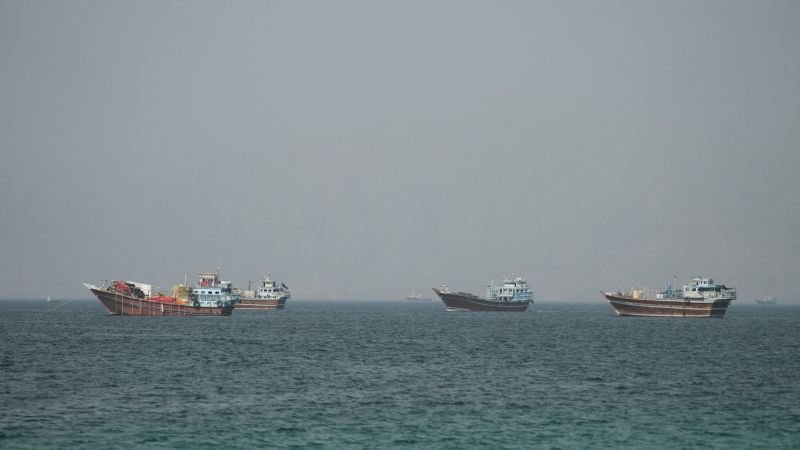
• Exchange of fire: The US and Iran will “stand down for now,” a Trump administration official said after both sides traded fire near the Strait of Hormuz. Technical talks with Iran remain “on track,” said a US official. It’s not clear yet what Iran’s position is on the matter. This weekend’s military action is testing an initial agreement that was supposed to halt hostilities during 60 days of negotiations.
• Strait of Hormuz: The official also said vessels can move freely in the strait. But the interim agreement has not been reflected in the waterway.
• In Lebanon: Iran says a full withdrawal of Israeli forces from Lebanon must be part of a final deal with the US, as fighting with Hezbollah further strains peace efforts.
30 Posts
The United States and Iran “will stand down for now” following an exchange of fire near the Strait of Hormuz over the last several days, a Trump administration official said on Sunday.
“Both sides will stand down for now and vessels can move freely,” the official said.
It’s not yet clear what Iran’s position is on the matter.
The United States and Iran have agreed to meet in Doha, Qatar, on Tuesday for further discussions, according to another US official.
The back-and-forth over the weekend tested the fragile US-Iran agreement. President Donald Trump threatened more military action if Iranian strikes continue, while Iran warned ceasefire violations would “result in the complete halt of all diplomatic processes.”
Oil futures rose slightly Sunday as US-Iran hostilities continued for a fourth consecutive day and with Iran insisting on control of the Strait of Hormuz.
Brent crude, the international benchmark, rose 0.9% to $72.20 a barrel, and US crude climbed 1.3%, to $70.09 a barrel. On Friday, oil prices reached their lowest levels since the war began, with Brent settling at about $72 and US crude closing around $69.
Oil prices saw declines last week on hopes the 60-day ceasefire would restore oil flows through the strait, which accounts for one-fifth of the world supply flow. Oil tanker traffic increased following the signing of the agreement on June 17, with the US and Iran stating that the strait would reopen without fees.
But spikes in traffic have slowed after Iran struck a vessel in the strait on Thursday and the United Nations paused plans to evacuate stranded seafarers and vessels.
US and Iranian forces have since targeted each other and traded strikes, prompting some vessels to use a route that hugs the Omani coast.
Lower oil prices depend on more than restoring trade flows. Damaged energy infrastructure needs to be repaired, and it will take months to fully get tankers sailing through the strait. Experts have warned that oil prices may not reach pre-war levels in 2026.
Oil prices remain well below the four-year high in April of about $126 a barrel, which has eased the burden on American consumers. The average national price of regular gas fell to $3.87 a gallon on Sunday, according to AAA.. That’s down almost 13% from a month ago.
Stock futures, meanwhile, were little changed.
Technical talks regarding the US-Iran memorandum of understanding are still “on track,” a senior US administration official said Sunday.
“Nothing has been canceled. Technical talks regarding the implementation of MoU are on track for the coming days as planned, and deconfliction channels are up and running after the Lake Lucerne Summit,” the official said, referring to recent talks in Switzerland led on the US side by Vice President JD Vance.
This weekend’s exchange of fire is testing the fragile US-Iran agreement. President Donald Trump threatened more military action if Iranian strikes continue, while Iran warned ceasefire violations would “result in the complete halt of all diplomatic processes.”
Some context: The US-Iran memorandum, signed earlier this month, spells out provisions for reopening the Strait of Hormuz, easing certain financial restrictions on Iran and sets out expectations for addressing Iran’s nuclear program during technical talks.
Its signing triggered a 60-day window to negotiate the final terms of a deal.
Despite Iran targeting US military sites in the Middle East with another wave of drone and missile fire, a US official told CNN a short while ago the attacks did not impact any of their intended targets.
The strikes were the latest in a string of blows traded in the region over the last several days, putting further strain on the already fragile ceasefire between Washington and Tehran.
Here’s the latest:
US allies targeted: Both Bahrain and Kuwait have said they were targeted by Tehran, with a residential building in Bahrain’s Muharraq governorate being heavily damaged overnight. Later in the day, Qatar’s Interior Ministry said a Qatari citizen on a vessel was killed after sustaining injuries from shrapnel resulting from “the military operations in the area,” though it did not provide more specific details.
Tehran’s justification: Iran’s Foreign Minister Abbas Araghchi said countries in the region must not allow “their territory or facilities” to be used for attacks on his country, according to the semi-official Tasnim news agency. Earlier Sunday, Araghchi also said the US “bears direct responsibility” for stopping Israeli attacks on Lebanon, which have continued this weekend and are another obstacle to peace efforts.
More on Lebanon: The fresh Israeli attacks come despite a US-brokered agreement that was signed between Israel, Lebanon and the US two days ago. Israel has approved continued military operations in southern Lebanon, according to a statement from its military, which said the plans were approved “in accordance with the ceasefire agreement.” Hezbollah, the Iran-backed militant group exchanging fire with Israel in Lebanon, was not party to the ceasefire agreement and has cast the pact as meaningless.
Gas prices fall: Meanwhile, the average price of regular gasoline in the US fell to $3.87 a gallon today, according to AAA, down $0.01 from yesterday and up $0.68 from this time a year ago. Oil prices dropped last week amid hopes that more oil would pass through the Strait of Hormuz during the US-Iran ceasefire. But the strait remains embroiled in this weekend’s latest hostilities.
CNN’s Zachary Cohen, Brad Lendon, Ibrahim Dahman, Mohammed Tawfeeq, Billy Stockwell, Eugenia Yosef, Oren Liebermann and Auzinea Bacon contributed to this reporting.
The average price of regular gasoline in the United States fell to $3.87 a gallon on Sunday, according to AAA.
Oil prices, which tend to move a few days ahead of gas prices, have hovered near their lowest levels since the start of the war in Iran, signaling that gas prices have more room to drop should oil prices extend their declines. Brent crude, the international benchmark, fell 4.3% on Friday to settle below $72 a barrel, and US crude dropped 3.7% to close near $69 a barrel.
The national average for gas prices remains almost 30% higher than before the war, though still well below this year’s high of $4.56 set in late May. Oil and gas prices had climbed due to decreased traffic in the Strait of Hormuz, a waterway that accounts for a fifth of the world’s oil supplies.
Oil prices dropped last week amid hopes that oil would pass through the strait after a ceasefire was reached between the United States and Iran. The two sides, however, continued to trade attacks on Sunday, the fourth consecutive day of hostilities.
Oil and gas prices are dependent on the restoration of trade flows, the repair of damaged oil production facitilies and the return of production sites that had paused during the war.
Iranian Foreign Minister Abbas Araghchi said Sunday that countries in the region must not allow “their territory or facilities,” to be used for attacks on Iran, according to the semi-official Tasnim news agency.
Tasnim reported that Araghchi made the remarks during a meeting in Baghdad with Iraqi Prime Minister Ali Faleh al-Zaidi, where he also discussed what Iran described as diplomatic efforts to end the “US-Israeli imposed war” against Iran.
According to Tasnim, Araghchi said regional countries must safeguard peace and security, “particularly by preventing the aggressor parties from using their territory and facilities to carry out unlawful attacks against Iran.”
A US official said Sunday that “all drones and missiles launched by Iran were shot down, intercepted, or failed to reach their intended targets.”
There were no US injuries or impacts to American locations, the official said.
“To be clear, Iran failed,” they said.
Some context: Iran’s Islamic Revolutionary Guard Corps said it targeted US military sites in neighboring countries, including Kuwait and Bahrain, after the US struck Iranian sites this weekend.
The latest exchange has tested a fragile ceasefire agreement between Washington and Tehran.
A Qatari citizen on a vessel was killed after sustaining injuries from shrapnel resulting from “the military operations in the area,” Qatar’s interior ministry said in a statement Sunday.
The ministry said the victim was found after maritime patrols launched a search for a vessel that had failed to return on time during routine monitoring by the General Directorate of Coasts and Borders Security.
According to the statement, the vessel, carrying two people, was located early Sunday by the Maritime Search and Rescue Team. The ministry said search operations confirmed that a Qatari citizen had been killed by shrapnel and that an Arab resident was also injured. The injured person was taken to a hospital for treatment and was in stable condition, the statement said.
The ministry said it was continuing investigations and related legal procedures.
The statement did not say whether the shrapnel was linked to Iranian drones launched against US military sites in Kuwait and Bahrain on Sunday.
Iran’s Islamic Revolutionary Guard Corps said it had targeted American military sites in neighboring countries following US strikes near the Strait of Hormuz. Later, the US military said it had carried out additional strikes on Iranian sites around the strategic waterway, saying they were in response to “continued Iranian aggression.”
President Donald Trump checked in on some of his Washington, DC, renovation projects Sunday morning, beginning with a stroll in the Lafayette Park next to the White House.
Secretary of the Interior Doug Burgum joined Trump in the park, which is undergoing renovations, as Trump seeks to make Washington “safe and beautiful.” The park was closed off to the public in January, and in April, the president celebrated on Truth Social as the fountains in the park were on for “the first time … in decades.”
The president also checked on the East Potomac Golf Links on Sunday, another DC site he is seeking to renovate, along with a slow loop around the planned site for the triumphal arch at the entrance to Arlington National Cemetery.
The visits comes as Iran and the US have traded military strikes over the last few days, testing the fragile agreement between Washington and Tehran.
Trump posted on social media Saturday night that the US may need to fully resume the war.
“There may come a point when we are no longer able to be reasonable, and will be forced to militarily complete the job that we very successfully started. If that happens, the Islamic Republic of Iran will no longer exist,” Trump said.
Iran has no alternative but to build a nuclear weapon, according to a commentary in a semi-official Iranian news outlet.
The commentary appeared in the news agency Fars, which is closely aligned with elements of Iran’s political and security establishment, particularly among conservatives and the Islamic Revolutionary Guard Corps.
It has not been endorsed by any government official. US President Donald Trump has painted stopping Iran from getting a nuclear weapon as a primary reason for the conflict.
In a later report on Sunday, Fars News Agency said that “a post arguing that Iran should build an atomic bomb was published on its user-generated ‘Fars Interactive’ platform and does not represent the agency’s official position.” The agency said the platform allows users to publish their own views.
“Iran has no path other than achieving nuclear deterrence, so that the military option for the occupation and partition of Iran is taken off the table,” the commentary said.
The commentary, which was not signed, is at odds with statements by many Iranian officials that Iran has no plans to obtain a nuclear weapon. The previous supreme leader, Ayatollah Ali Khamenei, issued a fatwa, or religious decree, banning the pursuit of a nuclear device.
“To attain the peace of mind it needs, Iran must definitely achieve nuclear deterrence so that it can be assured that the remaining issues will be resolved through negotiation,” the commentary on Fars said. “Only in this case can negotiations be conducted from the proper position.”
“Nuclear deterrence means that you can achieve a balance of power against the United States and Israel, which possess atomic bombs. It does not mean that war will not occur; rather, the scope of the conflict will become controllable,” the commentary said.
Israel approved continued military operations in southern Lebanon, according to a statement from the Israeli military, two days after the signing of the latest ceasefire agreement.
Israel Defense Forces (IDF) Chief of Staff Lt. Gen. Eyal Zamir approved the plans “in accordance with the ceasefire agreement,” the military said. The 14-point agreement, signed on Friday evening, allows for the IDF to act against the “attacks, threat posed by, and hostile intent” of Hezbollah.
“We will honor the agreement and work to ensure its success,” said Zamir.
Hezbollah and Iran rejected the latest agreement, demanding a complete Israeli withdrawal from Lebanon, which Israel has rejected.
Even since the signing of the trilateral agreement between the US, Israel, and Lebanon in Washington, fighting has continued in Lebanon. According to Lebanon’s state National News Agency, Israel carried out strikes near Deir Seryan and Taybeh on Sunday. Earlier in the day, an Israeli soldier was killed in a gunfight with a Hezbollah militant.
The fragile ceasefire between the US and Iran has been strained once again this week, with both sides having traded a number of attacks over the last few days.
Iran’s Foreign Minister Abbas Araghchi said today that any interference in Tehran’s management of the Strait of Hormuz will escalate tensions, and US Ambassador to the UN, Mike Waltz, said the US will continue to target Iranian military infrastructure if Tehran threatens shipping traffic there.
Here’s a look at what’s gone on so far today:
Both Bahrain and Kuwait have said that they were targeted by Tehran, with a residential building in Bahrain’s Muharraq governorate being heavily damaged overnight.
Several large merchant ships have passed through the southern part of the Strait of Hormuz. Tehran insists that ships must have its permission to sail through it on designated routes, but a growing number of vessels are using a route that hugs the Omani coast, threatening Iran’s leverage.
Fresh Israeli attacks have been reported in Lebanon today, two days after a US-brokered agreement was signed between Israel, Lebanon and the US.
An Israeli soldier was killed in a firefight with a Hezbollah gunman in southern Lebanon, the Israeli military said today.
Iran’s Araghchi said the US “bears direct responsibility” for stopping Israeli attacks on Lebanon. Meanwhile, Iranian Foreign Ministry spokesperson Esmaeil Baghaei said that a full withdrawal of Israeli forces from Lebanon must be part of a final deal with the US.
CNN’s Aida Karimi, Tim Lister, Logan Schiciano, Brad Lendon, Ibrahim Dahman, Billy Stockwell, Eugenia Yosef and Oren Liebermann contributed to this reporting.
The interim peace agreement reached between the United States and Iran is not being reflected in the Strait of Hormuz, leaving commercial vessel operators and their crews facing confusion and danger, shipping companies say.
Three distinct routes for ships have now emerged in the waterway, with different authorities vying to control the transit of vessels.
One southern route goes through the waters off Oman; a second route, which was used before the war, passes through the middle of the strait; and a third route further north is controlled by Iran.
This leaves vessel operators with a difficult choice over which path to take.
If ships opt for the non-Iranian routes, they risk being attacked. If they comply with Tehran’s demands and use the Iranian route, they fear the risk of Western sanctions should the agreement collapse.
Iran’s Revolutionary Guards have denounced routes not approved by Tehran as “unacceptable.” Iranian Foreign Minister Abbas Araghchi warned on Sunday that any attempt “to create parallel arrangements will only… increase tensions and delay the reopening of this vital waterway,” without specifying what alternative arrangements he was referring to.
Matthew Wright, a freight analyst at shipping intelligence firm Kpler, said that if the disagreements are not ironed out by mid-August, “we might end up seeing the three routes being used in a more chaotic manner and in a less safe way.”
“There’s obviously a big gap between what the US is saying, and what the Iranians are saying,” he added. “We’re in a very chaotic period.”
Read more about the challenge of safely navigating Hormuz here.
The US will continue to target Iranian military infrastructure if Tehran threatens shipping traffic in the Strait of Hormuz, US Ambassador to the United Nations Mike Waltz said today.
“If the Iranian regime thinks for a second that President (Donald) Trump is going to sit by, stand by, while Iran continues to attack international shipping without a response, or our bases without a response, they’re sadly mistaken,” Waltz said on “Fox News Sunday.”
Waltz added that the US will “continue to, militarily, if needed, take down their infrastructure that they’re trying to use to illegally control an international waterway.”
Waltz’s comments come after Trump on Saturday warned Iran “will no longer exist” should the US chose to “militarily complete the job” in Iran.
While Waltz said that technical discussions between the US and Iran continue and that Trump “will always give diplomacy a chance,” he stressed that “the president’s patience isn’t going to last forever.”
“Don’t think for a second that President Trump isn’t going to leave every option on the table to achieve not just our aim, the entire world’s aim that Iran never has a nuke,” Waltz added.
Iran says that a full withdrawal of Israeli forces from Lebanon must be part of a final deal with the US, as fighting continues to strain the tentative US-Iran agreement.
“The withdrawal of occupiers from all occupied Lebanese areas is necessary for reaching a final and lasting agreement to establish regional stability,” Foreign Ministry spokesman Esmaeil Baghaei said Sunday, according to the official Iranian news agency IRNA.
Iran also insisted on the full implementation of the first clause of the memorandum — ending Israel’s war and military operations against Lebanon, Baghaei said.
The first article of the memorandum of understanding signed earlier this month calls for “the immediate and permanent termination of military operations on all fronts, including in Lebanon.”
It also says “the final deal will confirm the permanent termination of the war on all fronts, including in Lebanon,” but does not explicitly demand the withdrawal of Israeli forces from southern Lebanon.
Also on Sunday, Iran’s chief negotiator, Mohammad Bagher Ghalibaf, said: “Our objective is to end the war in Lebanon, enable displaced people to return to their homes, end the occupation, and secure the withdrawal of the Zionist regime from Lebanese territory. “
“We are pursuing this matter with determination,” Ghalibaf told Nabih Berri, speaker of Lebanon’s parliament and the country’s most senior Shia official.
On the ground: Israel has consistently refused to withdraw its troops from southern Lebanon, citing an ongoing threat from the Iranian-backed Hezbollah to communities in northern Israel.
On Friday, the Israeli and Lebanese governments agreed a process by which the Lebanese military (LAF) would gradually take control of zones in southern Lebanon.
So far the Lebanese military has been unable to force Hezbollah to disarm or withdraw its fighters from southern Lebanon.
There have been four separate agreements on Lebanon in June alone. None of them has been able to stop the fighting.
But when at least five different parties – Israel, Lebanon, Iran, Hezbollah, and the US – have different positions, it’s no wonder that a comprehensive peace remains distant.
On June 4, Israel and Lebanon reached a US-brokered ceasefire agreement that was contingent upon a “complete cessation” of Hezbollah fire and the removal of all Hezbollah operatives from southern Lebanon. Hezbollah rejected that agreement – which allowed Israel to keep operating in southern Lebanon. Israel has long doubted that the Lebanese military had the ability – or the willingness – to disarm Hezbollah.
And the fighting continued.
Less than two weeks later, the US and Iran virtually signed a Memorandum of Understanding to pave the way for 60 days of negotiations. The first clause of that agreement called for a complete end to the fighting, including in Lebanon. But neither Israel nor Lebanon were part of that deal, and Israel’s Prime Minister Benjamin Netanyahu made clear to President Donald Trump that he did not view the agreement as binding.
And the fighting continued.
Two days later, Israel and Hezbollah agreed to renew the ceasefire in Lebanon as Iran demanded an end to the fighting there to begin negotiations with the US.
And the fighting continued.
The ensuing 48 hours saw some of the deadliest days of fighting since the war began in early-March. Five Israeli soldiers were killed in Hezbollah attacks; at least 67 people were killed in Israeli strikes.
On Friday, Israel and Lebanon signed a US-brokered framework agreement in an effort to push forward negotiations towards a broader peace agreement. Secretary of State Marco Rubio called it “the beginning of the beginning” of the delicate diplomatic process ahead. But Hezbollah rejected the agreement, calling it a “squandering of Lebanon’s sovereignty.”
And the fighting continued.
Two days after a US-brokered agreement was signed between Israel, Lebanon and the US aimed at moving toward a broader peace deal, fighting continues in southern Lebanon, with fresh Israeli attacks reported today.
In response to CNN, the Israeli military said they were not aware of any strikes in the Shebaa area.
Elsewhere, an Israeli soldier, Capt. David Hazutt, was killed in southern Lebanon in a firefight with a Hezbollah gunman, the Israeli military announced Sunday. The military said in a subsequent statement that soldiers later found and killed the gunman.
The clashes risk complicating efforts to secure a lasting peace agreement between the US and Iran, and have continued despite the memorandum of understanding recently reached between Washington and Tehran including a ceasefire in Lebanon.
Iran’s Foreign Minister Abbas Araghchi said today it is “regrettable” that Israel continues its attacks on Lebanon, pinning responsibility on the US to stop such strikes.
The Israeli military also carried out a drone attack in southern Lebanon on Saturday, which an IDF official told CNN was aimed at eliminating a threat to its troops.
The fighting persists in the country’s south despite Israel and Lebanon broadly welcoming Friday’s signing as a positive step. Israeli Prime Minister Benjamin Netanyahu celebrated the agreement, describing it as a major win for Israel. However, his far-right coalition partner, Itamar Ben Gvir, called it a “big mistake.”
As part of the agreement, Israel will withdraw from two areas in southern Lebanon, transferring the sites to the Lebanese military.
Hezbollah criticized the deal: The group’s Secretary-General Sheikh Naim Qassem said the agreement was “a squandering of Lebanon’s sovereignty.”
Read more about the newly signed agreement here.
Regional states, including Bahrain and Kuwait, have condemned recent Iranian attacks on their countries after the US and Iran exchanged fresh strikes, straining the ceasefire agreement signed earlier this month.
Iran’s Islamic Revolutionary Guard Corps said it targeted American military sites in neighboring countries following US strikes near the Strait of Hormuz. Later, the US military said it had launched more strikes on Iranian sites around the crucial waterway, saying they came in response to “continued Iranian aggression.”
Catch up on the latest developments here:
Trump warning: US President Donald Trump threatened Iran on Saturday, saying the US may be forced to use more military action if Tehran continues to launch strikes. The US president accused Iran of violating the ceasefire agreement between the two nations.
Regional criticism: Bahrain said today Iran had targeted it with “a number of ballistic missiles and drones,” an attack the country’s Foreign Ministry called a “dangerous escalation.” Meanwhile, Kuwait’s Foreign Affairs Ministry condemned what it said were “repeated, heinous” Iranian attacks as a “flagrant violation” of Kuwait’s sovereignty.
Iran’s response: Tehran said today that US strikes on the country a day earlier were a “clear violation” of the June 18 ceasefire memorandum of understanding. Also responding to the recent US strikes, Iran’s Islamic Revolutionary Guard Corps (IRGC) said any violation of the ceasefire will result in the “suspension of all related processes,” according to Iran’s semi-official Tasnim news agency.
Strait of Hormuz: Iranian Foreign Minister Abbas Araghchi said interference in Iran’s management of the critical waterway will escalate tensions. “Once obstacles are removed, the Strait of Hormuz will return to its pre-war capacity within 30 days under Iran’s exclusive management,” he said. The Iranian official also reiterated that the war must end completely on all fronts, including in Lebanon.
Fighting in Lebanon: An Israeli soldier was killed in southern Lebanon in a firefight with a Hezbollah gunman, the Israeli military said today, two days after a new agreement was signed in Washington between the two countries. Also on Sunday, Lebanon’s state National News Agency (NNA) reported that Israel carried out strikes near Deir Seryan and Taybeh in the country’s south.
World Cup elimination: Elsewhere, Iran’s soccer team has been eliminated from the 2026 FIFA World Cup, missing the 32-team knockout stages by one spot in heartbreaking fashion. It’s been a difficult World Cup for the Iranians amid the flaring regional violence.
CNN’s Brad Lendon, Yasha Saebi, Jacob Lev, Casey Gannon, Aida Karimi and Tim Lister contributed reporting.
Several large merchant ships passed through the southern part of the Strait of Hormuz heading for ports in the Gulf – in a further sign that more vessels are prepared to use a route that hugs the Omani coast.
Among the ships that entered the Gulf on Sunday were two oil tankers and two liquid gas carriers, according to ship tracking service Marine Traffic. A container ship also passed through the Strait by the same route.
The vessels had their transponders turned on, and their routes into the Gulf passed within a few miles of the Omani coast.
But some merchant ships are still using a different route close to the Iranian coast.
French shipping giant CMA GGM said its container ship Galapagos had exited the Strait Sunday, saying the transit “marks an important milestone in a regional context that remains complex and requires constant vigilance.”
Ship-tracking data showed the Galapagos sailing between the Iranian islands of Qeshm and Hormuz as it left the Gulf late Saturday.
Traffic is still highly sensitive to drone attacks and the presence of mines in the Strait. The Joint Maritime Information Center, which is overseen by the US Navy, raised the threat level in the strait to “substantial” on Saturday after attacks on merchant vessels.
But it also said that the southern route through the Strait near Oman had been expanded to allow for greater passage of marine traffic in both directions.
An Israeli soldier was killed in southern Lebanon in a firefight with a Hezbollah gunman, the Israeli military said on Sunday, two days after a new agreement was signed in Washington between the two countries.
The Israel Defense Forces (IDF) identified the soldier as Capt. David Hazutt. An Israeli military official said Hazutt encountered a Hezbollah fighter after entering a “suspicious structure” near Deir Seryan in southern Lebanon. Hazutt was killed in the encounter, while another soldier was lightly injured.
In a subsequent statement, the IDF said soldiers later found and killed the gunman after conducting extensive searches.
A total of 38 Israeli soldiers have been killed in southern Lebanon or northern Israel since the war began four months ago.
According to Lebanon’s state National News Agency (NNA), Israel carried out strikes near Deir Seryan and Taybeh in southern Lebanon. NNA also reported that Israel had fired a cluster munition near the town of Shebaa close to the Israel-Lebanon border.
In response to CNN, the IDF said they were not aware of Israeli strikes in the Shebaa area.
A new agreement: Friday’s signing has been described as a first step towards a comprehensive peace deal. Israel has agreed to withdraw from some areas in southern Lebanon where it is battling Hezbollah militants.
• Exchange of fire: The US and Iran will “stand down for now,” a Trump administration official said after both sides traded fire near the Strait of Hormuz. Technical talks with Iran remain “on track,” said a US official. It’s not clear yet what Iran’s position is on the matter. This weekend’s military action is testing an initial agreement that was supposed to halt hostilities during 60 days of negotiations.
• Strait of Hormuz: The official also said vessels can move freely in the strait. But the interim agreement has not been reflected in the waterway.
• In Lebanon: Iran says a full withdrawal of Israeli forces from Lebanon must be part of a final deal with the US, as fighting with Hezbollah further strains peace efforts.
The United States and Iran “will stand down for now” following an exchange of fire near the Strait of Hormuz over the last several days, a Trump administration official said on Sunday.
“Both sides will stand down for now and vessels can move freely,” the official said.
It’s not yet clear what Iran’s position is on the matter.
The United States and Iran have agreed to meet in Doha, Qatar, on Tuesday for further discussions, according to another US official.
The back-and-forth over the weekend tested the fragile US-Iran agreement. President Donald Trump threatened more military action if Iranian strikes continue, while Iran warned ceasefire violations would “result in the complete halt of all diplomatic processes.”
Oil futures rose slightly Sunday as US-Iran hostilities continued for a fourth consecutive day and with Iran insisting on control of the Strait of Hormuz.
Brent crude, the international benchmark, rose 0.9% to $72.20 a barrel, and US crude climbed 1.3%, to $70.09 a barrel. On Friday, oil prices reached their lowest levels since the war began, with Brent settling at about $72 and US crude closing around $69.
Oil prices saw declines last week on hopes the 60-day ceasefire would restore oil flows through the strait, which accounts for one-fifth of the world supply flow. Oil tanker traffic increased following the signing of the agreement on June 17, with the US and Iran stating that the strait would reopen without fees.
But spikes in traffic have slowed after Iran struck a vessel in the strait on Thursday and the United Nations paused plans to evacuate stranded seafarers and vessels.
US and Iranian forces have since targeted each other and traded strikes, prompting some vessels to use a route that hugs the Omani coast.
Lower oil prices depend on more than restoring trade flows. Damaged energy infrastructure needs to be repaired, and it will take months to fully get tankers sailing through the strait. Experts have warned that oil prices may not reach pre-war levels in 2026.
Oil prices remain well below the four-year high in April of about $126 a barrel, which has eased the burden on American consumers. The average national price of regular gas fell to $3.87 a gallon on Sunday, according to AAA.. That’s down almost 13% from a month ago.
Stock futures, meanwhile, were little changed.
Technical talks regarding the US-Iran memorandum of understanding are still “on track,” a senior US administration official said Sunday.
“Nothing has been canceled. Technical talks regarding the implementation of MoU are on track for the coming days as planned, and deconfliction channels are up and running after the Lake Lucerne Summit,” the official said, referring to recent talks in Switzerland led on the US side by Vice President JD Vance.
This weekend’s exchange of fire is testing the fragile US-Iran agreement. President Donald Trump threatened more military action if Iranian strikes continue, while Iran warned ceasefire violations would “result in the complete halt of all diplomatic processes.”
Some context: The US-Iran memorandum, signed earlier this month, spells out provisions for reopening the Strait of Hormuz, easing certain financial restrictions on Iran and sets out expectations for addressing Iran’s nuclear program during technical talks.
Its signing triggered a 60-day window to negotiate the final terms of a deal.
Despite Iran targeting US military sites in the Middle East with another wave of drone and missile fire, a US official told CNN a short while ago the attacks did not impact any of their intended targets.
The strikes were the latest in a string of blows traded in the region over the last several days, putting further strain on the already fragile ceasefire between Washington and Tehran.
Here’s the latest:
US allies targeted: Both Bahrain and Kuwait have said they were targeted by Tehran, with a residential building in Bahrain’s Muharraq governorate being heavily damaged overnight. Later in the day, Qatar’s Interior Ministry said a Qatari citizen on a vessel was killed after sustaining injuries from shrapnel resulting from “the military operations in the area,” though it did not provide more specific details.
Tehran’s justification: Iran’s Foreign Minister Abbas Araghchi said countries in the region must not allow “their territory or facilities” to be used for attacks on his country, according to the semi-official Tasnim news agency. Earlier Sunday, Araghchi also said the US “bears direct responsibility” for stopping Israeli attacks on Lebanon, which have continued this weekend and are another obstacle to peace efforts.
More on Lebanon: The fresh Israeli attacks come despite a US-brokered agreement that was signed between Israel, Lebanon and the US two days ago. Israel has approved continued military operations in southern Lebanon, according to a statement from its military, which said the plans were approved “in accordance with the ceasefire agreement.” Hezbollah, the Iran-backed militant group exchanging fire with Israel in Lebanon, was not party to the ceasefire agreement and has cast the pact as meaningless.
Gas prices fall: Meanwhile, the average price of regular gasoline in the US fell to $3.87 a gallon today, according to AAA, down $0.01 from yesterday and up $0.68 from this time a year ago. Oil prices dropped last week amid hopes that more oil would pass through the Strait of Hormuz during the US-Iran ceasefire. But the strait remains embroiled in this weekend’s latest hostilities.
CNN’s Zachary Cohen, Brad Lendon, Ibrahim Dahman, Mohammed Tawfeeq, Billy Stockwell, Eugenia Yosef, Oren Liebermann and Auzinea Bacon contributed to this reporting.
The average price of regular gasoline in the United States fell to $3.87 a gallon on Sunday, according to AAA.
Oil prices, which tend to move a few days ahead of gas prices, have hovered near their lowest levels since the start of the war in Iran, signaling that gas prices have more room to drop should oil prices extend their declines. Brent crude, the international benchmark, fell 4.3% on Friday to settle below $72 a barrel, and US crude dropped 3.7% to close near $69 a barrel.
The national average for gas prices remains almost 30% higher than before the war, though still well below this year’s high of $4.56 set in late May. Oil and gas prices had climbed due to decreased traffic in the Strait of Hormuz, a waterway that accounts for a fifth of the world’s oil supplies.
Oil prices dropped last week amid hopes that oil would pass through the strait after a ceasefire was reached between the United States and Iran. The two sides, however, continued to trade attacks on Sunday, the fourth consecutive day of hostilities.
Oil and gas prices are dependent on the restoration of trade flows, the repair of damaged oil production facitilies and the return of production sites that had paused during the war.
Iranian Foreign Minister Abbas Araghchi said Sunday that countries in the region must not allow “their territory or facilities,” to be used for attacks on Iran, according to the semi-official Tasnim news agency.
Tasnim reported that Araghchi made the remarks during a meeting in Baghdad with Iraqi Prime Minister Ali Faleh al-Zaidi, where he also discussed what Iran described as diplomatic efforts to end the “US-Israeli imposed war” against Iran.
According to Tasnim, Araghchi said regional countries must safeguard peace and security, “particularly by preventing the aggressor parties from using their territory and facilities to carry out unlawful attacks against Iran.”
A US official said Sunday that “all drones and missiles launched by Iran were shot down, intercepted, or failed to reach their intended targets.”
There were no US injuries or impacts to American locations, the official said.
“To be clear, Iran failed,” they said.
Some context: Iran’s Islamic Revolutionary Guard Corps said it targeted US military sites in neighboring countries, including Kuwait and Bahrain, after the US struck Iranian sites this weekend.
The latest exchange has tested a fragile ceasefire agreement between Washington and Tehran.
A Qatari citizen on a vessel was killed after sustaining injuries from shrapnel resulting from “the military operations in the area,” Qatar’s interior ministry said in a statement Sunday.
The ministry said the victim was found after maritime patrols launched a search for a vessel that had failed to return on time during routine monitoring by the General Directorate of Coasts and Borders Security.
According to the statement, the vessel, carrying two people, was located early Sunday by the Maritime Search and Rescue Team. The ministry said search operations confirmed that a Qatari citizen had been killed by shrapnel and that an Arab resident was also injured. The injured person was taken to a hospital for treatment and was in stable condition, the statement said.
The ministry said it was continuing investigations and related legal procedures.
The statement did not say whether the shrapnel was linked to Iranian drones launched against US military sites in Kuwait and Bahrain on Sunday.
Iran’s Islamic Revolutionary Guard Corps said it had targeted American military sites in neighboring countries following US strikes near the Strait of Hormuz. Later, the US military said it had carried out additional strikes on Iranian sites around the strategic waterway, saying they were in response to “continued Iranian aggression.”
President Donald Trump checked in on some of his Washington, DC, renovation projects Sunday morning, beginning with a stroll in the Lafayette Park next to the White House.
Secretary of the Interior Doug Burgum joined Trump in the park, which is undergoing renovations, as Trump seeks to make Washington “safe and beautiful.” The park was closed off to the public in January, and in April, the president celebrated on Truth Social as the fountains in the park were on for “the first time … in decades.”
The president also checked on the East Potomac Golf Links on Sunday, another DC site he is seeking to renovate, along with a slow loop around the planned site for the triumphal arch at the entrance to Arlington National Cemetery.
The visits comes as Iran and the US have traded military strikes over the last few days, testing the fragile agreement between Washington and Tehran.
Trump posted on social media Saturday night that the US may need to fully resume the war.
“There may come a point when we are no longer able to be reasonable, and will be forced to militarily complete the job that we very successfully started. If that happens, the Islamic Republic of Iran will no longer exist,” Trump said.
Iran has no alternative but to build a nuclear weapon, according to a commentary in a semi-official Iranian news outlet.
The commentary appeared in the news agency Fars, which is closely aligned with elements of Iran’s political and security establishment, particularly among conservatives and the Islamic Revolutionary Guard Corps.
It has not been endorsed by any government official. US President Donald Trump has painted stopping Iran from getting a nuclear weapon as a primary reason for the conflict.
In a later report on Sunday, Fars News Agency said that “a post arguing that Iran should build an atomic bomb was published on its user-generated ‘Fars Interactive’ platform and does not represent the agency’s official position.” The agency said the platform allows users to publish their own views.
“Iran has no path other than achieving nuclear deterrence, so that the military option for the occupation and partition of Iran is taken off the table,” the commentary said.
The commentary, which was not signed, is at odds with statements by many Iranian officials that Iran has no plans to obtain a nuclear weapon. The previous supreme leader, Ayatollah Ali Khamenei, issued a fatwa, or religious decree, banning the pursuit of a nuclear device.
“To attain the peace of mind it needs, Iran must definitely achieve nuclear deterrence so that it can be assured that the remaining issues will be resolved through negotiation,” the commentary on Fars said. “Only in this case can negotiations be conducted from the proper position.”
“Nuclear deterrence means that you can achieve a balance of power against the United States and Israel, which possess atomic bombs. It does not mean that war will not occur; rather, the scope of the conflict will become controllable,” the commentary said.
Israel approved continued military operations in southern Lebanon, according to a statement from the Israeli military, two days after the signing of the latest ceasefire agreement.
Israel Defense Forces (IDF) Chief of Staff Lt. Gen. Eyal Zamir approved the plans “in accordance with the ceasefire agreement,” the military said. The 14-point agreement, signed on Friday evening, allows for the IDF to act against the “attacks, threat posed by, and hostile intent” of Hezbollah.
“We will honor the agreement and work to ensure its success,” said Zamir.
Hezbollah and Iran rejected the latest agreement, demanding a complete Israeli withdrawal from Lebanon, which Israel has rejected.
Even since the signing of the trilateral agreement between the US, Israel, and Lebanon in Washington, fighting has continued in Lebanon. According to Lebanon’s state National News Agency, Israel carried out strikes near Deir Seryan and Taybeh on Sunday. Earlier in the day, an Israeli soldier was killed in a gunfight with a Hezbollah militant.
The fragile ceasefire between the US and Iran has been strained once again this week, with both sides having traded a number of attacks over the last few days.
Iran’s Foreign Minister Abbas Araghchi said today that any interference in Tehran’s management of the Strait of Hormuz will escalate tensions, and US Ambassador to the UN, Mike Waltz, said the US will continue to target Iranian military infrastructure if Tehran threatens shipping traffic there.
Here’s a look at what’s gone on so far today:
Both Bahrain and Kuwait have said that they were targeted by Tehran, with a residential building in Bahrain’s Muharraq governorate being heavily damaged overnight.
Several large merchant ships have passed through the southern part of the Strait of Hormuz. Tehran insists that ships must have its permission to sail through it on designated routes, but a growing number of vessels are using a route that hugs the Omani coast, threatening Iran’s leverage.
Fresh Israeli attacks have been reported in Lebanon today, two days after a US-brokered agreement was signed between Israel, Lebanon and the US.
An Israeli soldier was killed in a firefight with a Hezbollah gunman in southern Lebanon, the Israeli military said today.
Iran’s Araghchi said the US “bears direct responsibility” for stopping Israeli attacks on Lebanon. Meanwhile, Iranian Foreign Ministry spokesperson Esmaeil Baghaei said that a full withdrawal of Israeli forces from Lebanon must be part of a final deal with the US.
CNN’s Aida Karimi, Tim Lister, Logan Schiciano, Brad Lendon, Ibrahim Dahman, Billy Stockwell, Eugenia Yosef and Oren Liebermann contributed to this reporting.
The interim peace agreement reached between the United States and Iran is not being reflected in the Strait of Hormuz, leaving commercial vessel operators and their crews facing confusion and danger, shipping companies say.
Three distinct routes for ships have now emerged in the waterway, with different authorities vying to control the transit of vessels.
One southern route goes through the waters off Oman; a second route, which was used before the war, passes through the middle of the strait; and a third route further north is controlled by Iran.
This leaves vessel operators with a difficult choice over which path to take.
If ships opt for the non-Iranian routes, they risk being attacked. If they comply with Tehran’s demands and use the Iranian route, they fear the risk of Western sanctions should the agreement collapse.
Iran’s Revolutionary Guards have denounced routes not approved by Tehran as “unacceptable.” Iranian Foreign Minister Abbas Araghchi warned on Sunday that any attempt “to create parallel arrangements will only… increase tensions and delay the reopening of this vital waterway,” without specifying what alternative arrangements he was referring to.
Matthew Wright, a freight analyst at shipping intelligence firm Kpler, said that if the disagreements are not ironed out by mid-August, “we might end up seeing the three routes being used in a more chaotic manner and in a less safe way.”
“There’s obviously a big gap between what the US is saying, and what the Iranians are saying,” he added. “We’re in a very chaotic period.”
Read more about the challenge of safely navigating Hormuz here.
The US will continue to target Iranian military infrastructure if Tehran threatens shipping traffic in the Strait of Hormuz, US Ambassador to the United Nations Mike Waltz said today.
“If the Iranian regime thinks for a second that President (Donald) Trump is going to sit by, stand by, while Iran continues to attack international shipping without a response, or our bases without a response, they’re sadly mistaken,” Waltz said on “Fox News Sunday.”
Waltz added that the US will “continue to, militarily, if needed, take down their infrastructure that they’re trying to use to illegally control an international waterway.”
Waltz’s comments come after Trump on Saturday warned Iran “will no longer exist” should the US chose to “militarily complete the job” in Iran.
While Waltz said that technical discussions between the US and Iran continue and that Trump “will always give diplomacy a chance,” he stressed that “the president’s patience isn’t going to last forever.”
“Don’t think for a second that President Trump isn’t going to leave every option on the table to achieve not just our aim, the entire world’s aim that Iran never has a nuke,” Waltz added.
Iran says that a full withdrawal of Israeli forces from Lebanon must be part of a final deal with the US, as fighting continues to strain the tentative US-Iran agreement.
“The withdrawal of occupiers from all occupied Lebanese areas is necessary for reaching a final and lasting agreement to establish regional stability,” Foreign Ministry spokesman Esmaeil Baghaei said Sunday, according to the official Iranian news agency IRNA.
Iran also insisted on the full implementation of the first clause of the memorandum — ending Israel’s war and military operations against Lebanon, Baghaei said.
The first article of the memorandum of understanding signed earlier this month calls for “the immediate and permanent termination of military operations on all fronts, including in Lebanon.”
It also says “the final deal will confirm the permanent termination of the war on all fronts, including in Lebanon,” but does not explicitly demand the withdrawal of Israeli forces from southern Lebanon.
Also on Sunday, Iran’s chief negotiator, Mohammad Bagher Ghalibaf, said: “Our objective is to end the war in Lebanon, enable displaced people to return to their homes, end the occupation, and secure the withdrawal of the Zionist regime from Lebanese territory. “
“We are pursuing this matter with determination,” Ghalibaf told Nabih Berri, speaker of Lebanon’s parliament and the country’s most senior Shia official.
On the ground: Israel has consistently refused to withdraw its troops from southern Lebanon, citing an ongoing threat from the Iranian-backed Hezbollah to communities in northern Israel.
On Friday, the Israeli and Lebanese governments agreed a process by which the Lebanese military (LAF) would gradually take control of zones in southern Lebanon.
So far the Lebanese military has been unable to force Hezbollah to disarm or withdraw its fighters from southern Lebanon.
There have been four separate agreements on Lebanon in June alone. None of them has been able to stop the fighting.
But when at least five different parties – Israel, Lebanon, Iran, Hezbollah, and the US – have different positions, it’s no wonder that a comprehensive peace remains distant.
On June 4, Israel and Lebanon reached a US-brokered ceasefire agreement that was contingent upon a “complete cessation” of Hezbollah fire and the removal of all Hezbollah operatives from southern Lebanon. Hezbollah rejected that agreement – which allowed Israel to keep operating in southern Lebanon. Israel has long doubted that the Lebanese military had the ability – or the willingness – to disarm Hezbollah.
And the fighting continued.
Less than two weeks later, the US and Iran virtually signed a Memorandum of Understanding to pave the way for 60 days of negotiations. The first clause of that agreement called for a complete end to the fighting, including in Lebanon. But neither Israel nor Lebanon were part of that deal, and Israel’s Prime Minister Benjamin Netanyahu made clear to President Donald Trump that he did not view the agreement as binding.
And the fighting continued.
Two days later, Israel and Hezbollah agreed to renew the ceasefire in Lebanon as Iran demanded an end to the fighting there to begin negotiations with the US.
And the fighting continued.
The ensuing 48 hours saw some of the deadliest days of fighting since the war began in early-March. Five Israeli soldiers were killed in Hezbollah attacks; at least 67 people were killed in Israeli strikes.
On Friday, Israel and Lebanon signed a US-brokered framework agreement in an effort to push forward negotiations towards a broader peace agreement. Secretary of State Marco Rubio called it “the beginning of the beginning” of the delicate diplomatic process ahead. But Hezbollah rejected the agreement, calling it a “squandering of Lebanon’s sovereignty.”
And the fighting continued.
Two days after a US-brokered agreement was signed between Israel, Lebanon and the US aimed at moving toward a broader peace deal, fighting continues in southern Lebanon, with fresh Israeli attacks reported today.
In response to CNN, the Israeli military said they were not aware of any strikes in the Shebaa area.
Elsewhere, an Israeli soldier, Capt. David Hazutt, was killed in southern Lebanon in a firefight with a Hezbollah gunman, the Israeli military announced Sunday. The military said in a subsequent statement that soldiers later found and killed the gunman.
The clashes risk complicating efforts to secure a lasting peace agreement between the US and Iran, and have continued despite the memorandum of understanding recently reached between Washington and Tehran including a ceasefire in Lebanon.
Iran’s Foreign Minister Abbas Araghchi said today it is “regrettable” that Israel continues its attacks on Lebanon, pinning responsibility on the US to stop such strikes.
The Israeli military also carried out a drone attack in southern Lebanon on Saturday, which an IDF official told CNN was aimed at eliminating a threat to its troops.
The fighting persists in the country’s south despite Israel and Lebanon broadly welcoming Friday’s signing as a positive step. Israeli Prime Minister Benjamin Netanyahu celebrated the agreement, describing it as a major win for Israel. However, his far-right coalition partner, Itamar Ben Gvir, called it a “big mistake.”
As part of the agreement, Israel will withdraw from two areas in southern Lebanon, transferring the sites to the Lebanese military.
Hezbollah criticized the deal: The group’s Secretary-General Sheikh Naim Qassem said the agreement was “a squandering of Lebanon’s sovereignty.”
Read more about the newly signed agreement here.
Regional states, including Bahrain and Kuwait, have condemned recent Iranian attacks on their countries after the US and Iran exchanged fresh strikes, straining the ceasefire agreement signed earlier this month.
Iran’s Islamic Revolutionary Guard Corps said it targeted American military sites in neighboring countries following US strikes near the Strait of Hormuz. Later, the US military said it had launched more strikes on Iranian sites around the crucial waterway, saying they came in response to “continued Iranian aggression.”
Catch up on the latest developments here:
Trump warning: US President Donald Trump threatened Iran on Saturday, saying the US may be forced to use more military action if Tehran continues to launch strikes. The US president accused Iran of violating the ceasefire agreement between the two nations.
Regional criticism: Bahrain said today Iran had targeted it with “a number of ballistic missiles and drones,” an attack the country’s Foreign Ministry called a “dangerous escalation.” Meanwhile, Kuwait’s Foreign Affairs Ministry condemned what it said were “repeated, heinous” Iranian attacks as a “flagrant violation” of Kuwait’s sovereignty.
Iran’s response: Tehran said today that US strikes on the country a day earlier were a “clear violation” of the June 18 ceasefire memorandum of understanding. Also responding to the recent US strikes, Iran’s Islamic Revolutionary Guard Corps (IRGC) said any violation of the ceasefire will result in the “suspension of all related processes,” according to Iran’s semi-official Tasnim news agency.
Strait of Hormuz: Iranian Foreign Minister Abbas Araghchi said interference in Iran’s management of the critical waterway will escalate tensions. “Once obstacles are removed, the Strait of Hormuz will return to its pre-war capacity within 30 days under Iran’s exclusive management,” he said. The Iranian official also reiterated that the war must end completely on all fronts, including in Lebanon.
Fighting in Lebanon: An Israeli soldier was killed in southern Lebanon in a firefight with a Hezbollah gunman, the Israeli military said today, two days after a new agreement was signed in Washington between the two countries. Also on Sunday, Lebanon’s state National News Agency (NNA) reported that Israel carried out strikes near Deir Seryan and Taybeh in the country’s south.
World Cup elimination: Elsewhere, Iran’s soccer team has been eliminated from the 2026 FIFA World Cup, missing the 32-team knockout stages by one spot in heartbreaking fashion. It’s been a difficult World Cup for the Iranians amid the flaring regional violence.
CNN’s Brad Lendon, Yasha Saebi, Jacob Lev, Casey Gannon, Aida Karimi and Tim Lister contributed reporting.
Several large merchant ships passed through the southern part of the Strait of Hormuz heading for ports in the Gulf – in a further sign that more vessels are prepared to use a route that hugs the Omani coast.
Among the ships that entered the Gulf on Sunday were two oil tankers and two liquid gas carriers, according to ship tracking service Marine Traffic. A container ship also passed through the Strait by the same route.
The vessels had their transponders turned on, and their routes into the Gulf passed within a few miles of the Omani coast.
But some merchant ships are still using a different route close to the Iranian coast.
French shipping giant CMA GGM said its container ship Galapagos had exited the Strait Sunday, saying the transit “marks an important milestone in a regional context that remains complex and requires constant vigilance.”
Ship-tracking data showed the Galapagos sailing between the Iranian islands of Qeshm and Hormuz as it left the Gulf late Saturday.
Traffic is still highly sensitive to drone attacks and the presence of mines in the Strait. The Joint Maritime Information Center, which is overseen by the US Navy, raised the threat level in the strait to “substantial” on Saturday after attacks on merchant vessels.
But it also said that the southern route through the Strait near Oman had been expanded to allow for greater passage of marine traffic in both directions.
An Israeli soldier was killed in southern Lebanon in a firefight with a Hezbollah gunman, the Israeli military said on Sunday, two days after a new agreement was signed in Washington between the two countries.
The Israel Defense Forces (IDF) identified the soldier as Capt. David Hazutt. An Israeli military official said Hazutt encountered a Hezbollah fighter after entering a “suspicious structure” near Deir Seryan in southern Lebanon. Hazutt was killed in the encounter, while another soldier was lightly injured.
In a subsequent statement, the IDF said soldiers later found and killed the gunman after conducting extensive searches.
A total of 38 Israeli soldiers have been killed in southern Lebanon or northern Israel since the war began four months ago.
According to Lebanon’s state National News Agency (NNA), Israel carried out strikes near Deir Seryan and Taybeh in southern Lebanon. NNA also reported that Israel had fired a cluster munition near the town of Shebaa close to the Israel-Lebanon border.
In response to CNN, the IDF said they were not aware of Israeli strikes in the Shebaa area.
A new agreement: Friday’s signing has been described as a first step towards a comprehensive peace deal. Israel has agreed to withdraw from some areas in southern Lebanon where it is battling Hezbollah militants.





Responses