
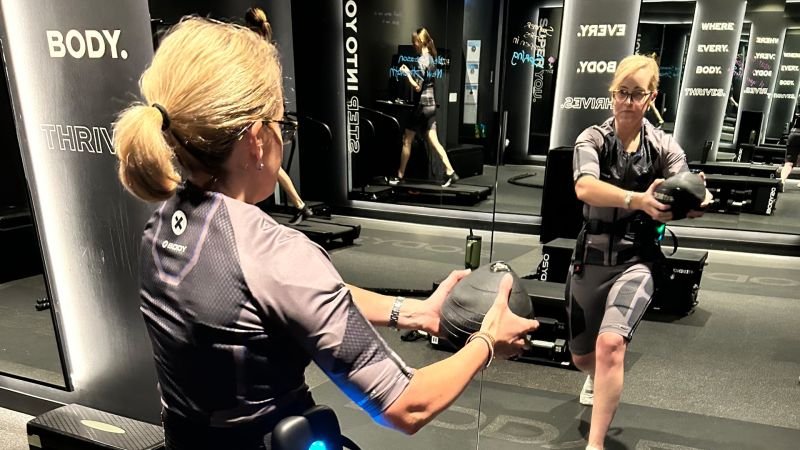
When she wasn’t seeing the results she wanted from her workout classes, Emily Ferrara decided to swap the barre for an electrode suit.
“It came up on Google, and I read about the science behind it and then shared it with my old trainer, and she’s like, ‘this sounds legit.’ So I did some research, and I was like, that’s pretty interesting, only 20 minutes,” she said.
The 43-year-old had some concerns about her thyroid disorder and PMOS, but after talking with a doctor, she got the go-ahead to try the method. Now, she’s been going to an EMS studio in Atlanta for two years, attending three classes a week, and says she’s seen her body composition change, with increased muscle and lower body fat.
In addition to the three EMS workout classes, Ferrara does cardio twice a week. She’s tested her body composition since attending the studio and said she’s seen the results she wanted.
“My body fat was much higher. And it wasn’t just like a BMI testing, they were able to assess it, and so then I was able to say, ‘OK, my weight has gone down a little bit, but my body composition has changed, so it’s not as much fat, it’s more muscle now,’” she said.
Each class starts with Ferrera putting on her EMS suit and warming up on the treadmill to generate body heat that allows the electrodes to function. Then she does around 20 minutes of exercise, some with a medicine ball and some with suspension bands called TRX.
EMS – which stands for electrical muscle stimulation – is growing in popularity on social media and at studios across the country. According to Playlist, parent company of the gym and spa membership app ClassPass, the number of venues on ClassPass with electrical muscle stimulation workouts rose more than 16% from 2023 to 2025.
Proponents say the workout’s minimal movements, like short sets of squats and lifting light weights, leave them with soreness but also increase their muscle.
Soccer star Cristiano Ronaldo has said he uses EMS as a “supplement” to his daily workout, using the technology to stimulate his abdominal region, and actor Tom Holland suited up in EMS equipment to prepare for a “Spider-Man” movie.
With EMS, a machine sends electrical impulses through electrodes in the suit, resulting in involuntary muscle contractions.
Long before EMS hit the mainstream workout space, it was used in the physical therapy area for recovery efforts and even in Soviet sports in the 1970s, with the goal of increasing muscle strength in athletes.
Dr. Greg Holtzman, division director of clinical practice for Washington University PT, said he doesn’t believe the workout is worth it most of the time, as it targets only isolated muscles, when people could get more out of varied exercises like functional strength training or weightlifting.
“The literature out there generally does support the potential use of e-stim for the very weak and the very strong. I describe the very weak kind of being that post-operative patient, or the very strong, where you’re trying to really target a very specific muscle group for really targeted gains in that particular muscle group. But as a general exercise tool, probably not as efficient as it could be – or comfortable, to be quite frank,” he said.
EMS uses larger muscle fibers first, he said, stimulating many at the same time, compared with how the body’s muscles function normally, conserving energy by recruiting only the necessary smaller muscle fibers before using the larger ones.
Holtzman said there are risks involved with EMS, including skin irritation and discomfort. Though it’s generally not something that can send a person to the hospital, he said, people with active infections, malignant forms of cancer or pacemakers should consult with a medical provider before starting.
Increased power on the machine will not necessarily injure the muscles it’s targeting, he said, but it can create prolonged soreness.
“E-stim itself is probably not going to be the thing that contracts the muscle so hard that we get an injury, but because of the way it recruits different muscle fibers, people do have to be cautious of the fatigue they feel, continue to maintain good form, even in the presence of e-stim, so they don’t cause an injury just with the movement themselves,” he said.
A 2022 meta-analysis comparing the effects of EMS against conventional strength training found that there was no overall difference between each of the methods in terms of strength development.
“The findings acquired through the meta-analysis are in line with the general consensus of current research. NMES training shows similar but not greater strength gains than conventional strength training,” the study said.
But Nick D’Amico is a believer. After recovering from a double lung transplant about four years ago, he was looking to get back into a routine to regain his previous fitness.
D’Amico, 70, said he did research on EMS before starting it a few months ago, and seeing its popularity of the workout across Europe gave him some “comfort” in trying it. The results he got after just two workouts immediately hooked him.
“Once they apply the technology to your suit, you feel like you’re lifting 10 times more than you are,” he said. “It just makes the whole experience more effective. I mean, you literally can get quite a workout in less than 30 minutes.”
In addition to changing to a healthier diet, he said, he’s lost about 8 pounds over two and a half months and noticed a change in his body composition.
“I’ve put on a lot more muscle in my arms, legs, chest. I mean, I can see a difference,” he said. “My wife notices a difference. My clothes fit better. I feel like I look better. I had these little skinny arms. Now I feel like I’m back to looking pretty fit again.”
EMS is a “staple” in the rehabilitation realm, said Crystal Busbee, a physical therapist at Emory Healthcare. She said it assists in activating muscles after an injury or surgery, waking them back up, and is a common tool used in the early stages of rehabilitation, often along with additional strengthening exercises.
Busbee often uses EMS after ACL reconstruction surgeries, placing the pads on a patient’s quadricep muscle and “re-teaching” the brain to contract it.
“The electro-stimulation is jumping on motor nerves and helping contract those muscle fibers, which then kind of wakes up the quad, which is super helpful to kind of engage it, and then once you take it off, the quad is firing a little bit better. So we use it typically to kind of wake us back up and minimize the amount of muscle that we may lose in post-surgery or post-injury,” she said.
EMS can also be used with neurologically involved patients, such as someone who’s had a stroke, to contract a muscle that they may not be able to otherwise, according to Busbee.
In the clinical setting, Busbee said, physical therapists use different size electrodes for various parts of the body, attached to a machine that transmits an electrical current to the electrodes.
But in the workout area, she said, if people can tolerate exercise appropriately, they should be able to get strength gains without using a tool like EMS.
“While it does activate and maybe would recruit more fibers, it’s kind of helping with the firing of fibers and maybe not necessarily helping with true strengthening,” she said.
Ferrera says she sees herself continuing to attend classes for the foreseeable future. For her, it isn’t just the workout that’s the draw, but how quick it is — lasting around 20 minutes. She doesn’t want to leave her family for longer amounts of time to go to the gym or other workout classes.
“Being in a class for an hour is valuable time away from my kid, my family, and then also work, so it’s really nice because I can just come in, come out. I can get the results. I’m so sore for like a day or two after, and I think it’s like the most efficient process,” she said.





Responses