
• Space opens for diplomacy: There has been a lull in fighting after escalating strikes threatened the US-Iran agreement. Mediators are trying to bring the two back to the table, while an American official told CNN the US was deliberately striking and then pausing to avoid escalation and let diplomacy work.
• No sign of new leader: Iran’s slain Supreme Leader Ali Khamenei was buried in his hometown Mashhad early Friday local time. His son and successor Mojtaba Khamenei did not appear publicly at all during the funeral. CNN’s Fred Pleitgen was in Tehran as the final funeral events took place.
• Assassination plot: Israel shared intelligence with the US that Tehran devised a new plan to assassinate President Donald Trump, sources told CNN.
9 Posts
A figure with an obscured face stood among a row of carefully selected men chosen to lead the funeral prayer over the body of Iran’s slain leader, Ali Khamenei, on Thursday. The man’s mysterious attire sparked a buzz on social media, with users theorizing whether the new Supreme Leader Mojtaba Khamenei had concealed himself to attend his father’s burial in Mashhad.
It was yet another theory among many that surfaced during the weeklong grand funeral ceremony for Khamenei, who was killed in Israeli strikes coordinated with the United States in late February.
In the week of ceremony for Ali Khamenei, AI videos showing Mojtaba Khamenei in civilian clothing and a black baseball cap walking among the mourners in Tehranis to bid farewell to his father. Pro-regime journalists prophesized that he was among the crowd at the shrine? while others shared pictures of a clean-shaven man in a black cap, claiming it was the ayatollah in disguise.
Now, the latest cause of mystery is a man wearing a black baseball cap and what appears to be a large mask covering his face, shown in pictures shown by the state broadcaster. He stood prominently among the select group at a private event held for Khamenei’s family and close friends on Thursday, led by another one of his sons, Mostafa.
Social media accounts scrutinized the man’s build, glasses, and height, comparing them to those of the new supreme leader in an effort to determine whether it was him who was concealed behind the mask. Mojtaba Khamenei has yet to make a public appearance since his appointment four months ago.
Even as Iran’s precarious political situation grows more turbulent amid deep internal divisions over diplomacy with the US, the Islamic Republic has chosen to keep its new leader concealed, offering no further proof of life beyond written statements attributed to him.
This approach signals that the regime is willing to keep the state’s top authority shrouded in mystery, despite the speculation it is causing.
His absence has left some doubting his capacity to lead, with others even suggesting that he may be dead.
The average price for regular gas in the United States rose another 4 cents overnight to a little over $3.88 a gallon, according to AAA. After rising 5 cents Thursday, gas prices are now 9 cents a gallon more expensive than they were just two days ago.
That may seem a bit dramatic considering oil prices are up just 6% since the United States and Iran started exchanging fire in the Persian Gulf again. But that’s how gas prices work: They rise like a rocket and fall like a feather.
Gas prices have fallen very gradually since hitting their wartime peak of $4.56 in mid-May. That’s because when prices rise, gas station owners tend to sell less of it and keep retail prices much closer to wholesale prices than usual — making less profit. When prices start falling, station owners gradually reduce the price to make up for lost profit.
And when oil prices rise, in anticipation of rising gas prices, station owners start raising prices quickly.
For more on why you pay what you pay at the gas pump, check out this CNN Explains video, where we interview a gas station owner about how he sets prices each day.
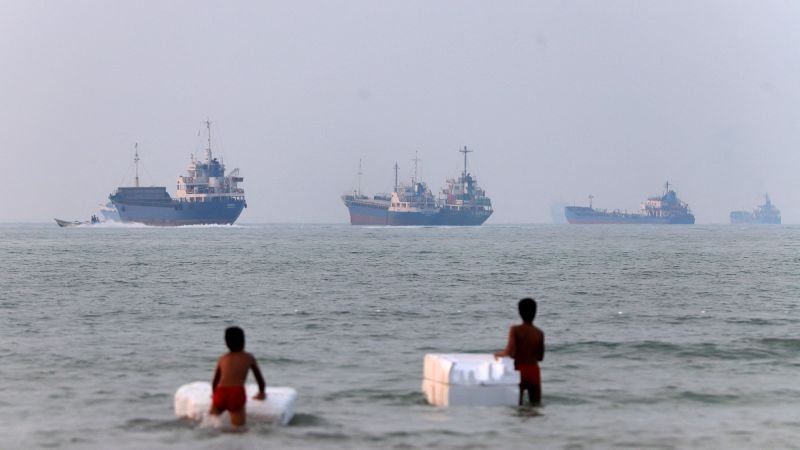
The Strait of Hormuz is loaded with mines (which are gradually being cleared) — so if you want to get in and out, you have two options: hug Oman’s northern coast or use Iran’s designated shipping lane.
Iran really wants ships to use its lane — targeting vessels on the Omanian side with drones to get its message across, which is what started this whole flareup in tit-for-tat attacks this week.
Shipping companies appear to be complying, at least for now. Of the 22 verified transits through the Strait of Hormuz yesterday, just one vessel crossed via the Omanian channel, according to Kpler, which uses transponder and satellite data to track ships.
To note: Some ships are turning off their transponders and making a break for it, so it’s not clear exactly how many vessels are going in and out of the strait. But 22 crossings is way down from around 40 to 50 over the past few weeks and significantly lower than the over 100 transits that took place every day before the war started.
Since its inception in 1979, the Islamic Republic has been a system built around the centrality of one man: the Supreme Leader.
The first person to hold the position, Ruhollah Khomeini was a larger-than-life figure who came to power off the back of a coalition of Islamist and leftist revolutionaries.
His successor, Ali Khamenei, didn’t have the same religious credentials but was steeped in the power structure of the young republic, having been president and overseeing the war with Iraq.
In the 37 years that he ruled as supreme leader, not a week went by that he didn’t address crowds or meet state officials or foreign delegations.
He was ever-present with his pronouncements on all matters of Iranian life and deeply involved in building out the political and economic power networks that has kept the regime in power even when he, as its top leader, was assassinated.
But now, the Islamic Republic has entered a new phase, one in which the top of the pyramid is nowhere to be seen or even heard.
Mojtaba Khamenei’s no-show at his father’s funeral might be down to legitimate security concerns the regime has about his safety but it will undoubtedly feed into the wider question regime supporters and opponents have been asking every day for the past four months: who is really calling the shots?
At some point, one would assume, the millions of faithful who took to the streets this week will need to actually see the leader whose authority is supposed to permeate through the system.
The longer he remains in absentia the looser his grasp will be as the system his father built was so tightly connected to the top that without it, it risks unravelling and perhaps ushering a new form of governance in Iran.
When Tehran blockaded the Strait of Hormuz in response to strikes by the United States and Israel on February 28, the Lloyd’s market sprang into action. Overnight, the risks of transiting the strait skyrocketed, and insurance premiums needed to reflect that. War insurance policies were swiftly cancelled to be reinstated at much higher prices.
Insurance underwriters are once again scrutinizing prices and “individual risk factors” following renewed strikes across the Middle East this week, said David Smith, head of marine at London broker McGill and Partners.
In the immediate aftermath of the US-Israeli strikes, rates for ships passing through the strait soared to as high as 10% of a vessel’s value from roughly 0.25%-0.5% before the war, according to Marcus Baker, the global head of marine and cargo for insurance broker Marsh.
On an oil tanker worth $100 million, “that’s a $10 million voyage,” he noted. Hull war rates, which cover a ship’s physical structure against damage or loss caused by conflict, have since pulled back to 1-3% of a ship’s value.
At the same time, some underwriters are offering “no-claims bonuses,” returning half the premium to ship owners if their vessels sail through the strait without incident, Baker told CNN.
The Hormuz crisis is a high-stakes affair for insurers. War insurance premiums will “track exactly what is happening geopolitically… almost on an hourly basis,” said Smith of McGill and Partners.
Underwriters insuring ships wishing to transit Hormuz want to price the policy just six hours ahead of the voyage, down from the usual 24-48 hours, according to Smith. Once issued, policies are valid for just three to seven days before needing to be renegotiated.
Diplomacy is happening behind the scenes to ease tensions with Iran, a US official told CNN, after exchanges of fire in the past several days derailed the ceasefire between Tehran and Washington.
Pakistan and Qatar are also working to bring the two countries back to the negotiating table, regional sources told CNN.
Meanwhile, Iran’s slain Supreme Leader Ayatollah Ali Khamenei has been buried following days of funeral proceedings, where one figure was noticeably absent: Khamenei’s son and new Supreme Leader Mojtaba Khamenei.
If you’re just joining us, here’s the latest:
US strategy: The US has been deliberately striking and then pausing to avoid escalation and let diplomacy work, the official said. It is maintaining a target list as leverage. Earlier on Thursday, crews aboard the USS Abraham Lincoln were preparing for any potential strikes.
Iran alleges attacks: Iran’s state-run media has claimed military sites in two cities were targeted by several strikes on Thursday evening. But a US official told CNN the US military is not currently conducting strikes, while Israeli officials said they were “not familiar with Israeli involvement in strikes in Iran now.”
Nuclear discussions continue: The US and Iran are continuing to engage in technical negotiations on nuclear issues with an eye to a diplomatic solution, a US official said.
Plot against Trump’s life: Israel shared intelligence with the US that Iran had recently devised a new plan to assassinate President Donald Trump, two sources familiar with the matter told CNN.
Trump-Netanyahu call: Trump and Israeli Prime Minister Benjamin Netanyahu held a phone call on Thursday evening, “during which they agreed to continue coordination between their countries on the various fronts,” according to a readout from the Israeli prime minister’s office.
Hormuz traffic stalls: Traffic in the Strait of Hormuz dramatically dropped off again this week following strikes on several commercial vessels. Traffic had increased during the ceasefire when negotiations between the US and Iran were ongoing.
Fighting in Lebanon: Separately, Lebanese President Joseph Aoun tied his country’s continued participation in talks with Israel to the beginning of a military withdrawal from occupied areas of southern Lebanon, according to a diplomatic source familiar with the matter.
CNN’s Pamela Brown, Mostafa Salem, Sophia Saifi, Lauren Kent, Helen Regan, Mohammed Tawfeeq, Dana Karni, Avery Schmitz, Charbel Mallo and Aida Karimi contributed reporting.
Iran’s late Supreme Leader Ayatollah Ali Khamenei was buried early Friday morning local time, according to a statement posted on his official X account.
The burial took place at the Imam Reza shrine in the city of Mashhad, where Khamenei was born. Khamenei’s family attended the private ceremony, which came after a dayslong public funeral attended by waves of mourners.
New Supreme Leader Mojtaba Khamenei has not been seen in public during the funeral events.
US President Donald Trump and Israeli Prime Minister Benjamin Netanyahu held a phone call on Thursday evening, “during which they agreed to continue coordination between their countries on the various fronts,” according to a readout from the Israeli prime minister’s office.
“President Trump updated the Prime Minister on the American moves in the Gulf,” the readout from Netanyahu’s office said.
For context: The leader of Turkey, which just hosted the NATO leaders summit in the capital Ankara, has repeatedly accused Israel of undermining the Memorandum of Understanding agreement between the US and Iran. Also this week, Israel expressed concerns over the potential sale of advanced F-35 stealth fighter jets to Turkey, which Trump had floated during the NATO summit.
In an exclusive interview with CNN, Netanyahu said Erdoğan is “not exactly a model ally of the United States.” Netanyahu also claimed that Erdoğan “threatens to destroy my country, the one and only Jewish state.”
Diplomacy is happening behind the scenes to ease tensions in the US-Iran conflict, according to a US official.
The US has been deliberately striking and then pausing to avoid escalation and let diplomacy work, the official said. It is maintaining a target list as leverage.
Multiple officials told CNN Thursday there were preparations for potential US strikes if needed, but they are currently letting diplomacy take the lead.
On the USS Abraham Lincoln stationed in the Arabian Sea on Thursday, crews loaded up fighter jets with armaments and pilots practiced drills in preparation for any potential strikes.
US officials said the most recent Iranian claims that there had already been more US strikes on Thursday were inaccurate. However, the situation is dynamic and strikes could resume if needed, they added.
• Space opens for diplomacy: There has been a lull in fighting after escalating strikes threatened the US-Iran agreement. Mediators are trying to bring the two back to the table, while an American official told CNN the US was deliberately striking and then pausing to avoid escalation and let diplomacy work.
• No sign of new leader: Iran’s slain Supreme Leader Ali Khamenei was buried in his hometown Mashhad early Friday local time. His son and successor Mojtaba Khamenei did not appear publicly at all during the funeral. CNN’s Fred Pleitgen was in Tehran as the final funeral events took place.
• Assassination plot: Israel shared intelligence with the US that Tehran devised a new plan to assassinate President Donald Trump, sources told CNN.
A figure with an obscured face stood among a row of carefully selected men chosen to lead the funeral prayer over the body of Iran’s slain leader, Ali Khamenei, on Thursday. The man’s mysterious attire sparked a buzz on social media, with users theorizing whether the new Supreme Leader Mojtaba Khamenei had concealed himself to attend his father’s burial in Mashhad.
It was yet another theory among many that surfaced during the weeklong grand funeral ceremony for Khamenei, who was killed in Israeli strikes coordinated with the United States in late February.
In the week of ceremony for Ali Khamenei, AI videos showing Mojtaba Khamenei in civilian clothing and a black baseball cap walking among the mourners in Tehranis to bid farewell to his father. Pro-regime journalists prophesized that he was among the crowd at the shrine? while others shared pictures of a clean-shaven man in a black cap, claiming it was the ayatollah in disguise.
Now, the latest cause of mystery is a man wearing a black baseball cap and what appears to be a large mask covering his face, shown in pictures shown by the state broadcaster. He stood prominently among the select group at a private event held for Khamenei’s family and close friends on Thursday, led by another one of his sons, Mostafa.
Social media accounts scrutinized the man’s build, glasses, and height, comparing them to those of the new supreme leader in an effort to determine whether it was him who was concealed behind the mask. Mojtaba Khamenei has yet to make a public appearance since his appointment four months ago.
Even as Iran’s precarious political situation grows more turbulent amid deep internal divisions over diplomacy with the US, the Islamic Republic has chosen to keep its new leader concealed, offering no further proof of life beyond written statements attributed to him.
This approach signals that the regime is willing to keep the state’s top authority shrouded in mystery, despite the speculation it is causing.
His absence has left some doubting his capacity to lead, with others even suggesting that he may be dead.
The average price for regular gas in the United States rose another 4 cents overnight to a little over $3.88 a gallon, according to AAA. After rising 5 cents Thursday, gas prices are now 9 cents a gallon more expensive than they were just two days ago.
That may seem a bit dramatic considering oil prices are up just 6% since the United States and Iran started exchanging fire in the Persian Gulf again. But that’s how gas prices work: They rise like a rocket and fall like a feather.
Gas prices have fallen very gradually since hitting their wartime peak of $4.56 in mid-May. That’s because when prices rise, gas station owners tend to sell less of it and keep retail prices much closer to wholesale prices than usual — making less profit. When prices start falling, station owners gradually reduce the price to make up for lost profit.
And when oil prices rise, in anticipation of rising gas prices, station owners start raising prices quickly.
For more on why you pay what you pay at the gas pump, check out this CNN Explains video, where we interview a gas station owner about how he sets prices each day.
The Strait of Hormuz is loaded with mines (which are gradually being cleared) — so if you want to get in and out, you have two options: hug Oman’s northern coast or use Iran’s designated shipping lane.
Iran really wants ships to use its lane — targeting vessels on the Omanian side with drones to get its message across, which is what started this whole flareup in tit-for-tat attacks this week.
Shipping companies appear to be complying, at least for now. Of the 22 verified transits through the Strait of Hormuz yesterday, just one vessel crossed via the Omanian channel, according to Kpler, which uses transponder and satellite data to track ships.
To note: Some ships are turning off their transponders and making a break for it, so it’s not clear exactly how many vessels are going in and out of the strait. But 22 crossings is way down from around 40 to 50 over the past few weeks and significantly lower than the over 100 transits that took place every day before the war started.
Since its inception in 1979, the Islamic Republic has been a system built around the centrality of one man: the Supreme Leader.
The first person to hold the position, Ruhollah Khomeini was a larger-than-life figure who came to power off the back of a coalition of Islamist and leftist revolutionaries.
His successor, Ali Khamenei, didn’t have the same religious credentials but was steeped in the power structure of the young republic, having been president and overseeing the war with Iraq.
In the 37 years that he ruled as supreme leader, not a week went by that he didn’t address crowds or meet state officials or foreign delegations.
He was ever-present with his pronouncements on all matters of Iranian life and deeply involved in building out the political and economic power networks that has kept the regime in power even when he, as its top leader, was assassinated.
But now, the Islamic Republic has entered a new phase, one in which the top of the pyramid is nowhere to be seen or even heard.
Mojtaba Khamenei’s no-show at his father’s funeral might be down to legitimate security concerns the regime has about his safety but it will undoubtedly feed into the wider question regime supporters and opponents have been asking every day for the past four months: who is really calling the shots?
At some point, one would assume, the millions of faithful who took to the streets this week will need to actually see the leader whose authority is supposed to permeate through the system.
The longer he remains in absentia the looser his grasp will be as the system his father built was so tightly connected to the top that without it, it risks unravelling and perhaps ushering a new form of governance in Iran.
When Tehran blockaded the Strait of Hormuz in response to strikes by the United States and Israel on February 28, the Lloyd’s market sprang into action. Overnight, the risks of transiting the strait skyrocketed, and insurance premiums needed to reflect that. War insurance policies were swiftly cancelled to be reinstated at much higher prices.
Insurance underwriters are once again scrutinizing prices and “individual risk factors” following renewed strikes across the Middle East this week, said David Smith, head of marine at London broker McGill and Partners.
In the immediate aftermath of the US-Israeli strikes, rates for ships passing through the strait soared to as high as 10% of a vessel’s value from roughly 0.25%-0.5% before the war, according to Marcus Baker, the global head of marine and cargo for insurance broker Marsh.
On an oil tanker worth $100 million, “that’s a $10 million voyage,” he noted. Hull war rates, which cover a ship’s physical structure against damage or loss caused by conflict, have since pulled back to 1-3% of a ship’s value.
At the same time, some underwriters are offering “no-claims bonuses,” returning half the premium to ship owners if their vessels sail through the strait without incident, Baker told CNN.
The Hormuz crisis is a high-stakes affair for insurers. War insurance premiums will “track exactly what is happening geopolitically… almost on an hourly basis,” said Smith of McGill and Partners.
Underwriters insuring ships wishing to transit Hormuz want to price the policy just six hours ahead of the voyage, down from the usual 24-48 hours, according to Smith. Once issued, policies are valid for just three to seven days before needing to be renegotiated.
Diplomacy is happening behind the scenes to ease tensions with Iran, a US official told CNN, after exchanges of fire in the past several days derailed the ceasefire between Tehran and Washington.
Pakistan and Qatar are also working to bring the two countries back to the negotiating table, regional sources told CNN.
Meanwhile, Iran’s slain Supreme Leader Ayatollah Ali Khamenei has been buried following days of funeral proceedings, where one figure was noticeably absent: Khamenei’s son and new Supreme Leader Mojtaba Khamenei.
If you’re just joining us, here’s the latest:
US strategy: The US has been deliberately striking and then pausing to avoid escalation and let diplomacy work, the official said. It is maintaining a target list as leverage. Earlier on Thursday, crews aboard the USS Abraham Lincoln were preparing for any potential strikes.
Iran alleges attacks: Iran’s state-run media has claimed military sites in two cities were targeted by several strikes on Thursday evening. But a US official told CNN the US military is not currently conducting strikes, while Israeli officials said they were “not familiar with Israeli involvement in strikes in Iran now.”
Nuclear discussions continue: The US and Iran are continuing to engage in technical negotiations on nuclear issues with an eye to a diplomatic solution, a US official said.
Plot against Trump’s life: Israel shared intelligence with the US that Iran had recently devised a new plan to assassinate President Donald Trump, two sources familiar with the matter told CNN.
Trump-Netanyahu call: Trump and Israeli Prime Minister Benjamin Netanyahu held a phone call on Thursday evening, “during which they agreed to continue coordination between their countries on the various fronts,” according to a readout from the Israeli prime minister’s office.
Hormuz traffic stalls: Traffic in the Strait of Hormuz dramatically dropped off again this week following strikes on several commercial vessels. Traffic had increased during the ceasefire when negotiations between the US and Iran were ongoing.
Fighting in Lebanon: Separately, Lebanese President Joseph Aoun tied his country’s continued participation in talks with Israel to the beginning of a military withdrawal from occupied areas of southern Lebanon, according to a diplomatic source familiar with the matter.
CNN’s Pamela Brown, Mostafa Salem, Sophia Saifi, Lauren Kent, Helen Regan, Mohammed Tawfeeq, Dana Karni, Avery Schmitz, Charbel Mallo and Aida Karimi contributed reporting.
Iran’s late Supreme Leader Ayatollah Ali Khamenei was buried early Friday morning local time, according to a statement posted on his official X account.
The burial took place at the Imam Reza shrine in the city of Mashhad, where Khamenei was born. Khamenei’s family attended the private ceremony, which came after a dayslong public funeral attended by waves of mourners.
New Supreme Leader Mojtaba Khamenei has not been seen in public during the funeral events.
US President Donald Trump and Israeli Prime Minister Benjamin Netanyahu held a phone call on Thursday evening, “during which they agreed to continue coordination between their countries on the various fronts,” according to a readout from the Israeli prime minister’s office.
“President Trump updated the Prime Minister on the American moves in the Gulf,” the readout from Netanyahu’s office said.
For context: The leader of Turkey, which just hosted the NATO leaders summit in the capital Ankara, has repeatedly accused Israel of undermining the Memorandum of Understanding agreement between the US and Iran. Also this week, Israel expressed concerns over the potential sale of advanced F-35 stealth fighter jets to Turkey, which Trump had floated during the NATO summit.
In an exclusive interview with CNN, Netanyahu said Erdoğan is “not exactly a model ally of the United States.” Netanyahu also claimed that Erdoğan “threatens to destroy my country, the one and only Jewish state.”
Diplomacy is happening behind the scenes to ease tensions in the US-Iran conflict, according to a US official.
The US has been deliberately striking and then pausing to avoid escalation and let diplomacy work, the official said. It is maintaining a target list as leverage.
Multiple officials told CNN Thursday there were preparations for potential US strikes if needed, but they are currently letting diplomacy take the lead.
On the USS Abraham Lincoln stationed in the Arabian Sea on Thursday, crews loaded up fighter jets with armaments and pilots practiced drills in preparation for any potential strikes.
US officials said the most recent Iranian claims that there had already been more US strikes on Thursday were inaccurate. However, the situation is dynamic and strikes could resume if needed, they added.



Responses