
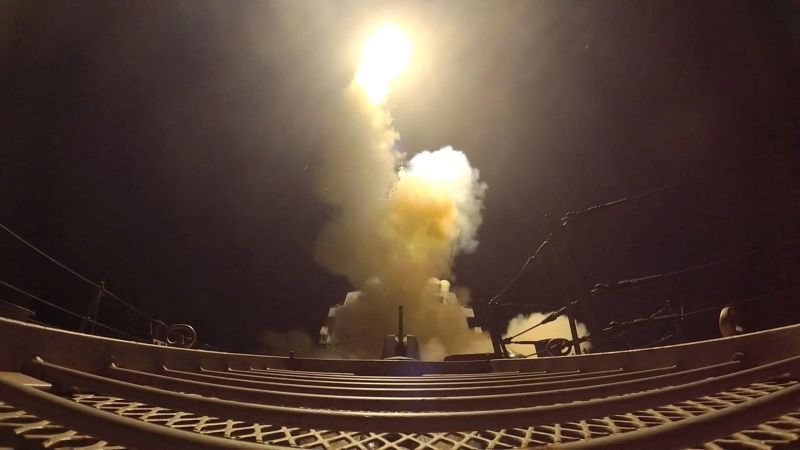
• Hourslong strikes: The US military said it hit dozens of Iranian military targets in a second night of strikes. According to reports of explosions from Iranian media, US strikes have expanded beyond the coastal areas bordering the Strait of Hormuz.
• Diplomatic breakdown: Iran says the US is undermining talks with Oman on ensuring safe passage through the strait. The weekend’s escalation has threatened the fragile agreement between Washington and Tehran as they near the halfway mark of a 60-day window to negotiate a deal.
• US allies under fire: Sirens were activated in Bahrain while the military in Kuwait said it was dealing with “hostile aerial targets.” Jordan’s military intercepted four missiles it said were launched by Iran.
• Oil prices climb: Brent crude and US crude prices were up over 3% on Monday as concerns deepen over Tehran’s declared closure of the strait.
18 Posts
Yemen’s Iran-backed Houthi rebels have accused Saudi Arabia of carrying out strikes on the capital’s airport on Monday, warning that the attack marks the end of a years-long de facto truce with Riyadh.
“We affirm that this aggression will not pass without response and punishment,” he added.
In a separate statement, the Houthis’ Political Bureau said that the attack “reflects the level of hatred and criminality harbored by the Saudi regime – and the Americans behind it – toward our people.”
“This targeting comes in the context of implementing the U.S. desire to maintain the unjust blockade imposed on our people for more than 10 years.”
An Iranian aircraft that was approaching Sanaa airport on Monday diverted to another airfield at Hodeidah, also in a Houthi-controlled part of Yemen.
The Houthis are one of Iran’s principal allies in the region, and on several occasions since the start of the war between the US and Iran have warned they could take action to block the Bab al Mandab Strait, a chokepoint at the southern end of the Red Sea.
The Red Sea has become more important to Saudi oil exports since Iran blocked traffic through the Strait of Hormuz, making any disruption there a potential trigger for a rise in global oil prices.
The flare-up follows more than four years of relative calm that began with a UN-brokered truce in 2022 and was sustained by direct Saudi-Houthi talks after Riyadh and Tehran restored diplomatic ties the following year.
US President Donald Trump said “we’re going to hit them very hard” as he criticizes Iran for failing to agree to a deal.
“We hit them very hard last night. Every time they send a drone, we hit them very hard. But we had a deal. What nobody knows, we had a deal. It was a done deal, and then they broke it. They always break it. We’ve had 10 deals with these people, and so we’re just going to hit them very hard,” he said in a phone interview with Fox News.
Trump said in addition to renewed attacks, the US would become “guardian” of the Strait of Hormuz.
“Now we’re going to guard it, and we’re going to get paid for guarding it,” he said.
Trump said he would expect payment for guarding the Strait of Hormuz because “we just want to be reimbursed for doing all of this, for putting our people in danger.”
His comments came after the US military increased the number of strikes it is carrying out against Iran over the weekend.
Fourteen vessels — half of them Iranian — transited the Strait of Hormuz yesterday, according to data and intelligence firm Kpler, as the US-Iran ceasefire unravels and fewer ships risk navigating the crucial waterway.
Five of the seven Iranian vessels followed the route that hugs the Iranian coastline, which the Iranian regime has sought to push ships into using to ensure greater control over the strait. The other two vessels were “dark,” meaning they didn’t broadcast their location data as they transited the strait.
Of the other seven vessels, five were “dark,” one used the Iranian route, and one used the International Maritime Organization route that passes through the middle of the strait and was in use before the war.
As the US and Iran traded more intense strikes over the weekend, 52% fewer ships attempted to cross the strait than the previous week, Kpler added. Additionally, more vessels used the Iranian route or went “dark” while those publicly taking the IMO or Omani routes almost completely disappeared.
A tanker traveling through the Gulf of Aden has reported being approached by six small boats off the coast of Yemen, the UK Maritime Trade Operations center (UKMTO) said today.
The incident was described by UKMTO as “suspicious activity.”
The report came shortly after a Houthi media outlet claimed that Saudi aircraft carried out strikes on the airport in the Yemeni capital of Sanaa. Saudi Arabia has not yet commented on this reporting.
Some context: The Houthis are a militant group backed by Iran. Tehran has provided the group with weapons and technology for, among other things, sea mines, ballistic and cruise missiles, and unmanned aerial vehicles, according to a 2021 report from the Center for Strategic and International Studies.
Earlier this year, Iranian media reported that Iran and the Houthis were considering closing the Bab al-Mandab strait, a crucial waterway for Saudi Arabia, in response to Israel’s attacks on Lebanon.
Nearly 15% of global maritime trade passes Bab al-Mandab. Despite Iran’s closure of the Strait of Hormuz, Bab al-Mandab has remained largely navigable throughout the war, preserving a critical export route for Saudi Arabia, the world’s biggest crude exporter.
CNN’s Nadeen Ebrahim contributed to this reporting.
A Houthi media outlet in Yemen has claimed that Saudi aircraft have carried out multiple airstrikes on the airport in the capital, Sanaa.
“Saudi aggression targets Sanaa International Airport with multiple airstrikes,” Almasirah reported.
There has been no word from Saudi Arabia.
The Defense Ministry in Yemen’s internationally recognized government appeared to take responsibility for the strikes, saying its patience had run out, and it would confront and deal with hostile aircraft that violate Yemeni airspace
Last week, the government accused Iran of sending a flight to the Houthis carrying military and security personnel, as well as Iranian experts in drone and missile-system development.
Tension has been growing between the Houthis and Saudi Arabia over a range of issues, including a long-running Saudi blockade of Houthi-held territory in the country’s north and direct flights between Tehran and Sanaa.
After one such flight last week, Hizam al-Asad, a member of the Houthis’ political bureau, said “civilian flights between Sana’a and Tehran will continue, even if this requires paralyzing the operations of all airports in Saudi Arabia.”
Attacks on Iran have continued into Monday afternoon local time, the country’s state media is reporting, after the weekend saw the US bombardment of hundreds of Iranian targets.
Three locations in the city of Abadan in southwest Iran were hit around 1:45 p.m. local time (6:15 a.m. ET), the semi-official Tasnim news outlet reported, citing the deputy governor of Khuzestan Province. At least two people were killed and three others injured, it said.
Explosions were also heard in southern Iran, near the city of Bandar Abbas and Qeshm Island, around midday local time (4:30 a.m. ET), according to the semi-official Mehr News Agency.
CNN has reached out to United States Central Command and the Office of the Secretary of Defense for comment.
It’s nearly a month since the United States and Iran agreed a Memorandum of Understanding designed to stop the fighting and start the clock towards a broader settlement.
But over the past few days, a cycle of violence has accelerated, sparked by attacks on several merchant ships transiting the Strait of Hormuz. The US military has responded with hundreds of strikes against targets on the Iranian coast and infrastructure further inland.
Each side accuses the other of bad faith and reneging on commitments.
The June 17 agreement left key provisions deliberately vague. Article 5 commits Iran to using its “best efforts” to ensure safe commercial passage for 60 days, while also saying Iran and Oman will “define the future administration and maritime services” in the Strait of Hormuz.
To Iran, that means a continuing role in managing shipping, with hardliners demanding that ships trying to pass without permission be targeted.
“The Strait of Hormuz remains under the total oversight and management of Iran through the 30 coming days,” Iranian Foreign Minister Abbas Araghchi said on June 27. Only “after all obstacles are removed” would the total capacity of the waterway be restored.
A regional source told CNN that the MoU “is working like a thermostat,” adding, “It is regulating, basically kicks in and out.”
“Under the framework of the MoU both sides are asserting a right to attack,” the source said.
As those attacks escalate, the agreement is being tested. “At best, it’s in intensive care. But it may also be slipping into a coma,” a European diplomat said.
Indeed, US President Donald Trump said last week after a ship was struck in the Gulf of Oman: “To me, I think it’s over. I don’t want to deal with them (Iran) anymore.”
At the same time, Trump hasn’t closed the door on further negotiations. The MoU was meant to trigger a 60-day window during which the US and Iran would seek a deal on the broader issues: Iran’s nuclear stocks and enrichment program, sanctions and Iranian assets frozen overseas.
That window opened 26 days ago. There is no sign that those issues have yet been broached.
US strikes are increasing in number and now reaching beyond the coastal areas bordering the Strait of Hormuz, according to reports of explosions on Iranian media, signaling the increased intensity of this round of attacks.
Overnight, most US bombing was still concentrated in areas along Iran’s southern coast but one attack struck a military facility in Na’in, in central Iran, killing one person and wounding seven others, the province’s deputy governor told the state-run Islamic Republic News Agency (IRNA).
There were also more strikes over this weekend – US Central Command (CENTCOM) said it hit 140 targets overnight Saturday compared to 90 overnight Wednesday and 80 on Tuesday night. As for yesterday night, CENTCOM did not specify the precise number, saying only that the US struck “dozens of targets at multiple locations.”
At least one of those strikes hit civilian infrastructure too. One attack struck a water pumping station in Mahshar County, on the southern coast, killed the facility’s security guard and wounded four others, according to Iran’s state broadcaster IRIB.
Video geolocated and verified by CNN also showed an Iranian aircraft hangar at an airport in the southwestern city of Omidiyeh in flames. And a telecommunications tower near the village of Taherouyi in Sirik County was struck too, the IRIB said.
This latest round of strikes confirms that the US-Iran ceasefire is in tatters, with Tehran saying it is responding to US strikes with its own attacks against American bases in the region.
Still, one analyst, retired US Air Force Colonel Cedric Leighton, yesterday characterized this latest phase of the war as “a series of strikes and counterstrikes, punch, counter punch, that is basically designed to keep the pot on a simmer … but not boiling over.”
CNN’s Chris Lau contributed reporting.
Iran has insisted that it wants to ensure the safe passage of ships through the Strait of Hormuz, but again claimed that the United States is obstructing its efforts.
Talks in Oman at the weekend had been focused solely on a new arrangement for the strait, Foreign Ministry spokesman Esmail Baghaei said Monday.
“Our effort was to reach a mechanism, in consultation with Oman, to ensure the safe passage of ships,” he said, but “this was not achieved due to the overt and covert pressures of the United States on Oman.”
Baghaei was speaking after a second consecutive night of US strikes across Iran, with Iran retaliating by targeting US military facilities in several Gulf states.
So long as Washington “continues to violate its commitments, the Islamic Republic of Iran will likewise refrain from fulfilling the obligations it has undertaken,” Baghaei said.
As a coastal state, Iran has “both the right and the responsibility to take the necessary measures to safeguard our security and national interests,” Baghaei said
US “claims about escorting commercial vessels are themselves evidence of Washington’s determination to perpetuate insecurity in the region,” he added.
Iran has insisted it has a role in managing traffic through the Strait; the United States is demanding unfettered freedom of navigation and has encouraged shipping to use a route close to the coast of Oman.
Over the weekend, an Indian container ship was struck by a drone off the coast of Oman. Iran’s IRGC Navy says a vessel using an unapproved route in Strait was ‘struck’ by a warning shot and stopped.
The incident triggered fresh US strikes on Saturday and Sunday night.
Oil prices are rising as escalating attacks between the United States and Iran deepen concerns over Tehran’s declared closure of the Strait of Hormuz.
Brent crude, the global oil benchmark, climbed 3.60% to $78.7 a barrel, up from its recent low of around $70 a barrel. WTI, the US benchmark, climbed 3.50% to $73.92 a barrel. Oil prices are still well below their wartime peaks of above $120 a barrel for Brent.
The exchange of attacks between the US and Iran “has increasingly centred on the Strait of Hormuz, where Iran has claimed the waterway is effectively closed and warned vessels against transiting, even as US officials insist it remains open and are actively escorting commercial traffic,” Deutsche Bank analysts wrote in a note Monday.
“Reports of damage to vessels, intercepted missiles and drones, and strikes on military and energy-linked sites across the Gulf underscore the widening scope of the conflict,” they added.
US allies Bahrain, Kuwait and Jordan all reported responding to aerial threats on Monday morning local time, after Iran said it was launching strikes across the region in response to US attacks on its territory.
Sirens were activated in Bahrain while the military in Kuwait said it was dealing with “hostile aerial targets,” and Jordan’s military intercepted four missiles from Iran. All three countries also reported aerial attacks on Sunday.
In Bahrain, the Islamic Revolutionary Guard Corps (IRGC) said its air force struck the Isa Air Base, Iran’s semi-official Fars news agency reported.
The Isa Air Base doesn’t hold a permanent US presence, but rather periodic rotations of US personnel.
Bases housing US operations in Kuwait were also hit, including a missile base that was set on fire, where missile launchers and ammunition depots were destroyed, the IRGC said.
In Jordan, the IRGC said it had targeted several large missile depots and fuel storage facilities at Prince Hassan Air Base, in a statement reported by Fars early Monday local time.
CNN could not verify reports of strikes on US bases. CNN has reached out to Central Command, which is responsible for US forces in the region, for comment on the Iranian state media reports.
CNN’s Lex Harvey and Yasha Saebi contributed reporting.
The conflict between the US and Iran has devolved into a “very determined fight over who controls the Strait of Hormuz,” said Mehran Kamrava, professor of government at Georgetown University in Qatar.
“Iran is keenly aware of the fact that it cannot match the United States and Israel militarily. So, it is trying to turn the conflict from a military one into an economic one,” Kamrava said, adding it has “in some ways succeeded in doing so.”
“Iran is determined to hold onto the Strait of Hormuz as a source of leverage,” Kamrava told CNN’s Will Ripley.
“Iran wants to establish some sort of administrative influence, and the Americans are determined to undermine that influence.”
The US has claimed its strikes are intended to reduce Iran’s ability to attack ships in the crucial waterway.
“It’s all about the Strait of Hormuz right now,” Kamrava said.
US Central Command says it used “one-way attack aerial drones, and one-way attack sea drones for the first time” in strikes against Iran on Sunday.
The exact type of drones or in what numbers each were used was not specified in its press release.
US aerial attack drones saw their first use early in the war with Iran, when CENTCOM deployed the Low-cost Unmanned Combat Attack System (LUCAS) – essentially a knock off of the Iranian-designed Shahed 136 drones that Russia has used in large numbers in its war on Ukraine.
“These low-cost drones, modeled after Iran’s Shahed drones, are now delivering American-made retribution,” CENTCOM said in a social media post at the time.
As for sea drones, the US has been experimenting with a few types, according to analyst Carl Schuster, a former director of the US Pacific Command’s Joint Intelligence Center.
“The most suitable for one-way strikes is the Fleet-class unmanned surface vessel (USV),” Schuster told CNN.
These craft were designed for mine-countermeasures or anti-submarine missions, but with a speed of more than 40 mph they could be adapted for one-way, “suicide strikes,” he said.
“They are expensive (over $2 million per) but … would be hard to stop,” Schuster said, adding that the USV and the LUCAS aerial drones are designed to be deployed from US Navy littoral combat ships.
CNN has geolocated and verified videos from Iran showing the aftermath of a strike at an airport in Omidiyeh, a southwestern city.
The videos posted on Monday showed an aircraft hangar in flames after being struck.
Valiollah Hayati, the deputy governor of the Iranian province of Khuzestan, said Omidiyeh was among several cities targeted by US strikes early Monday local time, according to Iranian state media IRNA. He did not mention the airport and said authorities are currently assessing the affected areas for damage.
US Central Command said on Sunday evening ET that it had completed its latest wave of strikes in Iran, hitting “dozens” of targets.
CNN’s Lex Harvey and Yasha Saebi contributed reporting.
The United States launched an hourslong wave of strikes against Iran on Sunday night.
The US Central Command (CENTCOM) said it hit dozens of Iranian military targets in its latest strikes.
As sunrise approached over the Gulf, Iran responded to the attack by targeting regional US bases, the Islamic Revolutionary Guard Corps (IRGC) said.
Here’s the latest:
US renews Iran strikes: Forces launched strikes against Iran at 5 p.m. ET Sunday “to continue degrading their ability to attack civilian mariners and commercial ships freely transiting the Strait of Hormuz,” CENTCOM said, adding the order was given by US President Donald Trump.
One killed: Explosions were reported in the south of Iran. A security guard was killed and four others were wounded after a projectile hit a water pumping station in Mahshahr County, southwestern Iran, state media IRNA reported citing an Iranian official.
Iran responds: Following the hourslong strike, Iran attacked US military bases with drones and missiles, the IRGC said. Sirens were activated in Bahrain, the country’s interior ministry said. In Kuwait, the military said it was dealing with aerial threats. And Jordan’s military intercepted four missiles from within its airspace, according to state media.
Oil prices rise: Brent crude, the international benchmark, rose 3.92% to $78.99 a barrel Sunday. US crude climbed 3.44% to $73.87 a barrel.
CNN’s Eyad Kourdi, Lex Harvey, Mohammed Tawfeeq, Yasha Saebi and Zachary Cohen contributed to this report.
It’s been a volatile weekend in the Middle East. The flare-up between the US and Iran comes as both countries near the halfway mark of a 60-day window to negotiate the final terms of a deal, following an initial agreement in June.
What happened over the weekend:
As mediators race to revive diplomacy, Iranian Foreign Minister Abbas Araghchi travels to Muscat to meet with his Omani counterpart. Oman drafts a tentative proposal to manage traffic in the Strait of Hormuz through two separately controlled routes, according to a source.
Hours later, Iran’s Islamic Revolutionary Guard Corps (IRGC) say they fired a warning shot at a vessel trying to cross the Strait of Hormuz via an unauthorized route, and declares the waterway closed.
The US military launches its third round of strikes in a week, saying the IRGC “blatantly attacked” a Cyprus-flagged container ship transiting the Strait of Hormuz. Multiple explosions are reported in the south of Iran. In a later update, the US Central Command (CENTCOM) says it hit 140 Iranian military targets.
The IRGC says it launched strikes on US military targets across the Gulf. Authorities in Gulf nations report defending against attacks, including in Qatar, where three people are hurt by falling debris during interception operations.
Indian authorities say one of its nationals is missing after an attack on a commercial vessel on the Strait of Hormuz. It adds 10 others were rescued from the ship.
The US and Iran are at odds over the status of the Strait Hormuz. US President Donald Trump and CENTCOM insist the waterway is open, while Iran’s strait authority says the passage of vessels is “not possible.”
The US military launches another round of strikes after the previous day’s assault in the evening and says it hit dozens of Iranian military targets. Iran reports multiple explosions in the south of the country, including at a water pumping station where one person was killed.
Iran says it conducted a new wave of missile and drone attacks toward US bases in the region, including those in Kuwait and Bahrain.
Dalia Abdelwahab, Aleena Fayaz, Eyad Kourdi, Mitchell McCluskey, Laura Sharman, Julia Benbrook, Billy Stockwell, Aida Karimi, Mohammed Tawfeeq, Zachary Cohen, Piper Hudspeth Blackburn and Lex Harvey contributed reporting.
Oil prices climbed Sunday after a weekend of strikes between the United States and Iran.
Brent crude, the international benchmark, rose 3.92% to $78.99 a barrel, and US crude climbed 3.44% to $73.87 a barrel.
But the increase is “pretty tame,” Bob McNally, founder and president of Rapidan Energy Group, told CNN. Brent crude oil prices have trended lower since reaching $115 a barrel in April.
McNally said oil prices have fallen because of President Donald Trump’s reassurance that he wants the Strait of Hormuz open to avoid “a real economic and financial catastrophe.”
Iran has warned vessels against using alternative routes, such as traveling along the Omani coastline. The Omani “southern route” remains open, according to a naval advisory board.
With the uptick in oil prices, gas prices may soon be on the rise. An average gallon of gas in the US costs about $3.87, according to data from AAA — a 30% increase from when the war began in late February.
Gas prices had reached an average of $4.56 on Memorial Day, a busy weekend for drivers. McNally said the drop since the holiday is due to crude oil having “really unwound most of its war gains. That’s partly due to the president’s messaging and balancing on that.”
Meanwhile, Dow Jones futures and S&P futures slipped 0.2%, while Nasdaq futures dropped 0.3%.
Washington and Tehran have been making contradictory claims about the status of marine traffic in the Strait of Hormuz, which is key to Tehran’s leverage in negotiations.
Over the weekend, Iran’s Islamic Revolutionary Guard Corps (IRGC) said it closed the Strait of Hormuz after firing a warning shot at a vessel attempting to use an unauthorized route to cross the waterway.
Iran’s strait authority later backed up the claim and said the passage of vessels is “not possible” and it would review permits once “stability and calm are restored.”
US Central Command declared the waterway was “open to all vessels” and US forces were prepared to ensure “freedom of navigation.”
The Joint Maritime Information Center, which is overseen by the US Navy, also said the “southern route” through the strait, which hugs the Omani coastline, remains open for two-way traffic.
US President Donald Trump also told CNN “it’s open as far as we’re concerned.”
Tracking data shows traffic was reduced to a trickle Sunday.
CNN’s Lex Harvey, Julia Benbrook, Billy Stockwell, Aida Karimi, Catherine Nicholls and Izzy Lippolis contributed reporting.
• Hourslong strikes: The US military said it hit dozens of Iranian military targets in a second night of strikes. According to reports of explosions from Iranian media, US strikes have expanded beyond the coastal areas bordering the Strait of Hormuz.
• Diplomatic breakdown: Iran says the US is undermining talks with Oman on ensuring safe passage through the strait. The weekend’s escalation has threatened the fragile agreement between Washington and Tehran as they near the halfway mark of a 60-day window to negotiate a deal.
• US allies under fire: Sirens were activated in Bahrain while the military in Kuwait said it was dealing with “hostile aerial targets.” Jordan’s military intercepted four missiles it said were launched by Iran.
• Oil prices climb: Brent crude and US crude prices were up over 3% on Monday as concerns deepen over Tehran’s declared closure of the strait.
Yemen’s Iran-backed Houthi rebels have accused Saudi Arabia of carrying out strikes on the capital’s airport on Monday, warning that the attack marks the end of a years-long de facto truce with Riyadh.
“We affirm that this aggression will not pass without response and punishment,” he added.
In a separate statement, the Houthis’ Political Bureau said that the attack “reflects the level of hatred and criminality harbored by the Saudi regime – and the Americans behind it – toward our people.”
“This targeting comes in the context of implementing the U.S. desire to maintain the unjust blockade imposed on our people for more than 10 years.”
An Iranian aircraft that was approaching Sanaa airport on Monday diverted to another airfield at Hodeidah, also in a Houthi-controlled part of Yemen.
The Houthis are one of Iran’s principal allies in the region, and on several occasions since the start of the war between the US and Iran have warned they could take action to block the Bab al Mandab Strait, a chokepoint at the southern end of the Red Sea.
The Red Sea has become more important to Saudi oil exports since Iran blocked traffic through the Strait of Hormuz, making any disruption there a potential trigger for a rise in global oil prices.
The flare-up follows more than four years of relative calm that began with a UN-brokered truce in 2022 and was sustained by direct Saudi-Houthi talks after Riyadh and Tehran restored diplomatic ties the following year.
US President Donald Trump said “we’re going to hit them very hard” as he criticizes Iran for failing to agree to a deal.
“We hit them very hard last night. Every time they send a drone, we hit them very hard. But we had a deal. What nobody knows, we had a deal. It was a done deal, and then they broke it. They always break it. We’ve had 10 deals with these people, and so we’re just going to hit them very hard,” he said in a phone interview with Fox News.
Trump said in addition to renewed attacks, the US would become “guardian” of the Strait of Hormuz.
“Now we’re going to guard it, and we’re going to get paid for guarding it,” he said.
Trump said he would expect payment for guarding the Strait of Hormuz because “we just want to be reimbursed for doing all of this, for putting our people in danger.”
His comments came after the US military increased the number of strikes it is carrying out against Iran over the weekend.
Fourteen vessels — half of them Iranian — transited the Strait of Hormuz yesterday, according to data and intelligence firm Kpler, as the US-Iran ceasefire unravels and fewer ships risk navigating the crucial waterway.
Five of the seven Iranian vessels followed the route that hugs the Iranian coastline, which the Iranian regime has sought to push ships into using to ensure greater control over the strait. The other two vessels were “dark,” meaning they didn’t broadcast their location data as they transited the strait.
Of the other seven vessels, five were “dark,” one used the Iranian route, and one used the International Maritime Organization route that passes through the middle of the strait and was in use before the war.
As the US and Iran traded more intense strikes over the weekend, 52% fewer ships attempted to cross the strait than the previous week, Kpler added. Additionally, more vessels used the Iranian route or went “dark” while those publicly taking the IMO or Omani routes almost completely disappeared.
A tanker traveling through the Gulf of Aden has reported being approached by six small boats off the coast of Yemen, the UK Maritime Trade Operations center (UKMTO) said today.
The incident was described by UKMTO as “suspicious activity.”
The report came shortly after a Houthi media outlet claimed that Saudi aircraft carried out strikes on the airport in the Yemeni capital of Sanaa. Saudi Arabia has not yet commented on this reporting.
Some context: The Houthis are a militant group backed by Iran. Tehran has provided the group with weapons and technology for, among other things, sea mines, ballistic and cruise missiles, and unmanned aerial vehicles, according to a 2021 report from the Center for Strategic and International Studies.
Earlier this year, Iranian media reported that Iran and the Houthis were considering closing the Bab al-Mandab strait, a crucial waterway for Saudi Arabia, in response to Israel’s attacks on Lebanon.
Nearly 15% of global maritime trade passes Bab al-Mandab. Despite Iran’s closure of the Strait of Hormuz, Bab al-Mandab has remained largely navigable throughout the war, preserving a critical export route for Saudi Arabia, the world’s biggest crude exporter.
CNN’s Nadeen Ebrahim contributed to this reporting.
A Houthi media outlet in Yemen has claimed that Saudi aircraft have carried out multiple airstrikes on the airport in the capital, Sanaa.
“Saudi aggression targets Sanaa International Airport with multiple airstrikes,” Almasirah reported.
There has been no word from Saudi Arabia.
The Defense Ministry in Yemen’s internationally recognized government appeared to take responsibility for the strikes, saying its patience had run out, and it would confront and deal with hostile aircraft that violate Yemeni airspace
Last week, the government accused Iran of sending a flight to the Houthis carrying military and security personnel, as well as Iranian experts in drone and missile-system development.
Tension has been growing between the Houthis and Saudi Arabia over a range of issues, including a long-running Saudi blockade of Houthi-held territory in the country’s north and direct flights between Tehran and Sanaa.
After one such flight last week, Hizam al-Asad, a member of the Houthis’ political bureau, said “civilian flights between Sana’a and Tehran will continue, even if this requires paralyzing the operations of all airports in Saudi Arabia.”
Attacks on Iran have continued into Monday afternoon local time, the country’s state media is reporting, after the weekend saw the US bombardment of hundreds of Iranian targets.
Three locations in the city of Abadan in southwest Iran were hit around 1:45 p.m. local time (6:15 a.m. ET), the semi-official Tasnim news outlet reported, citing the deputy governor of Khuzestan Province. At least two people were killed and three others injured, it said.
Explosions were also heard in southern Iran, near the city of Bandar Abbas and Qeshm Island, around midday local time (4:30 a.m. ET), according to the semi-official Mehr News Agency.
CNN has reached out to United States Central Command and the Office of the Secretary of Defense for comment.
It’s nearly a month since the United States and Iran agreed a Memorandum of Understanding designed to stop the fighting and start the clock towards a broader settlement.
But over the past few days, a cycle of violence has accelerated, sparked by attacks on several merchant ships transiting the Strait of Hormuz. The US military has responded with hundreds of strikes against targets on the Iranian coast and infrastructure further inland.
Each side accuses the other of bad faith and reneging on commitments.
The June 17 agreement left key provisions deliberately vague. Article 5 commits Iran to using its “best efforts” to ensure safe commercial passage for 60 days, while also saying Iran and Oman will “define the future administration and maritime services” in the Strait of Hormuz.
To Iran, that means a continuing role in managing shipping, with hardliners demanding that ships trying to pass without permission be targeted.
“The Strait of Hormuz remains under the total oversight and management of Iran through the 30 coming days,” Iranian Foreign Minister Abbas Araghchi said on June 27. Only “after all obstacles are removed” would the total capacity of the waterway be restored.
A regional source told CNN that the MoU “is working like a thermostat,” adding, “It is regulating, basically kicks in and out.”
“Under the framework of the MoU both sides are asserting a right to attack,” the source said.
As those attacks escalate, the agreement is being tested. “At best, it’s in intensive care. But it may also be slipping into a coma,” a European diplomat said.
Indeed, US President Donald Trump said last week after a ship was struck in the Gulf of Oman: “To me, I think it’s over. I don’t want to deal with them (Iran) anymore.”
At the same time, Trump hasn’t closed the door on further negotiations. The MoU was meant to trigger a 60-day window during which the US and Iran would seek a deal on the broader issues: Iran’s nuclear stocks and enrichment program, sanctions and Iranian assets frozen overseas.
That window opened 26 days ago. There is no sign that those issues have yet been broached.
US strikes are increasing in number and now reaching beyond the coastal areas bordering the Strait of Hormuz, according to reports of explosions on Iranian media, signaling the increased intensity of this round of attacks.
Overnight, most US bombing was still concentrated in areas along Iran’s southern coast but one attack struck a military facility in Na’in, in central Iran, killing one person and wounding seven others, the province’s deputy governor told the state-run Islamic Republic News Agency (IRNA).
There were also more strikes over this weekend – US Central Command (CENTCOM) said it hit 140 targets overnight Saturday compared to 90 overnight Wednesday and 80 on Tuesday night. As for yesterday night, CENTCOM did not specify the precise number, saying only that the US struck “dozens of targets at multiple locations.”
At least one of those strikes hit civilian infrastructure too. One attack struck a water pumping station in Mahshar County, on the southern coast, killed the facility’s security guard and wounded four others, according to Iran’s state broadcaster IRIB.
Video geolocated and verified by CNN also showed an Iranian aircraft hangar at an airport in the southwestern city of Omidiyeh in flames. And a telecommunications tower near the village of Taherouyi in Sirik County was struck too, the IRIB said.
This latest round of strikes confirms that the US-Iran ceasefire is in tatters, with Tehran saying it is responding to US strikes with its own attacks against American bases in the region.
Still, one analyst, retired US Air Force Colonel Cedric Leighton, yesterday characterized this latest phase of the war as “a series of strikes and counterstrikes, punch, counter punch, that is basically designed to keep the pot on a simmer … but not boiling over.”
CNN’s Chris Lau contributed reporting.
Iran has insisted that it wants to ensure the safe passage of ships through the Strait of Hormuz, but again claimed that the United States is obstructing its efforts.
Talks in Oman at the weekend had been focused solely on a new arrangement for the strait, Foreign Ministry spokesman Esmail Baghaei said Monday.
“Our effort was to reach a mechanism, in consultation with Oman, to ensure the safe passage of ships,” he said, but “this was not achieved due to the overt and covert pressures of the United States on Oman.”
Baghaei was speaking after a second consecutive night of US strikes across Iran, with Iran retaliating by targeting US military facilities in several Gulf states.
So long as Washington “continues to violate its commitments, the Islamic Republic of Iran will likewise refrain from fulfilling the obligations it has undertaken,” Baghaei said.
As a coastal state, Iran has “both the right and the responsibility to take the necessary measures to safeguard our security and national interests,” Baghaei said
US “claims about escorting commercial vessels are themselves evidence of Washington’s determination to perpetuate insecurity in the region,” he added.
Iran has insisted it has a role in managing traffic through the Strait; the United States is demanding unfettered freedom of navigation and has encouraged shipping to use a route close to the coast of Oman.
Over the weekend, an Indian container ship was struck by a drone off the coast of Oman. Iran’s IRGC Navy says a vessel using an unapproved route in Strait was ‘struck’ by a warning shot and stopped.
The incident triggered fresh US strikes on Saturday and Sunday night.
Oil prices are rising as escalating attacks between the United States and Iran deepen concerns over Tehran’s declared closure of the Strait of Hormuz.
Brent crude, the global oil benchmark, climbed 3.60% to $78.7 a barrel, up from its recent low of around $70 a barrel. WTI, the US benchmark, climbed 3.50% to $73.92 a barrel. Oil prices are still well below their wartime peaks of above $120 a barrel for Brent.
The exchange of attacks between the US and Iran “has increasingly centred on the Strait of Hormuz, where Iran has claimed the waterway is effectively closed and warned vessels against transiting, even as US officials insist it remains open and are actively escorting commercial traffic,” Deutsche Bank analysts wrote in a note Monday.
“Reports of damage to vessels, intercepted missiles and drones, and strikes on military and energy-linked sites across the Gulf underscore the widening scope of the conflict,” they added.
US allies Bahrain, Kuwait and Jordan all reported responding to aerial threats on Monday morning local time, after Iran said it was launching strikes across the region in response to US attacks on its territory.
Sirens were activated in Bahrain while the military in Kuwait said it was dealing with “hostile aerial targets,” and Jordan’s military intercepted four missiles from Iran. All three countries also reported aerial attacks on Sunday.
In Bahrain, the Islamic Revolutionary Guard Corps (IRGC) said its air force struck the Isa Air Base, Iran’s semi-official Fars news agency reported.
The Isa Air Base doesn’t hold a permanent US presence, but rather periodic rotations of US personnel.
Bases housing US operations in Kuwait were also hit, including a missile base that was set on fire, where missile launchers and ammunition depots were destroyed, the IRGC said.
In Jordan, the IRGC said it had targeted several large missile depots and fuel storage facilities at Prince Hassan Air Base, in a statement reported by Fars early Monday local time.
CNN could not verify reports of strikes on US bases. CNN has reached out to Central Command, which is responsible for US forces in the region, for comment on the Iranian state media reports.
CNN’s Lex Harvey and Yasha Saebi contributed reporting.
The conflict between the US and Iran has devolved into a “very determined fight over who controls the Strait of Hormuz,” said Mehran Kamrava, professor of government at Georgetown University in Qatar.
“Iran is keenly aware of the fact that it cannot match the United States and Israel militarily. So, it is trying to turn the conflict from a military one into an economic one,” Kamrava said, adding it has “in some ways succeeded in doing so.”
“Iran is determined to hold onto the Strait of Hormuz as a source of leverage,” Kamrava told CNN’s Will Ripley.
“Iran wants to establish some sort of administrative influence, and the Americans are determined to undermine that influence.”
The US has claimed its strikes are intended to reduce Iran’s ability to attack ships in the crucial waterway.
“It’s all about the Strait of Hormuz right now,” Kamrava said.
US Central Command says it used “one-way attack aerial drones, and one-way attack sea drones for the first time” in strikes against Iran on Sunday.
The exact type of drones or in what numbers each were used was not specified in its press release.
US aerial attack drones saw their first use early in the war with Iran, when CENTCOM deployed the Low-cost Unmanned Combat Attack System (LUCAS) – essentially a knock off of the Iranian-designed Shahed 136 drones that Russia has used in large numbers in its war on Ukraine.
“These low-cost drones, modeled after Iran’s Shahed drones, are now delivering American-made retribution,” CENTCOM said in a social media post at the time.
As for sea drones, the US has been experimenting with a few types, according to analyst Carl Schuster, a former director of the US Pacific Command’s Joint Intelligence Center.
“The most suitable for one-way strikes is the Fleet-class unmanned surface vessel (USV),” Schuster told CNN.
These craft were designed for mine-countermeasures or anti-submarine missions, but with a speed of more than 40 mph they could be adapted for one-way, “suicide strikes,” he said.
“They are expensive (over $2 million per) but … would be hard to stop,” Schuster said, adding that the USV and the LUCAS aerial drones are designed to be deployed from US Navy littoral combat ships.
CNN has geolocated and verified videos from Iran showing the aftermath of a strike at an airport in Omidiyeh, a southwestern city.
The videos posted on Monday showed an aircraft hangar in flames after being struck.
Valiollah Hayati, the deputy governor of the Iranian province of Khuzestan, said Omidiyeh was among several cities targeted by US strikes early Monday local time, according to Iranian state media IRNA. He did not mention the airport and said authorities are currently assessing the affected areas for damage.
US Central Command said on Sunday evening ET that it had completed its latest wave of strikes in Iran, hitting “dozens” of targets.
CNN’s Lex Harvey and Yasha Saebi contributed reporting.
The United States launched an hourslong wave of strikes against Iran on Sunday night.
The US Central Command (CENTCOM) said it hit dozens of Iranian military targets in its latest strikes.
As sunrise approached over the Gulf, Iran responded to the attack by targeting regional US bases, the Islamic Revolutionary Guard Corps (IRGC) said.
Here’s the latest:
US renews Iran strikes: Forces launched strikes against Iran at 5 p.m. ET Sunday “to continue degrading their ability to attack civilian mariners and commercial ships freely transiting the Strait of Hormuz,” CENTCOM said, adding the order was given by US President Donald Trump.
One killed: Explosions were reported in the south of Iran. A security guard was killed and four others were wounded after a projectile hit a water pumping station in Mahshahr County, southwestern Iran, state media IRNA reported citing an Iranian official.
Iran responds: Following the hourslong strike, Iran attacked US military bases with drones and missiles, the IRGC said. Sirens were activated in Bahrain, the country’s interior ministry said. In Kuwait, the military said it was dealing with aerial threats. And Jordan’s military intercepted four missiles from within its airspace, according to state media.
Oil prices rise: Brent crude, the international benchmark, rose 3.92% to $78.99 a barrel Sunday. US crude climbed 3.44% to $73.87 a barrel.
CNN’s Eyad Kourdi, Lex Harvey, Mohammed Tawfeeq, Yasha Saebi and Zachary Cohen contributed to this report.
It’s been a volatile weekend in the Middle East. The flare-up between the US and Iran comes as both countries near the halfway mark of a 60-day window to negotiate the final terms of a deal, following an initial agreement in June.
What happened over the weekend:
As mediators race to revive diplomacy, Iranian Foreign Minister Abbas Araghchi travels to Muscat to meet with his Omani counterpart. Oman drafts a tentative proposal to manage traffic in the Strait of Hormuz through two separately controlled routes, according to a source.
Hours later, Iran’s Islamic Revolutionary Guard Corps (IRGC) say they fired a warning shot at a vessel trying to cross the Strait of Hormuz via an unauthorized route, and declares the waterway closed.
The US military launches its third round of strikes in a week, saying the IRGC “blatantly attacked” a Cyprus-flagged container ship transiting the Strait of Hormuz. Multiple explosions are reported in the south of Iran. In a later update, the US Central Command (CENTCOM) says it hit 140 Iranian military targets.
The IRGC says it launched strikes on US military targets across the Gulf. Authorities in Gulf nations report defending against attacks, including in Qatar, where three people are hurt by falling debris during interception operations.
Indian authorities say one of its nationals is missing after an attack on a commercial vessel on the Strait of Hormuz. It adds 10 others were rescued from the ship.
The US and Iran are at odds over the status of the Strait Hormuz. US President Donald Trump and CENTCOM insist the waterway is open, while Iran’s strait authority says the passage of vessels is “not possible.”
The US military launches another round of strikes after the previous day’s assault in the evening and says it hit dozens of Iranian military targets. Iran reports multiple explosions in the south of the country, including at a water pumping station where one person was killed.
Iran says it conducted a new wave of missile and drone attacks toward US bases in the region, including those in Kuwait and Bahrain.
Dalia Abdelwahab, Aleena Fayaz, Eyad Kourdi, Mitchell McCluskey, Laura Sharman, Julia Benbrook, Billy Stockwell, Aida Karimi, Mohammed Tawfeeq, Zachary Cohen, Piper Hudspeth Blackburn and Lex Harvey contributed reporting.
Oil prices climbed Sunday after a weekend of strikes between the United States and Iran.
Brent crude, the international benchmark, rose 3.92% to $78.99 a barrel, and US crude climbed 3.44% to $73.87 a barrel.
But the increase is “pretty tame,” Bob McNally, founder and president of Rapidan Energy Group, told CNN. Brent crude oil prices have trended lower since reaching $115 a barrel in April.
McNally said oil prices have fallen because of President Donald Trump’s reassurance that he wants the Strait of Hormuz open to avoid “a real economic and financial catastrophe.”
Iran has warned vessels against using alternative routes, such as traveling along the Omani coastline. The Omani “southern route” remains open, according to a naval advisory board.
With the uptick in oil prices, gas prices may soon be on the rise. An average gallon of gas in the US costs about $3.87, according to data from AAA — a 30% increase from when the war began in late February.
Gas prices had reached an average of $4.56 on Memorial Day, a busy weekend for drivers. McNally said the drop since the holiday is due to crude oil having “really unwound most of its war gains. That’s partly due to the president’s messaging and balancing on that.”
Meanwhile, Dow Jones futures and S&P futures slipped 0.2%, while Nasdaq futures dropped 0.3%.
Washington and Tehran have been making contradictory claims about the status of marine traffic in the Strait of Hormuz, which is key to Tehran’s leverage in negotiations.
Over the weekend, Iran’s Islamic Revolutionary Guard Corps (IRGC) said it closed the Strait of Hormuz after firing a warning shot at a vessel attempting to use an unauthorized route to cross the waterway.
Iran’s strait authority later backed up the claim and said the passage of vessels is “not possible” and it would review permits once “stability and calm are restored.”
US Central Command declared the waterway was “open to all vessels” and US forces were prepared to ensure “freedom of navigation.”
The Joint Maritime Information Center, which is overseen by the US Navy, also said the “southern route” through the strait, which hugs the Omani coastline, remains open for two-way traffic.
US President Donald Trump also told CNN “it’s open as far as we’re concerned.”
Tracking data shows traffic was reduced to a trickle Sunday.
CNN’s Lex Harvey, Julia Benbrook, Billy Stockwell, Aida Karimi, Catherine Nicholls and Izzy Lippolis contributed reporting.





Responses