
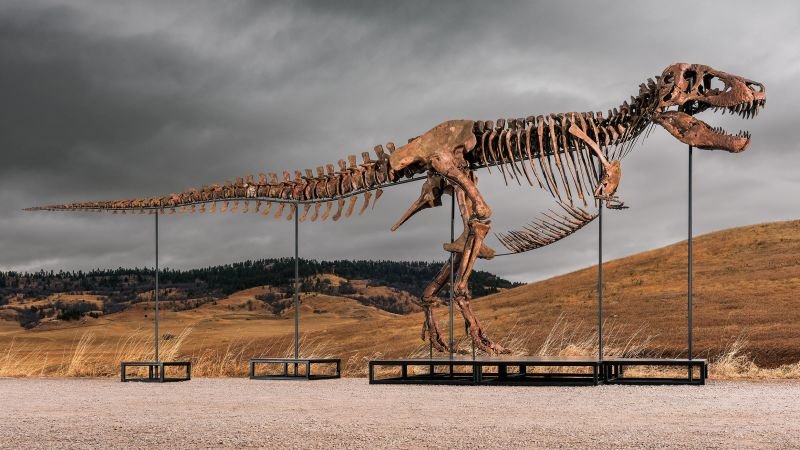
Before he became the namesake of one of the largest predators that ever lived — or made it into the footnotes of an auction catalog — the late Gary “Gus” Licking, a cattle rancher in South Dakota, had always suspected his land was hiding something big.
The Licking ranch sits within the Hell Creek Formation, a legendary geological boneyard that stretches across Montana, Wyoming and the Dakotas. It’s the most important place in the world for the most famous of dinosaurs, Tyrannosaurus rex. One of the first skeletons of T. rex was found there in 1902, and the name T. rex was given to the species based on fossils unearthed in this area.
Stan, an almost-complete T. rex skeleton discovered miles up the road from Licking’s place, sold at auction in 2020 for $31.8 million, a record at the time.
Now, the rancher’s 6,500-acre property in Harding County is writing its own chapter in Hell Creek history, having yielded a fossil near the magnitude of Stan. Named Gus in honor of Licking, the newer skeleton is set to be auctioned Tuesday at Sotheby’s in New York City, when it could become the world’s most expensive fossil.
But Gus’ sale, likely into private hands, is also bound to spark controversy because of what it represents: a paleontological predicament in which experts say ownership and stewardship are increasingly at odds — and science is usually the loser.
In Gus’ case, this conundrum began with a chance encounter. Licking had found dinosaur teeth and bones over the years, only dreaming of a bigger find until he met a stranger who would make it a reality. “I was passing by the ranch randomly one day and Gary was checking a watering trough near the road, so I stopped I and introduced myself,” said Thomas Heitkamp, a commercial paleontologist and founder of Theropoda Expeditions, a Texas-based company that specializes in excavating fossils on private land.
“The Licking ranch had been on my radar because of its location within the Hell Creek formation. Gary had always been interested in fossils and artifacts, and he had quite a good collection of things he had found in his home,” Heitkamp told CNN in an email. “I think he knew how fossil-rich his property was from spending so much of his life there, and he believed if it was hunted thoroughly enough, a specimen might be found someday. I’m happy we were able to give him that experience.”
Heitkamp and his team discovered Gus on Licking’s land in 2021. Licking singled out the skeleton’s approximate location, but he died before the team completed the excavation and never saw the specimen in its full glory.
At 38 feet in length and 12.5 feet tall, with a skull measuring 54 inches, Gus is one of the largest T. rexes ever found, according to Sotheby’s. It includes 183 fossil bone elements, making it about 61% complete by bone count, or 75% to 80% complete by mass.
The auction house said Gus is one of the most complete T. rex fossils ever found, but the specimen is less complete than both Stan, which is about 70% complete by bone count, and Sue — the first dinosaur fossil sold at auction in 1997. The latter skeleton set the standard with its impressive 90% completeness. Gus also reportedly shows bite marks and evidence of fractures that the dinosaur survived, which Sotheby’s said may add to its scientific significance.
However, no scientific work has been published on Gus, because most researchers will refuse to formally study a privately held specimen. Heitkamp said that “several independent researchers” have already seen Gus informally, but the sale — perfectly legal because the fossil comes from private land — is destined to reignite the debate about fossil auctions and the potential disappearance from the public realm of T. rex skeletons, the majority of which are already in private hands.
“If this specimen goes to a private individual, it may or may not ever be seen by the public again,” said Stuart Sumida, a professor of biology at California State University, San Bernardino, and president of the Society of Vertebrate Paleontology, or SVP, an organization that firmly opposes fossil sales. When a fossil ends up in private hands, its future is uncertain. Some fossils are loaned to institutions such as museums, while remaining privately owned, while others wind up in private collections and disappear from the public realm.
“Not only that, it will never be subjected to actual proper scientific study — no reputable journal in the world will publish a scientific study based on something that’s not held in the public trust,” Sumida added.
SVP mandates its members study only specimens held in publicly accessible collections. Doing so is the only way that other scientists can access the same specimens for further study — something that can’t be guaranteed with private ownership.
“If you sell something, it’s generally lost to science,” Sumida said. And there are few clear ways to turn back the clock.
Heitkamp said his team had been hiking around Licking’s ranch for a year before finding Gus in a small valley with little visible bedrock, which is why it had been missed earlier. “It was immediately clear that the fossil material was from a T. rex, which is always exciting to see,” he said.
Heitkamp, who started his career cataloging fossils at Bonhams auction house in Los Angeles before founding Theropoda Expeditions in 2012, excavated the Licking site over the course of three field seasons, from 2021 to 2023. He and his team could only work for about five months each year when the ground wasn’t frozen.
“We hand dug an area of roughly 7,000 square feet to collect all of the material,’ he said. “The site had several natural faults, which made tracking the fossil layer more difficult. The sheer number of bones over that wide of an area definitely provided its technical challenges.”
After the excavation, an equal amount of lab work followed to properly isolate, identify and clean up the bones, as well as fill in gaps left by missing bones using sculpted pieces made of epoxy resin, and finally mounting the skeleton in a “predatory pose” on a custom steel armature, according to Sotheby’s.
Apart from its large size, Gus has other aspects that make it desirable. The skull has about 82% of the original bones represented, and the skeleton includes rarely found components such as the wishbone, a complete pelvis and both feet. Sotheby’s said only one other specimen is known to have two well-represented feet.
Sotheby’s estimates that Gus will go for up to $30 million, but that amount is likely a conservative number. The current record holder for a fossil auction — Apex the Stegosaurus, bought in 2024 by billionaire Ken Griffin — had a presale estimate of up to $6 million but went for $44.6 million.
Gus also comes with “full rights,” meaning it does not contain any copyrighted bits of other dinosaurs, which might make it more appealing to potential buyers and drive up the price since they would hold those rights. Usually, when a bone is missing from a skeleton, a cast from another, existing skeleton is purchased to fill in the gap. The de facto standard for this process is Stan, the neighboring T. rex from the same South Dakota county as Gus.
“In most museums that have a T. rex, what you actually see is a casting of Stan, and most T. rex that have come to market before have been partially Stan, because that has been the only place to get full replica material,” said Cassandra Hatton, Sotheby’s vice chairman and worldwide head of science and natural history, who managed the sale of Apex and is now handling Gus.
“This T. rex has no Stan material in it. The team who excavated this dinosaur has excavated other T. rex, and they have made their own scans and molds of everything, so they were able to make Gus completely free of Stan,” Hatton said. A buyer could, potentially, make Gus a Stan competitor and license or produce casts for museums or private collectors.
Hatton acknowledged that no formal scientific study is possible on Gus but added that “all of the great museums in the world started from private collections.” The investment of time and money put into excavating and polishing a skeleton such as Gus would not be possible, according to Hatton, without the prospect of a high-value sale.
“Nobody can dispute the fact that if these fossils are not excavated, they are lost,” she said. “There aren’t people going out there to dig these up. It is the commercial paleontologists who are spending their own money and their own time to go.”
When asked where she hopes Gus ends up, Hatton said, “Somewhere that I could take my son to see it.”
Heitkamp echoes Hatton’s point of view on the urgency of retrieving fossils such as Gus. “I don’t know ultimately where Gus will end up,” he said, “but I know that it is important that he was found before time erased him completely.”
There’s a certain amount of truth in that sentiment, according to David Hone, a paleontologist and reader in zoology at Queen Mary University of London. “There’s only so many paleontologists in the world who’ve got time to excavate stuff and collect it and put it in museums, so some things would be lost, absolutely, and potentially even some valuable things,” he said.
However, Hone argued, a museum or other public institutions could easily unearth specimens such as Gus if only the landowners where these discoveries come up so wished. These institutions could then put a professional paleontologist, rather than a commercial one, in charge of the excavation.
“If you gave me a million dollars, that’s probably more than enough money to go find and dig up a T. rex. Five million would pretty much guarantee it. I don’t know if it’d be as good as this one, but it’d be a 10th of the price, maybe a 20th of the price,” he said.
The SVP’s Sumida agrees that private landowners who believe there are precious fossils on their land also have the option of involving a museum rather than a commercial operation. “To suggest that they are somehow saving the dinosaurs for the world is quite an exaggeration, because paleontologists can do that and help you make money doing it,” he said. “I have many colleagues who have done tremendous work with private landowners.”
One possible solution to the conundrum, according to Sumida, is to institute a scientific equivalent of the Giving Pledge, a campaign started by Warren Buffett, Bill Gates and Melinda French Gates to encourage the world’s super-wealthy to commit more than half of their fortunes to philanthropic causes and charitable organizations.
Having spoken to some buyers of expensive fossils, Hone said he believes they want both ownership and public access, but they can’t have both.
“Don’t pretend you’re doing science a service by paying $50 million to put a T. rex in your house, because you’ve just bought something, in the same way that if you find some ultrarare Ferrari in a barn and have it restored and put in your house, it’s not a great thing for car enthusiasts, you just own it now — and that’s fine, but it’s not bringing benefit or joy to anyone outside of you,” Hone said. “Fossils are not scientific specimens until they’re in museums, and they’re not being formally studied until they’re in museums.”
Sometimes, even ending up in a museum won’t suffice. Apex the Stegosaurus is currently on a four-year loan at the American Museum of Natural History in New York and visible to the public, but according to Sumida, that doesn’t fix the problem.
“People will get to see it, but once you mount a specimen, you can’t study it. You have to study the pieces individually, or how they were associated in the ground,” he said. “Once somebody has rebuilt part of it in plaster and painted it, you can look at it, but you can’t study it. Gus has also been mounted to look very, very pretty, so that someone will buy it. It’s now unstudiable.”
The SVP has written a letter to the museum expressing opposition to the loan of Apex, noting that the temporary status makes permanent access from researchers impossible, another requirement for scientific study.
CNN reached out to the American Museum of Natural History for comment; the museum did not provide any but sent back a 2024 news release about the start of the loan of Apex. In a statement contained in the document, Roger Benson, the museum’s Macaulay Curator of Paleontology, said: “As exciting as is it is to have this dinosaur on display, it is even more exciting to have the opportunity to study it and make important scientific data available for research.”
The statement is a reference to the museum releasing digital 3D scans of the fossil to researchers. However, such scans still don’t mitigate the problem, the SVP said in its letter, because they cannot replace the scientific value of studying the original fossil.
“When we publish research, we need to make sure that research is repeatable, meaning that other scientists can check our data and results and verify our conclusions, or not,” said Steve Brusatte, a professor of paleontology and evolution at Scotland’s University of Edinburgh. “As scientists, we cannot live in a world where some oligarch is the gatekeeper, deciding which scientists can study a fossil, and which scientists are denied. Imagine that — some rich guy owns a fossil and lets one of my colleagues see it, but doesn’t let me see it because he disagrees with my political views or hates my favorite baseball team. True open gold standard science cannot exist in this kind of world, which is why our professional ethics require fossils be curated in museums for us to study them and publish on them.”
With price tags of $30 million or more, no museum or other public institution can afford to participate in these auctions, according to Brusatte. But public auctions such as this one could be just the tip of the iceberg.
“I’ve heard of private sales of T. rex specimens that have achieved more than $50 million,” said Susannah Maidment, a fossil expert and a senior researcher at London’s Museum of Natural History. “It’s an amount of money that would absolutely revolutionize the collections, facilities and galleries of any museum or university across the UK. ”
The discussion around fossil auctions is often framed as a debate about ownership, when it is really a discussion about stewardship, said Kristi Curry Rogers, a professor in biology and geology at Macalester College in St. Paul, Minnesota, who’s also vice president of the SVP.
“Scientifically significant fossils are non-renewable records of Earth’s history. Every one of these specimens represents information that can never be recreated once it is lost or becomes inaccessible,” she said.
“Specimens of scientific importance should be permanently curated in institutions that guarantee access for future researchers and the public. That principle protects not only today’s science, but also the opportunities for future generations of scientists to ask and answer questions that we cannot yet imagine.”
Sign up for CNN’s Wonder Theory science newsletter. Explore the universe with news on fascinating discoveries, scientific advancements and more.




Responses