
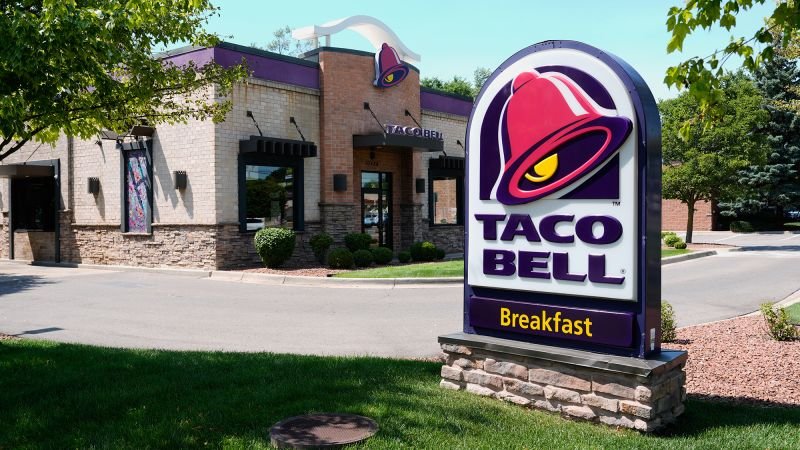
Taco Bell has been the shining star of the fast-food business for several years. But now the company is contending with a restaurant’s worst nightmare: an explosive diarrhea outbreak.
Shredded iceberg lettuce sold at some Midwestern Taco Bell locations has been connected with the massive cyclosporiasis parasite outbreak sweeping across parts of the United States. The CDC has identified more than 1,600 cases in the outbreak, including nearly 100 hospitalizations, and states are investigating thousands more. The lettuce was supplied to Taco Bell in Michigan, Ohio, West Virginia, Indiana and Kentucky by Taylor Farms, a source familiar with the investigation told CNN’s Brenda Goodman and Deidre McPhillips Thursday.
Taylor Farms did not respond to CNN’s request for comment.
Taco Bell on Thursday said it removed the potentially compromised lettuce from its nationwide supply chain as a precaution, and it would find a replacement within 24 hours in certain states.
“We are proud to have consistently acted quickly and proactively to protect our guests,” Taco Bell said in a statement.
But history shows fast-food patrons are a fickle bunch, and Taco Bell may have a lot more work to do to win back grossed-out customers – especially those who got sick.
Taco Bell was on a serious hot streak. The company’s sales have grown across its existing locations in eight consecutive quarters. And it’s not just eking out gains: The company said sales at stores open at least a year grew a remarkable 8% in the first quarter. Profit was up 16% in those stores.
McDonald’s, by comparison, grew 3.8% by the same sales measure in the first quarter. Burger King was up 5.8%. Wendy’s fell 2.1%.
Taco Bell has been attracting customers with its value offerings, including several menu items priced at $3 or less.
But, as McDonald’s and Chipotle can attest, that goodwill can change in a second.
In late 2024, McDonald’s was in the middle of a rebound until an E. coli outbreak traced to onions served on McDonald’s Quarter Pounders sickened more than 100 customers. McDonald’s sales in the fourth quarter of 2024 tumbled 1.4% after climbing 4.3% in the same quarter a year earlier.
That’s why Taco Bell’s response to the outbreak will be key.
So far, the company has done more work in the kitchen than in the public sphere. Removing the affected lettuce was the necessary first step, but a short statement published to its website may not be sufficient to satisfy customers that Taco Bell has gained control of the situation.
”In this instance, the statement falls far short of what stakeholders need when serious food safety issues arise,” said Deborah Hileman, CEO of the Institute for Crisis Management. “A more effective message would have included a robust sentence about how they are addressing the issue and adhering to rigorous safety standards.”
McDonald’s, by contrast, spent $100 million on a publicity campaign and franchisee support program in 2024 to lure customers back into restaurants. The company’s CEO Chris Kempczinski held a special media call and several interviews to calm fears and ensure customers (and investors) that McDonald’s was taking serious action to resolve the problem.
Chipotle in the previous decade was a different story: The company failed to contain a massive E. coli outbreak that began in 2015 and suffered such reputational damage that it replaced its CEO and founder with Brian Niccol – who had been Taco Bell’s CEO for seven years. It took years for Chipotle sales to rebound.
“Customers do not expect a global supply chain to be perfect, but they do expect candor, urgency and accountability when something goes wrong,” said Evan Nierman, CEO of global crisis PR firm Red Banyan. “Whether this becomes lasting reputational damage will depend far more on Taco Bell’s response than on the contaminated lettuce itself.”
The company’s statements have felt too guarded and impersonal for such a large outbreak, Nierman said. He suggested an executive provide regular updates and make themselves available to speak to the public about the company’s efforts.
Taco Bell did not respond to CNN’s questions about its planned response to the outbreak.
If it doesn’t get out in front of the issue, the company could face a unique challenge getting customers to return. Taco Bell has long been the butt of jokes about its menu causing intestinal concerns. Whether real or imagined, the stigma is there, making this particular crisis one that Taco Bell needs to address in full force.
“This outbreak is especially dangerous for Taco Bell because it collides with one of the oldest jokes about the brand,” Nierman said. “Taco Bell needs to move quickly before that joke hardens into a lasting judgment about the safety of its food.”




Responses