
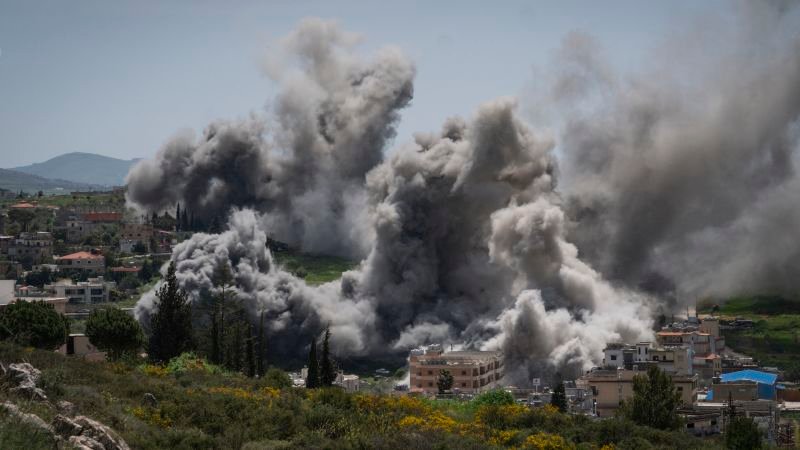
• Intensifying conflict: Seven consecutive nights of US strikes have been followed by waves of Iranian drones and missiles, fired at a widening number of targets in countries that host US bases. Regional allies fended off fresh Iranian attacks and raised alarms this morning.
• Ceasefire in tatters: Tehran says it is suspending its commitments under the initial agreement reached with Washington last month. At least 50 people have been killed in the renewed US bombing campaign, according to Iran’s Health Ministry.
• Key facilities: An Iranian provincial official said the US damaged a water desalination plant in its latest barrage. The US military has not yet responded to the claim. Authorities in Kuwait also reported an Iranian attack on a desalination plant, which are vital to water supply in the region. Bridges, power plants and oil facilities have come under fire across the region.
22 Posts
The Middle East is reeling as the US-Iran conflict intensifies. The US has continued to attack areas across Iran, and Tehran has targeted American allies in the region.
A US strike on Iran damaged a desalination plant in the south of the country, according to the deputy governor of Hormozgan province, leaving 20 villages without water. The US military has yet to respond to the claim.
Meanwhile, Kuwait’s Ministry of Electricity, Water and Renewable Energy said that Iranian attacks hit a power generation and water desalination plant, causing a fire.
If you’re just joining us, here are some of the latest developments:
At least 12 people have been killed by US strikes in Iran in the last day, according to the Iranian Health Ministry, taking the total death toll to 50 since this latest phase of the war began.
Tehran has suspended its commitments under the deal reached with the US, Iran’s deputy foreign minister Khazem Gharibabadi said as the conflict continues.
Iran’s Islamic Revolutionary Guard Corps has warned that those who attack Iran will be met with the same force, quoting the Quran in its statement.
The US has bolstered its fleet of refueling aircraft in Israel as part of adjustments to its force posture in the Middle East region, an Israeli military official said.
And Kuwaiti authorities have reported “significant” damage to a “vital” site in the oil sector and some injuries following repeated Iranian attacks.
CNN’s Jessie Yeung, Adam Pourahmadi, Issy Ronald, Tim Lister, Sophie Tanno, Eugenia Yosef and Ibrahim Dahman contributed to this reporting.
Iran’s Islamic Revolutionary Guard Corps (IRGC) has warned that those who attack Iran will be met with the same force, as it launched strikes on American allies in the Middle East region following a fresh wave of US attacks.
Here’s a closer look at the Revolutionary Guards:
What is the IRGC? The IRGC is an elite wing of the Iranian military, established in the aftermath of Iran’s revolution in 1979 as a parallel security institution to the national army. The group’s goal was to protect the revolutionary government and its leaders, although it grew to be seen as a deep state more powerful than the army and one with a vast business empire.
What do they do? The Revolutionary Guard chief reports directly to the supreme leader, now Mojtaba Khamenei. The IRGC holds deep influence over domestic politics and the economy, with interests extending to and beyond the construction, telecommunications, auto and energy industries.
In 2009, its Basij subgroup cracked down on anti-government demonstrations and helped secure the position of hardline then-President Mahmoud Ahmadinejad.
Designated “terrorists”: US President Donald Trump officially designated the IRGC a terrorist group in 2019. Iran’s Supreme National Security Council then declared the US a “state sponsor of terrorism” and American troops operating in the region as “terrorist groups,” according to IRNA, Iran’s state-run news agency.
US allies in the region also consider the Revolutionary Guards a major security threat, with Bahrain and Saudi Arabia adding the IRGC to their terror lists in 2018.
The European Union declared the group a terrorist organization this year after Iran’s violent crackdown on anti-government protests, while the United Kingdom designated the IRGC a national security threat earlier this week.
CNN’s Leila Gharagozlou, Adam Pourahmadi, Nadeen Ebrahim, Tamara Qiblawi, Sophie Tanno and Catherine Nicholls contributed to this report.
Iran has suspended its commitments under the deal reached with the United States a month ago, deputy foreign minister Khazem Gharibabadi said.
The memorandum of understanding between the two sides ended weeks of fighting and opened space for detailed talks but has collapsed under exchanges of fire between Iran and the US.
“We were in negotiations. Unfortunately, it was the Americans themselves who, in fact, took these aggressive actions, in violation of their own commitments,” Gharibabadi told Iran’s state broadcaster on Saturday.
As a result, “We have suspended all of our commitments and are, in fact, no longer implementing them,” he said.
His remarks are another sign that negotiations between Iran and the US, through the mediation of Qatar and Pakistan, are moribund.
Last week, US President Donald Trump said he thought that the ceasefire was “over” after an Iranian drone attack on a ship transiting the Strait of Hormuz.
Earlier this week, Iranian foreign ministry spokesperson Esmaeil Baghaei said Tehran would continue to respond “firmly” to US strikes and had no plans for negotiations.
“We currently have no plans for negotiations and remain focused on defending the country,” Baghaei told reporters in Tehran on Wednesday.
The US is continuing to bombard Iran, as Tehran maintains its attacks on American allies in the Persian Gulf. Last night saw the seventh consecutive round of overnight US strikes on Iran this week.
Here’s a look at how the conflict has escalated over the past seven days:
Early Sunday local time, Iran’s Islamic Revolutionary Guard Corps (IRGC) closed the Strait of Hormuz after firing a warning shot at a vessel it said was attempting to use an unauthorized route to cross the waterway. The US military launched multiple rounds of strikes on Iran in response. Bahrain, Qatar, Kuwait, Oman and Jordan all reported incoming attacks as Iran retaliated.
In the early hours of Monday morning, the US carried out another round of strikes on Iran, including on two locations near Ahvaz, a city known for its petroleum industry, as well as a water pumping station in southwestern Iran’s Khuzestan, state media reported. The IRGC launched a new wave of missile and drone attacks toward US bases in the region, including in Bahrain and Kuwait.
Early Tuesday, the US military said it struck targets across Iran for five hours, damaging a power plant on Iran’s Kish Island, according to Iranian state media. Iran launched waves of strikes towards Bahrain, while Jordan’s state news agency said the country shot down four missiles fired from Iran. Four Kuwaiti service members were wounded by an Iranian attack on a Kuwaiti naval vessel, the country’s Defense Ministry said. The IRGC also said it “struck and disabled” two tankers in Strait of Hormuz. That night, the US struck Iran ahead of reimplementing its blockade of the country’s ports
On Wednesday, the US carried out multiple rounds of strikes on Iran, killing at least seven Iranian military personnel, according to Iran’s army. A hospital in southwestern Iran was temporarily evacuated after a projectile from a US strike landed nearby, state-run media reported. Jordan, Kuwait and Bahrain responded to Iranian attacks.
Early Thursday local time, an explosion was heard in Tehran, as state media reported attacks across Iran. Jordan and Kuwait’s armies said that they intercepted Iranian strikes. That evening, the US launched more strikes, with attacks reported across Iran.
In the early hours of yesterday, Kuwait, Bahrain, Jordan and Qatar reported more Iranian attacks. Kuwait said Iran hit a power generation and water desalination plant. The US struck Iran again, with Iranian state media reporting that several bridges in the south of the country and a maritime control tower were hit. Iran claimed it targeted US forces in Syria, though both US military and Syrian officials disputed this.
The US carried out a seventh night of overnight strikes from yesterday into today, targeting coastal areas near the Persian Gulf and Strait of Hormuz, as well as transport infrastructure further inland, according to Iranian state media. The attacks damaged a desalination plant in the south of the country, leaving 20 villages without water, according to the deputy governor of Hormozgan province. Kuwait, Bahrain, Jordan and Saudi Arabia reported raising alarms or fending off Iranian attacks, as Kuwait said another power and water desalination plant was hit.
CNN’s Dalia Abdelwahab, Aleena Fayaz, Laura Sharman, Eyad Kourdi, Xiaoqian Lin, Mohammed Tawfeeq, Kareem El Damanhoury, Ross Adkin, Lex Harvey, Yasha Saebi, Max Saltman, Clay Voytek, Aida Karimi, Hira Humayun, Kathleen Magramo, Davis Winkie, Zachary Cohen, Kit Maher, Billy Stockwell, Mitchell McCluskey, Hanna Park, Ibrahim Dahman, Sana Noor Haq, Sophie Tanno, Mostafa Salem, Isaac Yee, Jessie Yeung, Adam Pourahmadi and Tim Lister contributed to this reporting.
The US has bolstered its fleet of refueling aircraft in Israel as part of adjustments to its force posture in the Middle East region, an Israeli military official said today, amid consecutive waves of US strikes on Iran.
Israel has not been involved in the latest waves of strikes on Iran since the breakdown of a fragile ceasefire between Washington and Tehran, despite its previous involvement in “Operation Epic Fury.” Nor has Iran attempted to launch attacks on Israel but on Saturday again threatened any country helping the US.
Additionally, the US chose to station some of the tanker aircraft at Israeli Air Force bases, in coordination with the Israel Defense Forces (IDF), in order to reduce disruption to civilian air traffic and due to operational considerations, the official said.
The IDF is making every effort to facilitate the deployment of US forces in Israel while safeguarding its own aviation needs, the official added.
At least 12 people were killed in Iran by US strikes in the last day, taking the total death toll to 50 since this latest phase of the war began, according to the Iranian Health Ministry.
At least 500 people have additionally been injured in US strikes since June 27, when the fragile ceasefire in the region first began to fray, said Hossein Kermanpour, a ministry spokesperson.
Five women and two children are among those who have been killed in the last month, he said.
Gulf states are looking on with growing apprehension as the conflict between Iran and the United States escalates again.
A pattern of strikes and counterstrikes is firmly bedded in, with the additional complication of growing tension between Saudi Arabia and the Iran-allied Houthis in Yemen, who are determined to break a blockade against them.
The diplomatic track seems moribund for now. The flurry of Pakistani and Qatari delegations visiting Iran in an effort to sustain the ceasefire has given way to pessimism among regional diplomats. Qatar itself has been hit twice in the recent flare-up.
Iranian drones have also targeted Oman, days after negotiations between the two states on a management scheme for the Strait. And Iran’s Islamic Revolutionary Guards (IRGC) has struck ships sailing close to the Omani coastline. Traffic in the Strait of Hormuz is down to a trickle.
Iran has repeatedly warned it is ready to step up strikes on neighbors that host US military facilities and a semi-official outlet – Fars – published a list of five ports in Bahrain, Saudi Arabia, Kuwait, Qatar and the United Arab Emirates that it said could become targets if Iranian infrastructure were attacked.
US targeting in recent days has included tunnels, roads, bridges and railways, according to Iranian state media – heightening anxiety that the conflict could spiral.
“Every US escalation is met by an Iranian escalation, as each side seeks to establish new deterrence thresholds with every exchange,” according to Israeli analyst Danny Citrinowicz.
Rather than force Iran back to the negotiating table, “an equally plausible outcome is a conflict that spirals beyond either side’s intentions, expanding into a much broader regional war with diminishing opportunities to restore diplomacy,” Citrinowicz posted on X Saturday.
Kuwaiti authorities have reported “significant” damage to a “vital” site in the oil sector and some injuries following repeated Iranian attacks.
The injured individuals were treated, and the site was evacuated, a statement from the Kuwait Petroleum Cooperation said. It did not specify how many people were injured nor detail the damage sustained by the site.
Kuwait’s fire service added today that its forces were battling two fires in two different locations following Iranian attacks. A power generation and water desalination plant have also been struck by Iran, Kuwait’s Ministry of Electricity, Water and Renewable Energy said earlier on Saturday.
Five fire service teams and three oil sector fire teams battled flames at one location, Kuwait’s fire service said, adding that several firefighters and one worker sustained injuries in the process. Three fire teams were working to control the other incident.
Elsewhere in the country, debris from intercepted projectiles fell in several residential areas, causing damage but no casualities, a statement issued by the Kuwaiti army said.
Kuwait’s Foreign Ministry condemned Iran’s attacks and accused Tehran of being “in flagrant violation of international law” for targeting power and desalination plants.
The ministry said Kuwait maintained the right to “take all necessary measures” to defend itself.
Iran’s Revolutionary Guards quoted the Quran in warning that those who attack Iran will be met with the same force, as it launched strikes on US allies in the Middle East region following a fresh wave of US attacks.
There have been days of back-and-forth strikes between the US and Iran focused on control over the strategic Strait of Hormuz with no sign of de-escalation.
The IRGC went on to issue a warning to neighbouring Gulf states, saying that, therefore, “countries hosting U.S. occupying forces, which have provided their territory to these invading criminals to launch attacks against Iran, should be prepared to receive a corresponding response.”
Overnight, both Iran and Kuwait reported strikes on desalination plants –- which are crucial for ensuring access to drinking water across much of the Middle East.
They are among the most critical civilian infrastructure in the region. So, what do experts say about the legality of hitting them?
When desalination plants were targeted in March, the World Water Council – a UN-affiliated organization which advocates for global water security – condemned the attacks and called on all parties “to fully respect their obligations under international law.”
In a statement, it pointed towards an article of the Geneva Convention which prohibits combatants from attacking essential resources for civilians’ survival “such as drinking water installations and supplies.”
Likewise, Kenneth Roth, a former executive director of Human Rights Watch told CNN in March that “desalination plants are purely civilian infrastructure. There is no legal argument whatsoever for attacking them.”
Similarly, amid previous threats from Trump to hit Iranian power plants, legal expert Craig Jones, a senior lecturer at the UK’s Newcastle University, laid out a framework to CNN for considering the legality of such strikes on civilian infrastructure.
There are two key questions to consider, he said: Does such action have a “concrete and direct” military advantage? And if so, is this advantage proportionate to the harm inflicted on civilians and the environment?
Even if there is a legitimate military advantage to be gained, Jones said this doesn’t mean the action necessarily meets the “threshold for proportionality,” which requires impact on civilians to be considered.
A US attack on Iran has damaged a desalination plant in the south of the country, leaving 20 villages without water, according to the deputy governor of Hormozgan province.
Iran’s attacks on countries in the region have also continued, with the strikes targeting US facilities, according to Iranian state media.
Here’s the latest in the conflict:
The US military said its strikes on Iran have taken place for a seventh consecutive night, with the US targeting coastal areas near the Persian Gulf and Strait of Hormuz, as well as transport infrastructure further inland, according to Iranian state media.
A top Islamic Revolutionary Guard Corps (IRGC) official and military adviser to Iran’s supreme leader warned the US yesterday of a “full-scale offensive” if the strikes persisted.
US allies in the Gulf, including Kuwait, Bahrain, Jordan and Saudi Arabia, reported raising alarms or fending off Iranian attacks early today. Iran state media claimed its forces had targeted US forces and facilities across Bahrain and Kuwait. CNN could not independently verify the claims.
Kuwait’s Ministry of Electricity, Water and Renewable Energy said that Iranian attacks hit a power generation and water desalination plant, causing a fire.
CNN’s Adam Pourahmadi, Tim Lister, Jessie Yeung, Dalia Abdelwahab and Ibrahim Dahman contributed to this reporting.
The US is not going to achieve regime change in Iran as things stand, warns Ambassador Ryan Crocker.
There’s little chance for significant change in Iran and the war has not helped the home front, he added.
Crocker, a former longtime US ambassador to Middle East countries including Iraq, Syria and Lebanon, told CNN’s Elex Michaelson earlier that the US is in a “worse place” than it was before the start of the war with Iran. “There’s no question about it,” he said.
Crocker, who survived the 1983 bombing of the US embassy in Beirut, Lebanon, said that at this point an unconditional opening of the Strait of Hormuz to all maritime traffic should be the objective.
To accomplish that requires “a combination of diplomatic efforts, economic pressure and kinetic action,” he said.
Regime change would be ambitious at this point, and returning the US to where it was at the onset of the war is key, Crocker added.
“The Iranians know how to do war,” he said, adding that the extended fighting has hardened the regime even more, and bombing them “into submission” will not work.
As we’ve been reporting, Kuwait has said Iran attacked one of its desalination plants, while Iranian media later reported the US had struck one of its plants in Jask, a strategically important port city in the Hormozgan province, citing a provincial official. CNN has reached out to the US military for a response.
Desalination plants are significant in the Middle East region, providing a key lifeline of drinking water and sustaining certain remote regions through droughts.
Regional Arab countries, including Kuwait, are almost entirely dependent on desalination for drinking water. Desalination is the process of converting seawater into drinking water.
In Kuwait and Oman, desalination accounts for around 90% of freshwater needs, Bahrain 85%, and Saudi Arabia around 70%. Major Gulf cities, including Abu Dhabi, Dubai, Doha, Kuwait City and Jeddah, are almost wholly dependent on desalinated water.
Iran is less dependent on desalination than its Gulf neighbours for drinking water. Still, the process is key for providing water to coastal and island communities and to help to offset droughts.
The targeting of key civilian infrastructure including desalination plants could be considered a war crime.
CNN’s Mostafa Salem contributed reporting.
A US missile attack damaged a desalination plant in southern Iran in the latest wave of attacks, according to a provincial official.
Desalination plants are a critical source of drinking water for countries in the Gulf.
“Several missiles” struck electrical facilities and desalination water pumps at Bonji on the coast, leaving 20 villages without water, according to the deputy governor of Hormozgan province.
An assessment of the extent of the damage was underway, he said.
Iranian media outlets published images of the purported damage to the site.
CNN is reaching out to the US military for a response.
The US has carried out it seventh straight night of strikes against Iran, saying it hit military and maritime targets as part of efforts to wrest control of the Strait of Hormuz from Iran.
A vital resource: Kuwait said Saturday that Iran attacked one of its desalination plants, the second consecutive day that one of its facilities was struck. The small Gulf state relies on desalination for about 90% of its water.
Sirens sounded in Bahrain this morning, as the country’s Interior Ministry warned citizens to remain calm and head to the nearest safe place.
It marks the fifth time that sirens have sounded in Bahrain over the past 12 hours, the ministry wrote on X, and comes after Iran launched another wave of attacks on US allies in the region.
Overnight, Bahrain’s military said it intercepted multiple Iranian attacks.
Iran attacked a power generation and water desalination plant in Kuwait, the Gulf nation said on Saturday.
“Another power and water desalination plant was subjected to a hostile attack that resulted in a fire breaking out in one of the plant’s components,” said Kuwait’s Ministry of Electricity, Water and Renewable Energy.
In response to the fire, authorities took “precautionary” measures including disconnecting a number of generating units, the statement said.
A similar attack took place just a day ago, with a fire breaking out at another Kuwaiti power generation and water desalination plant – prompting the government to urge residents to conserve electricity during the sweltering summer heat.
Kuwait has been one of the countries most frequently targeted by Iran since hostilities resumed between Tehran and Washington.
Bahrain’s military intercepted multiple Iranian attacks overnight into Saturday, it said on X.
“The Bahrain Defence Force’s air defense systems intercepted and destroyed several” Iranian aerial attacks on Saturday, the BDF posted on X.
Bahrain is home to the headquarters of the US 5th Fleet. Its interior ministry previously reported that air alert sirens had been activated multiple times into Saturday morning local time.
Several US allies reported raising alarms or fending off Iranian attacks early Saturday local time, according to state media and local authorities, as Iran claims to have launched strikes across the region.
US allies reporting strikes or alerts:
Kuwait issued seven warnings over 12 hours, extending into early Saturday, saying its air defenses were responding to missile and drone threats. Kuwait Airlines announced it would reschedule most of its Saturday flights due to the airspace closing, temporarily suspending all takeoffs and landings at the Kuwait International Airport.
Bahrain announced that its sirens had been activated, and urged members of the public to seek safety.
Jordan’s air defenses intercepted 10 Iranian missiles early Saturday, Reuters reported, citing Jordanian state media.
Saudi Arabia briefly issued warnings in two locations before lifting them several minutes later, saying the danger had passed.
Iran’s claims: Iran state media claims Iran’s forces had targeted US forces and facilities across Bahrain and Kuwait. CNN could not independently verify the claims.
Ibrahim Dahman contributed reporting.
The US struck Iran for a seventh consecutive night, again targeting coastal areas near the Persian Gulf and Strait of Hormuz – as well as transport infrastructure further inland, according to Iranian state media.
Strikes late Friday into early Saturday were reported in the port city of Bandar Abbas, and the nearby islands of Qeshm and Larak which sits in the Strait of Hormuz.
Bridges and a tunnel on a highway linking Bandar Abbas to Hajiabad further inland were also targeted, IRIB reported.
Other areas targeted include Ahvaz, Darab, Yazd, Omidiyeh and Bushehr county – with some lying much further inland. CNN could not independently verify Iran’s claims
CENTCOM said its strikes had targeted “hit surveillance sites, military logistics infrastructure, underground weapons storage, and maritime capabilities.”
US President Donald Trump has repeatedly threatened to strike Iran’s bridges and power plants if Tehran does not return to the negotiating table.
Several Arab nations have fiercely criticized Tehran’s sweeping strikes on US allies in the Middle East after the Trump administration escalated deadly attacks on Iran this week for seven consecutive days.
The Iranian military hit several countries late Thursday through early Friday, including Oman, Jordan, Kuwait and Qatar, where a child was wounded by falling shrapnel from an intercepted strike.
In Iraq, an Iranian missile and drone attack killed nine fighters of an Iranian-Kurdish group, according to an official from the group.
Leaders in the region have issued stark condemnations and renewed demands for diplomacy – though US and Iranian officials show no signs of letting up.
Here are some of the statements calling for diplomacy:
Qatar: The Foreign Ministry in Qatar – whose officials acted as key mediators for discussions between Tehran and Washington earlier this year – urged “a serious return to dialogue and negotiations” and “understandings reached through diplomatic efforts.”
UAE: The United Arab Emirates’ foreign minister vehemently criticized the Iranian strike in Iraq, warning the attack presents a “flagrant violation of the Republic of Iraq’s and Iraqi Kurdistan’s sovereignty.”
Jordan: The country’s foreign minister denounced “brutal Iranian attacks” as a “blatant breach of international law” and cautioned against a “dangerous escalation” in the wider region.
Kuwait: The Kuwaiti foreign minister expressed “strong denunciation of recent reprehensible Iranian aggressions” against Bahrain, Qatar and Jordan, describing the attacks as a “direct threat to the security of their people.”
• Intensifying conflict: Seven consecutive nights of US strikes have been followed by waves of Iranian drones and missiles, fired at a widening number of targets in countries that host US bases. Regional allies fended off fresh Iranian attacks and raised alarms this morning.
• Ceasefire in tatters: Tehran says it is suspending its commitments under the initial agreement reached with Washington last month. At least 50 people have been killed in the renewed US bombing campaign, according to Iran’s Health Ministry.
• Key facilities: An Iranian provincial official said the US damaged a water desalination plant in its latest barrage. The US military has not yet responded to the claim. Authorities in Kuwait also reported an Iranian attack on a desalination plant, which are vital to water supply in the region. Bridges, power plants and oil facilities have come under fire across the region.
The Middle East is reeling as the US-Iran conflict intensifies. The US has continued to attack areas across Iran, and Tehran has targeted American allies in the region.
A US strike on Iran damaged a desalination plant in the south of the country, according to the deputy governor of Hormozgan province, leaving 20 villages without water. The US military has yet to respond to the claim.
Meanwhile, Kuwait’s Ministry of Electricity, Water and Renewable Energy said that Iranian attacks hit a power generation and water desalination plant, causing a fire.
If you’re just joining us, here are some of the latest developments:
At least 12 people have been killed by US strikes in Iran in the last day, according to the Iranian Health Ministry, taking the total death toll to 50 since this latest phase of the war began.
Tehran has suspended its commitments under the deal reached with the US, Iran’s deputy foreign minister Khazem Gharibabadi said as the conflict continues.
Iran’s Islamic Revolutionary Guard Corps has warned that those who attack Iran will be met with the same force, quoting the Quran in its statement.
The US has bolstered its fleet of refueling aircraft in Israel as part of adjustments to its force posture in the Middle East region, an Israeli military official said.
And Kuwaiti authorities have reported “significant” damage to a “vital” site in the oil sector and some injuries following repeated Iranian attacks.
CNN’s Jessie Yeung, Adam Pourahmadi, Issy Ronald, Tim Lister, Sophie Tanno, Eugenia Yosef and Ibrahim Dahman contributed to this reporting.
Iran’s Islamic Revolutionary Guard Corps (IRGC) has warned that those who attack Iran will be met with the same force, as it launched strikes on American allies in the Middle East region following a fresh wave of US attacks.
Here’s a closer look at the Revolutionary Guards:
What is the IRGC? The IRGC is an elite wing of the Iranian military, established in the aftermath of Iran’s revolution in 1979 as a parallel security institution to the national army. The group’s goal was to protect the revolutionary government and its leaders, although it grew to be seen as a deep state more powerful than the army and one with a vast business empire.
What do they do? The Revolutionary Guard chief reports directly to the supreme leader, now Mojtaba Khamenei. The IRGC holds deep influence over domestic politics and the economy, with interests extending to and beyond the construction, telecommunications, auto and energy industries.
In 2009, its Basij subgroup cracked down on anti-government demonstrations and helped secure the position of hardline then-President Mahmoud Ahmadinejad.
Designated “terrorists”: US President Donald Trump officially designated the IRGC a terrorist group in 2019. Iran’s Supreme National Security Council then declared the US a “state sponsor of terrorism” and American troops operating in the region as “terrorist groups,” according to IRNA, Iran’s state-run news agency.
US allies in the region also consider the Revolutionary Guards a major security threat, with Bahrain and Saudi Arabia adding the IRGC to their terror lists in 2018.
The European Union declared the group a terrorist organization this year after Iran’s violent crackdown on anti-government protests, while the United Kingdom designated the IRGC a national security threat earlier this week.
CNN’s Leila Gharagozlou, Adam Pourahmadi, Nadeen Ebrahim, Tamara Qiblawi, Sophie Tanno and Catherine Nicholls contributed to this report.
Iran has suspended its commitments under the deal reached with the United States a month ago, deputy foreign minister Khazem Gharibabadi said.
The memorandum of understanding between the two sides ended weeks of fighting and opened space for detailed talks but has collapsed under exchanges of fire between Iran and the US.
“We were in negotiations. Unfortunately, it was the Americans themselves who, in fact, took these aggressive actions, in violation of their own commitments,” Gharibabadi told Iran’s state broadcaster on Saturday.
As a result, “We have suspended all of our commitments and are, in fact, no longer implementing them,” he said.
His remarks are another sign that negotiations between Iran and the US, through the mediation of Qatar and Pakistan, are moribund.
Last week, US President Donald Trump said he thought that the ceasefire was “over” after an Iranian drone attack on a ship transiting the Strait of Hormuz.
Earlier this week, Iranian foreign ministry spokesperson Esmaeil Baghaei said Tehran would continue to respond “firmly” to US strikes and had no plans for negotiations.
“We currently have no plans for negotiations and remain focused on defending the country,” Baghaei told reporters in Tehran on Wednesday.
The US is continuing to bombard Iran, as Tehran maintains its attacks on American allies in the Persian Gulf. Last night saw the seventh consecutive round of overnight US strikes on Iran this week.
Here’s a look at how the conflict has escalated over the past seven days:
Early Sunday local time, Iran’s Islamic Revolutionary Guard Corps (IRGC) closed the Strait of Hormuz after firing a warning shot at a vessel it said was attempting to use an unauthorized route to cross the waterway. The US military launched multiple rounds of strikes on Iran in response. Bahrain, Qatar, Kuwait, Oman and Jordan all reported incoming attacks as Iran retaliated.
In the early hours of Monday morning, the US carried out another round of strikes on Iran, including on two locations near Ahvaz, a city known for its petroleum industry, as well as a water pumping station in southwestern Iran’s Khuzestan, state media reported. The IRGC launched a new wave of missile and drone attacks toward US bases in the region, including in Bahrain and Kuwait.
Early Tuesday, the US military said it struck targets across Iran for five hours, damaging a power plant on Iran’s Kish Island, according to Iranian state media. Iran launched waves of strikes towards Bahrain, while Jordan’s state news agency said the country shot down four missiles fired from Iran. Four Kuwaiti service members were wounded by an Iranian attack on a Kuwaiti naval vessel, the country’s Defense Ministry said. The IRGC also said it “struck and disabled” two tankers in Strait of Hormuz. That night, the US struck Iran ahead of reimplementing its blockade of the country’s ports
On Wednesday, the US carried out multiple rounds of strikes on Iran, killing at least seven Iranian military personnel, according to Iran’s army. A hospital in southwestern Iran was temporarily evacuated after a projectile from a US strike landed nearby, state-run media reported. Jordan, Kuwait and Bahrain responded to Iranian attacks.
Early Thursday local time, an explosion was heard in Tehran, as state media reported attacks across Iran. Jordan and Kuwait’s armies said that they intercepted Iranian strikes. That evening, the US launched more strikes, with attacks reported across Iran.
In the early hours of yesterday, Kuwait, Bahrain, Jordan and Qatar reported more Iranian attacks. Kuwait said Iran hit a power generation and water desalination plant. The US struck Iran again, with Iranian state media reporting that several bridges in the south of the country and a maritime control tower were hit. Iran claimed it targeted US forces in Syria, though both US military and Syrian officials disputed this.
The US carried out a seventh night of overnight strikes from yesterday into today, targeting coastal areas near the Persian Gulf and Strait of Hormuz, as well as transport infrastructure further inland, according to Iranian state media. The attacks damaged a desalination plant in the south of the country, leaving 20 villages without water, according to the deputy governor of Hormozgan province. Kuwait, Bahrain, Jordan and Saudi Arabia reported raising alarms or fending off Iranian attacks, as Kuwait said another power and water desalination plant was hit.
CNN’s Dalia Abdelwahab, Aleena Fayaz, Laura Sharman, Eyad Kourdi, Xiaoqian Lin, Mohammed Tawfeeq, Kareem El Damanhoury, Ross Adkin, Lex Harvey, Yasha Saebi, Max Saltman, Clay Voytek, Aida Karimi, Hira Humayun, Kathleen Magramo, Davis Winkie, Zachary Cohen, Kit Maher, Billy Stockwell, Mitchell McCluskey, Hanna Park, Ibrahim Dahman, Sana Noor Haq, Sophie Tanno, Mostafa Salem, Isaac Yee, Jessie Yeung, Adam Pourahmadi and Tim Lister contributed to this reporting.
The US has bolstered its fleet of refueling aircraft in Israel as part of adjustments to its force posture in the Middle East region, an Israeli military official said today, amid consecutive waves of US strikes on Iran.
Israel has not been involved in the latest waves of strikes on Iran since the breakdown of a fragile ceasefire between Washington and Tehran, despite its previous involvement in “Operation Epic Fury.” Nor has Iran attempted to launch attacks on Israel but on Saturday again threatened any country helping the US.
Additionally, the US chose to station some of the tanker aircraft at Israeli Air Force bases, in coordination with the Israel Defense Forces (IDF), in order to reduce disruption to civilian air traffic and due to operational considerations, the official said.
The IDF is making every effort to facilitate the deployment of US forces in Israel while safeguarding its own aviation needs, the official added.
At least 12 people were killed in Iran by US strikes in the last day, taking the total death toll to 50 since this latest phase of the war began, according to the Iranian Health Ministry.
At least 500 people have additionally been injured in US strikes since June 27, when the fragile ceasefire in the region first began to fray, said Hossein Kermanpour, a ministry spokesperson.
Five women and two children are among those who have been killed in the last month, he said.
Gulf states are looking on with growing apprehension as the conflict between Iran and the United States escalates again.
A pattern of strikes and counterstrikes is firmly bedded in, with the additional complication of growing tension between Saudi Arabia and the Iran-allied Houthis in Yemen, who are determined to break a blockade against them.
The diplomatic track seems moribund for now. The flurry of Pakistani and Qatari delegations visiting Iran in an effort to sustain the ceasefire has given way to pessimism among regional diplomats. Qatar itself has been hit twice in the recent flare-up.
Iranian drones have also targeted Oman, days after negotiations between the two states on a management scheme for the Strait. And Iran’s Islamic Revolutionary Guards (IRGC) has struck ships sailing close to the Omani coastline. Traffic in the Strait of Hormuz is down to a trickle.
Iran has repeatedly warned it is ready to step up strikes on neighbors that host US military facilities and a semi-official outlet – Fars – published a list of five ports in Bahrain, Saudi Arabia, Kuwait, Qatar and the United Arab Emirates that it said could become targets if Iranian infrastructure were attacked.
US targeting in recent days has included tunnels, roads, bridges and railways, according to Iranian state media – heightening anxiety that the conflict could spiral.
“Every US escalation is met by an Iranian escalation, as each side seeks to establish new deterrence thresholds with every exchange,” according to Israeli analyst Danny Citrinowicz.
Rather than force Iran back to the negotiating table, “an equally plausible outcome is a conflict that spirals beyond either side’s intentions, expanding into a much broader regional war with diminishing opportunities to restore diplomacy,” Citrinowicz posted on X Saturday.
Kuwaiti authorities have reported “significant” damage to a “vital” site in the oil sector and some injuries following repeated Iranian attacks.
The injured individuals were treated, and the site was evacuated, a statement from the Kuwait Petroleum Cooperation said. It did not specify how many people were injured nor detail the damage sustained by the site.
Kuwait’s fire service added today that its forces were battling two fires in two different locations following Iranian attacks. A power generation and water desalination plant have also been struck by Iran, Kuwait’s Ministry of Electricity, Water and Renewable Energy said earlier on Saturday.
Five fire service teams and three oil sector fire teams battled flames at one location, Kuwait’s fire service said, adding that several firefighters and one worker sustained injuries in the process. Three fire teams were working to control the other incident.
Elsewhere in the country, debris from intercepted projectiles fell in several residential areas, causing damage but no casualities, a statement issued by the Kuwaiti army said.
Kuwait’s Foreign Ministry condemned Iran’s attacks and accused Tehran of being “in flagrant violation of international law” for targeting power and desalination plants.
The ministry said Kuwait maintained the right to “take all necessary measures” to defend itself.
Iran’s Revolutionary Guards quoted the Quran in warning that those who attack Iran will be met with the same force, as it launched strikes on US allies in the Middle East region following a fresh wave of US attacks.
There have been days of back-and-forth strikes between the US and Iran focused on control over the strategic Strait of Hormuz with no sign of de-escalation.
The IRGC went on to issue a warning to neighbouring Gulf states, saying that, therefore, “countries hosting U.S. occupying forces, which have provided their territory to these invading criminals to launch attacks against Iran, should be prepared to receive a corresponding response.”
Overnight, both Iran and Kuwait reported strikes on desalination plants –- which are crucial for ensuring access to drinking water across much of the Middle East.
They are among the most critical civilian infrastructure in the region. So, what do experts say about the legality of hitting them?
When desalination plants were targeted in March, the World Water Council – a UN-affiliated organization which advocates for global water security – condemned the attacks and called on all parties “to fully respect their obligations under international law.”
In a statement, it pointed towards an article of the Geneva Convention which prohibits combatants from attacking essential resources for civilians’ survival “such as drinking water installations and supplies.”
Likewise, Kenneth Roth, a former executive director of Human Rights Watch told CNN in March that “desalination plants are purely civilian infrastructure. There is no legal argument whatsoever for attacking them.”
Similarly, amid previous threats from Trump to hit Iranian power plants, legal expert Craig Jones, a senior lecturer at the UK’s Newcastle University, laid out a framework to CNN for considering the legality of such strikes on civilian infrastructure.
There are two key questions to consider, he said: Does such action have a “concrete and direct” military advantage? And if so, is this advantage proportionate to the harm inflicted on civilians and the environment?
Even if there is a legitimate military advantage to be gained, Jones said this doesn’t mean the action necessarily meets the “threshold for proportionality,” which requires impact on civilians to be considered.
A US attack on Iran has damaged a desalination plant in the south of the country, leaving 20 villages without water, according to the deputy governor of Hormozgan province.
Iran’s attacks on countries in the region have also continued, with the strikes targeting US facilities, according to Iranian state media.
Here’s the latest in the conflict:
The US military said its strikes on Iran have taken place for a seventh consecutive night, with the US targeting coastal areas near the Persian Gulf and Strait of Hormuz, as well as transport infrastructure further inland, according to Iranian state media.
A top Islamic Revolutionary Guard Corps (IRGC) official and military adviser to Iran’s supreme leader warned the US yesterday of a “full-scale offensive” if the strikes persisted.
US allies in the Gulf, including Kuwait, Bahrain, Jordan and Saudi Arabia, reported raising alarms or fending off Iranian attacks early today. Iran state media claimed its forces had targeted US forces and facilities across Bahrain and Kuwait. CNN could not independently verify the claims.
Kuwait’s Ministry of Electricity, Water and Renewable Energy said that Iranian attacks hit a power generation and water desalination plant, causing a fire.
CNN’s Adam Pourahmadi, Tim Lister, Jessie Yeung, Dalia Abdelwahab and Ibrahim Dahman contributed to this reporting.
The US is not going to achieve regime change in Iran as things stand, warns Ambassador Ryan Crocker.
There’s little chance for significant change in Iran and the war has not helped the home front, he added.
Crocker, a former longtime US ambassador to Middle East countries including Iraq, Syria and Lebanon, told CNN’s Elex Michaelson earlier that the US is in a “worse place” than it was before the start of the war with Iran. “There’s no question about it,” he said.
Crocker, who survived the 1983 bombing of the US embassy in Beirut, Lebanon, said that at this point an unconditional opening of the Strait of Hormuz to all maritime traffic should be the objective.
To accomplish that requires “a combination of diplomatic efforts, economic pressure and kinetic action,” he said.
Regime change would be ambitious at this point, and returning the US to where it was at the onset of the war is key, Crocker added.
“The Iranians know how to do war,” he said, adding that the extended fighting has hardened the regime even more, and bombing them “into submission” will not work.
As we’ve been reporting, Kuwait has said Iran attacked one of its desalination plants, while Iranian media later reported the US had struck one of its plants in Jask, a strategically important port city in the Hormozgan province, citing a provincial official. CNN has reached out to the US military for a response.
Desalination plants are significant in the Middle East region, providing a key lifeline of drinking water and sustaining certain remote regions through droughts.
Regional Arab countries, including Kuwait, are almost entirely dependent on desalination for drinking water. Desalination is the process of converting seawater into drinking water.
In Kuwait and Oman, desalination accounts for around 90% of freshwater needs, Bahrain 85%, and Saudi Arabia around 70%. Major Gulf cities, including Abu Dhabi, Dubai, Doha, Kuwait City and Jeddah, are almost wholly dependent on desalinated water.
Iran is less dependent on desalination than its Gulf neighbours for drinking water. Still, the process is key for providing water to coastal and island communities and to help to offset droughts.
The targeting of key civilian infrastructure including desalination plants could be considered a war crime.
CNN’s Mostafa Salem contributed reporting.
A US missile attack damaged a desalination plant in southern Iran in the latest wave of attacks, according to a provincial official.
Desalination plants are a critical source of drinking water for countries in the Gulf.
“Several missiles” struck electrical facilities and desalination water pumps at Bonji on the coast, leaving 20 villages without water, according to the deputy governor of Hormozgan province.
An assessment of the extent of the damage was underway, he said.
Iranian media outlets published images of the purported damage to the site.
CNN is reaching out to the US military for a response.
The US has carried out it seventh straight night of strikes against Iran, saying it hit military and maritime targets as part of efforts to wrest control of the Strait of Hormuz from Iran.
A vital resource: Kuwait said Saturday that Iran attacked one of its desalination plants, the second consecutive day that one of its facilities was struck. The small Gulf state relies on desalination for about 90% of its water.
Sirens sounded in Bahrain this morning, as the country’s Interior Ministry warned citizens to remain calm and head to the nearest safe place.
It marks the fifth time that sirens have sounded in Bahrain over the past 12 hours, the ministry wrote on X, and comes after Iran launched another wave of attacks on US allies in the region.
Overnight, Bahrain’s military said it intercepted multiple Iranian attacks.
Iran attacked a power generation and water desalination plant in Kuwait, the Gulf nation said on Saturday.
“Another power and water desalination plant was subjected to a hostile attack that resulted in a fire breaking out in one of the plant’s components,” said Kuwait’s Ministry of Electricity, Water and Renewable Energy.
In response to the fire, authorities took “precautionary” measures including disconnecting a number of generating units, the statement said.
A similar attack took place just a day ago, with a fire breaking out at another Kuwaiti power generation and water desalination plant – prompting the government to urge residents to conserve electricity during the sweltering summer heat.
Kuwait has been one of the countries most frequently targeted by Iran since hostilities resumed between Tehran and Washington.
Bahrain’s military intercepted multiple Iranian attacks overnight into Saturday, it said on X.
“The Bahrain Defence Force’s air defense systems intercepted and destroyed several” Iranian aerial attacks on Saturday, the BDF posted on X.
Bahrain is home to the headquarters of the US 5th Fleet. Its interior ministry previously reported that air alert sirens had been activated multiple times into Saturday morning local time.
Several US allies reported raising alarms or fending off Iranian attacks early Saturday local time, according to state media and local authorities, as Iran claims to have launched strikes across the region.
US allies reporting strikes or alerts:
Kuwait issued seven warnings over 12 hours, extending into early Saturday, saying its air defenses were responding to missile and drone threats. Kuwait Airlines announced it would reschedule most of its Saturday flights due to the airspace closing, temporarily suspending all takeoffs and landings at the Kuwait International Airport.
Bahrain announced that its sirens had been activated, and urged members of the public to seek safety.
Jordan’s air defenses intercepted 10 Iranian missiles early Saturday, Reuters reported, citing Jordanian state media.
Saudi Arabia briefly issued warnings in two locations before lifting them several minutes later, saying the danger had passed.
Iran’s claims: Iran state media claims Iran’s forces had targeted US forces and facilities across Bahrain and Kuwait. CNN could not independently verify the claims.
Ibrahim Dahman contributed reporting.
The US struck Iran for a seventh consecutive night, again targeting coastal areas near the Persian Gulf and Strait of Hormuz – as well as transport infrastructure further inland, according to Iranian state media.
Strikes late Friday into early Saturday were reported in the port city of Bandar Abbas, and the nearby islands of Qeshm and Larak which sits in the Strait of Hormuz.
Bridges and a tunnel on a highway linking Bandar Abbas to Hajiabad further inland were also targeted, IRIB reported.
Other areas targeted include Ahvaz, Darab, Yazd, Omidiyeh and Bushehr county – with some lying much further inland. CNN could not independently verify Iran’s claims
CENTCOM said its strikes had targeted “hit surveillance sites, military logistics infrastructure, underground weapons storage, and maritime capabilities.”
US President Donald Trump has repeatedly threatened to strike Iran’s bridges and power plants if Tehran does not return to the negotiating table.
Several Arab nations have fiercely criticized Tehran’s sweeping strikes on US allies in the Middle East after the Trump administration escalated deadly attacks on Iran this week for seven consecutive days.
The Iranian military hit several countries late Thursday through early Friday, including Oman, Jordan, Kuwait and Qatar, where a child was wounded by falling shrapnel from an intercepted strike.
In Iraq, an Iranian missile and drone attack killed nine fighters of an Iranian-Kurdish group, according to an official from the group.
Leaders in the region have issued stark condemnations and renewed demands for diplomacy – though US and Iranian officials show no signs of letting up.
Here are some of the statements calling for diplomacy:
Qatar: The Foreign Ministry in Qatar – whose officials acted as key mediators for discussions between Tehran and Washington earlier this year – urged “a serious return to dialogue and negotiations” and “understandings reached through diplomatic efforts.”
UAE: The United Arab Emirates’ foreign minister vehemently criticized the Iranian strike in Iraq, warning the attack presents a “flagrant violation of the Republic of Iraq’s and Iraqi Kurdistan’s sovereignty.”
Jordan: The country’s foreign minister denounced “brutal Iranian attacks” as a “blatant breach of international law” and cautioned against a “dangerous escalation” in the wider region.
Kuwait: The Kuwaiti foreign minister expressed “strong denunciation of recent reprehensible Iranian aggressions” against Bahrain, Qatar and Jordan, describing the attacks as a “direct threat to the security of their people.”





Responses