
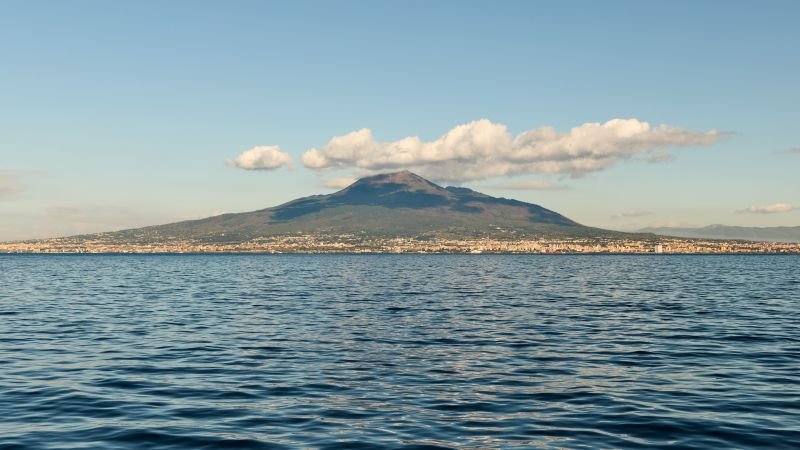
Pompeii is often thought of as an undisturbed time capsule, a once-bustling port that fell silent after Mount Vesuvius erupted and blanketed the ancient Roman city with a thick layer of ash in AD 79.
“It is such a great persistent narrative,” Dr. Steven Tuck, professor and head of classics at Miami University in Oxford, Ohio, told CNN. “You walk around Pompeii, and you’re pretty much hit with that story: Everybody dies, everything’s wiped out.”
But Tuck’s visits to Pompeii over the years revealed what he calls “evidence via absence,” or clues from items missing that fateful day, such as empty household shrines and stables.
“When you look more closely, you realize that there’s a lot of stuff missing that should be there,” Tuck said. “There are no boats tied up on the dock and all of the strong boxes where people kept their cash in in the Roman world, they’re all empty. Eventually, it occurred to me that this doesn’t jibe with that story that everybody died.”
For the past decade, Tuck has worked on the Pompeii Survivors Project, an exhaustive search for those who managed to flee before Pompeii and nearby Herculaneum were destroyed. His findings were published in the 2025 book “Escape From Pompeii: The Great Eruption of Mount Vesuvius and its Survivors.”
He scoured online databases that international teams of scholars created to search for Latin inscriptions of names from both cities, which were chiseled into stone plaques nearly 2,000 years ago. Tuck then traced the names to see whether their stories ended on the day of the eruption.
The journeys of three of the people Tuck pursued dominate the new docuseries “Pompeii: Out of Time,” executive produced and hosted by actor Tom Hiddleston, who studied classics at the UK’s University of Cambridge and first visited the city in 1998 as a 17-year-old fascinated by history.
The series premieres Wednesday on National Geographic and will begin streaming Thursday on Disney+ and Hulu.
The docudrama blends dramatic reenactments and investigative research to take viewers inside the lives of a teenage blacksmith apprentice, a businesswoman and a Praetorian Guard on the day of the eruption — all with a timer running in the background, a countdown clock that reveals the ultimate fate of each person.
“What is so remarkable about the story of Pompeii is that we have the privilege of access to the breadth and diversity of detail about their ordinary lives,” Hiddleston said. “Pompeii is a living monument to the past. You can reach across time and feel connected to a thread of human history.”
Ongoing research at Pompeii, including projects led by experts such as Tuck featured in the series, are shedding light on previously hidden aspects of daily life for the city’s residents before and after the devastation.
The findings showcase that as the narrative changes, it becomes a deeper and more layered look at human courage and resilience in the face of an unexpected natural disaster.
At the beginning of “Pompeii: Out of Time,” an earthquake rumbles through the city, but people carry on with their daily lives, not seeming to think much of the disturbance.
“There wasn’t the awareness of the relationship between those earthquakes and what was to come later,” Christopher Jackson, geologist and visiting professor in the department of Earth science and engineering at Imperial College London, told CNN. In the series, Jackson takes Hiddleston through the stages of the eruption.
Earthquakes occurred for four days before the eruption. A series of tremors 17 years earlier had damaged buildings and water infrastructure in the city. They were still under repair when Mount Vesuvius erupted, Jackson said.
“People didn’t really probably know they were living in the shadow of an active volcano because it hadn’t erupted in their lifetimes,” Jackson said.
Roman lawyer and author Pliny the Younger witnessed the destruction across the Bay of Naples, recording what is believed to be one of the first written accounts of a volcanic eruption. His uncle Pliny the Elder was a naval and army commander of the Roman Empire who died trying to rescue people across the bay from the devastation.
Scientists such as Jackson have compared Pliny the Younger’s account with the geological record preserved at Vesuvius, using his detailed chronicle to help reconstruct the volcano’s activity.
The eruption unfolded in five phases over about 24 hours, a harrowing, cumulative ordeal for unsuspecting residents.
“The pyroclastic flows, these hot, fast, dense, gassy flows that cascaded down the sides of Vesuvius into Pompeii and Herculaneum, led to a significant amount of people dying very, very quickly,” Jackson said. “Ahead of those flows, it was the drip, drip, drip of the ash coming out from the eruption column, which led to the collapse of roofs.”
Scientists still consider Mount Vesuvius an active volcano — it last erupted in 1944. Experts believe the volcano is currently in a quiescent state, but researchers monitor it around the clock. Sulfurous steam curls inside the main crater.
“You suddenly feel dwarfed by the scale of the volcano because it’s indescribably large,” Jackson said of his experience climbing to the top. “And then when you look down towards Pompeii and Herculaneum, what struck me is how far away they are. That just shows you the force of nature associated with these volcanic eruptions.”
Tracing names from about 20,000 inscriptions led Tuck along the journey of survivors to 48 Roman cities.
Survivors stayed within about 20 miles (32 kilometers) of Pompeii and Herculaneum, seeking out communities that felt similar. Many were freed slaves and members of the merchant class.
But there are key differences between the survivors, Tuck noted. Residents from Herculaneum stayed closer to the edges of destruction. These individuals were poorer and intermarried within their own refugee community.
Tuck was able to reconstruct the story of a woman who lost her husband but managed to escape Pompeii with her infant daughter. They reached Ostia, the port city of ancient Rome, where she remarried a physician of the emperor. The professor also found evidence that her daughter later married and had children.
“The people from Pompeii spread out more,” Tuck said. “They seem to have had better assets and better networking. They rebuild businesses. Their kids run for public office. They make religious dedications for deities that there’s no evidence they worshipped in Pompeii. They really seem to adapt to their new communities.”
Tuck said he believes residents of Herculaneum remained close by because they came from a smaller, more insular community, whereas Pompeians were more connected to the larger ancient Roman world and boasted a diverse population of foreigners.
Working on the survivor project, which enabled Tuck to follow some family trees for a couple hundred years, has changed how he perceives the story of Pompeii.
“It shifts the narrative to one of survival, of hope, of something that’s a really different human-centered story that continues on,” he said.
Part of the allure of discoveries at Pompeii have been the impressive homes, covered in colorful murals, of the city’s elite. But new research is shedding light on what life was like for middle- and lower-class residents.
“One of the things I liked about the docuseries is that they really want to place an emphasis on everyday life and on real people’s experiences,” said Caitie Barrett, an archaeologist and professor in the department of classics at Cornell University in Ithaca, New York. Barrett is one of the scientists featured in the series.
Barrett is codirecting an excavation project at Pompeii that explores a larger elite house and an adjacent smaller dwelling to understand how the relationships between the people in both households changed over time.
“Most of the people who were active there were not the wealthy homeowners, they were the enslaved people who were made to work for them,” Barrett said. “That gives us an opportunity to try to understand what their lives and experiences were like, and not just the posh owners of the place.”
The team is excavating the latrines of both homes to uncover new evidence about health, diet, household labor and sanitation — and finding some surprises along the way, such as bone hairpins and a plethora of little glass bottles that once held liquids.
“It’s not uncommon to find trash inside cesspits, but why were they getting rid of these little glass bottles?” Barrett asked. “Is this the ancient equivalent of flushing your medications down the toilet?”
Analysis of residue inside the bottles in the future could one day tell the tale.
Tuck is focusing on wall paintings the middle class had inside smaller houses and how the subject matter differed from murals inside elite homes.
“They’re not just living their lives trying to emulate the very rich, they have their own culture, and I think it’s worthwhile trying to define that,” Tuck said.
Hiddleston said he was struck by the details of everyday life that remain preserved in Herculaneum and Pompeii: bread left baking in the oven, baby cradles that resemble modern ones, mosaics and frescoes that reveal what people ate and whom they worshipped, and even graffiti from little children showcasing gladiators in combat.
“I spent years making this series, and I feel that I’m only just beginning to understand Pompeii,” Hiddleston said. “We pick three ordinary lives to follow. There’s still more town to discover, more frescoes, more mosaics, more houses, more villas. Our relationship with the past is an endlessly evolving mystery, and I don’t think we’ll solve it anytime soon.”
Sign up for CNN’s Wonder Theory science newsletter. Explore the universe with news on fascinating discoveries, scientific advancements and more.





Responses