
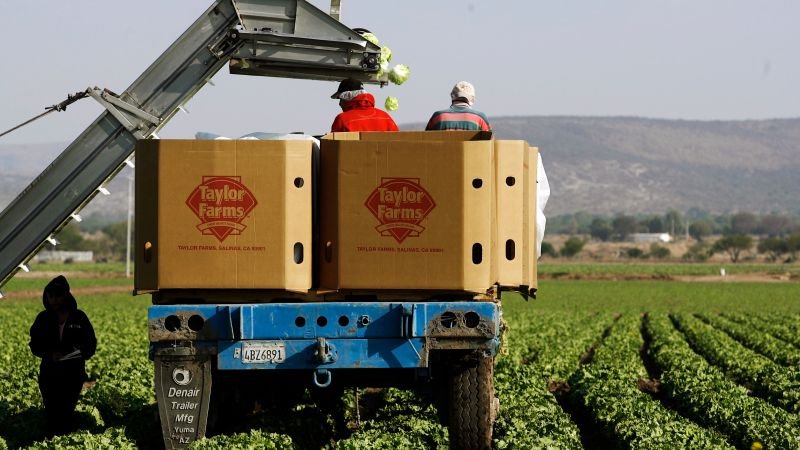
Health officials investigating the large outbreak of diarrhea caused by the parasite cyclospora say they have “very strong” evidence that shredded iceberg lettuce supplied by Taylor Farms is the likely source, despite a false positive test for the parasite over the weekend.
“FDA’s traceback investigation and outbreak data continue to converge on shredded iceberg lettuce from Taylor Farms locations in Central Mexico,” the US Food and Drug Administration said in a statement Monday.
“Protecting the American public remains our highest priority. We encourage the public to continue to avoid all products listed in Taylor Farms voluntary recall.”
On Sunday, Taylor Farms recalled iceberg lettuce shipped to 27 states.
Taylor Farms is a major produce supplier in the US, selling lettuce and bagged salad kits under several private store labels. However, the company did not mention specific retailers, restaurants or product names in its recall notice.
Taco Bell has also removed affected shredded iceberg lettuce supplied by Taylor Farms from its restaurants in five states amid the outbreak.
The FDA reported Saturday that a Taylor Farms lettuce sample had tested positive for cyclospora, but a follow-up from the agency Sunday said the test “should be considered a false positive.”
Taylor Farms said Monday that “FDA apologized to us” for the false positive.
“To be clear, at this moment, FDA has not identified a single positive product test result for Cyclospora,” the company’s statement said.
The FDA made its own clarification Monday.
“To clarify, this false-positive lab sample DOES NOT change the basis for FDA’s ongoing outbreak investigation or the overwhelming epidemiological data supporting the current voluntary recall by Taylor Farms,” it said.
Health officials said they did not offer Taylor Farms an official apology.
Frank Yiannas, former deputy commissioner of food policy and reponse at the FDA, called the false positive result “unfortunate – and consequential.”
He said he could see why the average consumer might assume that because the laboratory result was determined to be a false positive, the recall itself was unnecessary.
“That not what this means,” Yiannas said in a statement.
Because it’s so difficult to find cyclospora on produce, he said, “epidemiological evidence alone can, in some circumstances, provide sufficient justification for public health action.”
“FDA deserves credit for its transparency in promptly communicating the laboratory error,” Yiannas added. “However, transparency alone is not enough. It is equally important that the agency determine the root cause of the laboratory or quality control failure, implement appropriate corrective actions, and share the lessons learned with both the public and the regulated industry.”
In a media briefing Monday, FDA officials said that finding and tracing cyclospora in fresh produce has always been challenging. Because it can take a week or longer for people to develop symptoms, the produce item that made them sick could be past its shelf life.
“Given that time, as well as the need to do epidemiology, all of the potentially contaminated product could have already been discarded or consumed,” an FDA official said.
“And so it is a little bit of a chasing game when it comes to testing. But the data from an epidemiology and trace back standpoint, we believe, is very strong.”
The evidence that led to the recall comes from interviews with people who tested positive for cyclospora and were confirmed to be part of the same cluster of illnesses.
As of Monday, more than 8,000 cyclosporiasis cases have been reported in the outbreak that includes Michigan, Ohio, Indiana, Kentucky and West Virginia. If all the cases are confirmed to be related, the outbreak will be the largest foodborne illness outbreak since the US began tracking them.
Michigan alone accounts for the majority of cases, with more than 6,100 reported as of Monday.
“Based on interviews with 2,025 individuals affected by cyclosporiasis in Michigan, many did not report eating lettuce at a restaurant chain or other food establishment, However, lettuce still appeared frequently in food questionnaires, including those without restaurant or fast-food exposure,” Laina Stebbins, spokesperson for the Michigan Department of Health and Human Services, said in a statement.
Stebbins said Michigan health officials haven’t changed their recommendations as a result of the false positive test.
“MDHHS continues to recommend Michigan residents purchase whole heads of lettuce instead of pre-washed, bagged lettuce or pre-mixed salad kits and follow safety guidance provided by the department,” she added.
Not all the cyclosporiasis cases around the country are part of the outbreak in the Midwest. The FDA says it has investigated five subclusters of cyclospora since the season started in May.
Three of those investigations are considered to be over, FDA Acting Commissioner Kyle Diamantas said Monday.
According to the US Centers for Disease Control and Prevention, symptoms of cyclosporiasis can start between two days and two weeks after consuming contaminated food or water.
Symptoms include:
watery diarrhea
loss of appetite
weight loss
cramping
bloating and increased gas
nausea
fatigue





Responses