
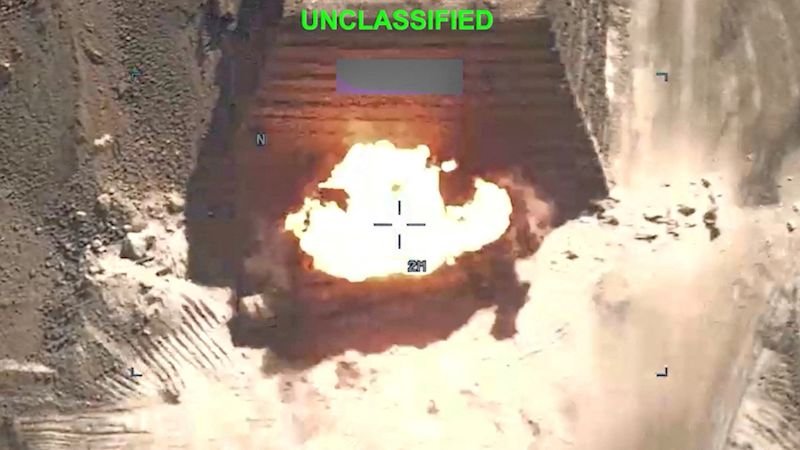
• Hegseth testifies: US Defense Secretary Pete Hegseth is appearing now before lawmakers in Congress. Nearly 100 US service members have suffered some level of injury since July 7, according to the Pentagon, which has been slow to disclose nonfatal attacks.
• Trump’s warning: US President Donald Trump said the US will hit the area of Pickaxe Mountain — a fortified underground facility believed to be connected to Iran’s nuclear program — “probably pretty soon.”
• Widening conflict: Kuwait, Bahrain and Jordan say they intercepted aerial attacks today. Meanwhile, Iranian-backed Houthi forces in Yemen have warned Saudi vessels to refrain from using the Red Sea, a move that Trump has downplayed.
• On Lebanon: Trump said he and Lebanese President Joseph Aoun, who is at the White House today, will discuss “concrete plans” for the US to help Lebanon oust Iranian-backed Hezbollah from parts of the south. Israel began partially withdrawing forces from southern Lebanon under a US-brokered ceasefire agreement.
34 Posts
US Defense Secretary Pete Hegseth is appearing before a key Senate panel for the first time since the US-Iran conflict re-escalated this month.
Hegseth is expected to face questions from lawmakers about the latest reporting this week that the Pentagon has been slow to disclose injuries to US troops during the ongoing war with Iran.
Nearly 100 US service members have suffered some level of injury since July 7, according to the Pentagon.
The public hearing before the Senate Appropriations Committee is to consider a supplemental funding request, at a time when the Trump administration has been lobbying members of Congress for tens of billions of dollars to fund the ongoing war with Iran.
US Defense Secretary Pete Hegseth is set to face lawmakers on Capitol Hill this afternoon, as President Donald Trump previewed strikes on a fortified underground facility believed to be connected to Iran’s nuclear program.
It comes amid heightened tension in the region and a widening conflict, with Kuwait, Bahrain and Jordan saying they again intercepted aerial attacks. Iranian-backed Houthi forces in Yemen have also warned of a blockade in the Red Sea.
Here’s the latest:
Trump said that the US will be “hitting” Iran’s Pickaxe Mountain “pretty soon.” The fortified underground facility was declared to the UN’s International Atomic Energy Agency in 2020 as a future facility to assemble the centrifuges that make nuclear fuel.
Israel believes that Iran moved advanced centrifuges and part of its stockpile of highly enriched uranium to Pickaxe Mountain, according to an Israeli source familiar with the matter. When asked if he believes that Iran has moved nuclear centrifuges into the site, Trump said “we don’t have it on record.”
Iran targeted several water desalination and power plants in Kuwait last night, the Kuwaiti government said in a statement. In nearby Bahrain, sirens were sounded warning residents of an Iranian attack, and Jordan’s armed forces said air defense systems intercepted and shot down three Iranian missiles targeting the kingdom on Tuesday.
Houthi forces in Yemen declared a maritime blockade on Saudi shipping in the Red Sea. The group broadcasted a message to Saudi vessels, telling them to refrain from using the waterway. The blockade exacerbating global energy supply concerns amid renewed attacks on tankers in the Strait of Hormuz.
Trump has downplayed the threat of a Houthi blockade of the Red Sea, telling reporters that “if there is something like that, we’ll just have to take care of business.” He declined to detail how the US would respond if the Houthis sought to close off the waterway.
In the meantime, Trump said he would discuss “concrete plans” for the US to help Lebanon oust Iran-backed Hezbollah with Lebanese President Joseph Aoun. The two met at the White House today. Trump also said the Israeli Defense Forces are “in the process” of withdrawing from Lebanon.
Hegseth is scheduled to appear before the Senate Appropriations Committee at 2:30 p.m. ET. The Trump administration has been lobbying members of Congress for tens of billions of dollars to fund the ongoing war with Iran.
CNN’s Jedd Rosche, Catherine Nicholls, Tal Shalev, Hanna Ziady, Eleni Giokos, Aileen Graef, Adam Cancryn, Tim Lister and Mostafa Salem contributed reporting to this post.
Two Lebanese Red Cross paramedics were injured and an ambulance was damaged when a land mine exploded Tuesday in southern Lebanon.
The first responders had coordinated with authorities to ensure safe access to the eastern Zawtar area and were helping to look for a missing person when the explosion occurred.
The Lebanese Red Cross said it is coordinating with Lebanon’s army and other authorities to secure the area, which has been seeded with mines and unexploded “remnants of war,” to ensure the paramedics can safely be reached and evacuated from the area.
The Israeli military said it has heard about the incident and is looking into it.
The explosion happened as Israel was starting to withdraw from parts of southern Lebanon under a US-brokered deal, clearing the way for the Lebanese army to take over.
US House Speaker Mike Johnson said Tuesday he does not believe Congress must vote to authorize the war in Iran, telling reporters the focus is on bringing the monthslong conflict to a “resolution.”
The Louisiana Republican called the recent deaths of US service members a “great tragedy,” reiterating that the administration was “working around the clock to resolve” the conflict “in a way so they don’t suffer any more troop losses.”
Johnson has long insisted that Congress should give the Trump administration wide latitude in its handling of the conflict and its negotiations with the regime’s leaders. He has also resisted labeling it a war, and in March said he believed US operations in Iran would wrap up in “a short time period.”
Pressed by CNN’s Lauren Fox today on those statements, the speaker said the “problem” was Tehran.
“Look, the Iranians are not to be trusted. That’s the problem,” he told Fox. “Every time we think we get to some resolution on this, they violate the confidence of the people on the other side of the table, and they do it almost instantaneously. That’s why we’re so frustrated.”
Israeli forces fired near Lebanese army units in southern Lebanon in what the latter said could hinder the implementation of the crucial first steps of a US-brokered ceasefire deal.
The ceasefire between Israel and Lebanon signed last month aims to transfer control of territory in southern Lebanon from the Israel Defense Forces (IDF) to the Lebanese military. This gradual process starts with Israeli withdrawal from several “pilot zones” near the so-called “Yellow Line,” which demarcates the area occupied by the Israeli military.
The Lebanese army said Tuesday that it was deploying to Zawtar al-Gharbiya, a town in the country’s south, when the IDF approached the outskirts and “opened fire near the units.” Lebanon’s army said such actions “could obstruct the implementation of deployment measures in the pilot areas.”
The IDF said Lebanese forces entered the nearby town of Zawtar al-Sharqiyah, which it said is not part of the pilot area. The Lebanese army denies entering the town. Israeli forces fired warning shots into the air, and Lebanese units withdrew with no injuries reported, according to the IDF.
The US-brokered agreement is ultimately intended to end the fighting in southern Lebanon and lead to a broader peace agreement between the two neighboring countries. Israel has been in conflict with Hezbollah, an Iranian-backed Lebanese militant group, since early-March.
CNN’s Charbel Mallo contributed to this post.
Bulgaria’s parliamentary Defense Committee approved a government proposal on Tuesday to allow the temporary deployment of US aerial refueling tanker aircraft and American military personnel at Bezmer Air Base, a move that drew a sharp warning from Iran against facilitating US military operations.
The committee backed a Council of Ministers draft decision permitting up to eight US tanker aircraft and 250 US military personnel to be stationed at the air base in southeastern Bulgaria in support of operations in the Middle East, the official Bulgarian News Agency said.
The United States requested the deployment from July 24 to October 1, the agency added.
The US Central Command, in response to a CNN question about the matter, said: “For operational security reasons, we do not discuss troop movements or speculate on future force posture.”
Tehran promptly warned Bulgaria against allowing its territory or facilities to be used in support of US military action against Iran.
Iranian Foreign Ministry spokesman Esmaeil Baghaei said any participation in the planning or execution of such operations would amount to complicity in “the crime of aggression and war crimes.” He urged Bulgaria’s full parliament to reject the deployment.
Under a 2006 bilateral Defense Cooperation Agreement, Bulgaria, a NATO ally, has designated Bezmer Air Base as a joint-use facility with the US military.
Mohammad Toutounchi, the Iranian ambassador to Kuwait, was formally summoned on Tuesday by the Kuwaiti government after it said an attack on one of its oil tankers led to injuries.
“[Toutounchi] has been handed a memorandum of protest after Iran targeted Kuwaiti tanker ‘Kifan’ Monday evening while it was crossing through the Strait of Hormuz. This has led to a number of its crew members sustaining injuries,” the Kuwaiti Ministry of Foreign Affairs announced in an Arabic-language post on X.
The post also said that in his meeting with Toutounchi, Kuwaiti Deputy Foreign Minister Hamad Suleiman Mashaan al-Mashaan condemned “iniquitous” Iranian attacks on the country since the start of the US-Iran war in late February.
Remember: Kuwait, a key US ally that hosts several American military installations, has been on the receiving end on Iranian retaliation for US attacks.
The act of summoning a country’s ambassador is a diplomatic mechanism often employed to convey extreme displeasure or protest. It generally involves a formal delivery of specific grievances that the ambassador is expected to convey to their government.
President Donald Trump downplayed the impact of looming midterm elections and renewed hostilities with Iran on his decision making.
Asked if he believes Tehran is trying to affect the midterm elections by threatening access to the Strait of Hormuz, Trump told reporters, “They won’t have any impact on me. I’m just going to do the right thing.”
He added: “I don’t view it as ‘Gee we’re having an election in a period of time.’ … No, the election — I can’t think about that having to do with this.”
The president went on to argue that “people are very impressed” with his overseas ventures, talking at length about his operation in Venezuela earlier this year.
US President Donald Trump has just said that the US will be “hitting” Iran’s Pickaxe Mountain “pretty soon.”
The fortified underground facility is located about a mile south of Natanz in central Iran and was declared to the UN’s International Atomic Energy Agency in 2020 as a future facility to assemble the centrifuges that make nuclear fuel.
When asked if he believes that Iran has moved nuclear centrifuges into the site, Trump said “we don’t have it on record.”
“It doesn’t mean anything unless they have the material. They don’t have — we follow the material, that’s where the action is,” the president said.
Trump made a similar comment last week, when he told conservative radio host Hugh Hewitt that his country would “probably give Pickaxe a shot relatively soon.”
CNN reported earlier Tuesday that Israel believes Iran moved advanced centrifuges and part of its stockpile of highly enriched uranium to the site after the 12-day war last June, according to an Israeli source familiar with the matter.
Lebanese President Joseph Aoun met US President Donald Trump at the White House today, marking the first visit by a Lebanese president to the Oval Office in nearly 20 years.
In the meeting, Aoun thanked Trump for his “historic” achievement of brokering a trilateral deal among Israel, Lebanon and the US, saying its “ultimate objective” is to end “the state of hostility between Lebanon and Israel forever.”
Under the deal, Israel will withdraw from two areas in southern Lebanon, transferring the sites to the Lebanese military.
Israel has been waging a sustained war against the Iranian-backed Lebanese Shiite militant group Hezbollah.
Israeli attacks on the group in Lebanon have complicated efforts to secure a lasting peace agreement between the US and Iran, a Shiite theocracy.
Aoun said Lebanon’s speaker of parliament, Nabih Berri, “is supportive of what we are doing.” Berri heads the Shiite Amal party, which is allied with Hezbollah.
“The framework doesn’t require the endorsement of parliament — that is the prerogative of the president,” Aoun said.
Aoun added that Berri “wants to see the end of the war” and is “supportive of ending the state of hostility, ending the war once for all.”
US President Donald Trump said he and Lebanese President Joseph Aoun would be discussing “concrete plans” for the US to help Lebanon oust Hezbollah.
Trump also said the Israeli Defense Forces are “in the process” of withdrawing from Lebanon.
“That was a great agreement they signed with Lebanon,” he said, adding they are “redeploying.”
Trump said he would be willing to speak with Hezbollah.
“I would speak to Hezbollah. I speak to everybody,” he said, adding if Aoun asked him to speak to Hezbollah, he would.
President Donald Trump on Tuesday shrugged off the threat of the Iran-backed Houthis blockading the Red Sea, telling reporters that “if there is something like that, we’ll just have to take care of business.”
“So far, it hasn’t happened. Might happen, but we take care of things,” he said from the Oval Office. “We’ve done that with the Houthis before and we haven’t heard from them in a while since we did what we did originally.”
A naval blockade of the Red Sea could open up a new front in the US’ war with Iran, further squeezing the flow of oil out of the Middle East.
Houthi forces in Yemen warned Saudi vessels to refrain from using the Red Sea, in a message broadcast on Monday to shipping in the vital waterway. That’s already impacting shipping and leaving corporations anxious, a risk manager for a Fortune 500 company told CNN earlier Tuesday.
Trump declined to detail how the US would respond if the Houthis sought to close off the waterway, instead pointing to previous strikes on the group.
“It was about 45 days of very powerful action we took against the Houthis, and we’ve had no problem with the Houthis,” he said. “They’ve had no problem with us for a long period of time, including during this conflict.”
The blockade of Saudi Arabia-linked shipping announced Monday by Iranian-backed Houthi authorities is already impacting shipping and leaving corporations anxious, a risk manager for a Fortune 500 company told CNN.
The risk manager, who requested anonymity to discuss sensitive business interests, said that a tanker that recently departed the western Saudi port of Yanbu carrying oil to China turned back at the Yemen border under Houthi threats.
The blockade’s “initial effects seem to be … giving pause to the alternative shipping arrangements the Saudis have made with the (Persian) Gulf shut,” the source said.
While the US and Iran have engaged in fighting around the Strait of Hormuz that leads into the Persian Gulf, slowing shipping to a trickle, the Bab-el-Mandeb strait leading to the Red Sea had remained open during the conflict. Sources previously told CNN that Iran had been plotting to push the Houthis to threaten Bab-el-Mandeb as a “nuclear option” to strengthen Iran’s hand against the US.
“We are anxious for stability,” the risk manager said, “and any new escalations that may extend or broaden the conflict are concerns for us and global trade in general.”
CNN’s Zachary Cohen contributed to this story.
The militaries of both Kuwait and Bahrain say they are intercepting attacks.
“Iran continues its systematic hostile approach through its criminal attacks targeting civilians in the Kingdom of Bahrain,” the General Command of the Bahrain Defense Force said Tuesday.
“Bahrain Defense Force’s air defense systems confronted, intercepted and destroyed a number of treacherous Iranian aerial attacks today,” it said.
In an alert, Kuwait’s military said it was “currently responding to hostile missile and drone threats,” though it did not say where these attacks originated.
The US launched a tenth consecutive night of strikes at Iran overnight, as the conflict in the region escalates further.
People in Tehran have been speaking to the Iranian news agency WANA about the latest attacks, giving differing responses about the need for both diplomacy and continued fighting.
“But in my view, if we are going to fight, although this war is very difficult, we can no longer easily repair the damage. Anything that is destroyed cannot simply be rebuilt.”
Israel believes that Iran moved advanced centrifuges and part of its stockpile of highly enriched uranium to a fortified underground facility south of Tehran after the 12-day war last June, according to an Israeli source familiar with the matter.
Israeli intelligence had been monitoring the site, known as Pickaxe Mountain, for months or more because it was one of Iran’s key nuclear facilities. The hardened facility deep underground made it a difficult target for the US and Israel, and its location in the center of the country made a ground operation incredibly challenging.
CNN previously reported that Iran had dramatically escalated efforts to seal off its cache of near bomb-grade uranium, deliberately collapsing tunnels and booby-trapping entrances with explosive mines. Iran has approximately 440 kilograms of highly enriched uranium, and the removal of the uranium remains one of the key war goals for both Israel and the United States. Israel assesses that Tehran moved a portion of that uranium to Pickaxe Mountain.
The Wall Street Journal was first to report on the Israeli assessment.
Construction and activity at the site increased after the 12-day war between Israel and Iran in June 2025, the Israeli source said. Near the end of that war, the US carried out strikes on three Iranian nuclear facilities – Fordow, Natanz, and Isfahan – but it did not strike Pickaxe Mountain.
In December, a senior Israeli official told CNN, “There are constant signals, statements and messages indicating that Iran is rearming and boosting its capabilities and preparing for an attack.”
Iran targeted several water desalination and power plants in Kuwait last night, the Kuwaiti government said in a statement, in the fourth consecutive day of attacks on key infrastructure in the Arab country.
Fires that broke out in some of these facilities following the attack have since been controlled, Kuwait’s Ministry of Electricity, Water and Renewable Energy said in a statement today, and several generators were “taken out of service.”
Kuwait has accused Iran of targeting its power and desalination plants several times over the past week. Desalination accounts for around 90% of freshwater needs in the oil-rich nation.
In nearby Bahrain, sirens were sounded warning residents of an Iranian attack and calling for people to head to the nearest safe place. It’s unclear what damaged was caused after the attack.
Jordan’s armed forces said air defense systems intercepted and shot down three Iranian missiles targeting the kingdom on Tuesday. The three countries have been some of the countries most frequently targeted by Iran since hostilities resumed between Tehran and Washington this month.
Iranian-backed Houthi forces in Yemen have warned Saudi vessels to refrain from using the Red Sea, in a message broadcast to shipping in the vital waterway.
The message, broadcast on FM radio and obtained by CNN, said that because of the “constant siege (of) the Yemeni nation … we warn all ships belonging (to) the Saudi enemy to proceed via [indistinct] and the Gulf of Aden.”
The 29-second message in English concludes: “In case of noncompliance of Yemeni armed forces’ decision, those ships will be in our target.”
The Houthis announced the maritime blockade on Monday.
Saudi Arabia’s cabinet on Tuesday condemned the Houthis’ “baseless claims and false accusations” and denounced Iranian attacks on Kuwait, Bahrain and Jordan, while calling for an immediate halt to military escalation across the region.
In a statement, the cabinet reiterated the kingdom’s support for Yemen and its internationally recognized government, which opposes the Houthis, and said Saudi Arabia would act to protect its own interests at sea.
The warning marks “a significant escalation of the regional maritime threat environment, expanding the confrontation from aviation and political pressure into the maritime domain,” according to Marisks, a Greek maritime security agency.
“Should the Houthis decide to enforce the embargo militarily, the most likely initial targets will be vessels directly owned, operated or controlled by Saudi interests,” Marisks said.
Reuters reported Tuesday that the Houthis also sent an email to shipping companies, warning them not to load or discharge cargo at Saudi ports. The message said this could make the ships targets “in any location.”
Some context: The Red Sea has become an important outlet for Saudi oil via the port of Yanbu since the Strait of Hormuz was effectively closed as a result of the conflict between Iran and the United States. More than 4 million barrels of crude a day left Yanbu last month.
There were 209 verified crossings of the Bab el-Mandeb chokepoint at the southern end of the Red Sea between July 15 and 19, according to maritime intelligence group Kpler. The Houthis have previously attacked ships in the area.
Kpler said 85 crude and product tankers are actively operating inside the Red Sea.
Bab el-Mandeb links Europe and Asia through one of the world’s busiest shipping routes. Nearly 15% of global maritime trade passes through the strait. Previous disruptions to shipping between 2023 and 2025 cost around $20 billion a year, according to industry estimates.
This post has been updated with additional information.
The Pentagon has identified today a US solider who was killed in action in Iraq.
Sgt. Michael Emmanuel Swinton was killed during a “controlled detonation” of a one-way Iranian drone system on July 19 in Iraq. Swinton was from Fayetteville, North Carolina.
“Sgt. Michael Emmanuel Swinton, 30, of Fayetteville, North Carolina, was killed in action during a controlled detonation of a downed One-Way Unmanned Aerial System on July 19, 2026, at Erbil Air Base, Iraq. The incident is under investigation,” the Department of Defense said in a statement.
US Central Command had announced earlier that two US soldiers were killed in Iranian strikes on Jordan and that separately, a US service member was killed in northern Iraq “during a controlled detonation of unexploded ordnance from a downed Iranian one-way attack drone.”
Oil prices are rising after the Iran-backed Houthi group in Yemen declared a maritime blockade on Saudi shipping, exacerbating global energy supply concerns amid renewed attacks on tankers in the Strait of Hormuz.
Brent crude, the global oil benchmark, ticked up 1.8% to $90.85 a barrel shortly before 8.00 a.m. ET. WTI, the US benchmark, climbed by a similar margin to $83.97 a barrel. Brent has now risen by almost $20 a barrel this month, as fighting between the United States and Iran ramps up again.
Oil prices were rising even before the Houthi rebels threatened Saudi Arabia’s Red Sea exports, a lifeline for the global oil market, via a blockade of the Bab al-Mandeb Strait, a chokepoint at the southern end of the Red Sea.
Saudi Arabia has increased exports from its Yanbu port in the Red Sea to 4 million barrels per day, seeking to bypass Hormuz, according to consultancy Rystad Energy.
The firm’s vessel tracking data “indicates that approximately 2.5 million barrels per day of these volumes are currently moving south through (Bab al-Mandeb), leaving a critical alternative export route directly exposed to potential Houthi action,” senior vice president Jorge León wrote in a note.
In late 2023, the Houthis caused severe disruption to container shipping in the Red Sea, in retaliation for Israel’s military campaign against Hamas. Container shipping volumes have still not returned in full to the waterway.
Meanwhile, the International Energy Agency warned Tuesday that global energy security would deteriorate further unless the Strait of Hormuz reopened. “There is no room for complacency on oil security amid the escalation in hostilities and a continued drawdown of available commercial inventories,” IEA Executive Director Fatih Birol said in a statement.
• Hegseth testifies: US Defense Secretary Pete Hegseth is appearing now before lawmakers in Congress. Nearly 100 US service members have suffered some level of injury since July 7, according to the Pentagon, which has been slow to disclose nonfatal attacks.
• Trump’s warning: US President Donald Trump said the US will hit the area of Pickaxe Mountain — a fortified underground facility believed to be connected to Iran’s nuclear program — “probably pretty soon.”
• Widening conflict: Kuwait, Bahrain and Jordan say they intercepted aerial attacks today. Meanwhile, Iranian-backed Houthi forces in Yemen have warned Saudi vessels to refrain from using the Red Sea, a move that Trump has downplayed.
• On Lebanon: Trump said he and Lebanese President Joseph Aoun, who is at the White House today, will discuss “concrete plans” for the US to help Lebanon oust Iranian-backed Hezbollah from parts of the south. Israel began partially withdrawing forces from southern Lebanon under a US-brokered ceasefire agreement.
US Defense Secretary Pete Hegseth is appearing before a key Senate panel for the first time since the US-Iran conflict re-escalated this month.
Hegseth is expected to face questions from lawmakers about the latest reporting this week that the Pentagon has been slow to disclose injuries to US troops during the ongoing war with Iran.
Nearly 100 US service members have suffered some level of injury since July 7, according to the Pentagon.
The public hearing before the Senate Appropriations Committee is to consider a supplemental funding request, at a time when the Trump administration has been lobbying members of Congress for tens of billions of dollars to fund the ongoing war with Iran.
US Defense Secretary Pete Hegseth is set to face lawmakers on Capitol Hill this afternoon, as President Donald Trump previewed strikes on a fortified underground facility believed to be connected to Iran’s nuclear program.
It comes amid heightened tension in the region and a widening conflict, with Kuwait, Bahrain and Jordan saying they again intercepted aerial attacks. Iranian-backed Houthi forces in Yemen have also warned of a blockade in the Red Sea.
Here’s the latest:
Trump said that the US will be “hitting” Iran’s Pickaxe Mountain “pretty soon.” The fortified underground facility was declared to the UN’s International Atomic Energy Agency in 2020 as a future facility to assemble the centrifuges that make nuclear fuel.
Israel believes that Iran moved advanced centrifuges and part of its stockpile of highly enriched uranium to Pickaxe Mountain, according to an Israeli source familiar with the matter. When asked if he believes that Iran has moved nuclear centrifuges into the site, Trump said “we don’t have it on record.”
Iran targeted several water desalination and power plants in Kuwait last night, the Kuwaiti government said in a statement. In nearby Bahrain, sirens were sounded warning residents of an Iranian attack, and Jordan’s armed forces said air defense systems intercepted and shot down three Iranian missiles targeting the kingdom on Tuesday.
Houthi forces in Yemen declared a maritime blockade on Saudi shipping in the Red Sea. The group broadcasted a message to Saudi vessels, telling them to refrain from using the waterway. The blockade exacerbating global energy supply concerns amid renewed attacks on tankers in the Strait of Hormuz.
Trump has downplayed the threat of a Houthi blockade of the Red Sea, telling reporters that “if there is something like that, we’ll just have to take care of business.” He declined to detail how the US would respond if the Houthis sought to close off the waterway.
In the meantime, Trump said he would discuss “concrete plans” for the US to help Lebanon oust Iran-backed Hezbollah with Lebanese President Joseph Aoun. The two met at the White House today. Trump also said the Israeli Defense Forces are “in the process” of withdrawing from Lebanon.
Hegseth is scheduled to appear before the Senate Appropriations Committee at 2:30 p.m. ET. The Trump administration has been lobbying members of Congress for tens of billions of dollars to fund the ongoing war with Iran.
CNN’s Jedd Rosche, Catherine Nicholls, Tal Shalev, Hanna Ziady, Eleni Giokos, Aileen Graef, Adam Cancryn, Tim Lister and Mostafa Salem contributed reporting to this post.
Two Lebanese Red Cross paramedics were injured and an ambulance was damaged when a land mine exploded Tuesday in southern Lebanon.
The first responders had coordinated with authorities to ensure safe access to the eastern Zawtar area and were helping to look for a missing person when the explosion occurred.
The Lebanese Red Cross said it is coordinating with Lebanon’s army and other authorities to secure the area, which has been seeded with mines and unexploded “remnants of war,” to ensure the paramedics can safely be reached and evacuated from the area.
The Israeli military said it has heard about the incident and is looking into it.
The explosion happened as Israel was starting to withdraw from parts of southern Lebanon under a US-brokered deal, clearing the way for the Lebanese army to take over.
US House Speaker Mike Johnson said Tuesday he does not believe Congress must vote to authorize the war in Iran, telling reporters the focus is on bringing the monthslong conflict to a “resolution.”
The Louisiana Republican called the recent deaths of US service members a “great tragedy,” reiterating that the administration was “working around the clock to resolve” the conflict “in a way so they don’t suffer any more troop losses.”
Johnson has long insisted that Congress should give the Trump administration wide latitude in its handling of the conflict and its negotiations with the regime’s leaders. He has also resisted labeling it a war, and in March said he believed US operations in Iran would wrap up in “a short time period.”
Pressed by CNN’s Lauren Fox today on those statements, the speaker said the “problem” was Tehran.
“Look, the Iranians are not to be trusted. That’s the problem,” he told Fox. “Every time we think we get to some resolution on this, they violate the confidence of the people on the other side of the table, and they do it almost instantaneously. That’s why we’re so frustrated.”
Israeli forces fired near Lebanese army units in southern Lebanon in what the latter said could hinder the implementation of the crucial first steps of a US-brokered ceasefire deal.
The ceasefire between Israel and Lebanon signed last month aims to transfer control of territory in southern Lebanon from the Israel Defense Forces (IDF) to the Lebanese military. This gradual process starts with Israeli withdrawal from several “pilot zones” near the so-called “Yellow Line,” which demarcates the area occupied by the Israeli military.
The Lebanese army said Tuesday that it was deploying to Zawtar al-Gharbiya, a town in the country’s south, when the IDF approached the outskirts and “opened fire near the units.” Lebanon’s army said such actions “could obstruct the implementation of deployment measures in the pilot areas.”
The IDF said Lebanese forces entered the nearby town of Zawtar al-Sharqiyah, which it said is not part of the pilot area. The Lebanese army denies entering the town. Israeli forces fired warning shots into the air, and Lebanese units withdrew with no injuries reported, according to the IDF.
The US-brokered agreement is ultimately intended to end the fighting in southern Lebanon and lead to a broader peace agreement between the two neighboring countries. Israel has been in conflict with Hezbollah, an Iranian-backed Lebanese militant group, since early-March.
CNN’s Charbel Mallo contributed to this post.
Bulgaria’s parliamentary Defense Committee approved a government proposal on Tuesday to allow the temporary deployment of US aerial refueling tanker aircraft and American military personnel at Bezmer Air Base, a move that drew a sharp warning from Iran against facilitating US military operations.
The committee backed a Council of Ministers draft decision permitting up to eight US tanker aircraft and 250 US military personnel to be stationed at the air base in southeastern Bulgaria in support of operations in the Middle East, the official Bulgarian News Agency said.
The United States requested the deployment from July 24 to October 1, the agency added.
The US Central Command, in response to a CNN question about the matter, said: “For operational security reasons, we do not discuss troop movements or speculate on future force posture.”
Tehran promptly warned Bulgaria against allowing its territory or facilities to be used in support of US military action against Iran.
Iranian Foreign Ministry spokesman Esmaeil Baghaei said any participation in the planning or execution of such operations would amount to complicity in “the crime of aggression and war crimes.” He urged Bulgaria’s full parliament to reject the deployment.
Under a 2006 bilateral Defense Cooperation Agreement, Bulgaria, a NATO ally, has designated Bezmer Air Base as a joint-use facility with the US military.
Mohammad Toutounchi, the Iranian ambassador to Kuwait, was formally summoned on Tuesday by the Kuwaiti government after it said an attack on one of its oil tankers led to injuries.
“[Toutounchi] has been handed a memorandum of protest after Iran targeted Kuwaiti tanker ‘Kifan’ Monday evening while it was crossing through the Strait of Hormuz. This has led to a number of its crew members sustaining injuries,” the Kuwaiti Ministry of Foreign Affairs announced in an Arabic-language post on X.
The post also said that in his meeting with Toutounchi, Kuwaiti Deputy Foreign Minister Hamad Suleiman Mashaan al-Mashaan condemned “iniquitous” Iranian attacks on the country since the start of the US-Iran war in late February.
Remember: Kuwait, a key US ally that hosts several American military installations, has been on the receiving end on Iranian retaliation for US attacks.
The act of summoning a country’s ambassador is a diplomatic mechanism often employed to convey extreme displeasure or protest. It generally involves a formal delivery of specific grievances that the ambassador is expected to convey to their government.
President Donald Trump downplayed the impact of looming midterm elections and renewed hostilities with Iran on his decision making.
Asked if he believes Tehran is trying to affect the midterm elections by threatening access to the Strait of Hormuz, Trump told reporters, “They won’t have any impact on me. I’m just going to do the right thing.”
He added: “I don’t view it as ‘Gee we’re having an election in a period of time.’ … No, the election — I can’t think about that having to do with this.”
The president went on to argue that “people are very impressed” with his overseas ventures, talking at length about his operation in Venezuela earlier this year.
US President Donald Trump has just said that the US will be “hitting” Iran’s Pickaxe Mountain “pretty soon.”
The fortified underground facility is located about a mile south of Natanz in central Iran and was declared to the UN’s International Atomic Energy Agency in 2020 as a future facility to assemble the centrifuges that make nuclear fuel.
When asked if he believes that Iran has moved nuclear centrifuges into the site, Trump said “we don’t have it on record.”
“It doesn’t mean anything unless they have the material. They don’t have — we follow the material, that’s where the action is,” the president said.
Trump made a similar comment last week, when he told conservative radio host Hugh Hewitt that his country would “probably give Pickaxe a shot relatively soon.”
CNN reported earlier Tuesday that Israel believes Iran moved advanced centrifuges and part of its stockpile of highly enriched uranium to the site after the 12-day war last June, according to an Israeli source familiar with the matter.
Lebanese President Joseph Aoun met US President Donald Trump at the White House today, marking the first visit by a Lebanese president to the Oval Office in nearly 20 years.
In the meeting, Aoun thanked Trump for his “historic” achievement of brokering a trilateral deal among Israel, Lebanon and the US, saying its “ultimate objective” is to end “the state of hostility between Lebanon and Israel forever.”
Under the deal, Israel will withdraw from two areas in southern Lebanon, transferring the sites to the Lebanese military.
Israel has been waging a sustained war against the Iranian-backed Lebanese Shiite militant group Hezbollah.
Israeli attacks on the group in Lebanon have complicated efforts to secure a lasting peace agreement between the US and Iran, a Shiite theocracy.
Aoun said Lebanon’s speaker of parliament, Nabih Berri, “is supportive of what we are doing.” Berri heads the Shiite Amal party, which is allied with Hezbollah.
“The framework doesn’t require the endorsement of parliament — that is the prerogative of the president,” Aoun said.
Aoun added that Berri “wants to see the end of the war” and is “supportive of ending the state of hostility, ending the war once for all.”
US President Donald Trump said he and Lebanese President Joseph Aoun would be discussing “concrete plans” for the US to help Lebanon oust Hezbollah.
Trump also said the Israeli Defense Forces are “in the process” of withdrawing from Lebanon.
“That was a great agreement they signed with Lebanon,” he said, adding they are “redeploying.”
Trump said he would be willing to speak with Hezbollah.
“I would speak to Hezbollah. I speak to everybody,” he said, adding if Aoun asked him to speak to Hezbollah, he would.
President Donald Trump on Tuesday shrugged off the threat of the Iran-backed Houthis blockading the Red Sea, telling reporters that “if there is something like that, we’ll just have to take care of business.”
“So far, it hasn’t happened. Might happen, but we take care of things,” he said from the Oval Office. “We’ve done that with the Houthis before and we haven’t heard from them in a while since we did what we did originally.”
A naval blockade of the Red Sea could open up a new front in the US’ war with Iran, further squeezing the flow of oil out of the Middle East.
Houthi forces in Yemen warned Saudi vessels to refrain from using the Red Sea, in a message broadcast on Monday to shipping in the vital waterway. That’s already impacting shipping and leaving corporations anxious, a risk manager for a Fortune 500 company told CNN earlier Tuesday.
Trump declined to detail how the US would respond if the Houthis sought to close off the waterway, instead pointing to previous strikes on the group.
“It was about 45 days of very powerful action we took against the Houthis, and we’ve had no problem with the Houthis,” he said. “They’ve had no problem with us for a long period of time, including during this conflict.”
The blockade of Saudi Arabia-linked shipping announced Monday by Iranian-backed Houthi authorities is already impacting shipping and leaving corporations anxious, a risk manager for a Fortune 500 company told CNN.
The risk manager, who requested anonymity to discuss sensitive business interests, said that a tanker that recently departed the western Saudi port of Yanbu carrying oil to China turned back at the Yemen border under Houthi threats.
The blockade’s “initial effects seem to be … giving pause to the alternative shipping arrangements the Saudis have made with the (Persian) Gulf shut,” the source said.
While the US and Iran have engaged in fighting around the Strait of Hormuz that leads into the Persian Gulf, slowing shipping to a trickle, the Bab-el-Mandeb strait leading to the Red Sea had remained open during the conflict. Sources previously told CNN that Iran had been plotting to push the Houthis to threaten Bab-el-Mandeb as a “nuclear option” to strengthen Iran’s hand against the US.
“We are anxious for stability,” the risk manager said, “and any new escalations that may extend or broaden the conflict are concerns for us and global trade in general.”
CNN’s Zachary Cohen contributed to this story.
The militaries of both Kuwait and Bahrain say they are intercepting attacks.
“Iran continues its systematic hostile approach through its criminal attacks targeting civilians in the Kingdom of Bahrain,” the General Command of the Bahrain Defense Force said Tuesday.
“Bahrain Defense Force’s air defense systems confronted, intercepted and destroyed a number of treacherous Iranian aerial attacks today,” it said.
In an alert, Kuwait’s military said it was “currently responding to hostile missile and drone threats,” though it did not say where these attacks originated.
The US launched a tenth consecutive night of strikes at Iran overnight, as the conflict in the region escalates further.
People in Tehran have been speaking to the Iranian news agency WANA about the latest attacks, giving differing responses about the need for both diplomacy and continued fighting.
“But in my view, if we are going to fight, although this war is very difficult, we can no longer easily repair the damage. Anything that is destroyed cannot simply be rebuilt.”
Israel believes that Iran moved advanced centrifuges and part of its stockpile of highly enriched uranium to a fortified underground facility south of Tehran after the 12-day war last June, according to an Israeli source familiar with the matter.
Israeli intelligence had been monitoring the site, known as Pickaxe Mountain, for months or more because it was one of Iran’s key nuclear facilities. The hardened facility deep underground made it a difficult target for the US and Israel, and its location in the center of the country made a ground operation incredibly challenging.
CNN previously reported that Iran had dramatically escalated efforts to seal off its cache of near bomb-grade uranium, deliberately collapsing tunnels and booby-trapping entrances with explosive mines. Iran has approximately 440 kilograms of highly enriched uranium, and the removal of the uranium remains one of the key war goals for both Israel and the United States. Israel assesses that Tehran moved a portion of that uranium to Pickaxe Mountain.
The Wall Street Journal was first to report on the Israeli assessment.
Construction and activity at the site increased after the 12-day war between Israel and Iran in June 2025, the Israeli source said. Near the end of that war, the US carried out strikes on three Iranian nuclear facilities – Fordow, Natanz, and Isfahan – but it did not strike Pickaxe Mountain.
In December, a senior Israeli official told CNN, “There are constant signals, statements and messages indicating that Iran is rearming and boosting its capabilities and preparing for an attack.”
Iran targeted several water desalination and power plants in Kuwait last night, the Kuwaiti government said in a statement, in the fourth consecutive day of attacks on key infrastructure in the Arab country.
Fires that broke out in some of these facilities following the attack have since been controlled, Kuwait’s Ministry of Electricity, Water and Renewable Energy said in a statement today, and several generators were “taken out of service.”
Kuwait has accused Iran of targeting its power and desalination plants several times over the past week. Desalination accounts for around 90% of freshwater needs in the oil-rich nation.
In nearby Bahrain, sirens were sounded warning residents of an Iranian attack and calling for people to head to the nearest safe place. It’s unclear what damaged was caused after the attack.
Jordan’s armed forces said air defense systems intercepted and shot down three Iranian missiles targeting the kingdom on Tuesday. The three countries have been some of the countries most frequently targeted by Iran since hostilities resumed between Tehran and Washington this month.
Iranian-backed Houthi forces in Yemen have warned Saudi vessels to refrain from using the Red Sea, in a message broadcast to shipping in the vital waterway.
The message, broadcast on FM radio and obtained by CNN, said that because of the “constant siege (of) the Yemeni nation … we warn all ships belonging (to) the Saudi enemy to proceed via [indistinct] and the Gulf of Aden.”
The 29-second message in English concludes: “In case of noncompliance of Yemeni armed forces’ decision, those ships will be in our target.”
The Houthis announced the maritime blockade on Monday.
Saudi Arabia’s cabinet on Tuesday condemned the Houthis’ “baseless claims and false accusations” and denounced Iranian attacks on Kuwait, Bahrain and Jordan, while calling for an immediate halt to military escalation across the region.
In a statement, the cabinet reiterated the kingdom’s support for Yemen and its internationally recognized government, which opposes the Houthis, and said Saudi Arabia would act to protect its own interests at sea.
The warning marks “a significant escalation of the regional maritime threat environment, expanding the confrontation from aviation and political pressure into the maritime domain,” according to Marisks, a Greek maritime security agency.
“Should the Houthis decide to enforce the embargo militarily, the most likely initial targets will be vessels directly owned, operated or controlled by Saudi interests,” Marisks said.
Reuters reported Tuesday that the Houthis also sent an email to shipping companies, warning them not to load or discharge cargo at Saudi ports. The message said this could make the ships targets “in any location.”
Some context: The Red Sea has become an important outlet for Saudi oil via the port of Yanbu since the Strait of Hormuz was effectively closed as a result of the conflict between Iran and the United States. More than 4 million barrels of crude a day left Yanbu last month.
There were 209 verified crossings of the Bab el-Mandeb chokepoint at the southern end of the Red Sea between July 15 and 19, according to maritime intelligence group Kpler. The Houthis have previously attacked ships in the area.
Kpler said 85 crude and product tankers are actively operating inside the Red Sea.
Bab el-Mandeb links Europe and Asia through one of the world’s busiest shipping routes. Nearly 15% of global maritime trade passes through the strait. Previous disruptions to shipping between 2023 and 2025 cost around $20 billion a year, according to industry estimates.
This post has been updated with additional information.
The Pentagon has identified today a US solider who was killed in action in Iraq.
Sgt. Michael Emmanuel Swinton was killed during a “controlled detonation” of a one-way Iranian drone system on July 19 in Iraq. Swinton was from Fayetteville, North Carolina.
“Sgt. Michael Emmanuel Swinton, 30, of Fayetteville, North Carolina, was killed in action during a controlled detonation of a downed One-Way Unmanned Aerial System on July 19, 2026, at Erbil Air Base, Iraq. The incident is under investigation,” the Department of Defense said in a statement.
US Central Command had announced earlier that two US soldiers were killed in Iranian strikes on Jordan and that separately, a US service member was killed in northern Iraq “during a controlled detonation of unexploded ordnance from a downed Iranian one-way attack drone.”
Oil prices are rising after the Iran-backed Houthi group in Yemen declared a maritime blockade on Saudi shipping, exacerbating global energy supply concerns amid renewed attacks on tankers in the Strait of Hormuz.
Brent crude, the global oil benchmark, ticked up 1.8% to $90.85 a barrel shortly before 8.00 a.m. ET. WTI, the US benchmark, climbed by a similar margin to $83.97 a barrel. Brent has now risen by almost $20 a barrel this month, as fighting between the United States and Iran ramps up again.
Oil prices were rising even before the Houthi rebels threatened Saudi Arabia’s Red Sea exports, a lifeline for the global oil market, via a blockade of the Bab al-Mandeb Strait, a chokepoint at the southern end of the Red Sea.
Saudi Arabia has increased exports from its Yanbu port in the Red Sea to 4 million barrels per day, seeking to bypass Hormuz, according to consultancy Rystad Energy.
The firm’s vessel tracking data “indicates that approximately 2.5 million barrels per day of these volumes are currently moving south through (Bab al-Mandeb), leaving a critical alternative export route directly exposed to potential Houthi action,” senior vice president Jorge León wrote in a note.
In late 2023, the Houthis caused severe disruption to container shipping in the Red Sea, in retaliation for Israel’s military campaign against Hamas. Container shipping volumes have still not returned in full to the waterway.
Meanwhile, the International Energy Agency warned Tuesday that global energy security would deteriorate further unless the Strait of Hormuz reopened. “There is no room for complacency on oil security amid the escalation in hostilities and a continued drawdown of available commercial inventories,” IEA Executive Director Fatih Birol said in a statement.




Responses