
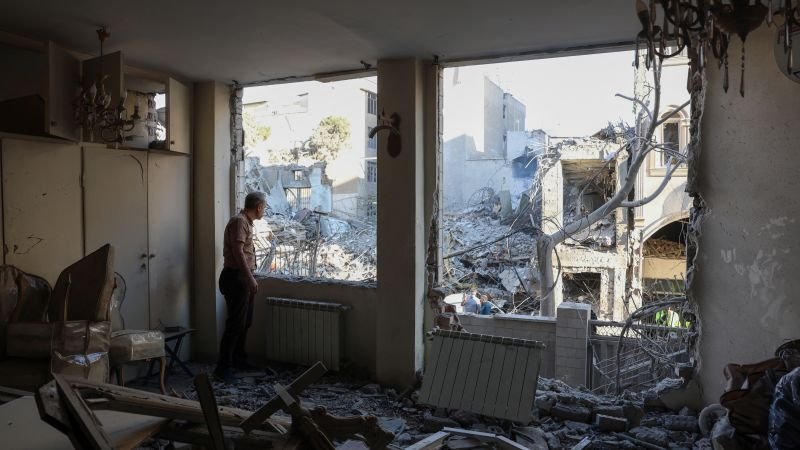
• US attacks: The US military has launched fresh strikes against Iran tonight. In a post on social media, US Central Command described the attacks as “a powerful response to yesterday’s attempted Iranian attacks” on US forces.
• Vow of retribution: Earlier today, US President Donald Trump promised retribution after the US military said it intercepted a “surprise attack” by Iran, ending days of relative calm in the Middle East. “We’re going to be hitting them very hard because it’s our turn to hit them. They know it’s coming,” he told reporters in the Oval Office.
• Energy shock: Oil prices rose in the wake of the renewed fighting. Tankers are now looking for new shipping routes after the recent declaration by the Iranian-backed Houthis that Saudi ships trying to reach the Indian Ocean would be targeted.
33 Posts
Explosions were heard in several southern locations in Iran after the US launched fresh strikes on the country, reported Iranian state media Press TV in the early hours of Thursday local time.
It comes shortly after US Central Command confirmed it began launching strikes as a “powerful response” to Iran’s attempted attack on US forces in the region Tuesday night.
The US military has launched strikes against Iran after President Donald Trump pledged to hit the country “very hard” on Wednesday, US Central Command announced.
“We’re going to be hitting them very hard because it’s our turn to hit them. They know it’s coming,” Trump told reporters in the Oval Office on Wednesday.
On Tuesday night, Iran’s Islamic Revolutionary Guard Corps launched multiple ballistic missiles towards US forces in the region, and Jordan’s military said it intercepted five missiles.
Vessel traffic through two critical shipping chokepoints remains heavily depressed amid US-Iran tensions and threats to trade in the region.
MarineTraffic data shows at least 14 commercial ships passed through the Strait of Hormuz over the last 24 hours, amid the ongoing US-Iran conflict. Eight vessels moved into the Persian Gulf — five cargo ships and three tankers — while six departed into the Gulf of Oman, made up of five cargo ships and one tanker.
Before the war, vessel traffic through the Strait of Hormuz averaged about 120 crossings per day.
Farther west, at least 37 commercial vessels transited the Bab al-Mandeb Strait over the same 24-hour period. Nineteen ships entered the Red Sea — including 14 cargo ships and five tankers — while 18 exited into the Gulf of Aden, consisting of 13 cargo ships and five tankers.
The shipping industry is exploring new routes for moving oil out of the region after Iran-backed Houthi rebels began to apply pressure in the narrow channel separating Yemen from Djibouti.
Transits of the Bab al-Mandeb have fallen by 22% since then. Shipping through the Strait of Hormuz remains at historically low levels.
Four members of Iran’s Islamic Revolutionary Guard Corp were killed in US-Saudi airstrikes in Iraq on Wednesday, according to a provincial Iranian official.
Hasan Ghamari, deputy governor of Markazi province for political, security and social affairs, told Iran’s state-run Islamic Republic News Agency that the four were providing security for Arbaeen pilgrimage ceremonies when they were killed in Diyala province in eastern Iraq.
Arbaeen marks the end of a 40-day mourning period commemorating the seventh-century death of Imam Hussein, grandson of Islam’s Prophet Mohammed.
Ghamari released the names of the four people he identified as IRGC members.
Iraq’s Popular Mobilization Forces (PMF) media office spokesman Kareem al-Kinani told CNN on Wednesday that six Iranian pilgrims were killed in the strikes.
“Regardless of their professions in Iran, these six entered Iraq as pilgrims and not as fighters or advisers, as some have claimed,” al-Kinani said.
At least 20 people were killed and 32 others injured by the US-Saudi strikes early Wednesday local time, according to the PMF, an umbrella group of Iranian-aligned militias.
CNN has reached out to the Iraqi government for comment.
President Donald Trump pledged to forcefully respond to Iran’s attempted attack on US military positions, saying it was “our turn” in the ongoing attacks that briefly went quiet as he sought a diplomatic off-ramp.
“We’re going to be hitting them very hard because it’s our turn to hit them. They know it’s coming,” he told reporters in the Oval Office on Wednesday.
Iran fired missiles toward US forces in the region overnight, according to the US military. All were intercepted.
It was a departure from the usual pattern in the tit-for-tat attacks, which have seen Iran responding to US strikes, and appeared to demonstrate Iran’s willingness to restart the hostilities.
“They’re asking us not to do it,” Trump said of the US retaliation, adding all the incoming fire had been “knocked down to the ground.”
“But they nevertheless took a shot, so it’s our turn,” he went on, “and we’ll see if we get there with an agreement at some point. But we’re going to hit them very hard.”
Later, Trump suggested the attack was carried out by a different faction of Iranian leadership than the officials the US has been talking to.
“It was a different group than we’re dealing with,” he said. “They’ve already apologized, but you know we gotta smack them a little bit.”
President Donald Trump said Wednesday that he would be “quite disappointed” with President Xi Jinping of China if he provided weapons to Iran.
Reuters reported Wednesday that Iran is expected to receive a shipment of 300-400 Chinese-made shoulder-fired air-defense missile launchers “within weeks.” The deal is reportedly valued at $60 million to $70 million.
CNN has previously reported that US intelligence indicated China was preparing to deliver new air defense systems to Iran, at a time when Tehran is seeking to replenish certain weapons systems with the help of key foreign partners. At that time, a spokesperson for Beijing’s embassy in Washington said the report was “untrue.”
“Well, that would be surprising,” Trump told reporters in the Oval Office Thursday, when asked about the Reuters report.
“I mean, things like that happen, but that would be surprising. He (Xi) told me very strongly he wouldn’t partake, and he knows I’d be quite disappointed,” Trump added.
US President Donald Trump threatened to retaliate against Iran this morning after an Iranian missile attack on US forces was intercepted, ending a short pause in the hostilities between the nations. “We are going to beat the f**king sh*t out of them,” Trump said on Fox News.
In Iraq, the US and Saudi Arabia coordinated to strike Iran-backed militias in response to attacks on US forces and Saudi oil facilities. The US-Saudi strikes triggered fierce criticism from multiple wings of Iraqi politics, with former Prime Minister Mohammed Shia al-Sudani cautioning against a “dangerous overstep of the principle of Islamic brotherhood.”
If you’re just joining, catch up on all the latest here:
US-Saudi strike: The Iraqi prime minister directed the country’s Foreign Ministry to pursue legal action against the United States and Saudi Arabia after the countries’ strikes killed or injured dozens.
Oil prices rise again: The price of Brent crude oil, the global benchmark, jumped in reaction to Trump’s promise of retaliation against Iran’s attempted attack on US forces. The price was up over 7%, to $90.66, as of 2:30 p.m. ET.
New tanker routes: The shipping industry is exploring alternative routes – including through the Suez Canal – to get oil out of the region after the recent declaration by the Iranian-backed Houthis that Saudi ships trying to reach the Indian Ocean would be targeted. Transits of the Bab al-Mandeb Strait have fallen by 22% since then, and transits through the Strait of Hormuz remain at low levels.
Israel-Lebanon truce: The Israeli military accused Iran-backed Hezbollah of violating a ceasefire in Lebanon. Earlier Wednesday, Lebanon’s state-run National News Agency reported that Israeli forces were setting fire to homes in South Lebanon.
Fire at Egyptian port: Egypt’s Ministry of Petroleum and Mineral Resources said a fire broke out aboard two vessels at the Mediterranean port of Damietta. No injuries or deaths were reported, and Egyptian authorities have not announced a cause.
CNN’s Sana Noor Haq, Jennifer Hansler, Mustafa Qadri, Dana Karni, Aileen Graef, Mohammed Tawfeeq, John Towfighi, Tim Lister, Eleni Giokos and Aqeel Najim contributed reporting.
Saudi Defense Minister Khalid bin Salman met with Vice President JD Vance in Washington, DC, on Wednesday, as the US-Iran war threatened to embroil the kingdom.
According to sources familiar with the matter, Prince Khalid was originally scheduled to travel to the United States last week, but his trip was postponed. His visit to Washington was brief, and he left after his meeting with Vance, according to the sources.
His visit came less than a day after the US and Saudi Arabia conducted joint military operations against Iran-linked “logistics and weapons sites” in Iraq. He was also in Washington at the same time as Israeli Prime Minister Benjamin Netanyahu, though one source said that timing was coincidental.
The Saudi defense minister discussed a number of issues with Vance, including the joint strikes and Saudi Arabia’s response to attacks on its infrastructure, according to one of the sources. He also had a message from Crown Prince Mohammad bin Salman that he wanted to deliver in person, the source said. Another source told CNN that Khalid wanted to convey his country’s view on the ongoing war.
The kingdom’s assessment, according to the sources, is that Iran will seek to create leverage through escalation and will continue trying to use pro-Iranian militias in Iraq and Yemen’s Houthis to do so. Saudi Arabia still wants to see de-escalation and believes that escalation and prolonging the war comes with major risks, the sources said, but that it will respond if necessary, as it did on Tuesday.
The Saudi response to the Houthis and the Iraqi militias was meant to make clear that attacking civilian infrastructure is a red line that will not go unanswered, although the kingdom still seeks de-escalation. It was also intended to send Iran’s proxies a message that this is not their war to fight, the sources said.
A fire broke out aboard two vessels at Egypt’s Mediterranean port of Damietta during cargo operations Wednesday at a liquefied natural gas terminal, temporarily disrupting port activity, according to Egypt’s Ministry of Petroleum and Mineral Resources.
The ministry said emergency crews contained the fire aboard a regasification vessel and a storage vessel. No injuries or deaths were reported.
Authorities were “taking the necessary measures to assess the situation,” the ministry added, without identifying the cause of the fire or providing further details.
British maritime security firm Ambrey said an initial assessment indicated that a floating LNG storage facility — US-owned and operated flying the Marshall Islands flag — was struck. Multiple industry sources identified the vessel as the Energos Winter and said a suspected drone strike caused a fire that spread to a second vessel.
The reported drone strike has not been officially confirmed. No state or nonstate actor has claimed responsibility, and Egyptian authorities have not announced a cause.
Maritime risk-management company Marisks said the affected vessels have been moved outside the port and that operations at unaffected berths and terminals were expected to resume overnight. The LNG terminal remained under assessment.
Marisks said there was insufficient evidence to determine the cause or attribute responsibility. It said a deliberate attack, if confirmed, would represent a significant expansion of regional hostilities into Mediterranean energy infrastructure.
The Israeli military has accused Hezbollah of violating a ceasefire in Lebanon, blaming the Iran-backed militant group for an attack on an engineering vehicle in the south of the country.
“This incident constitutes a blatant violation of the ceasefire agreement in Lebanon by the Hezbollah terrorist organization,” the Israel Defense Forces said. No injuries were reported.
Earlier Wednesday, Lebanon’s state-run National News Agency reported that Israeli forces were setting fire to homes in Qantara, South Lebanon.
Israel and Lebanon last month signed an agreement that aims to transfer control of Hezbollah-dominated territory in southern Lebanon from the IDF to the Lebanese military, but both the IDF and Hezbollah have continued to trade blows.
Israel’s military chief, Lt. Gen. Eyal Zamir, visited Lebanon on Wednesday, telling troops there that “if required, we will deepen our operations and reach additional areas.”
Lebanon was also a key part of the ceasefire agreement between Iran and the US that has now collapsed.
The Islamic Resistance in Iraq accused the US of targeting members of the Popular Mobilization Forces (PMF) and a convoy serving pilgrims in Karbala, killing and wounding dozens.
In a statement Wednesday, the coalition of Iran-backed militias, which is closely tied to the PMF umbrella group, also accused the Saudi government of acting as an agent of the United States.
The group gave Iraqi authorities until August 7 to respond to the incident, warning that it would take direct action if the government failed to do so.
It also threatened that its response to the US could include targets in Saudi Arabia but said it would avoid disrupting the upcoming Arbaeen pilgrimage. Arbaeen marks the end of a 40-day mourning period commemorating the seventh-century death of Imam Hussein, grandson of Islam’s Prophet Mohammed.
Iraqi Parliament Speaker Haibat al-Halbousi condemned the US-Saudi strikes and called on the Iraqi government and prime minister “to conduct a comprehensive and transparent investigation into this attack, and to take all diplomatic and legal measures that safeguard Iraq’s rights and sovereignty.”
“This should be done in parallel with uncovering the parties involved in any hostile acts originating from Iraqi territory toward neighboring countries and holding those responsible accountable in accordance with the provisions of the law,” he added.
Iraqi Prime Minister Ali al-Zaidi directed the country’s Foreign Ministry to pursue legal action against the United States and Saudi Arabia after the two countries launched strikes in Iraq on Wednesday, killing and wounding dozens, the Iraqi military said in a statement.
Iraq’s National Security Council, chaired by al-Zaidi, instructed the ministry to take action under international law and the United Nations Charter.
Washington and Riyadh struck several areas in northern and southern Iraq earlier Wednesday local time, following attacks by Iran-backed armed groups on US forces and Saudi oil facilities.
At least 20 people were killed and 32 wounded in strikes on “logistics and weapons sites,” according to the Popular Mobilization Forces, an umbrella group of Iran-aligned Iraqi militias.
Earlier in this month, al-Zaidi said during a face-to-face meeting with US President Donald Trump that his country would confront Iranian-backed militias in Iraq.
Al-Zaidi did not provide a detailed public strategy for achieving the goal, which has eluded previous Iraqi governments.
The Trump administration on Wednesday imposed sanctions on two Iranian firms accused of supporting a protection racket in the Strait of Hormuz.
Persian Gulf Marine Insurance Company and HormuzSafe Marine Services Authority are “integral to an Islamic Revolutionary Guard Corps (IRGC)-backed extortion scheme that forces commercial vessels to purchase mandatory maritime ‘insurance’ to transit the Strait,” the US Treasury Department said in a press release.
Re-establishing free and open transit through the key waterway remains a thorny issue as Iran seeks to maintain its control over the strait.
According to the Treasury Department, the insurance provided by the firms “covers risks, most of which are created by Iran itself, such as vessel seizures, and aims to generate revenue to fund the regime’s terror and corruption.”
The administration also imposed sanctions on companies operating “shadow fleet” vessels that have transported sanctioned Iranian crude and petrochemicals to China and the United Arab Emirates.
Israeli Prime Minister Benjamin Netanyahu met Tuesday evening with US Vice President JD Vance at Blair House in Washington, an Israeli official told CNN. The official said Netanyahu is expected to meet separately with US Secretary of Defense Pete Hegseth on Wednesday.
In recent months, Vance has publicly criticized Israel, accusing members of Netanyahu’s cabinet of working to sabotage the Iran negotiations and seeking to turn American public opinion against them, warning that Israel is alienating “the only powerful ally they have left.”
The Vance meeting followed an expanded Oval Office meeting earlier between Netanyahu and US President Donald Trump, which Vance and Hegseth also attended, as well as Secretary of State Marco Rubio and special envoy Steve Witkoff.
In a statement, Netanyahu described the Oval Office meeting as “excellent,” calling it “one of the best conversations I’ve had with the president of the United States”. He emphasized “full partnership and mutual support,” and said both sides shared the goal of preventing Iran from obtaining nuclear weapons, along with addressing additional goals.
US President Donald Trump warned Tehran was “going to get a beating” for an attempted Iranian attack on US forces in the Middle East. Speaking to Fox News today, the US president said, “We are going to beat the f**king sh*t out of them.”
It comes hours after joint strikes by Washington and Riyadh against Iran-backed militias in Iraq, in response to attacks on US forces and Saudi oil facilities, fracturing tenuous diplomacy.
Trump added that the US coordinated with Iraqi officials before the assault on Iran-aligned militias in Iraq. Meanwhile, Iraqi Prime Minister Ali al-Zaidi postponed a planned trip to Riyadh, citing “today’s events.”
The US-Saudi strikes triggered fierce criticism from multiple wings of Iraqi politics, with former Prime Minister Mohammed Shia al-Sudani cautioning against a “dangerous overstep of the principle of Islamic brotherhood.” The umbrella group for Iran-aligned Iraqi militias targeted in the salvo — the Popular Mobilization Forces (PMF) — echoed warnings of a “highly dangerous escalation.”
Here’s what else you need to know:
US-Saudi strikes: At least 20 people were killed and 32 others injured by US and Saudi forces’ strikes on Iran-aligned Iraqi militias Wednesday, according to the PMF. US Central Command said it hit “multiple terrorist logistics and weapons sites across eastern Iraq,” which followed strikes by Iran-backed armed groups on US forces and Saudi oil infrastructure.
Tehran not seeking talks with US: Iranian officials have not asked for negotiations with Washington over the past two weeks, according to Iranian Deputy Foreign Minister Kazem Gharibabadi. Trump has claimed Iran was “dying for a negotiation.”
Iran fires missiles on Jordan: Jordanian air defenses intercepted five missiles launched by Tehran early Wednesday local time, according to a military spokesperson, hours after Iran’s Islamic Revolutionary Guard Corps announced strikes on US military targets in the Arab nation.
US bombing of Iranian school “national shame”: Democratic Rep. Yassamin Ansari told CNN on Tuesday the February 28 US strike on the Shajareh Tayyiba school in Minab — which killed 168 children and 14 adults — was a “war crime” and “national shame.” Earlier this month, CNN reported the government investigation into the attack has sat for months with a military command.
CNN’s Aqeel Najim, Tim Lister, Aida Karimi, Nechirvan Mando, Karina Tsui, Eyad Kourdi, Lex Harvey, Mustafa Qadri and Jake Tapper contributed reporting.
Oil prices jumped Wednesday morning after President Donald Trump told Fox News that Iran is “going to get a beating” in response to an attempted attack on US forces.
Brent crude rose 5.8%, to $86.82 per barrel. US crude jumped 6.4%, to $84.30 per barrel.
Dow futures were down 330 points, or 0.6%. S&P 500 and Nasdaq 100 futures were each down about 0.1%.
US President Donald Trump promised retribution for an Iranian missile attack that was intercepted by US forces.
“We are going to beat the f**king sh*t out of them,” Trump told Fox News Wednesday morning.
Trump also said the US coordinated with the Iraqis before US-Saudi strikes against Iran-backed Shiite militias in Iraq.
Trump called the militias a “cancer on the world” and did not rule out further action against proxies in the region.
The shipping industry is looking for new options after the recent declaration by the Iranian-backed Houthis that Saudi ships trying to reach the Indian Ocean would be targeted, according to analysts.
A number of tankers are using the northern route out of the Red Sea through the Suez Canal or loading oil at Sidi Kerir on Egypt’s Mediterranean coast, where crude arrives through a pipeline from Saudi Arabia, according to shipping data.
“Rising Sidi Kerir loadings suggest greater use of the Suez-SUMED (pipeline) system,” Bakr noted Tuesday in a post on X. Even so, the Egyptian route “cannot 100% replace Bab al-Mandeb for crude exports to Asia,” she added.
The Houthis declared a naval blockade against Saudi Arabian ports on July 20 and have since claimed to have struck three Saudi tankers — the latest unconfirmed attack being on Tuesday.
Transits of the Bab al-Mandeb have fallen by 22% since the Houthi blockade was announced, according to maritime intelligence group Windward, from about 48 to 37 a day. Windward also noted that war-risk insurers are now excluding vessels with any Saudi port history from Red Sea coverage.
Transits through the Strait of Hormuz remain at very low levels, with the southern route supported by the US military seeing virtually no traffic, according to Windward.
“Hormuz recorded zero tanker crossings in either direction on Monday,” it said.
Crossings were higher on Tuesday, according to Kpler, with 12 confirmed transits, six leaving the Gulf and six entering. It noted the continued trend of ships using the Iranian corridor, which accounted for 10 of the 12 crossings.
“As the conflict spreads across multiple maritime fronts, resilience is becoming increasingly expensive — even if oil markets have yet to fully reflect that reality,” it said.
Iran’s Foreign Ministry has condemned the US and Saudi Arabia attacks in Iraq, where 20 were killed and 32 wounded, according to Iran’s semi-official Tasnim news agency.
The ministry reaffirmed the country’s support for Iraq “and held the ‘war-mongering US regime’ and its allies responsible,” Tasnim reported on its Telegram channel.
Washington and Riyadh launched strikes on multiple regions of Iraq’s northern and southern flanks earlier Wednesday local time, following attacks by Iran-backed armed groups on US forces and Saudi oil facilities.
At least 20 people were killed and 32 wounded by the strikes, which hit “logistics and weapons sites,” according to the Popular Mobilization Forces, an Iran-aligned Iraqi militia.
Iraq’s recently elected President Nizar Amidi also condemned the attacks, labeling it as “unacceptable and a flagrant violation of Iraq’s sovereignty,” on X.
US Central Command’s chief warned troops in a recent letter that sharing cellphone videos online could help Iran strike US bases, a source familiar with the matter told CNN.
In a July 28 letter, which was obtained by Reuters, Adm. Brad Cooper said that cellphone footage shared online and in the news allowed Iran to assess whether its strikes have been successful “in near real-time.”
It comes after four US soldiers were killed due to Iranian strikes in mid-July.
Cooper warned in the letter, according to Reuters and confirmed by a source, that the cost could be measured in the lives of American service members and civilians targeted in Gulf countries.
US Central Command spokesperson Capt. Tim Hawkins said in a statement to CNN, “The message is a general reminder to our service members on the importance of maintaining operational security. This is one of many opportunities Admiral Cooper has used to convey operational priorities.”
• US attacks: The US military has launched fresh strikes against Iran tonight. In a post on social media, US Central Command described the attacks as “a powerful response to yesterday’s attempted Iranian attacks” on US forces.
• Vow of retribution: Earlier today, US President Donald Trump promised retribution after the US military said it intercepted a “surprise attack” by Iran, ending days of relative calm in the Middle East. “We’re going to be hitting them very hard because it’s our turn to hit them. They know it’s coming,” he told reporters in the Oval Office.
• Energy shock: Oil prices rose in the wake of the renewed fighting. Tankers are now looking for new shipping routes after the recent declaration by the Iranian-backed Houthis that Saudi ships trying to reach the Indian Ocean would be targeted.
Explosions were heard in several southern locations in Iran after the US launched fresh strikes on the country, reported Iranian state media Press TV in the early hours of Thursday local time.
It comes shortly after US Central Command confirmed it began launching strikes as a “powerful response” to Iran’s attempted attack on US forces in the region Tuesday night.
The US military has launched strikes against Iran after President Donald Trump pledged to hit the country “very hard” on Wednesday, US Central Command announced.
“We’re going to be hitting them very hard because it’s our turn to hit them. They know it’s coming,” Trump told reporters in the Oval Office on Wednesday.
On Tuesday night, Iran’s Islamic Revolutionary Guard Corps launched multiple ballistic missiles towards US forces in the region, and Jordan’s military said it intercepted five missiles.
Vessel traffic through two critical shipping chokepoints remains heavily depressed amid US-Iran tensions and threats to trade in the region.
MarineTraffic data shows at least 14 commercial ships passed through the Strait of Hormuz over the last 24 hours, amid the ongoing US-Iran conflict. Eight vessels moved into the Persian Gulf — five cargo ships and three tankers — while six departed into the Gulf of Oman, made up of five cargo ships and one tanker.
Before the war, vessel traffic through the Strait of Hormuz averaged about 120 crossings per day.
Farther west, at least 37 commercial vessels transited the Bab al-Mandeb Strait over the same 24-hour period. Nineteen ships entered the Red Sea — including 14 cargo ships and five tankers — while 18 exited into the Gulf of Aden, consisting of 13 cargo ships and five tankers.
The shipping industry is exploring new routes for moving oil out of the region after Iran-backed Houthi rebels began to apply pressure in the narrow channel separating Yemen from Djibouti.
Transits of the Bab al-Mandeb have fallen by 22% since then. Shipping through the Strait of Hormuz remains at historically low levels.
Four members of Iran’s Islamic Revolutionary Guard Corp were killed in US-Saudi airstrikes in Iraq on Wednesday, according to a provincial Iranian official.
Hasan Ghamari, deputy governor of Markazi province for political, security and social affairs, told Iran’s state-run Islamic Republic News Agency that the four were providing security for Arbaeen pilgrimage ceremonies when they were killed in Diyala province in eastern Iraq.
Arbaeen marks the end of a 40-day mourning period commemorating the seventh-century death of Imam Hussein, grandson of Islam’s Prophet Mohammed.
Ghamari released the names of the four people he identified as IRGC members.
Iraq’s Popular Mobilization Forces (PMF) media office spokesman Kareem al-Kinani told CNN on Wednesday that six Iranian pilgrims were killed in the strikes.
“Regardless of their professions in Iran, these six entered Iraq as pilgrims and not as fighters or advisers, as some have claimed,” al-Kinani said.
At least 20 people were killed and 32 others injured by the US-Saudi strikes early Wednesday local time, according to the PMF, an umbrella group of Iranian-aligned militias.
CNN has reached out to the Iraqi government for comment.
President Donald Trump pledged to forcefully respond to Iran’s attempted attack on US military positions, saying it was “our turn” in the ongoing attacks that briefly went quiet as he sought a diplomatic off-ramp.
“We’re going to be hitting them very hard because it’s our turn to hit them. They know it’s coming,” he told reporters in the Oval Office on Wednesday.
Iran fired missiles toward US forces in the region overnight, according to the US military. All were intercepted.
It was a departure from the usual pattern in the tit-for-tat attacks, which have seen Iran responding to US strikes, and appeared to demonstrate Iran’s willingness to restart the hostilities.
“They’re asking us not to do it,” Trump said of the US retaliation, adding all the incoming fire had been “knocked down to the ground.”
“But they nevertheless took a shot, so it’s our turn,” he went on, “and we’ll see if we get there with an agreement at some point. But we’re going to hit them very hard.”
Later, Trump suggested the attack was carried out by a different faction of Iranian leadership than the officials the US has been talking to.
“It was a different group than we’re dealing with,” he said. “They’ve already apologized, but you know we gotta smack them a little bit.”
President Donald Trump said Wednesday that he would be “quite disappointed” with President Xi Jinping of China if he provided weapons to Iran.
Reuters reported Wednesday that Iran is expected to receive a shipment of 300-400 Chinese-made shoulder-fired air-defense missile launchers “within weeks.” The deal is reportedly valued at $60 million to $70 million.
CNN has previously reported that US intelligence indicated China was preparing to deliver new air defense systems to Iran, at a time when Tehran is seeking to replenish certain weapons systems with the help of key foreign partners. At that time, a spokesperson for Beijing’s embassy in Washington said the report was “untrue.”
“Well, that would be surprising,” Trump told reporters in the Oval Office Thursday, when asked about the Reuters report.
“I mean, things like that happen, but that would be surprising. He (Xi) told me very strongly he wouldn’t partake, and he knows I’d be quite disappointed,” Trump added.
US President Donald Trump threatened to retaliate against Iran this morning after an Iranian missile attack on US forces was intercepted, ending a short pause in the hostilities between the nations. “We are going to beat the f**king sh*t out of them,” Trump said on Fox News.
In Iraq, the US and Saudi Arabia coordinated to strike Iran-backed militias in response to attacks on US forces and Saudi oil facilities. The US-Saudi strikes triggered fierce criticism from multiple wings of Iraqi politics, with former Prime Minister Mohammed Shia al-Sudani cautioning against a “dangerous overstep of the principle of Islamic brotherhood.”
If you’re just joining, catch up on all the latest here:
US-Saudi strike: The Iraqi prime minister directed the country’s Foreign Ministry to pursue legal action against the United States and Saudi Arabia after the countries’ strikes killed or injured dozens.
Oil prices rise again: The price of Brent crude oil, the global benchmark, jumped in reaction to Trump’s promise of retaliation against Iran’s attempted attack on US forces. The price was up over 7%, to $90.66, as of 2:30 p.m. ET.
New tanker routes: The shipping industry is exploring alternative routes – including through the Suez Canal – to get oil out of the region after the recent declaration by the Iranian-backed Houthis that Saudi ships trying to reach the Indian Ocean would be targeted. Transits of the Bab al-Mandeb Strait have fallen by 22% since then, and transits through the Strait of Hormuz remain at low levels.
Israel-Lebanon truce: The Israeli military accused Iran-backed Hezbollah of violating a ceasefire in Lebanon. Earlier Wednesday, Lebanon’s state-run National News Agency reported that Israeli forces were setting fire to homes in South Lebanon.
Fire at Egyptian port: Egypt’s Ministry of Petroleum and Mineral Resources said a fire broke out aboard two vessels at the Mediterranean port of Damietta. No injuries or deaths were reported, and Egyptian authorities have not announced a cause.
CNN’s Sana Noor Haq, Jennifer Hansler, Mustafa Qadri, Dana Karni, Aileen Graef, Mohammed Tawfeeq, John Towfighi, Tim Lister, Eleni Giokos and Aqeel Najim contributed reporting.
Saudi Defense Minister Khalid bin Salman met with Vice President JD Vance in Washington, DC, on Wednesday, as the US-Iran war threatened to embroil the kingdom.
According to sources familiar with the matter, Prince Khalid was originally scheduled to travel to the United States last week, but his trip was postponed. His visit to Washington was brief, and he left after his meeting with Vance, according to the sources.
His visit came less than a day after the US and Saudi Arabia conducted joint military operations against Iran-linked “logistics and weapons sites” in Iraq. He was also in Washington at the same time as Israeli Prime Minister Benjamin Netanyahu, though one source said that timing was coincidental.
The Saudi defense minister discussed a number of issues with Vance, including the joint strikes and Saudi Arabia’s response to attacks on its infrastructure, according to one of the sources. He also had a message from Crown Prince Mohammad bin Salman that he wanted to deliver in person, the source said. Another source told CNN that Khalid wanted to convey his country’s view on the ongoing war.
The kingdom’s assessment, according to the sources, is that Iran will seek to create leverage through escalation and will continue trying to use pro-Iranian militias in Iraq and Yemen’s Houthis to do so. Saudi Arabia still wants to see de-escalation and believes that escalation and prolonging the war comes with major risks, the sources said, but that it will respond if necessary, as it did on Tuesday.
The Saudi response to the Houthis and the Iraqi militias was meant to make clear that attacking civilian infrastructure is a red line that will not go unanswered, although the kingdom still seeks de-escalation. It was also intended to send Iran’s proxies a message that this is not their war to fight, the sources said.
A fire broke out aboard two vessels at Egypt’s Mediterranean port of Damietta during cargo operations Wednesday at a liquefied natural gas terminal, temporarily disrupting port activity, according to Egypt’s Ministry of Petroleum and Mineral Resources.
The ministry said emergency crews contained the fire aboard a regasification vessel and a storage vessel. No injuries or deaths were reported.
Authorities were “taking the necessary measures to assess the situation,” the ministry added, without identifying the cause of the fire or providing further details.
British maritime security firm Ambrey said an initial assessment indicated that a floating LNG storage facility — US-owned and operated flying the Marshall Islands flag — was struck. Multiple industry sources identified the vessel as the Energos Winter and said a suspected drone strike caused a fire that spread to a second vessel.
The reported drone strike has not been officially confirmed. No state or nonstate actor has claimed responsibility, and Egyptian authorities have not announced a cause.
Maritime risk-management company Marisks said the affected vessels have been moved outside the port and that operations at unaffected berths and terminals were expected to resume overnight. The LNG terminal remained under assessment.
Marisks said there was insufficient evidence to determine the cause or attribute responsibility. It said a deliberate attack, if confirmed, would represent a significant expansion of regional hostilities into Mediterranean energy infrastructure.
The Israeli military has accused Hezbollah of violating a ceasefire in Lebanon, blaming the Iran-backed militant group for an attack on an engineering vehicle in the south of the country.
“This incident constitutes a blatant violation of the ceasefire agreement in Lebanon by the Hezbollah terrorist organization,” the Israel Defense Forces said. No injuries were reported.
Earlier Wednesday, Lebanon’s state-run National News Agency reported that Israeli forces were setting fire to homes in Qantara, South Lebanon.
Israel and Lebanon last month signed an agreement that aims to transfer control of Hezbollah-dominated territory in southern Lebanon from the IDF to the Lebanese military, but both the IDF and Hezbollah have continued to trade blows.
Israel’s military chief, Lt. Gen. Eyal Zamir, visited Lebanon on Wednesday, telling troops there that “if required, we will deepen our operations and reach additional areas.”
Lebanon was also a key part of the ceasefire agreement between Iran and the US that has now collapsed.
The Islamic Resistance in Iraq accused the US of targeting members of the Popular Mobilization Forces (PMF) and a convoy serving pilgrims in Karbala, killing and wounding dozens.
In a statement Wednesday, the coalition of Iran-backed militias, which is closely tied to the PMF umbrella group, also accused the Saudi government of acting as an agent of the United States.
The group gave Iraqi authorities until August 7 to respond to the incident, warning that it would take direct action if the government failed to do so.
It also threatened that its response to the US could include targets in Saudi Arabia but said it would avoid disrupting the upcoming Arbaeen pilgrimage. Arbaeen marks the end of a 40-day mourning period commemorating the seventh-century death of Imam Hussein, grandson of Islam’s Prophet Mohammed.
Iraqi Parliament Speaker Haibat al-Halbousi condemned the US-Saudi strikes and called on the Iraqi government and prime minister “to conduct a comprehensive and transparent investigation into this attack, and to take all diplomatic and legal measures that safeguard Iraq’s rights and sovereignty.”
“This should be done in parallel with uncovering the parties involved in any hostile acts originating from Iraqi territory toward neighboring countries and holding those responsible accountable in accordance with the provisions of the law,” he added.
Iraqi Prime Minister Ali al-Zaidi directed the country’s Foreign Ministry to pursue legal action against the United States and Saudi Arabia after the two countries launched strikes in Iraq on Wednesday, killing and wounding dozens, the Iraqi military said in a statement.
Iraq’s National Security Council, chaired by al-Zaidi, instructed the ministry to take action under international law and the United Nations Charter.
Washington and Riyadh struck several areas in northern and southern Iraq earlier Wednesday local time, following attacks by Iran-backed armed groups on US forces and Saudi oil facilities.
At least 20 people were killed and 32 wounded in strikes on “logistics and weapons sites,” according to the Popular Mobilization Forces, an umbrella group of Iran-aligned Iraqi militias.
Earlier in this month, al-Zaidi said during a face-to-face meeting with US President Donald Trump that his country would confront Iranian-backed militias in Iraq.
Al-Zaidi did not provide a detailed public strategy for achieving the goal, which has eluded previous Iraqi governments.
The Trump administration on Wednesday imposed sanctions on two Iranian firms accused of supporting a protection racket in the Strait of Hormuz.
Persian Gulf Marine Insurance Company and HormuzSafe Marine Services Authority are “integral to an Islamic Revolutionary Guard Corps (IRGC)-backed extortion scheme that forces commercial vessels to purchase mandatory maritime ‘insurance’ to transit the Strait,” the US Treasury Department said in a press release.
Re-establishing free and open transit through the key waterway remains a thorny issue as Iran seeks to maintain its control over the strait.
According to the Treasury Department, the insurance provided by the firms “covers risks, most of which are created by Iran itself, such as vessel seizures, and aims to generate revenue to fund the regime’s terror and corruption.”
The administration also imposed sanctions on companies operating “shadow fleet” vessels that have transported sanctioned Iranian crude and petrochemicals to China and the United Arab Emirates.
Israeli Prime Minister Benjamin Netanyahu met Tuesday evening with US Vice President JD Vance at Blair House in Washington, an Israeli official told CNN. The official said Netanyahu is expected to meet separately with US Secretary of Defense Pete Hegseth on Wednesday.
In recent months, Vance has publicly criticized Israel, accusing members of Netanyahu’s cabinet of working to sabotage the Iran negotiations and seeking to turn American public opinion against them, warning that Israel is alienating “the only powerful ally they have left.”
The Vance meeting followed an expanded Oval Office meeting earlier between Netanyahu and US President Donald Trump, which Vance and Hegseth also attended, as well as Secretary of State Marco Rubio and special envoy Steve Witkoff.
In a statement, Netanyahu described the Oval Office meeting as “excellent,” calling it “one of the best conversations I’ve had with the president of the United States”. He emphasized “full partnership and mutual support,” and said both sides shared the goal of preventing Iran from obtaining nuclear weapons, along with addressing additional goals.
US President Donald Trump warned Tehran was “going to get a beating” for an attempted Iranian attack on US forces in the Middle East. Speaking to Fox News today, the US president said, “We are going to beat the f**king sh*t out of them.”
It comes hours after joint strikes by Washington and Riyadh against Iran-backed militias in Iraq, in response to attacks on US forces and Saudi oil facilities, fracturing tenuous diplomacy.
Trump added that the US coordinated with Iraqi officials before the assault on Iran-aligned militias in Iraq. Meanwhile, Iraqi Prime Minister Ali al-Zaidi postponed a planned trip to Riyadh, citing “today’s events.”
The US-Saudi strikes triggered fierce criticism from multiple wings of Iraqi politics, with former Prime Minister Mohammed Shia al-Sudani cautioning against a “dangerous overstep of the principle of Islamic brotherhood.” The umbrella group for Iran-aligned Iraqi militias targeted in the salvo — the Popular Mobilization Forces (PMF) — echoed warnings of a “highly dangerous escalation.”
Here’s what else you need to know:
US-Saudi strikes: At least 20 people were killed and 32 others injured by US and Saudi forces’ strikes on Iran-aligned Iraqi militias Wednesday, according to the PMF. US Central Command said it hit “multiple terrorist logistics and weapons sites across eastern Iraq,” which followed strikes by Iran-backed armed groups on US forces and Saudi oil infrastructure.
Tehran not seeking talks with US: Iranian officials have not asked for negotiations with Washington over the past two weeks, according to Iranian Deputy Foreign Minister Kazem Gharibabadi. Trump has claimed Iran was “dying for a negotiation.”
Iran fires missiles on Jordan: Jordanian air defenses intercepted five missiles launched by Tehran early Wednesday local time, according to a military spokesperson, hours after Iran’s Islamic Revolutionary Guard Corps announced strikes on US military targets in the Arab nation.
US bombing of Iranian school “national shame”: Democratic Rep. Yassamin Ansari told CNN on Tuesday the February 28 US strike on the Shajareh Tayyiba school in Minab — which killed 168 children and 14 adults — was a “war crime” and “national shame.” Earlier this month, CNN reported the government investigation into the attack has sat for months with a military command.
CNN’s Aqeel Najim, Tim Lister, Aida Karimi, Nechirvan Mando, Karina Tsui, Eyad Kourdi, Lex Harvey, Mustafa Qadri and Jake Tapper contributed reporting.
Oil prices jumped Wednesday morning after President Donald Trump told Fox News that Iran is “going to get a beating” in response to an attempted attack on US forces.
Brent crude rose 5.8%, to $86.82 per barrel. US crude jumped 6.4%, to $84.30 per barrel.
Dow futures were down 330 points, or 0.6%. S&P 500 and Nasdaq 100 futures were each down about 0.1%.
US President Donald Trump promised retribution for an Iranian missile attack that was intercepted by US forces.
“We are going to beat the f**king sh*t out of them,” Trump told Fox News Wednesday morning.
Trump also said the US coordinated with the Iraqis before US-Saudi strikes against Iran-backed Shiite militias in Iraq.
Trump called the militias a “cancer on the world” and did not rule out further action against proxies in the region.
The shipping industry is looking for new options after the recent declaration by the Iranian-backed Houthis that Saudi ships trying to reach the Indian Ocean would be targeted, according to analysts.
A number of tankers are using the northern route out of the Red Sea through the Suez Canal or loading oil at Sidi Kerir on Egypt’s Mediterranean coast, where crude arrives through a pipeline from Saudi Arabia, according to shipping data.
“Rising Sidi Kerir loadings suggest greater use of the Suez-SUMED (pipeline) system,” Bakr noted Tuesday in a post on X. Even so, the Egyptian route “cannot 100% replace Bab al-Mandeb for crude exports to Asia,” she added.
The Houthis declared a naval blockade against Saudi Arabian ports on July 20 and have since claimed to have struck three Saudi tankers — the latest unconfirmed attack being on Tuesday.
Transits of the Bab al-Mandeb have fallen by 22% since the Houthi blockade was announced, according to maritime intelligence group Windward, from about 48 to 37 a day. Windward also noted that war-risk insurers are now excluding vessels with any Saudi port history from Red Sea coverage.
Transits through the Strait of Hormuz remain at very low levels, with the southern route supported by the US military seeing virtually no traffic, according to Windward.
“Hormuz recorded zero tanker crossings in either direction on Monday,” it said.
Crossings were higher on Tuesday, according to Kpler, with 12 confirmed transits, six leaving the Gulf and six entering. It noted the continued trend of ships using the Iranian corridor, which accounted for 10 of the 12 crossings.
“As the conflict spreads across multiple maritime fronts, resilience is becoming increasingly expensive — even if oil markets have yet to fully reflect that reality,” it said.
Iran’s Foreign Ministry has condemned the US and Saudi Arabia attacks in Iraq, where 20 were killed and 32 wounded, according to Iran’s semi-official Tasnim news agency.
The ministry reaffirmed the country’s support for Iraq “and held the ‘war-mongering US regime’ and its allies responsible,” Tasnim reported on its Telegram channel.
Washington and Riyadh launched strikes on multiple regions of Iraq’s northern and southern flanks earlier Wednesday local time, following attacks by Iran-backed armed groups on US forces and Saudi oil facilities.
At least 20 people were killed and 32 wounded by the strikes, which hit “logistics and weapons sites,” according to the Popular Mobilization Forces, an Iran-aligned Iraqi militia.
Iraq’s recently elected President Nizar Amidi also condemned the attacks, labeling it as “unacceptable and a flagrant violation of Iraq’s sovereignty,” on X.
US Central Command’s chief warned troops in a recent letter that sharing cellphone videos online could help Iran strike US bases, a source familiar with the matter told CNN.
In a July 28 letter, which was obtained by Reuters, Adm. Brad Cooper said that cellphone footage shared online and in the news allowed Iran to assess whether its strikes have been successful “in near real-time.”
It comes after four US soldiers were killed due to Iranian strikes in mid-July.
Cooper warned in the letter, according to Reuters and confirmed by a source, that the cost could be measured in the lives of American service members and civilians targeted in Gulf countries.
US Central Command spokesperson Capt. Tim Hawkins said in a statement to CNN, “The message is a general reminder to our service members on the importance of maintaining operational security. This is one of many opportunities Admiral Cooper has used to convey operational priorities.”





Responses