
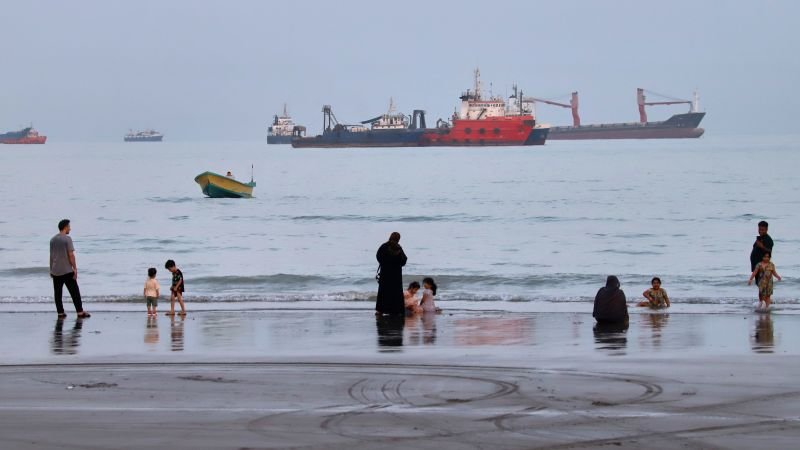
• Saudi Arabia braces: The country is anticipating “multiple coordinated attacks” on ports and airports by Iraqi militias working with Iran-backed Houthi rebels, a Saudi official told CNN, citing “multiple intelligence reports.”
• Hormuz deal: Iran and Oman are close to finalizing a proposed framework for commercial shipping through the Strait of Hormuz, Tehran’s deputy foreign minister said. The agreement would not automatically reopen the waterway, he warned. Iran has also denied any direct negotiations with the United States.
• Weapons supply: President Donald Trump has pushed back on reports of the Pentagon’s dwindling munitions stockpile, claiming the US has “massive amounts” but acknowledged some weapons supplies are “tighter.”
6 Posts
Fighting in the Middle East continues, and according to US President Donald Trump, the United States has weapons to continue the war with Iran.
Trump claimed Thursday that the US has “massive amounts” of munitions, following reports from various media, including CNN, on the Pentagon’s depleted stockpile. However, he did acknowledge certain munitions are in “tighter” supply after months of the war.
The president also said Thursday he’s “extremely happy” with Secretary of Defense Pete Hegseth, pushing back on reporting that he’s upset with him over munitions shortages.
Catch up on other headlines here:
Talks between Israel and Lebanon: The now-concluded talks between Israel and Lebanon in Rome “were productive on the technical and expert levels,” a US State Department spokesperson said. The three days of US-mediated technical discussions were set against the backdrop of renewed Israeli strikes on southern Lebanon.
Draft bill: Iranian lawmakers drafted a bill to regulate traffic through the Strait of Hormuz, including restrictions on certain vessels and penalties for violators, according to Iran’s semi-official Fars News Agency. The bill — currently under review by the Iranian Parliament’s National Security Commission — is an initiative separate from talks with Oman on commercial shipping through the waterway.
Comments from Iran: Iran’s parliament speaker and top negotiator accused Trump of “theater diplomacy” on Thursday as Washington and Tehran gave sharply conflicting accounts of whether talks to reopen the Strait of Hormuz were happening. The comments were an apparent response to Trump, who has repeatedly said negotiations are underway.
Strait traffic: MarineTraffic data on Thursday showed that at least seven commercial ships passed through the strait over the last 24 hours as Iranian and Omani officials near a framework for partially reopening the waterway. Six vessels moved into the Persian Gulf — five cargo ships and one tanker — while one cargo ship exited into the Gulf of Oman.
Developments on the ground: Saudi Arabia on Thursday braced for “multiple coordinated attacks” by Iraqi militias working with Iran-backed Houthis, a Saudi official told CNN, as the Middle East conflict threatens to continue to broaden in the region.
CNN’s Aileen Graef, Jennifer Hansler, Aida Karimi, Hira Humayun, Alessandra Freitas, Avery Schmitz, Kevin Liptak and Nic Robertson contributed reporting.
Saudi Arabia is bracing for “multiple coordinated attacks” by Iraqi militias working with Iran-backed Houthis, a Saudi official told CNN, as the Middle East conflict threatens to continue to broaden in the region.
The official cited “multiple intelligence reports” from Saudi Arabia and regional countries that the Iraqi militias “in coordination with the Houthis” are planning to attack the Gulf nation “in the very near future” under the guidance of Iran’s Islamic Revolutionary Guard Corps (IRGC).
The official expressed alarm, saying that the reports come as Saudi Arabia is encouraging de-escalation, and when negotiations seem to be heading in the right direction.
“Saudi Arabia will take all necessary measures to deal with any aggression,” the official said.
News of the anticipated attacks comes ahead of a joint Turkish-Saudi-Pakistani summit in Mecca, the holiest city in Islam, on Friday, where a joint defense agreement is expected to be declared, according to regional sources.
The reports of impending attacks come a day after Houthis claimed to attack a Saudi oil tanker in the Gulf of Aden, another key waterway. In the past few weeks Saudi Arabia has come under missile attacks from the Houthis in Yemen and drone attacks from pro-Iranian militias in Iraq.
President Donald Trump claimed the United States has “massive amounts” of munitions, following reports from various media, including CNN, on the Pentagon’s depleted stockpile.
“Defense companies are building the largest number of plants and factories in our country’s history,” he added.
Trump later acknowledged certain munitions are in “tighter” supply after months of war with Iran, while insisting the US had other, less advanced types of weapons to continue fighting if necessary.
He also said replenishing weapons stocks is critical in case another conflict arises.
He said there are ample supplies of less advanced weapons as defense contractors ramp up production of Patriot missile interceptors and Tomahawk missiles.
“We have certain types of munitions which are very — they may not be as accurate,” he said. “They may not be, you know, they’re not as elite.”
“We have elite, too, but we’re watching that very closely,” he went on. “But we have certain types which are very powerful and very good, and we have an unlimited supply, and so we’re in great shape.”
“We have to have more. We have other things maybe come up, maybe come up, and maybe don’t come up,” he concluded. “Hopefully, nothing else does come up. But we’re in very good shape. We have literally massive amounts of ammunition.”
CNN previously reported that the US military had exhausted nearly 80% of its interceptors for its key THAAD missile defense system, and that senior US military commanders had warned that the Pentagon’s munitions stockpile is “dangerously low,” according to multiple sources.
Iran is finalizing a deal with Oman for the movement of vessels through the Strait of Hormuz, but a deal between the two coastal nations does not mean the waterway will reopen, Tehran says.
Tehran says it requires a number of guarantees from the United States if vessels are to transit the strait freely.
In an interview with the state-run Islamic Republic News Agency (IRNA), Iranian Deputy Foreign Minister Kazem Gharibabadi spelled out Iran’s demands, saying the US must reverse actions it says violated previous commitments.
These include:
Ending the naval blockade on Iranian ports.
Addressing sanctions that were reimposed on Iran when the truce collapsed – especially on the oil sector – and resuming negotiations over Tehran’s frozen assets.
Addressing the US’ “failure” to ensure stability in Lebanon as envisaged under the memorandum of understanding reached with Washington in June.
Asked if Iran is essentially implementing Article 5 of the June agreement, which committed Iran to using its “best efforts” to ensure safe commercial passage for 60 days, Gharibabadi said “No.”
“Article 5 only established guiding principles, not a final operational plan,” he said, adding that “the new Iran–Oman understanding is presented as an entirely new model reflecting today’s security environment rather than a continuation of the previous 60-year arrangement.”
This means that shipping routes through the strait will change, with a significant portion of commercial traffic transiting through Iranian territorial waters and the remainder through Omani waters, he said.
Gharibabadi said the arrangement reflects a new strategy for exercising “effective sovereignty” over the strait, while stressing that Iran does not intend to routinely close the waterway in peacetime.
Iran’s parliament speaker and top negotiator accused US President Donald Trump of “theater diplomacy” on Thursday as Washington and Tehran gave sharply conflicting accounts of whether talks to reopen the Strait of Hormuz were taking place.
Ghalibaf’s comments were an apparent response to Trump, who has repeatedly said negotiations with Iran are underway, telling Fox News on Tuesday: “They had an all-day negotiation today, and it looks like things are very good.” Tehran has denied any US-Iran talks are taking place or planned, But Iranian Foreign Ministry spokesperson Esmaeil Baghaei said mediators are working to de-escalate tensions and pass messages between the two sides.
Trump said over the weekend that he had called off what he described as the biggest US attack on another country since World War II because Iran wanted to negotiate. He has warned Tehran it would be hit “really hard” if a deal was not reached.
Ghalibaf said the United States’ use of “bullying,” broken promises and what he called fake news as leverage was a “failed strategy.”
“Acknowledge the facts and fulfill your commitments. We don’t need more theater,” he added.
Iran and Oman are close to finalizing a proposed framework for commercial shipping through the Strait of Hormuz. However, the agreement would not automatically reopen the waterway, Iranian Deputy Foreign Minister Kazem Gharibabadi said in an interview with the state-run Islamic Republic News Agency (IRNA).
The ongoing talks between Iran and Oman are critically important because they could lead to the full reopening of the world’s most critical energy chokepoint.
Here’s what the talks have covered:
Gharibabadi said negotiations have continued for more than three weeks and produced broad agreement on proposed inbound and outbound shipping routes.
The talks also covered technical arrangements, the security and sovereignty of Iran and Oman, and a proposed joint coordination center to manage maritime traffic and collect information from vessels.
Under the proposed arrangement, temporary routes near Iran’s Larak Island in the Strait of Hormuz and through Omani territorial waters would close.
Parts of the new inbound and outbound corridors would pass through Iranian waters, marking a departure from a decades-old system under which commercial traffic traveled through Omani waters, Gharibabadi said.
The proposed route would initially operate for two to four months or possibly longer, according to Gharibabadi. Its implementation would require a separate decision by Iran’s senior leadership.
CNN has reached out to the government of Oman for comment on the details shared by the Iranian official.
Gharibabadi said those conditions largely concerned the United States, which he accused of reinstating a naval blockade, resuming hostilities and reimposing sanctions. The US has said it resumed strikes after Iran fired on vessels transiting the strait.
On Wednesday, Gharibabadi denied that Iran is currently negotiating with the US over the Strait of Hormuz. He described discussions with Oman as strictly bilateral.
• Saudi Arabia braces: The country is anticipating “multiple coordinated attacks” on ports and airports by Iraqi militias working with Iran-backed Houthi rebels, a Saudi official told CNN, citing “multiple intelligence reports.”
• Hormuz deal: Iran and Oman are close to finalizing a proposed framework for commercial shipping through the Strait of Hormuz, Tehran’s deputy foreign minister said. The agreement would not automatically reopen the waterway, he warned. Iran has also denied any direct negotiations with the United States.
• Weapons supply: President Donald Trump has pushed back on reports of the Pentagon’s dwindling munitions stockpile, claiming the US has “massive amounts” but acknowledged some weapons supplies are “tighter.”
Fighting in the Middle East continues, and according to US President Donald Trump, the United States has weapons to continue the war with Iran.
Trump claimed Thursday that the US has “massive amounts” of munitions, following reports from various media, including CNN, on the Pentagon’s depleted stockpile. However, he did acknowledge certain munitions are in “tighter” supply after months of the war.
The president also said Thursday he’s “extremely happy” with Secretary of Defense Pete Hegseth, pushing back on reporting that he’s upset with him over munitions shortages.
Catch up on other headlines here:
Talks between Israel and Lebanon: The now-concluded talks between Israel and Lebanon in Rome “were productive on the technical and expert levels,” a US State Department spokesperson said. The three days of US-mediated technical discussions were set against the backdrop of renewed Israeli strikes on southern Lebanon.
Draft bill: Iranian lawmakers drafted a bill to regulate traffic through the Strait of Hormuz, including restrictions on certain vessels and penalties for violators, according to Iran’s semi-official Fars News Agency. The bill — currently under review by the Iranian Parliament’s National Security Commission — is an initiative separate from talks with Oman on commercial shipping through the waterway.
Comments from Iran: Iran’s parliament speaker and top negotiator accused Trump of “theater diplomacy” on Thursday as Washington and Tehran gave sharply conflicting accounts of whether talks to reopen the Strait of Hormuz were happening. The comments were an apparent response to Trump, who has repeatedly said negotiations are underway.
Strait traffic: MarineTraffic data on Thursday showed that at least seven commercial ships passed through the strait over the last 24 hours as Iranian and Omani officials near a framework for partially reopening the waterway. Six vessels moved into the Persian Gulf — five cargo ships and one tanker — while one cargo ship exited into the Gulf of Oman.
Developments on the ground: Saudi Arabia on Thursday braced for “multiple coordinated attacks” by Iraqi militias working with Iran-backed Houthis, a Saudi official told CNN, as the Middle East conflict threatens to continue to broaden in the region.
CNN’s Aileen Graef, Jennifer Hansler, Aida Karimi, Hira Humayun, Alessandra Freitas, Avery Schmitz, Kevin Liptak and Nic Robertson contributed reporting.
Saudi Arabia is bracing for “multiple coordinated attacks” by Iraqi militias working with Iran-backed Houthis, a Saudi official told CNN, as the Middle East conflict threatens to continue to broaden in the region.
The official cited “multiple intelligence reports” from Saudi Arabia and regional countries that the Iraqi militias “in coordination with the Houthis” are planning to attack the Gulf nation “in the very near future” under the guidance of Iran’s Islamic Revolutionary Guard Corps (IRGC).
The official expressed alarm, saying that the reports come as Saudi Arabia is encouraging de-escalation, and when negotiations seem to be heading in the right direction.
“Saudi Arabia will take all necessary measures to deal with any aggression,” the official said.
News of the anticipated attacks comes ahead of a joint Turkish-Saudi-Pakistani summit in Mecca, the holiest city in Islam, on Friday, where a joint defense agreement is expected to be declared, according to regional sources.
The reports of impending attacks come a day after Houthis claimed to attack a Saudi oil tanker in the Gulf of Aden, another key waterway. In the past few weeks Saudi Arabia has come under missile attacks from the Houthis in Yemen and drone attacks from pro-Iranian militias in Iraq.
President Donald Trump claimed the United States has “massive amounts” of munitions, following reports from various media, including CNN, on the Pentagon’s depleted stockpile.
“Defense companies are building the largest number of plants and factories in our country’s history,” he added.
Trump later acknowledged certain munitions are in “tighter” supply after months of war with Iran, while insisting the US had other, less advanced types of weapons to continue fighting if necessary.
He also said replenishing weapons stocks is critical in case another conflict arises.
He said there are ample supplies of less advanced weapons as defense contractors ramp up production of Patriot missile interceptors and Tomahawk missiles.
“We have certain types of munitions which are very — they may not be as accurate,” he said. “They may not be, you know, they’re not as elite.”
“We have elite, too, but we’re watching that very closely,” he went on. “But we have certain types which are very powerful and very good, and we have an unlimited supply, and so we’re in great shape.”
“We have to have more. We have other things maybe come up, maybe come up, and maybe don’t come up,” he concluded. “Hopefully, nothing else does come up. But we’re in very good shape. We have literally massive amounts of ammunition.”
CNN previously reported that the US military had exhausted nearly 80% of its interceptors for its key THAAD missile defense system, and that senior US military commanders had warned that the Pentagon’s munitions stockpile is “dangerously low,” according to multiple sources.
Iran is finalizing a deal with Oman for the movement of vessels through the Strait of Hormuz, but a deal between the two coastal nations does not mean the waterway will reopen, Tehran says.
Tehran says it requires a number of guarantees from the United States if vessels are to transit the strait freely.
In an interview with the state-run Islamic Republic News Agency (IRNA), Iranian Deputy Foreign Minister Kazem Gharibabadi spelled out Iran’s demands, saying the US must reverse actions it says violated previous commitments.
These include:
Ending the naval blockade on Iranian ports.
Addressing sanctions that were reimposed on Iran when the truce collapsed – especially on the oil sector – and resuming negotiations over Tehran’s frozen assets.
Addressing the US’ “failure” to ensure stability in Lebanon as envisaged under the memorandum of understanding reached with Washington in June.
Asked if Iran is essentially implementing Article 5 of the June agreement, which committed Iran to using its “best efforts” to ensure safe commercial passage for 60 days, Gharibabadi said “No.”
“Article 5 only established guiding principles, not a final operational plan,” he said, adding that “the new Iran–Oman understanding is presented as an entirely new model reflecting today’s security environment rather than a continuation of the previous 60-year arrangement.”
This means that shipping routes through the strait will change, with a significant portion of commercial traffic transiting through Iranian territorial waters and the remainder through Omani waters, he said.
Gharibabadi said the arrangement reflects a new strategy for exercising “effective sovereignty” over the strait, while stressing that Iran does not intend to routinely close the waterway in peacetime.
Iran’s parliament speaker and top negotiator accused US President Donald Trump of “theater diplomacy” on Thursday as Washington and Tehran gave sharply conflicting accounts of whether talks to reopen the Strait of Hormuz were taking place.
Ghalibaf’s comments were an apparent response to Trump, who has repeatedly said negotiations with Iran are underway, telling Fox News on Tuesday: “They had an all-day negotiation today, and it looks like things are very good.” Tehran has denied any US-Iran talks are taking place or planned, But Iranian Foreign Ministry spokesperson Esmaeil Baghaei said mediators are working to de-escalate tensions and pass messages between the two sides.
Trump said over the weekend that he had called off what he described as the biggest US attack on another country since World War II because Iran wanted to negotiate. He has warned Tehran it would be hit “really hard” if a deal was not reached.
Ghalibaf said the United States’ use of “bullying,” broken promises and what he called fake news as leverage was a “failed strategy.”
“Acknowledge the facts and fulfill your commitments. We don’t need more theater,” he added.
Iran and Oman are close to finalizing a proposed framework for commercial shipping through the Strait of Hormuz. However, the agreement would not automatically reopen the waterway, Iranian Deputy Foreign Minister Kazem Gharibabadi said in an interview with the state-run Islamic Republic News Agency (IRNA).
The ongoing talks between Iran and Oman are critically important because they could lead to the full reopening of the world’s most critical energy chokepoint.
Here’s what the talks have covered:
Gharibabadi said negotiations have continued for more than three weeks and produced broad agreement on proposed inbound and outbound shipping routes.
The talks also covered technical arrangements, the security and sovereignty of Iran and Oman, and a proposed joint coordination center to manage maritime traffic and collect information from vessels.
Under the proposed arrangement, temporary routes near Iran’s Larak Island in the Strait of Hormuz and through Omani territorial waters would close.
Parts of the new inbound and outbound corridors would pass through Iranian waters, marking a departure from a decades-old system under which commercial traffic traveled through Omani waters, Gharibabadi said.
The proposed route would initially operate for two to four months or possibly longer, according to Gharibabadi. Its implementation would require a separate decision by Iran’s senior leadership.
CNN has reached out to the government of Oman for comment on the details shared by the Iranian official.
Gharibabadi said those conditions largely concerned the United States, which he accused of reinstating a naval blockade, resuming hostilities and reimposing sanctions. The US has said it resumed strikes after Iran fired on vessels transiting the strait.
On Wednesday, Gharibabadi denied that Iran is currently negotiating with the US over the Strait of Hormuz. He described discussions with Oman as strictly bilateral.





Responses