
New York —
One of America’s oldest sandwiches is the newest battleground in the freezer aisle.
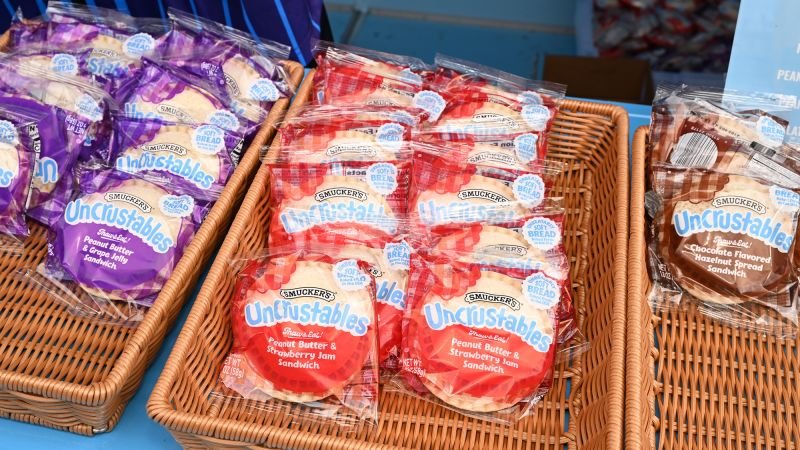
The humble peanut butter and jelly has been a staple in kitchens for decades, beloved by parents looking to fix a quick meal for their kids. Then the crustless, pre-packaged Uncrustables rolled out in grocery stores in 2000. The product has been an unstoppable force ever since, recently becoming a billion dollar brand for its parent company J.M. Smucker.
But Uncrustables isn’t just a hit with school-age kids. Adults, including pop stars and professional athletes, love the snack. Long-distance runners use them for fuel. Football players are some of the biggest fans, with NFL teams consuming at least 80,000 sandwiches a year.
Now, a wave of challengers, ranging from Trader Joe’s, jelly maker Welch’s to Jams, a better-for-you brand backed by former pro-athlete-turned-ESPN-host Pat McAfee, are all looking to eat into Smucker’s dominance.
Consumers are craving nostalgic flavors and food that is easy and affordable, according to Nate Rosen, consumer package goods analyst and writer of the newsletter Express Checkout.
“Nostalgia, especially for the late 90s and early aughts, has brought back a ton of products and flavors that people know and love from childhood,” he told CNN. “That age group is getting jobs, disposable income and, most importantly, starting to have kids — this is a product they already know and love, and it’s easy for them.”
How well a brand introduces a new product can determine its success. Rosen points to something fundamental about peanut butter and jelly: The two ingredients “are really easy to understand and intimately ingrained in American culture.”
“You need to reduce the amount of education needed, and a peanut butter and jelly sandwich has the least amount of education possible,” he added.
Uncrustables was created in 1995 by David Geske, who owned a packaged ice business, and his friend Len Kretchman. The idea originated from their kids, who wanted a peanut butter and jelly without the crust.
It was a hit with said kids, so their wives suggested they sell the crustless version that focused on the “best part of the sandwich.” The frozen sandwiches were sold at schools across the Midwest before eventually attracting the attention of Smucker in 1999, which bought the brand.
Nearly three decades later, the acquisition is still a major success. Uncrustables hit a major milestone this year, crossing $1 billion in annual sales, the company revealed in June. The brand is an important part of Smucker’s business, especially as it struggles with another, more recent purchase — Twinkies’ maker Hostess — that hasn’t paid off.
Worries over processed foods hasn’t slowed that success, either. The brand added more than 3 million households over the past year and continued distribution into new places, like convenience stores.
“We do expect to continue to see growth in the Uncrustables brand, and that is going to continue to be driven by the breadth of our position in the frozen category,” said CEO Mark Smucker on a June earnings call.
Uncrustables is also expanding its portfolio with new flavors, like blackberry, and adding a refrigerated version as well as higher-protein versions aimed at the breakfast category.
“Those efforts may be helping Uncrustables continue to attract new customers and increase its relevance across different parts of the day,” especially as more competitors hit the shelves, said Michael Gunther, senior vice president of research and market intelligence for Consumer Edge.
So far, sales are up 16% in 2026, marking the fourth consecutive year of double-digit sale increases, according to the firm’s scanning data.
A new batch of brands are hoping to capitalize on the success of Uncrustables.
One notable entrant is Jams, a year-old company that has more protein and less added sugar compared to an Uncrustable. It’s backed by big names in sports, including ESPN’s McAfee as well as soccer star Alex Morgan and Houston Texans quarterback C.J. Stroud. Earlier this year, the brand also partnered with the NFL for a specially designed sandwich to further tap into their obsession.
Sold at Target and Walmart, Jams is taking aim at Uncrustable’s weak spot: digital marketing and partnering with creators for promotion. (Smucker, which has done limited advertising in the past, said it’s planning to spend more on promotion this year.)
Meanwhile, another food giant, Welch’s, is rolling out at Walmart a “Real PB&J” that it says is 50% bigger than an Uncrustable and has about double the protein.
The product was created in response to consumers wanting “a bigger sandwich for bigger appetites, one that actually fills them up,” said Andrew Hartshorn, chief brand and innovation Officer at Welch’s, in a press release.
Welch’s entry into the space is long overdue, considering that they “own the second part in peanut butter and jelly,” Rosen said, but legacy brands move slowly and frozen food is difficult to distribute.
However, Smucker isn’t sitting still as competitors pop up.
The company has taken legal action against the now-defunct Chubby Snacks, defending its patented crimped seal. It’s also embroiled in a lawsuit with Trader Joe’s, claiming that grocery chain’s packaging looks too similar to theirs.
Still, Rosen sees the competitive pressure as a sign of a category that’s fully arrived — 26 years after Uncrustables hit store shelves.
“As more brands enter the market and the conversation grows, a positive feedback loop develops: People say, ‘I want that!’” he said. “So more products appear, and more people buy and think about peanut butter and jelly sandwiches.”



Responses