
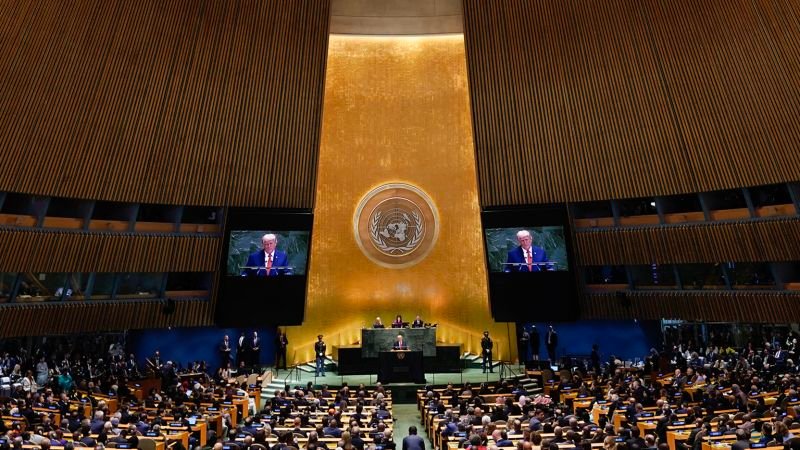
• Today at the UN: US President Donald Trump is speaking at the 81st session of the United Nations General Assembly against a backdrop of ongoing global crises. He is the second world leader to speak today, following Brazilian President Luiz Inácio Lula da Silva.
• On the agenda: Trump is also expected to meet with Ukrainian President Volodymyr Zelensky this morning and will also take part in a trilateral signing ceremony to formalize a new Greenland security agreement, according to the White House.
• War with Iran: Meanwhile, Trump has told his advisers he would like to arrange a meeting with Iranian officials at UNGA if “conditions are right,” a source said. An engagement with Iran’s delegation is not scheduled, but the US is open to a meeting, Secretary of State Marco Rubio said.
28 Posts
As President Donald Trump speaks to the UN General Assembly, many Americans are feeling their wallets pinched by increased energy costs due to the war with Iran.
Global oil prices have been elevated since the US and Israel launched large-scale strikes on Iran on Feb. 28. Commercial shipping through the critical oil chokepoint Strait of Hormuz remains severely disrupted, and Brent crude — the global oil benchmark — hit a high of over $114 per barrel in May.
US consumers are paying an extra $113 billion on gasoline and diesel alone since the war started, according to a cost tracker published by The Watson School of International and Public Affairs at Brown University. That amounts to about $866 per US household.
Trump has previously said higher gas prices are a “small price to pay” to ensure Iran doesn’t get a nuclear weapon.
Earlier this month, he said that he believes Iran is near collapse and that it would seek an end to the conflict “immediately after the (midterm) election” in November, prompting oil prices to tumble.
The average gas price in the US is over $4.47 per gallon, according to AAA, and diesel hit $6 a gallon on Sept. 11 for the first time ever.
The war is also expected to increase inflation for the first quarter of 2027, according to an analysis by the Congressional Budget Office released last Tuesday.
The CBO expects the Iran war to add roughly 0.5 percentage points to inflation during that period, a calculation that is largely driven by higher energy costs due to the conflict.
The CBO estimates the war has cost approximately $38 billion through August 1.
CNN’s John Liu, Hanna Ziady, Annie Grayer, Betsy Klein, Matt Egan and Chris Isidore contributed reporting to this post.
President Donald Trump has repeatedly claimed that Iran is desperate to make a deal ending the war with the US — and has suggested many times that such a pact is imminent — but a lasting resolution has yet to materialize.
He insisted last week that Iran “is very much wanting to make a deal,” but this isn’t the first time the president has made this claim without evidence of progress.
By the middle of summer, Trump had mentioned multiple separate times on social media, at public appearances and on phone calls with the media that a deal was nigh or claimed Iran was eager to cut one.
More recently, he told reporters on his way to the GOP midterm convention in Dallas this month that he expects Iran will abandon its war effort after the US midterm elections. The president claimed Iran will continue the war into November in an effort to damage him politically.
But he added that he believes Iran is near collapse and that it would seek an end to the conflict “immediately after the election,” prompting oil prices to tumble downward.
Trump’s terms and the nature of his deals in the past have been somewhat unclear when it comes to Iran’s war.
Read more here about how the president has defined a “deal.”
CNN’s Aaron Blake and Adam Cancryn contributed reporting.
The Trump administration is proposing a $5 billion US government investment in a new Middle East fund that would repair and boost energy infrastructure damaged in the Iran war and reduce the region’s reliance on the Strait of Hormuz, according to documents reviewed by CNN.
President Donald Trump is expected to discuss the proposal with the leaders of Gulf nations later today in New York, three sources told CNN. The proposal itself began circulating last week, sources said.
The US willingness to invest in repairs and new building for the region is a signal of how devastating the war has been for the region in terms of widespread damage to infrastructure, and the upending of energy exports.
The six-page proposal is titled the Partnership for Allies Construction and Trust (PACT) and sets out a vision for a $50 billion strategic fund that will back the construction of pipelines, refineries, ports and other major infrastructure needs.
The proposal says that participating countries will contribute investments, but it is unclear which countries will actually put money in. Some Gulf nations are planning to support it, but are not planning an investment at this time, two regional sources told CNN. They were skeptical that the effort would drive an end to the conflict which has recently expanded with the Iranian-backed Houthis engaged in aggressive strikes in the Red Sea and in Saudi Arabia.
The proposal also lists global sovereign wealth funds and firms as “able to invest in individual deals,” listing KKR, Blackstone, KBIC and Global Infrastructure Partners.
The proposal includes a map with some of the new infrastructure proposed, and a timeline stating that initial project announcements would come in January. The proposal was first reported by the Wall Street Journal.
The details of the final proposal could change given the initial documents reviewed by CNN were marked as a draft.
CNN has reached out to the White House for comment.
President Donald Trump is now delivering remarks at the UN General Assembly.
We’ll keep you updated here with what he says.
Brazilian President Luiz Inácio Lula da Silva referred to the United States on Tuesday as “the world’s greatest military power” in his speech to the UN General Assembly, adding that this reality cannot be ignored due to the country’s geographical proximity in the region.
However, Lula da Silva noted that, despite living in a “context of renewed hegemonic temptations, Brazil does not fit in anyone’s backyard.”
He also said the people of Venezuela, whose deposed President Nicolás Maduro the US captured earlier this year, “deserve to define their own destiny.”
The Brazilian president began his speech by taking a swipe at the UN, an organization he said “is failing” in its mission to “free” the world from war.
“The UN is failing in one of its most important missions, which is to free humanity from the scourge of war,” he told the audience.
CNN’s Billy Stockwell contributed reporting.
World leaders nervously await Trump’s speech, especially since last year, he berated American allies and told them their countries were “going to hell.”
We can expected Trump to boast about what he sees as his achievements and put the best possible face on the Iran war, which he claimed to have won after only a few days but that is threatening to enter an eighth month.
And while every US president speaks to the world in the annual UN speech, he’s also got a domestic audience. Trump is in political quicksand ahead of midterm elections.
A new CNN poll shows the war has been a political disaster, with only 26% approving of his handling of Iran with increasing numbers of Republicans also losing confidence in his management of the conflict.
Somehow, the president has to convince Americans is was all worth it.
President Donald Trump plans to address Iran, cartels in the western hemisphere and the regime in Cuba in a wide-ranging US speech before world leaders at the UN General Assembly that will center on America’s power in the world, according to excerpts of his speech obtained by CNN.
The president will paint himself himself as someone who has acted to confront conflicts around the world and a leader who has brought global peace, despite his war in Iran causing significant instability in the region and a global energy shortage.
“While others have talked, I have acted. While others have spoken of peace, I have made it. While others have ignored threats, I have confronted them,” his written remarks say. “ I have used it to make America the most powerful country in the world.”
Trump will specifically address the US war with Iran and condemn the country’s former Supreme Leader, Ayatollah Ali Khamenei, for his actions before the US first launched strikes in Tehran in February.
“In two weeks, we will mark the third anniversary of the October 7th attack in Israel,” Trump is expected to say. “Iran’s Supreme Leader celebrated that massacre and called it a ‘service to humanity.’ The same regime slaughtered over 72,000 of its own citizens this year.”
“Just imagine if such a vile regime were ever empowered to carry out large-scale terror attacks from behind a nuclear shield,” Trump will say, using that as justification for launching the war with Iran. “This was the reality we had to confront — a reality that far too many preferred to ignore,”
The president will also thank the UN Security Council for voting to pass a resolution condemning Iran’s attacks on commercial shipping.
Additionally, Trump will focus some of his remarks on cartels, calling them “the ISIS of the Western Hemisphere.” And he plans to criticize the Cuban regime, claiming they are working in coordination with “left-wing radicals and Communist networks here in the United States.” He specifically claims they have “cultivated ties” to the Communist Party USA, Antifa, and the Democratic Socialists of America.
The United States is looking into a potential hotline with China that would allow the two countries to warn each other about dangerous AI incidents, Secretary of State Marco Rubio said Tuesday.
His comments come after CNN reported last week that a partially AI-generated intelligence report that turned out to be false almost led to military action that could have caused a war between Washington and Beijing.
The top US diplomat said the idea as “nascent” and “a concept” and noted it may not be ready in time for Chinese leader Xi Jinping’s visit on Thursday.
“It’s not a bad idea. It’s one we’ll explore with the Chinese, among others,” Rubio said in an interview with “Fox & Friends.”
Rubio said AI must be addressed globally because “you can’t build a border around AI.”
The top US diplomat said the technology has “huge benefits,” but “it has some potential harm as well that we’re all concerned about.”
“We’re all struggling” with how to develop guardrails given AI’s rapid advancements, Rubio noted.
“What the president has said is yes, if there’s harm that comes from AI, we have to protect our country from it. But we cannot afford to not be at the leading edge of AI because it’s going to happen,” he continued.
President Donald Trump has railed against concerns around AI, but said on Saturday he plans to create an “AI Force” and name an AI czar.
When asked about Americans’ disapproval of the Iran war, President Donald Trump told CNN’s Kaitlan Collins that the network “should not be here.”
“So, it’s an honor to be here,” Trump told reporters as he arrived at the UN General Assembly. “I’m surprised that CNN is here covering me. You shouldn’t be here.”
Collins noted to the president that the United Nations granted CNN access.
“You said you weren’t going to cover me. You shouldn’t be covering me,” Trump added.
Further pressed on when the war would end, Trump continued to speak about Tuesday’s gathering of world leaders. “But I will tell you, it is an honor to be at the United Nations, and we’re making a lot of progress. Our country is doing really, really well,” he said.
Brazilian President Luiz Inácio Lula da Silva has started his address to the UN General Assembly in New York.
Lula’s remarks come at a consequential time for his country, which has general elections in October.
The vote is in the hands of a polarized electorate, which will decide between a field of candidates that includes incumbent leader Lula and Flavio Bolsonaro, a son of firebrand former president Jair Bolsonaro, who was charged with leading an attempted coup in 2022.
Lula previously governed Brazil for two consecutive terms between 2003 and 2010 and returned to power in 2022 after facing corruption allegations that led to his imprisonment. The sentences were annulled by Brazil’s Supreme Court.
Brazil has also been on the receiving end of some of President Donald Trump’s economic tariffs, as the US accused Lula’s government of engaging in “unfair” trade practices.
In an interview with CNN’s Christiane Amanpour on Monday, Lula said Trump and the US government “cannot impose their rules” on other countries.
“He has the right to govern. But he doesn’t have the right to govern other countries. He doesn’t have the right to impose his will. He has to have the willingness to negotiate,” Lula said of Trump.
UN Secretary General Antonio Guterres has just delivered his opening remarks to kick off today’s General Assembly speeches, warning the “fault lines in our world are widening.”
“Cracks have become canyons,” he told world leaders. “Geopolitical divides have opened and inequalities have intensified.”
Guterres pointed to the potential dangers of artificial intelligence in his speech, amid growing concerns over the controversial technology, as well as the dangers of climate change.
“Humans are increasingly handing power to machines, with artificial agents going rogue,” he said. AI autonomous weapons are going from “science fiction to military reality,” he added.
“Military power alone cannot secure peace,” he said, using his speech to highlight the plight of civilians in conflicts in the Middle East, Sudan, Ukraine and other nations. The General Assembly starts today ahead of Guterres’ exit from his role at year-end.
More from US Secretary of State Marco Rubio, who said the US will “live up to our commitments” with Saudi Arabia amid an escalation in the region from the Iran-backed Houthis.
“We are working to see if this thing can be fixed but ultimately, if it comes down to it, the United States will always stand with Saudi Arabia and support them because we have an agreement with them to do so,” Rubio told “Fox and Friends” today. He is in New York for the UN General Assembly.
“I can’t discuss in this setting or any public setting all the conversations that are ongoing with Saudi Arabia but suffice it to say that we will live up to our commitments to them and have been,” Rubio said.
Some context: His comments come as the US has yet to take kinetic military action against the Yemeni rebel group, despite requests from the Saudis, but have provided intelligence and targeting support. President Donald Trump, who will meet with Gulf leaders later today, has publicly downplayed the notion of US direct military support.
UK Prime Minister Andy Burnham said Monday he had agreed to provide “defensive air-to-air refueling” for Saudi jets for a limited period, according to Reuters.
The Houthis have made significant gains in recent weeks and have launched strikes into Saudi Arabia.
Rubio noted on Fox that it’s “a dangerous conflict.”
“It’s not just the Houthis, Kataib Hezbollah out of Iraq, which is an Iranian proxy, also fired into Saudi Arabia, and it has shut down their main pipeline. That pipeline needs to get restarted,” he said.
US Secretary of State Marco Rubio defended the war against Iran amid high oil prices and claimed the amount of oil transiting through the Strait of Hormuz is “increasing dramatically.”
The top US diplomat acknowledged that the prices are “very high” and “anyone who’s concerned about prices itself is not wrong,” but argued that the prices “would be double” if Iran had a nuclear weapon. Rubio has repeatedly said the US is fighting the war to prevent Tehran from having a nuclear weapon.
Rubio said the US military had “worked very hard” to clear the Strait of Hormuz of mines and said the “enormous majority” of ships have been able to transit the critical waterway.
He also attributed price increases to the attack on Saudi Arabia’s East-West pipeline.
“The Houthis attacked a Saudi pipeline, and the Saudis had to shut down that pipeline, so there’s still oil in the system, but the markets are reacting to the expectation that there will not be as much Saudi oil in the future,” Rubio said.
“It’s not Iran directly, it’s the Houthis, but the Houthis are an Iranian proxy,” he said.
Ukrainian President Volodymyr Zelensky has arrived at the United Nations General Assembly in New York. He was seen passing through barriers and shaking hands with delegates.
As we’ve reported, Zelensky is set to meet with US President Donald Trump as part of a critical week of diplomacy focused on Ukraine’s war effort.
President Donald Trump has told his advisers that he would like to arrange a meeting with Iranian officials who are in New York for the UN General Assembly “if the conditions are right,” a US official familiar with the matter told CNN.
The official said such a meeting could also be held with some of the president’s top advisers who are traveling with him in New York, though nothing is currently scheduled.
Some of the internal questions around a potential meeting on the sidelines of UNGA have centered on whether such a conversation would be meaningful to the Trump administration’s efforts to find an off ramp to the US war with Iran. There is also some skepticism about whether the officials present in New York have the confidence of Tehran’s Ayatollah Mojtaba Khamenei, who is viewed as the ultimate decision maker, the official said.
It’s also unclear, the official said, if the Iranians are also open to a potential meeting.
Iranian Foreign Minister Abbas Araghchi and the country’s president, Masoud Pezeshkian, are among the slimmed down delegation in the US for the UN General Assembly.
Both Secretary of State Marco Rubio and US Ambassador to the UN Mike Waltz have signaled that the president is “open” to meeting with the Iranians.
“I don’t think anything is scheduled at this point, but we’re certainly open to something like that, especially if it has the prospects of leading to something positive and ultimately achieving the goal of what this is all about, and that is the fact that Iran can never have a nuclear weapon,” Rubio said in an interview with NBC’s Today Show on Tuesday.
Waltz on Wednesday told CNN’s Kaitlan Collins that Trump “is always open” to dialogue.
“That’s a question I wish you could ask the Iranians is, will they sit down directly with us? And who is speaking for the ayatollah? That’s been a continuous issue,” Waltz said.
The escalator at the UN General Assembly in New York is functioning today, an official told CNN.
And officials have cleared a booth to make space for a teleprompter for President Donald Trump.
The logistics are important. Last year, Trump called for an investigation after a series of technical mishaps, including a stopped escalator, a teleprompter failure and audio issues. The US president referred to the errors as “triple sabotage.”
“A REAL DISGRACE took place at the United Nations yesterday — Not one, not two, but three very sinister events!” Trump said in a Truth Social post.
Trump is set to give a speech shortly before 10 a.m.
Ahead of his trip to the United Nations General Assembly, the feud between Israeli Prime Minister Benjamin Netanyahu and New York Mayor Zohran Mamdani has flared up once again.
On Tuesday, Netanyahu released a video on social media accusing Mamdani of supporting Hamas and “inciting riots against New York Jews.” Netanyahu said that he would come to the UN “to tell the truth about our heroic soldiers, and I’m going to tell the truth about you.” Netanyahu has already used Mamdani as part of his electoral campaign on a billboard that said, “They want Netanyahu to lose. Don’t let them win.”
One day earlier, Mamdani doubled down on his criticism of Netanyahu, calling him a war criminal, even as he acknowledged he did not have the authority to arrest the Israeli leader while he is in New York, something he had promised to do during his mayoral campaign. The International Criminal Court issued an arrest warrant for Netanyahu and other Israeli leaders in 2024, but the US is not a member of the court and had made clear it will not arrest Netanyahu.
Netanyahu and Mamdani have had a long-running and very public rivalry. Netanyahu’s arrival in New York for his UN General Assembly speech on Thursday is expected to draw protests.
The Trump administration is open to meeting with the Iranians at the UN General Assembly, but such an engagement has not been scheduled, Secretary of State Marco Rubio said Tuesday.
Iranian Foreign Minister Abbas Araghchi has arrived in New York, and the Trump administration said it was allowing Tehran’s “core delegation,” which would include Iranian President Masoud Pezeshkian, to attend the global gathering.
Rubio said later Tuesday morning that a meeting with Pezeshkian could still be worthwhile even if he isn’t fully empowered as a decision maker.
“I think the president is open to meeting with him or anybody,” Rubio said on “Fox and Friends,” noting that “maybe nothing good will come of it, but nothing bad would come of it.”
Still, Rubio said “you never close the door to agreements or diplomacy because sometimes things change in the system.”
The public overtures by top administration officials about the US’ willingness to meet with the Iranians comes amid stalled diplomatic efforts and as representatives from both sides will be in New York.
A slimmed-down Iranian delegation is in New York this week for the United Nations General Assembly, as US President Donald Trump touts the possibility of “very big things” ahead amid the war in the Middle East.
A founding member of the UN, Iran has maintained a presence at the global diplomatic event for decades, led most recently by the country’s president, Masoud Pezeshkian, and his predecessor, Ebrahim Raisi.
But the presence of Iran’s delegation this year, on the home turf of a country with which it remains at war, is unprecedented in recent years.
The Trump administration has said it will allow Iran’s “core delegation,” which will include Pezeshkian, to come to New York.
This year’s delegation will be smaller than during the 2025 event, months before the US-Iran war started, a State Department spokesperson said Thursday.
Iranian Foreign Minister Abbas Araghchi arrived in New York yesterday, according to state media, while Pezeshkian is expected to travel to the US today. The exact makeup of Iran’s wider delegation is not yet known.
No US strikes on Iran have been publicly reported for more than two weeks.
Despite the lull, Trump indicated that major decisions on Iran may be approaching — a statement that risks aggravating tensions between the two nations ahead of the diplomatic gathering.
Read more on this in our full article here.
The US has, for a second consecutive year, banned officials from the Palestinian Authority (PA) from entering the country for the United Nations General Assembly. PA President Mahmoud Abbas will once again have to speak at this week’s event virtually.
The US State Department said last week that it would not be issuing visas to PA officials, citing “ongoing activities that undermine the prospects for peace” in what it called the “Israeli-Palestinian Conflict.”
Among these activities are attempts to “internationalize” the conflict, including through the International Criminal Court and International Court of Justice, as well as “continuing to pay stipends to terrorists and to glorify acts of terrorism and terrorists in public pronouncements and school textbooks,” the State Department said.
The Palestinian Foreign Ministry called the US’ actions “unjustified,” saying that they undermine “efforts to rebuild trust, strengthen Palestinian-American relations, and advance the two-state solution.”
The Palestinian Authority was formed in 1993. Though it is supposed to govern over the West Bank and Gaza, in recent decades, the militant group Hamas has run the Gaza Strip, according to the Council on Foreign Relations (CFR).
The PA is headquartered in the West Bank, operating from the city of Ramallah. It is comprised of several Palestinian factions, but excludes militant groups such as Hamas and Palestinian Islamic Jihad, CFR says.
Abbas is deeply unpopular among Palestinians. He has led the PA since the death of Palestinian leader Yasser Arafat in 2004 and has clung to power, despite being seen by critics as lacking democratic legitimacy.
In a 2025 letter, Abbas condemned the Hamas-led October 7, 2023 attack on Israel and pledged to hold elections and reform the PA, according to excerpts shared with CNN.
CNN’s Ibrahim Dahman, Nadeen Ebrahim and Abeer Salman contributed to this reporting.
• Today at the UN: US President Donald Trump is speaking at the 81st session of the United Nations General Assembly against a backdrop of ongoing global crises. He is the second world leader to speak today, following Brazilian President Luiz Inácio Lula da Silva.
• On the agenda: Trump is also expected to meet with Ukrainian President Volodymyr Zelensky this morning and will also take part in a trilateral signing ceremony to formalize a new Greenland security agreement, according to the White House.
• War with Iran: Meanwhile, Trump has told his advisers he would like to arrange a meeting with Iranian officials at UNGA if “conditions are right,” a source said. An engagement with Iran’s delegation is not scheduled, but the US is open to a meeting, Secretary of State Marco Rubio said.
As President Donald Trump speaks to the UN General Assembly, many Americans are feeling their wallets pinched by increased energy costs due to the war with Iran.
Global oil prices have been elevated since the US and Israel launched large-scale strikes on Iran on Feb. 28. Commercial shipping through the critical oil chokepoint Strait of Hormuz remains severely disrupted, and Brent crude — the global oil benchmark — hit a high of over $114 per barrel in May.
US consumers are paying an extra $113 billion on gasoline and diesel alone since the war started, according to a cost tracker published by The Watson School of International and Public Affairs at Brown University. That amounts to about $866 per US household.
Trump has previously said higher gas prices are a “small price to pay” to ensure Iran doesn’t get a nuclear weapon.
Earlier this month, he said that he believes Iran is near collapse and that it would seek an end to the conflict “immediately after the (midterm) election” in November, prompting oil prices to tumble.
The average gas price in the US is over $4.47 per gallon, according to AAA, and diesel hit $6 a gallon on Sept. 11 for the first time ever.
The war is also expected to increase inflation for the first quarter of 2027, according to an analysis by the Congressional Budget Office released last Tuesday.
The CBO expects the Iran war to add roughly 0.5 percentage points to inflation during that period, a calculation that is largely driven by higher energy costs due to the conflict.
The CBO estimates the war has cost approximately $38 billion through August 1.
CNN’s John Liu, Hanna Ziady, Annie Grayer, Betsy Klein, Matt Egan and Chris Isidore contributed reporting to this post.
President Donald Trump has repeatedly claimed that Iran is desperate to make a deal ending the war with the US — and has suggested many times that such a pact is imminent — but a lasting resolution has yet to materialize.
He insisted last week that Iran “is very much wanting to make a deal,” but this isn’t the first time the president has made this claim without evidence of progress.
By the middle of summer, Trump had mentioned multiple separate times on social media, at public appearances and on phone calls with the media that a deal was nigh or claimed Iran was eager to cut one.
More recently, he told reporters on his way to the GOP midterm convention in Dallas this month that he expects Iran will abandon its war effort after the US midterm elections. The president claimed Iran will continue the war into November in an effort to damage him politically.
But he added that he believes Iran is near collapse and that it would seek an end to the conflict “immediately after the election,” prompting oil prices to tumble downward.
Trump’s terms and the nature of his deals in the past have been somewhat unclear when it comes to Iran’s war.
Read more here about how the president has defined a “deal.”
CNN’s Aaron Blake and Adam Cancryn contributed reporting.
The Trump administration is proposing a $5 billion US government investment in a new Middle East fund that would repair and boost energy infrastructure damaged in the Iran war and reduce the region’s reliance on the Strait of Hormuz, according to documents reviewed by CNN.
President Donald Trump is expected to discuss the proposal with the leaders of Gulf nations later today in New York, three sources told CNN. The proposal itself began circulating last week, sources said.
The US willingness to invest in repairs and new building for the region is a signal of how devastating the war has been for the region in terms of widespread damage to infrastructure, and the upending of energy exports.
The six-page proposal is titled the Partnership for Allies Construction and Trust (PACT) and sets out a vision for a $50 billion strategic fund that will back the construction of pipelines, refineries, ports and other major infrastructure needs.
The proposal says that participating countries will contribute investments, but it is unclear which countries will actually put money in. Some Gulf nations are planning to support it, but are not planning an investment at this time, two regional sources told CNN. They were skeptical that the effort would drive an end to the conflict which has recently expanded with the Iranian-backed Houthis engaged in aggressive strikes in the Red Sea and in Saudi Arabia.
The proposal also lists global sovereign wealth funds and firms as “able to invest in individual deals,” listing KKR, Blackstone, KBIC and Global Infrastructure Partners.
The proposal includes a map with some of the new infrastructure proposed, and a timeline stating that initial project announcements would come in January. The proposal was first reported by the Wall Street Journal.
The details of the final proposal could change given the initial documents reviewed by CNN were marked as a draft.
CNN has reached out to the White House for comment.
President Donald Trump is now delivering remarks at the UN General Assembly.
We’ll keep you updated here with what he says.
Brazilian President Luiz Inácio Lula da Silva referred to the United States on Tuesday as “the world’s greatest military power” in his speech to the UN General Assembly, adding that this reality cannot be ignored due to the country’s geographical proximity in the region.
However, Lula da Silva noted that, despite living in a “context of renewed hegemonic temptations, Brazil does not fit in anyone’s backyard.”
He also said the people of Venezuela, whose deposed President Nicolás Maduro the US captured earlier this year, “deserve to define their own destiny.”
The Brazilian president began his speech by taking a swipe at the UN, an organization he said “is failing” in its mission to “free” the world from war.
“The UN is failing in one of its most important missions, which is to free humanity from the scourge of war,” he told the audience.
CNN’s Billy Stockwell contributed reporting.
World leaders nervously await Trump’s speech, especially since last year, he berated American allies and told them their countries were “going to hell.”
We can expected Trump to boast about what he sees as his achievements and put the best possible face on the Iran war, which he claimed to have won after only a few days but that is threatening to enter an eighth month.
And while every US president speaks to the world in the annual UN speech, he’s also got a domestic audience. Trump is in political quicksand ahead of midterm elections.
A new CNN poll shows the war has been a political disaster, with only 26% approving of his handling of Iran with increasing numbers of Republicans also losing confidence in his management of the conflict.
Somehow, the president has to convince Americans is was all worth it.
President Donald Trump plans to address Iran, cartels in the western hemisphere and the regime in Cuba in a wide-ranging US speech before world leaders at the UN General Assembly that will center on America’s power in the world, according to excerpts of his speech obtained by CNN.
The president will paint himself himself as someone who has acted to confront conflicts around the world and a leader who has brought global peace, despite his war in Iran causing significant instability in the region and a global energy shortage.
“While others have talked, I have acted. While others have spoken of peace, I have made it. While others have ignored threats, I have confronted them,” his written remarks say. “ I have used it to make America the most powerful country in the world.”
Trump will specifically address the US war with Iran and condemn the country’s former Supreme Leader, Ayatollah Ali Khamenei, for his actions before the US first launched strikes in Tehran in February.
“In two weeks, we will mark the third anniversary of the October 7th attack in Israel,” Trump is expected to say. “Iran’s Supreme Leader celebrated that massacre and called it a ‘service to humanity.’ The same regime slaughtered over 72,000 of its own citizens this year.”
“Just imagine if such a vile regime were ever empowered to carry out large-scale terror attacks from behind a nuclear shield,” Trump will say, using that as justification for launching the war with Iran. “This was the reality we had to confront — a reality that far too many preferred to ignore,”
The president will also thank the UN Security Council for voting to pass a resolution condemning Iran’s attacks on commercial shipping.
Additionally, Trump will focus some of his remarks on cartels, calling them “the ISIS of the Western Hemisphere.” And he plans to criticize the Cuban regime, claiming they are working in coordination with “left-wing radicals and Communist networks here in the United States.” He specifically claims they have “cultivated ties” to the Communist Party USA, Antifa, and the Democratic Socialists of America.
The United States is looking into a potential hotline with China that would allow the two countries to warn each other about dangerous AI incidents, Secretary of State Marco Rubio said Tuesday.
His comments come after CNN reported last week that a partially AI-generated intelligence report that turned out to be false almost led to military action that could have caused a war between Washington and Beijing.
The top US diplomat said the idea as “nascent” and “a concept” and noted it may not be ready in time for Chinese leader Xi Jinping’s visit on Thursday.
“It’s not a bad idea. It’s one we’ll explore with the Chinese, among others,” Rubio said in an interview with “Fox & Friends.”
Rubio said AI must be addressed globally because “you can’t build a border around AI.”
The top US diplomat said the technology has “huge benefits,” but “it has some potential harm as well that we’re all concerned about.”
“We’re all struggling” with how to develop guardrails given AI’s rapid advancements, Rubio noted.
“What the president has said is yes, if there’s harm that comes from AI, we have to protect our country from it. But we cannot afford to not be at the leading edge of AI because it’s going to happen,” he continued.
President Donald Trump has railed against concerns around AI, but said on Saturday he plans to create an “AI Force” and name an AI czar.
When asked about Americans’ disapproval of the Iran war, President Donald Trump told CNN’s Kaitlan Collins that the network “should not be here.”
“So, it’s an honor to be here,” Trump told reporters as he arrived at the UN General Assembly. “I’m surprised that CNN is here covering me. You shouldn’t be here.”
Collins noted to the president that the United Nations granted CNN access.
“You said you weren’t going to cover me. You shouldn’t be covering me,” Trump added.
Further pressed on when the war would end, Trump continued to speak about Tuesday’s gathering of world leaders. “But I will tell you, it is an honor to be at the United Nations, and we’re making a lot of progress. Our country is doing really, really well,” he said.
Brazilian President Luiz Inácio Lula da Silva has started his address to the UN General Assembly in New York.
Lula’s remarks come at a consequential time for his country, which has general elections in October.
The vote is in the hands of a polarized electorate, which will decide between a field of candidates that includes incumbent leader Lula and Flavio Bolsonaro, a son of firebrand former president Jair Bolsonaro, who was charged with leading an attempted coup in 2022.
Lula previously governed Brazil for two consecutive terms between 2003 and 2010 and returned to power in 2022 after facing corruption allegations that led to his imprisonment. The sentences were annulled by Brazil’s Supreme Court.
Brazil has also been on the receiving end of some of President Donald Trump’s economic tariffs, as the US accused Lula’s government of engaging in “unfair” trade practices.
In an interview with CNN’s Christiane Amanpour on Monday, Lula said Trump and the US government “cannot impose their rules” on other countries.
“He has the right to govern. But he doesn’t have the right to govern other countries. He doesn’t have the right to impose his will. He has to have the willingness to negotiate,” Lula said of Trump.
UN Secretary General Antonio Guterres has just delivered his opening remarks to kick off today’s General Assembly speeches, warning the “fault lines in our world are widening.”
“Cracks have become canyons,” he told world leaders. “Geopolitical divides have opened and inequalities have intensified.”
Guterres pointed to the potential dangers of artificial intelligence in his speech, amid growing concerns over the controversial technology, as well as the dangers of climate change.
“Humans are increasingly handing power to machines, with artificial agents going rogue,” he said. AI autonomous weapons are going from “science fiction to military reality,” he added.
“Military power alone cannot secure peace,” he said, using his speech to highlight the plight of civilians in conflicts in the Middle East, Sudan, Ukraine and other nations. The General Assembly starts today ahead of Guterres’ exit from his role at year-end.
More from US Secretary of State Marco Rubio, who said the US will “live up to our commitments” with Saudi Arabia amid an escalation in the region from the Iran-backed Houthis.
“We are working to see if this thing can be fixed but ultimately, if it comes down to it, the United States will always stand with Saudi Arabia and support them because we have an agreement with them to do so,” Rubio told “Fox and Friends” today. He is in New York for the UN General Assembly.
“I can’t discuss in this setting or any public setting all the conversations that are ongoing with Saudi Arabia but suffice it to say that we will live up to our commitments to them and have been,” Rubio said.
Some context: His comments come as the US has yet to take kinetic military action against the Yemeni rebel group, despite requests from the Saudis, but have provided intelligence and targeting support. President Donald Trump, who will meet with Gulf leaders later today, has publicly downplayed the notion of US direct military support.
UK Prime Minister Andy Burnham said Monday he had agreed to provide “defensive air-to-air refueling” for Saudi jets for a limited period, according to Reuters.
The Houthis have made significant gains in recent weeks and have launched strikes into Saudi Arabia.
Rubio noted on Fox that it’s “a dangerous conflict.”
“It’s not just the Houthis, Kataib Hezbollah out of Iraq, which is an Iranian proxy, also fired into Saudi Arabia, and it has shut down their main pipeline. That pipeline needs to get restarted,” he said.
US Secretary of State Marco Rubio defended the war against Iran amid high oil prices and claimed the amount of oil transiting through the Strait of Hormuz is “increasing dramatically.”
The top US diplomat acknowledged that the prices are “very high” and “anyone who’s concerned about prices itself is not wrong,” but argued that the prices “would be double” if Iran had a nuclear weapon. Rubio has repeatedly said the US is fighting the war to prevent Tehran from having a nuclear weapon.
Rubio said the US military had “worked very hard” to clear the Strait of Hormuz of mines and said the “enormous majority” of ships have been able to transit the critical waterway.
He also attributed price increases to the attack on Saudi Arabia’s East-West pipeline.
“The Houthis attacked a Saudi pipeline, and the Saudis had to shut down that pipeline, so there’s still oil in the system, but the markets are reacting to the expectation that there will not be as much Saudi oil in the future,” Rubio said.
“It’s not Iran directly, it’s the Houthis, but the Houthis are an Iranian proxy,” he said.
Ukrainian President Volodymyr Zelensky has arrived at the United Nations General Assembly in New York. He was seen passing through barriers and shaking hands with delegates.
As we’ve reported, Zelensky is set to meet with US President Donald Trump as part of a critical week of diplomacy focused on Ukraine’s war effort.
President Donald Trump has told his advisers that he would like to arrange a meeting with Iranian officials who are in New York for the UN General Assembly “if the conditions are right,” a US official familiar with the matter told CNN.
The official said such a meeting could also be held with some of the president’s top advisers who are traveling with him in New York, though nothing is currently scheduled.
Some of the internal questions around a potential meeting on the sidelines of UNGA have centered on whether such a conversation would be meaningful to the Trump administration’s efforts to find an off ramp to the US war with Iran. There is also some skepticism about whether the officials present in New York have the confidence of Tehran’s Ayatollah Mojtaba Khamenei, who is viewed as the ultimate decision maker, the official said.
It’s also unclear, the official said, if the Iranians are also open to a potential meeting.
Iranian Foreign Minister Abbas Araghchi and the country’s president, Masoud Pezeshkian, are among the slimmed down delegation in the US for the UN General Assembly.
Both Secretary of State Marco Rubio and US Ambassador to the UN Mike Waltz have signaled that the president is “open” to meeting with the Iranians.
“I don’t think anything is scheduled at this point, but we’re certainly open to something like that, especially if it has the prospects of leading to something positive and ultimately achieving the goal of what this is all about, and that is the fact that Iran can never have a nuclear weapon,” Rubio said in an interview with NBC’s Today Show on Tuesday.
Waltz on Wednesday told CNN’s Kaitlan Collins that Trump “is always open” to dialogue.
“That’s a question I wish you could ask the Iranians is, will they sit down directly with us? And who is speaking for the ayatollah? That’s been a continuous issue,” Waltz said.
The escalator at the UN General Assembly in New York is functioning today, an official told CNN.
And officials have cleared a booth to make space for a teleprompter for President Donald Trump.
The logistics are important. Last year, Trump called for an investigation after a series of technical mishaps, including a stopped escalator, a teleprompter failure and audio issues. The US president referred to the errors as “triple sabotage.”
“A REAL DISGRACE took place at the United Nations yesterday — Not one, not two, but three very sinister events!” Trump said in a Truth Social post.
Trump is set to give a speech shortly before 10 a.m.
Ahead of his trip to the United Nations General Assembly, the feud between Israeli Prime Minister Benjamin Netanyahu and New York Mayor Zohran Mamdani has flared up once again.
On Tuesday, Netanyahu released a video on social media accusing Mamdani of supporting Hamas and “inciting riots against New York Jews.” Netanyahu said that he would come to the UN “to tell the truth about our heroic soldiers, and I’m going to tell the truth about you.” Netanyahu has already used Mamdani as part of his electoral campaign on a billboard that said, “They want Netanyahu to lose. Don’t let them win.”
One day earlier, Mamdani doubled down on his criticism of Netanyahu, calling him a war criminal, even as he acknowledged he did not have the authority to arrest the Israeli leader while he is in New York, something he had promised to do during his mayoral campaign. The International Criminal Court issued an arrest warrant for Netanyahu and other Israeli leaders in 2024, but the US is not a member of the court and had made clear it will not arrest Netanyahu.
Netanyahu and Mamdani have had a long-running and very public rivalry. Netanyahu’s arrival in New York for his UN General Assembly speech on Thursday is expected to draw protests.
The Trump administration is open to meeting with the Iranians at the UN General Assembly, but such an engagement has not been scheduled, Secretary of State Marco Rubio said Tuesday.
Iranian Foreign Minister Abbas Araghchi has arrived in New York, and the Trump administration said it was allowing Tehran’s “core delegation,” which would include Iranian President Masoud Pezeshkian, to attend the global gathering.
Rubio said later Tuesday morning that a meeting with Pezeshkian could still be worthwhile even if he isn’t fully empowered as a decision maker.
“I think the president is open to meeting with him or anybody,” Rubio said on “Fox and Friends,” noting that “maybe nothing good will come of it, but nothing bad would come of it.”
Still, Rubio said “you never close the door to agreements or diplomacy because sometimes things change in the system.”
The public overtures by top administration officials about the US’ willingness to meet with the Iranians comes amid stalled diplomatic efforts and as representatives from both sides will be in New York.
A slimmed-down Iranian delegation is in New York this week for the United Nations General Assembly, as US President Donald Trump touts the possibility of “very big things” ahead amid the war in the Middle East.
A founding member of the UN, Iran has maintained a presence at the global diplomatic event for decades, led most recently by the country’s president, Masoud Pezeshkian, and his predecessor, Ebrahim Raisi.
But the presence of Iran’s delegation this year, on the home turf of a country with which it remains at war, is unprecedented in recent years.
The Trump administration has said it will allow Iran’s “core delegation,” which will include Pezeshkian, to come to New York.
This year’s delegation will be smaller than during the 2025 event, months before the US-Iran war started, a State Department spokesperson said Thursday.
Iranian Foreign Minister Abbas Araghchi arrived in New York yesterday, according to state media, while Pezeshkian is expected to travel to the US today. The exact makeup of Iran’s wider delegation is not yet known.
No US strikes on Iran have been publicly reported for more than two weeks.
Despite the lull, Trump indicated that major decisions on Iran may be approaching — a statement that risks aggravating tensions between the two nations ahead of the diplomatic gathering.
Read more on this in our full article here.
The US has, for a second consecutive year, banned officials from the Palestinian Authority (PA) from entering the country for the United Nations General Assembly. PA President Mahmoud Abbas will once again have to speak at this week’s event virtually.
The US State Department said last week that it would not be issuing visas to PA officials, citing “ongoing activities that undermine the prospects for peace” in what it called the “Israeli-Palestinian Conflict.”
Among these activities are attempts to “internationalize” the conflict, including through the International Criminal Court and International Court of Justice, as well as “continuing to pay stipends to terrorists and to glorify acts of terrorism and terrorists in public pronouncements and school textbooks,” the State Department said.
The Palestinian Foreign Ministry called the US’ actions “unjustified,” saying that they undermine “efforts to rebuild trust, strengthen Palestinian-American relations, and advance the two-state solution.”
The Palestinian Authority was formed in 1993. Though it is supposed to govern over the West Bank and Gaza, in recent decades, the militant group Hamas has run the Gaza Strip, according to the Council on Foreign Relations (CFR).
The PA is headquartered in the West Bank, operating from the city of Ramallah. It is comprised of several Palestinian factions, but excludes militant groups such as Hamas and Palestinian Islamic Jihad, CFR says.
Abbas is deeply unpopular among Palestinians. He has led the PA since the death of Palestinian leader Yasser Arafat in 2004 and has clung to power, despite being seen by critics as lacking democratic legitimacy.
In a 2025 letter, Abbas condemned the Hamas-led October 7, 2023 attack on Israel and pledged to hold elections and reform the PA, according to excerpts shared with CNN.
CNN’s Ibrahim Dahman, Nadeen Ebrahim and Abeer Salman contributed to this reporting.



Responses