
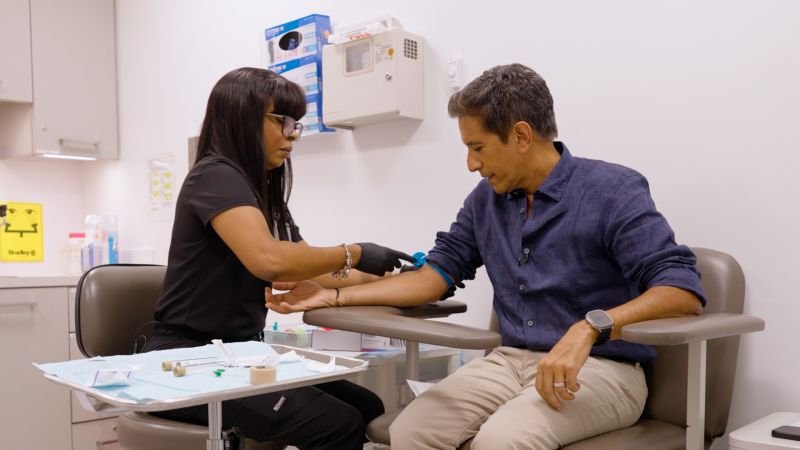
I hadn’t planned on being this nervous. I’m a neurosurgeon. I open skulls for a living.
Over the past 50 years, I’ve had my blood drawn dozens of times and never really thought much of it. “Routine, likely to come back normal,” is what I’ve always thought. Like most people, I’ve had results that were a little off: cholesterol too high one year and blood sugar that was a bit elevated in the past, as well. Dietary changes always did the trick for me.
This time felt different, however. As I watched the phlebotomist label two tubes of blood, I thought, “this will either be nothing, or it will change everything about how I spend the next year of my life.”
The blood test is called Galleri, made by a company called Grail, and it belongs to a new class of blood tests known as multicancer early detection tests. Some people refer to them as liquid biopsies. The idea is absurdly elegant: When tumors grow, most of them shed fragments of their DNA into the bloodstream. A single blood draw can find those DNA fragments and possibly flag the earliest whispers of more than 50 cancers.
That is the point my friend Katrina Firlik made when she called me a few months ago.
Katrina is also a neurosurgeon. We are around the same age and have spent our careers living in the world of scans and certainty. She took the test on a whim, she said. She was perfectly healthy and had no symptoms whatsoever. So she was stunned when it came back positive.
A subsequent PET scan lit up with what she described as a bright lump, “like a light bulb,” sitting in her chest. It was Hodgkin lymphoma, caught so early that her own thoracic surgeon told her, only half-joking, that she might be the luckiest unlucky person he’d ever met: Unlucky because, of course, she had cancer. Lucky because he said he rarely sees tumors that small.
Katrina told me she kept coming back to a single thought: If she hadn’t taken that test, when would this thing have finally made itself known? Would it have been a persistent cough at age 50? Shortness of breath on a hike at 60? Instead, she was able to go through treatment before the disease ever got the chance to make her sick. “I didn’t have to survive a cancer crisis. I got to skip it entirely,” she told me.
I have to admit, it was a pretty compelling story. I asked her if she thought I should get the test, too. “Do you like finding cancer early?” she responded. “Who doesn’t, right?” It’s why I rolled up my sleeve and found myself having that existential moment in a blood testing lab.
The numbers around early detection are genuinely staggering. Between 1975 and 2020, routine screening and prevention efforts are estimated to have prevented about 4.75 million cancer deaths in the United States. That’s one of the great public health achievements of the last half-century.
The catch is that virtually all that benefit comes from just five screenings: breast, cervical, colorectal, lung and prostate. Every other cancer – brain, pancreatic, ovarian, most blood cancers, dozens of others – has no recommended screening test at all. These are typically found the old-fashioned way, when someone starts to feel a little off or develops unrelenting pain. That means later in the process, when they’re harder to treat and the odds have already shifted against the patient.
So, yes, I like the idea of catching cancer early. But as I started to dig into this, I realized it wasn’t quite so simple. Liking an idea and trusting a test are two different things, and the more reporting we did on this issue over the past few months, the more that gap started to bother me.
Here’s the problem, in plain terms: These tests are good at telling you the truth when they’re positive, when they have found something. If Galleri flags something, the odds that it’s a real cancer are legitimately high. It’s called the positive predictive value. Katrina is an example of that.
But a test is really only as useful as its ability to also tell you the truth when it says no. What does “negative” really mean?
That’s where things get complicated.
I reached out to Dr. Vershalee Shukla, who runs a cancer screening program for firefighters in Arizona, a population that, because of chronic exposure to toxins and carcinogens on the job, develops cancer at an elevated rate. Shukla has run close to 10,000 of these liquid biopsies over the past five years. The number of cases they’ve caught this way: fewer than a dozen.
“It’s just not picking up cancers,” she told me. One week, her team drew blood from 500 firefighters on the same day. Every single result came back negative. Sounds good, but here’s the problem with that: No one wanted to go in for their regular screenings afterward, because their negative Galleri result gave them a false sense of security.
It took Shukla and her team close to two years to convince those same firefighters to go back and get the screenings they’d been skipping. When they finally did, they found 15 with cancers.
Here’s how I now think about it: A negative result doesn’t mean you’re totally clean. It means this particular test, on this day, didn’t find anything. If you let that become an excuse to forgo your colonoscopy or mammogram or any other recommended screening test, you just traded away a good screening tool for a false sense of peace.
The company agrees, Grail told me in an email: “All of our physician and patient materials are explicit that Galleri is not a replacement for routine screening and that it should be used in addition to routine screening tests.”
Even a positive test can carry unexpected consequences because, as hard as this might be to believe, not every cancer found early needs to be treated early – or treated at all. Some tumors are so slow-growing, they will never cause a problem in your lifetime. Find one of those, and you haven’t saved a life. You’ve started what doctors call a cascade of care. That might mean more scans, more biopsies, more waiting rooms, more sleepless nights wondering if your body has somehow betrayed you.
As remarkable as these new technologies are, there is an anticlimactic truth underneath it all. We simply don’t know the answer to the most fundamental question: Do they save lives? So far, the massive, lengthy trials to be able to prove that have not been done. This kind of finding can take decades to show.
Despite all that, I took the test anyway. I won’t pretend that it was totally rational or that the weeks of waiting for the results weren’t a little brutal. I thought about my wife and kids, how I would talk them through all this if the results came back positive. Several of my physician colleagues asked why I bothered to torture myself like this. I thought about getting the same call Katrina did and being lucky-unlucky, too.
My test came back negative.
By now you know that wasn’t nothing, but it wasn’t everything, either. It didn’t clear me. It didn’t mean I get to skip my scheduled screenings this year, and I’m not going to. I have my own colonoscopy scheduled right around my birthday.
What this process gave me was a very expensive (about $1,000) education in how to evaluate risk at a time when there are always new tests and options to assess it. Perhaps unsurprisingly, it also provided me with a renewed appreciation for the unglamorous tests we’ve trusted for decades, the colonoscopies and mammograms that nobody particularly enjoys but which come with something Galleri can’t yet offer: proof that they save lives.
What to know about multicancer early detection tests
- There are two multicancer early detection tests in the direct-to-consumer market in the US: Galleri by Grail and Cancerguard by Exact Sciences.
- Both tests say they can detect more than 50 cancers using a simple blood test.
- They are not routinely covered by insurance and cost $700 to $1,000 out of pocket.
- On September 23, advisers to the US Food and Drug Administration will meet to consider whether to recommend approval of the Galleri tests, which could encourage insurance coverage.
CNN’s Nadia Kounang contributed to this report.




Responses