
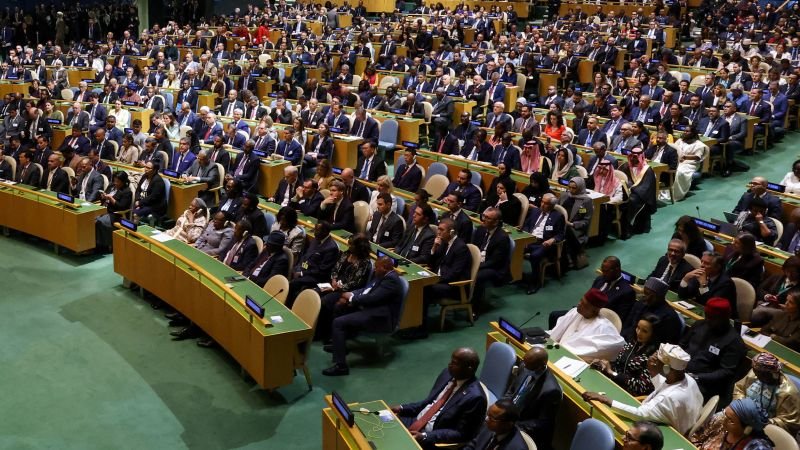
• Iran president speaks: In his UN General Assembly address, Iranian President Masoud Pezeshkian said Iranians have been “the victims of terrorism.” The sole US delegate in the room walked out.
• More on Iran: His speech comes after US President Donald Trump said yesterday that he faced a decision between annihilating Iran or making a deal to end the war. The US said delegations from both countries held talks on the sidelines through mediators.
• Zelensky gives remarks later: Ukrainian President Volodymyr Zelensky, who said he was ready for trilateral talks with Russia and US to end the war in Ukraine, is also speaking today.
• Eyes on Venezuela: Venezuela’s acting President Delcy Rodríguez will address UNGA more than eight months after the US captured her predecessor, Nicolás Maduro, who is currently being held in a Brooklyn detention center just miles away. Trump met with her last night as Washington maintains political pressure on her country to enact reforms.
23 Posts
Iranian President Masoud Pezeshkian told world leaders at the UN General Assembly that Tehran would not allow any nation to use the Strait of Hormuz to “impose their aggressions upon us.”
“They close access for us to our own waterway,” Pezeshkian said.
Still, the president said he sought cooperation in order to achieve security in the region. “Iran does not see her neighbors as security rivals,” he added.
Traffic via the critical waterway, through which one-fifth of global crude oil typically flows, has reduced significantly since the war started in February.
For context: The US military’s blockade of Iranian ports was reimposed in July after the collapse of the tentative ceasefire between the US and Iran. On Monday, US Central Command said US forces redirected 110 commercial vessels to ensure compliance with the blockade.
Iranian President Masoud Pezeshkian said that his country is seeking nuclear technology “for progress, not to threaten societies with weapons.”
“And we wish to cooperate and collaborate for security,” he said.
“We seek energy for progress. For years, there have been — they have labeled centrifuges, international sanctions, other labels when it comes to our nuclear technology. But for our country, peaceful nuclear technology is part of our inherent progress,” Pezeshkian said, citing needs for in advancements industries including agriculture and “supply of electrical energy.”
Pezeshkian also said Iran’s defense systems are a necessity to protect the country from attacks.
“Iran must be powerful, so as to avoid being threatened, to avoid its future being threatened,” he said. “Our defensive systems have been built so that no one can think that bombing of Iranian cities will go unanswered. That is why we have the military power we do for defense.”
Only a few minutes into Iranian President Masoud Pezeshkian’s address at the United Nations General Assembly, the sole US delegate in the room walked out.
Pezeshkian began his speech by rebutting US President Donald Trump’s address at UNGA yesterday, saying that “the United States president described us as terrorists. We have been the victims of terrorism.”
He highlighted the killing of Iran’s former Supreme Leader Ali Khamenei, the bombing of a school on the opening day of the US and Israel’s war with Iran that killed 156 people, and another attack on a sports hall the same day.
As he said this, the US delegate stood up and walked away.
Iranian President Masoud Pezeshkian started his speech to the UN General Assembly today by highlighting the deadly US strike on an Iranian elementary school at the outset of the war.
Pezeshkian said he came from “an Iran where, in truth, they bombed a school. You see, these children; these children perished under bombs with weapons used by the United States and Israel,” he said.
“They were innocent, had committed no crimes,” he added.
At least 120 children and 26 teachers, were among those killed when the school in the southern city of Minab was struck on February 28, according to Iranian officials.
Iranian President Masoud Pezeshkian is now delivering remarks to the United Nations General Assembly, as the conflict with his country approaches the seven-month mark.
US Secretary of State Marco Rubio and Russian Foreign Minister Sergey Lavrov have begun their meeting on the sidelines of the UN General Assembly.
The US and the Russian press pools were brought into the meeting room at the beginning, where the delegations sat facing each other at a long table. Rubio’s delegation included top State Department officials, Ambassador to the UN Mike Waltz, and Deputy National Security Adviser Mike Needham. The Russian delegation included Ambassador to the UN Vassily Nebenzia and Ambassador to the US Alexander Darchiev.
After a few moments to allow for photos, the pool shouted questions, including when the US would impose sanctions under the new Graham law. Neither answered, though Lavrov seemed to question why the press corps was “silent” at the beginning.
The Trump-led Board of Peace is delivering a “high-level” briefing on the sidelines of the United Nations General Assembly on Wednesday morning amid the stalled Gaza ceasefire plan.
The Board of Peace, which was created earlier this year and tasked with leading the Gaza ceasefire and reconstruction effort, has struggled to make substantive progress, with Hamas refusing to disarm and Israel carrying out near-daily strikes in Gaza.
In August, the board once again demanded that Hamas disarm before Israel would be required to withdraw its forces from Gaza. But Hamas has refused to unilaterally turn over its weapons, insisting on a phased approach with steps taken concurrently by both Israel and Hamas.
Israeli Prime Minister Benjamin Netanyahu, who is set to speak on Thursday at the UN, rejected the latest US-backed peace plan for Gaza which was laid out in a 15-point plan, leaving the future of the effort in doubt.
US President Donald Trump touted his Board of Peace during his remarks to the United Nations General Assembly yesterday, calling it a “significant group of people.”
Earlier this year, Trump said that the international body he formed to oversee the reconstruction of Gaza, “might” one day replace the United Nations.
But as Trump and other world leaders on the board attend this week’s General Debate, the Board of Peace has struggled to make tangible progress on peace efforts in the Middle East, and questions linger about its mission and effectiveness.
There will be a “high-level” briefing for the Board of Peace this week, a source familiar with the matter told CNN.
What is the Board of Peace? Trump initially pitched the board as a group overseeing the reconstruction of the Gaza Strip, but its stated mission has since expanded to tackle conflicts the world over.
Members of the panel, which Trump chairs, include several Gulf states, Turkey, Pakistan, Argentina and others, but most of the US’ European allies have not joined. Permanent membership carried a $1 billion price tag.
Despite major financial and personnel commitments Trump says board members have pledged, tangible progress has been scarce. The board still has yet to enter Gaza, and Israeli attacks on the Palestinian enclave have continued.
In July, Trump said the Board of Peace had reached a breakthrough in Gaza that involved Hamas surrendering its weapons as part of a 15-point peace plan. A senior Hamas official said that commitment was contingent on Israel upholding its obligations under the October ceasefire agreement.
But Israeli Prime Minister Benjamin Netanyahu said in August that Israel rejected the peace plan, demanding the full disarmament of Hamas before any Israeli forces withdraw.
CNN’s Jennifer Hansler, Kylie Atwood, Helen Regan, Kara Fox, Alejandra Jaramillo, Jeremy Diamond, Tal Shalev and Oren Liebermann contributed reporting.
Iranian President Masoud Pezeshkian is expected to speak at today’s United Nations General Assembly, nearly seven months since US-Israeli strikes started the war with Iran.
Here are some of the latest developments on the conflict:
Despite the US and Iran reaching a memorandum of understanding aimed at ending the war back in June, fighting has continued in the months since.
US President Donald Trump announced that the ceasefire was “OVER!” in early July, after Iran’s targeting of three commercial vessels in the Strait of Hormuz prompted an exchange of strikes.
In subsequent months, Trump stressed his disinterest in diplomacy and instructed US officials to end talks. Earlier this month, however, he said he was open to the “concept” of reopening negotiations with Iran.
Yesterday, Trump said that he has a “big decision” to make on Iran — casting it as a choice between striking a deal after the US midterm elections in November or annihilating Iran.
Later in the day, he said that members of his administration met with the Iranian delegation at the UN General Assembly for about three hours, in what he described as a “very good meeting.”
Meanwhile, Iranian officials have met with their counterparts in countries including Oman, the United Arab Emirates, and China in recent weeks.
In comments made at the start of this month, Pezeshkian said that, if the US “returns to its commitments under the aforementioned memorandum of understanding,” his country “will immediately reciprocate.”
Since the ceasefire broke down in July, the US has launched a number of attacks on Iran, with Tehran also targeting American bases in the region and vessels in the Strait of Hormuz.
Then, after a period of relative calm lasting for more than a month, the US and Iran began exchanging regular strikes at the end of August.
On August 30, the US military stuck Iran’s Larak Island, where it said forces were observed preparing to launch mines into the strait.
Iran’s Islamic Revolutionary Guard Corps (IRGC) vowed retaliation, firing missiles into Jordan, though they were intercepted, according to a US official.
In an update on September 8, the US military said it had “destroyed five Iranian crude oil carriers” after the IRGC “targeted a US Navy warship with ballistic missiles.”
Fighting has appears to have quietened, with no US strikes on Iran being publicly reported for more than two weeks.
CNN’s Kevin Liptak, Mostafa Salem, Aida Karimi, Maureen Chowdhury and Kit Maher contributed to this reporting.
Iranian President Masoud Pezeshkian said he will use his General Assembly address to highlight the deaths of dozens of children in a strike on an elementary school in southern Iran at the outset of the war.
Here’s a recap of what happened:
On February 28, at the start of the US-Iran war, the US struck the Shajareh Tayyiba school in Minab, southern Iran, while the US military was attacking a neighboring Islamic Revolutionary Guard Corps facility, CNN has reported. At least 156 people, including 120 children and 26 teachers, were killed, according to Iranian officials.
The strike was considered one of the worst civilian casualty incidents in recent US military history.
In March, two sources briefed on the preliminary findings of an ongoing internal investigation told CNN that US Central Command created target coordinates for the strike that hit the school using outdated information provided by the Defense Intelligence Agency, which contributed to the mistake.
US President Donald Trump had initially asserted that Iran might be to blame for the strike, though when pressed on why no one in his own administration seemed to be publicly supporting that claim, he responded: “Because I just don’t know enough about it.”
The Pentagon’s internal investigation remains stuck in limbo, as the stage where Defense Intelligence Agency analysts review satellite imagery and other intelligence sources has not yet been ordered by the Pentagon, three sources familiar with the matter told CNN in July.
This month, a United Nations fact-finding mission concluded in a new report that the strike may have been a war crime. The findings by the UN’s Independent International Fact-Finding Mission still need to be presented to the UN Human Rights Council, but could later be used by international courts like the International Criminal Court.
The leaders of Ukraine and Iran are set to speak at the United Nations General Assembly today amid a pair of ongoing conflicts that, while separate, have contributed to tensions between the countries.
Russia launched its full-scale invasion of Ukraine in February 2022, while Iran has been at war with the US and Israel since late February this year.
Though Tehran and Kyiv are nearly 1,500 miles apart as the crow flies, the wars have overlapping factors, as Iran and Russia are close strategic and military allies.
Many of Russia’s attacks on Ukraine have been carried out using Iranian-made Shahed drones, and Tehran has sent missiles and other weaponry to aid Moscow’s war effort.
Shortly after the Iran war broke out earlier this year, Ukrainian President Volodymyr Zelensky offered to help other countries, including the US, fend off Iranian drones and missiles.
Around the same time, CNN reported that Russia was helping Iran with advanced drone tactics and providing intelligence about US military positioning.
Ukraine has posted drone experts in the Middle East to help allies counter Iranian attacks, according to Zelensky. Kyiv has also signed defense agreements with Saudi Arabia and Qatar.
In late July, tensions flared further when Ukraine struck ships in the Caspian Sea involved in transporting military goods from Iran to Russia.
Iran condemned the attack, which killed one person, and threatened retaliation.
The next day, the foreign ministers of each country held a phone call.
Ukrainian Foreign Minister Andrii Sybiha stressed that his country’s actions were aimed at defending Ukraine “from Russian aggression and never intended to target civilian vessels or people.” Iranian Foreign Minister Abbas Araghchi said later that Syviha assured him the attack was unintentional.
CNN’s Kylie Atwood, Max Saltman, Nina Subkhanberdina, Natasha Bertrand, Jim Sciutto, Zachary Cohen, Jennifer Hansler, Nick Paton Walsh, Svitlana Vlasova, Victoria Butenko, Ivana Kottasová, Kosta Gak, Tim Lister, Karina Tsui, Billy Stockwell and Mohammed Tawfeeq contributed to this reporting.
President Donald Trump may be open to meeting his Iranian counterpart at the United Nations. History suggests Tehran will not reciprocate – even under far more favorable circumstances.
The United Nations General Assembly has already provided a venue for indirect negotiations between Iranian and American officials, marking a small but significant step forward in the war. Secretary of State Marco Rubio has said the president himself would be open to meeting Iranian President Masoud Pezeshkian.
The UN has brought longtime adversaries face to face, from Bill Clinton and Fidel Castro in 2000 to Barack Obama and Raúl Castro in 2015. Yet since the Islamic Republic was founded in 1979, no Iranian president has publicly shaken hands with an American counterpart at the UN or elsewhere.
It wasn’t for lack of trying.
In 2000, aides reportedly choreographed an impromptu hallway handshake between President Bill Clinton and Iranian President Mohammad Khatami at the United Nations. Khatami allegedly retreated to a restroom to avoid the encounter after Tehran vetoed it. The episode came during a rare diplomatic thaw, when both presidents had been engaged in conciliatory gestures and exploring better relations.
Thirteen years later, with relations warming, speculation mounted in New York over another possible handshake, this time between Presidents Barack Obama and Hassan Rouhani, also on the sidelines of the UN gathering. The plan collapsed once more when the Iranians refused a purely symbolic gesture without a follow-up plan, while other reports cited complications “back home.”
The closest a US President has come to a shaking hands with an Iranian counterpart was in 2015, when Obama shook hands with Iranian Foreign Minister Javad Zarif after the nuclear deal between Western powers and the Islamic Republic.
Trump tore up that agreement, imposed an unprecedented maximum pressure sanctions campaign on Iran, and launched the first direct US war on the Islamic Republic, killing its supreme leader.
Iranian President Masoud Pezeshkian’s security is being provided by the US Secret Service during the United Nations General Assembly, according to American officials.
Other Iranian officials are protected by the State Department’s Diplomatic Security Service, the officials said.
The federal security services for Pezeshkian and other members of the Iranian delegation are backed up by members of the New York Police Department’s Intelligence Bureau, along with NYPD detectives and highway patrol escorts, officials told CNN.
As a founding member of the UN, Iran has maintained a presence at the global diplomatic event for decades, led most recently by the country’s president, Pezeshkian, and his predecessor, Ebrahim Raisi.
But the presence of Iran’s delegation this year, on the home turf of a country with which it remains at war, is unprecedented in recent years.
CNN’s Billy Stockwell and Jennifer Hansler contributed to this report.
With nearly 200 foreign dignitaries expected to be in New York City this week, security across the metropolis has been ramped up, with thousands of New York City Police Department (NYPD) officers being posted at or around UN headquarters, according to New York City Police Commissioner Jessica Tisch.
Tisch held a security briefing on this week’s United Nations General Assembly (UNGA) alongside New York City Mayor Zohran Mamdani on Thursday, where officials outlined their plans to ensure the event’s safety.
Mamdani called it an “honor” for his city to be the host of UNGA, but noted that “New York City is always a target, and especially so when thousands of international representatives are present.”
The NYPD will work alongside the US Secret Service and the State Department’s Diplomatic Security Service to protect foreign dignitaries during the assembly, he said.
Mamdani stressed that there are “no known specific or credible threats” against either UNGA or New York City, but said that “our security posture will be elevated out of an abundance of caution. This is standard procedure.”
Earlier this month, the New York City Department of Transportation (NYC DOT) warned of “extensive street closures and delays across Manhattan.”
At times, areas will be closed to both pedestrians and vehicles, including the Franklin D. Roosevelt East River Drive, Mamdani said.
A temporary flight restriction will also be in effect within a 2-nautical-mile radius of the UN until Saturday, according to Tisch.
The General Debate of the 81st session of the United Nations General Assembly (UNGA) began yesterday, with world leaders from dozens of countries delivering addresses and taking part in meetings.
Here’s a look back at some of the key events that took place yesterday:
UN Secretary General Antonio Guterres delivered his opening remarks to kick off the day’s speeches, warning that the “fault lines in our world are widening.”
US President Donald Trump said that he has a “big decision” to make on Iran — casting it as a choice between striking a deal after the midterm elections or annihilating Iran.
Trump later said that members of his administration met with the Iranian delegation at UNGA for about three hours yesterday, in what he described vaguely as a “very good meeting.”
As Trump said during his address that Cuba’s communist government “will fall,” the Cuban delegation stood up and walked out of the room.
The US leader met with British Prime Minister Andy Burnham for the first time yesterday, with the pair bonding over their shared hope for Britain’s future.
Trump also met with acting Venezuelan President Delcy Rodríguez, as Washington maintains political pressure on her country to enact reforms.
Ukrainian President Volodymyr Zelensky said he is ready to meet with Russian leader Vladimir Putin for a trilateral meeting with the US to end the war in Ukraine.
CNN’s Billy Stockwell, Maureen Chowdhury, Alejandra Jaramillo, Kit Maher, Michael Rios, Mitchell McCluskey, Maria Sole Campinoti, and Daria Tarasova-Markina contributed to this reporting.
Senior US and Iranian officials held talks in New York for the first time in more than three months yesterday as President Donald Trump outlined Iran’s options: reach an agreement or face “annihilation.”
As the war entered its seventh month, US special envoy Steve Witkoff held “lengthy talks” with Iranian Foreign Minister Abbas Araghchi through mediators, the highest-level diplomatic contact between the warring parties since a ceasefire agreed in June quickly unravelled.
It’s unclear what the parties discussed during several hours of talks, and no significant breakthrough was reported. In customary fashion, Iranian media said Araghchi reiterated Tehran’s general demands, including the unfreezing of Iranian assets, lifting of the US’ naval blockade on the Islamic Republic, and an end to wars on “all resistance fronts.”
Whether that includes Yemen remains uncertain. Iran-backed Houthi rebels there have made significant advances and disrupted Saudi oil exports since the last round of talks.
Witkoff said on X that the talks were indirect, with mediators shuttling between the parties.
King Abdullah of Jordan was seen crossing his fingers in videos posted on X when asked after the meeting if a deal with Iran was possible.
“There’s a consensus that we need a way forward. That’s the only consensus,” US ambassador to Turkey, Tom Barrack, told reporters after the meeting, a video showed.
Diplomacy between Iran and the US had stalled in recent months as the region descended into further uncertainty over how the war will end. The Strait of Hormuz is still in turmoil as shadow fleet of tankers carry fuel through drone-threatened waters and the US and Iran exchange sporadic strikes.
At first glance, the order of countries speaking at the UN General Assembly seems a bit random. It isn’t alphabetical. It isn’t organized by region. And, though the US went second, it isn’t really organized by any metric of geopolitical power.
The system is more complicated than that. Ever since 1955, Brazil has opened the debate (except for 1983 and 1984) because “in the very early times, when no one wanted to speak first, Brazil always offered to speak first,” Desmond Parker, then the UN’s chief of protocol, told NPR in 2010.
The US then speaks second since it hosts the event. After that, a mixture of factors determines the order, including what representative a country sends, what date they applied to speak and keeping a geographic balance in the lineup.
“Everyone else follows in the order of the date at which the request was made. So, if we opened the speaker’s list as of the 10th of May, everyone who has applied to speak on the 11th of May will earn an early slot,” Parker said.
“The actual order is determined by precedence, meaning that heads of state speak first, followed by heads of government, followed by vice presidents, crown princes, ministers of foreign affairs and then other deputy ministers.”
This week, dozens of world leaders are gathering at the United Nations Headquarters in New York, where the 81st session of the UN General Assembly (UNGA) will take place.
UNGA was established in 1945, the same year that the UN was founded, and is the “chief deliberative, policymaking and representative organ” of the organization, its website says.
The assembly is made up of all 193 United Nations members, who vote on important international issues and take part in high-level debates.
The UNGA also “makes recommendations to States on international issues within its competence,” including political, economic, humanitarian, social and legal matters, it says.
The theme for this year’s general debate at UNGA is “restoring trust, managing transformation: a United Nations that delivers for all,” according to the UN’s website.
Every year, an UNGA president is elected by the assembly’s members. The post rotates among the UN’s five regional groups: African States, Asia-Pacific States, Eastern European States, Latin American and Caribbean States and Western European and other States.
The president of this year’s UNGA session is Khalilur Rahman, the foreign minister of Bangladesh, whose program is designed around “six interlocking pillars.”
One of these “pillars” involves encouraging the peaceful resolution of conflicts, the protection of civilians, upholding international humanitarian law, and fighting against intolerance, hate speech, and disinformation.
Other “pillars” are focused on topics including sustainability, protecting human rights, digital governance and multilateralism.
During his speech to the UN General Assembly yesterday, US President Donald Trump spoke about many of the biggest geopolitical issues but didn’t really deliver any big surprises.
On Iran: Most notably, he weighed a “big decision” on Iran, threatening to either “annihilate” the country or strike a deal, likely after the US midterm elections in November.
He boasted that Tehran’s power in the Middle East has been broken by the war and denied the US is low on munitions, despite a recent report from the Pentagon’s official watchdog acknowledging the depletion of key US munition stockpiles amid the war with Iran.
On Cuba: Trump also threatened Cuba, saying its communist government “will fall,” prompting the country’s delegation to walk out the room. He said his administration is “seeking a fundamental change” in Cuba, before noting that US Secretary of State Marco Rubio is leading negotiations with Havana.
On Greenland: He announced the US will “immediately begin the process of developing a large military presence” in Greenland. The US has operated a military base on the Arctic territory since 1951.
On AI: Trump once again dismissed calls to slowdown the development of AI, saying he won’t “stifle growth of something that will be bigger than the industrial revolution.”
CNN’s Alayna Treene, Alejandra Jaramillo and Maureen Chowdhury contributed to this reporting.
After dozens of world leaders addressed the United Nations General Assembly in New York yesterday, another 37 are set to speak today.
Here’s a look at who is scheduled this morning:
First to address UNGA today will be Syrian President Ahmed al-Sharaa. Last year, he became the first Syrian leader to do so in almost 60 years, after toppling the Assad regime in December 2024.
Speaking fifth will be Iranian President Masoud Pezeshkian. His visit to the New York City comes as the US-Iran war is ongoing.
Ukrainian leader Volodymyr Zelensky will be the 17th leader to speak this morning. At a press conference on the sidelines of the assembly yesterday, Zelensky said that he is ready to meet with Russian leader Vladimir Putin for a trilateral meeting with the US to end the war in his country
Leaders from another 18 countries are also set to speak this morning, including the heads of state from Latvia, Romania, Burundi, Paraguay, the Czech Republic, Argentina, Estonia and Timor Leste.
The leaders of Libya, Palau, Cyprus, the Dominican Republic, Botswana, Ecuador, Bulgaria, the Central African Republic, Panama and Ethiopia are also scheduled.
Will bring you the major lines from speeches as they happen.
• Iran president speaks: In his UN General Assembly address, Iranian President Masoud Pezeshkian said Iranians have been “the victims of terrorism.” The sole US delegate in the room walked out.
• More on Iran: His speech comes after US President Donald Trump said yesterday that he faced a decision between annihilating Iran or making a deal to end the war. The US said delegations from both countries held talks on the sidelines through mediators.
• Zelensky gives remarks later: Ukrainian President Volodymyr Zelensky, who said he was ready for trilateral talks with Russia and US to end the war in Ukraine, is also speaking today.
• Eyes on Venezuela: Venezuela’s acting President Delcy Rodríguez will address UNGA more than eight months after the US captured her predecessor, Nicolás Maduro, who is currently being held in a Brooklyn detention center just miles away. Trump met with her last night as Washington maintains political pressure on her country to enact reforms.
Iranian President Masoud Pezeshkian told world leaders at the UN General Assembly that Tehran would not allow any nation to use the Strait of Hormuz to “impose their aggressions upon us.”
“They close access for us to our own waterway,” Pezeshkian said.
Still, the president said he sought cooperation in order to achieve security in the region. “Iran does not see her neighbors as security rivals,” he added.
Traffic via the critical waterway, through which one-fifth of global crude oil typically flows, has reduced significantly since the war started in February.
For context: The US military’s blockade of Iranian ports was reimposed in July after the collapse of the tentative ceasefire between the US and Iran. On Monday, US Central Command said US forces redirected 110 commercial vessels to ensure compliance with the blockade.
Iranian President Masoud Pezeshkian said that his country is seeking nuclear technology “for progress, not to threaten societies with weapons.”
“And we wish to cooperate and collaborate for security,” he said.
“We seek energy for progress. For years, there have been — they have labeled centrifuges, international sanctions, other labels when it comes to our nuclear technology. But for our country, peaceful nuclear technology is part of our inherent progress,” Pezeshkian said, citing needs for in advancements industries including agriculture and “supply of electrical energy.”
Pezeshkian also said Iran’s defense systems are a necessity to protect the country from attacks.
“Iran must be powerful, so as to avoid being threatened, to avoid its future being threatened,” he said. “Our defensive systems have been built so that no one can think that bombing of Iranian cities will go unanswered. That is why we have the military power we do for defense.”
Only a few minutes into Iranian President Masoud Pezeshkian’s address at the United Nations General Assembly, the sole US delegate in the room walked out.
Pezeshkian began his speech by rebutting US President Donald Trump’s address at UNGA yesterday, saying that “the United States president described us as terrorists. We have been the victims of terrorism.”
He highlighted the killing of Iran’s former Supreme Leader Ali Khamenei, the bombing of a school on the opening day of the US and Israel’s war with Iran that killed 156 people, and another attack on a sports hall the same day.
As he said this, the US delegate stood up and walked away.
Iranian President Masoud Pezeshkian started his speech to the UN General Assembly today by highlighting the deadly US strike on an Iranian elementary school at the outset of the war.
Pezeshkian said he came from “an Iran where, in truth, they bombed a school. You see, these children; these children perished under bombs with weapons used by the United States and Israel,” he said.
“They were innocent, had committed no crimes,” he added.
At least 120 children and 26 teachers, were among those killed when the school in the southern city of Minab was struck on February 28, according to Iranian officials.
Iranian President Masoud Pezeshkian is now delivering remarks to the United Nations General Assembly, as the conflict with his country approaches the seven-month mark.
US Secretary of State Marco Rubio and Russian Foreign Minister Sergey Lavrov have begun their meeting on the sidelines of the UN General Assembly.
The US and the Russian press pools were brought into the meeting room at the beginning, where the delegations sat facing each other at a long table. Rubio’s delegation included top State Department officials, Ambassador to the UN Mike Waltz, and Deputy National Security Adviser Mike Needham. The Russian delegation included Ambassador to the UN Vassily Nebenzia and Ambassador to the US Alexander Darchiev.
After a few moments to allow for photos, the pool shouted questions, including when the US would impose sanctions under the new Graham law. Neither answered, though Lavrov seemed to question why the press corps was “silent” at the beginning.
The Trump-led Board of Peace is delivering a “high-level” briefing on the sidelines of the United Nations General Assembly on Wednesday morning amid the stalled Gaza ceasefire plan.
The Board of Peace, which was created earlier this year and tasked with leading the Gaza ceasefire and reconstruction effort, has struggled to make substantive progress, with Hamas refusing to disarm and Israel carrying out near-daily strikes in Gaza.
In August, the board once again demanded that Hamas disarm before Israel would be required to withdraw its forces from Gaza. But Hamas has refused to unilaterally turn over its weapons, insisting on a phased approach with steps taken concurrently by both Israel and Hamas.
Israeli Prime Minister Benjamin Netanyahu, who is set to speak on Thursday at the UN, rejected the latest US-backed peace plan for Gaza which was laid out in a 15-point plan, leaving the future of the effort in doubt.
US President Donald Trump touted his Board of Peace during his remarks to the United Nations General Assembly yesterday, calling it a “significant group of people.”
Earlier this year, Trump said that the international body he formed to oversee the reconstruction of Gaza, “might” one day replace the United Nations.
But as Trump and other world leaders on the board attend this week’s General Debate, the Board of Peace has struggled to make tangible progress on peace efforts in the Middle East, and questions linger about its mission and effectiveness.
There will be a “high-level” briefing for the Board of Peace this week, a source familiar with the matter told CNN.
What is the Board of Peace? Trump initially pitched the board as a group overseeing the reconstruction of the Gaza Strip, but its stated mission has since expanded to tackle conflicts the world over.
Members of the panel, which Trump chairs, include several Gulf states, Turkey, Pakistan, Argentina and others, but most of the US’ European allies have not joined. Permanent membership carried a $1 billion price tag.
Despite major financial and personnel commitments Trump says board members have pledged, tangible progress has been scarce. The board still has yet to enter Gaza, and Israeli attacks on the Palestinian enclave have continued.
In July, Trump said the Board of Peace had reached a breakthrough in Gaza that involved Hamas surrendering its weapons as part of a 15-point peace plan. A senior Hamas official said that commitment was contingent on Israel upholding its obligations under the October ceasefire agreement.
But Israeli Prime Minister Benjamin Netanyahu said in August that Israel rejected the peace plan, demanding the full disarmament of Hamas before any Israeli forces withdraw.
CNN’s Jennifer Hansler, Kylie Atwood, Helen Regan, Kara Fox, Alejandra Jaramillo, Jeremy Diamond, Tal Shalev and Oren Liebermann contributed reporting.
Iranian President Masoud Pezeshkian is expected to speak at today’s United Nations General Assembly, nearly seven months since US-Israeli strikes started the war with Iran.
Here are some of the latest developments on the conflict:
Despite the US and Iran reaching a memorandum of understanding aimed at ending the war back in June, fighting has continued in the months since.
US President Donald Trump announced that the ceasefire was “OVER!” in early July, after Iran’s targeting of three commercial vessels in the Strait of Hormuz prompted an exchange of strikes.
In subsequent months, Trump stressed his disinterest in diplomacy and instructed US officials to end talks. Earlier this month, however, he said he was open to the “concept” of reopening negotiations with Iran.
Yesterday, Trump said that he has a “big decision” to make on Iran — casting it as a choice between striking a deal after the US midterm elections in November or annihilating Iran.
Later in the day, he said that members of his administration met with the Iranian delegation at the UN General Assembly for about three hours, in what he described as a “very good meeting.”
Meanwhile, Iranian officials have met with their counterparts in countries including Oman, the United Arab Emirates, and China in recent weeks.
In comments made at the start of this month, Pezeshkian said that, if the US “returns to its commitments under the aforementioned memorandum of understanding,” his country “will immediately reciprocate.”
Since the ceasefire broke down in July, the US has launched a number of attacks on Iran, with Tehran also targeting American bases in the region and vessels in the Strait of Hormuz.
Then, after a period of relative calm lasting for more than a month, the US and Iran began exchanging regular strikes at the end of August.
On August 30, the US military stuck Iran’s Larak Island, where it said forces were observed preparing to launch mines into the strait.
Iran’s Islamic Revolutionary Guard Corps (IRGC) vowed retaliation, firing missiles into Jordan, though they were intercepted, according to a US official.
In an update on September 8, the US military said it had “destroyed five Iranian crude oil carriers” after the IRGC “targeted a US Navy warship with ballistic missiles.”
Fighting has appears to have quietened, with no US strikes on Iran being publicly reported for more than two weeks.
CNN’s Kevin Liptak, Mostafa Salem, Aida Karimi, Maureen Chowdhury and Kit Maher contributed to this reporting.
Iranian President Masoud Pezeshkian said he will use his General Assembly address to highlight the deaths of dozens of children in a strike on an elementary school in southern Iran at the outset of the war.
Here’s a recap of what happened:
On February 28, at the start of the US-Iran war, the US struck the Shajareh Tayyiba school in Minab, southern Iran, while the US military was attacking a neighboring Islamic Revolutionary Guard Corps facility, CNN has reported. At least 156 people, including 120 children and 26 teachers, were killed, according to Iranian officials.
The strike was considered one of the worst civilian casualty incidents in recent US military history.
In March, two sources briefed on the preliminary findings of an ongoing internal investigation told CNN that US Central Command created target coordinates for the strike that hit the school using outdated information provided by the Defense Intelligence Agency, which contributed to the mistake.
US President Donald Trump had initially asserted that Iran might be to blame for the strike, though when pressed on why no one in his own administration seemed to be publicly supporting that claim, he responded: “Because I just don’t know enough about it.”
The Pentagon’s internal investigation remains stuck in limbo, as the stage where Defense Intelligence Agency analysts review satellite imagery and other intelligence sources has not yet been ordered by the Pentagon, three sources familiar with the matter told CNN in July.
This month, a United Nations fact-finding mission concluded in a new report that the strike may have been a war crime. The findings by the UN’s Independent International Fact-Finding Mission still need to be presented to the UN Human Rights Council, but could later be used by international courts like the International Criminal Court.
The leaders of Ukraine and Iran are set to speak at the United Nations General Assembly today amid a pair of ongoing conflicts that, while separate, have contributed to tensions between the countries.
Russia launched its full-scale invasion of Ukraine in February 2022, while Iran has been at war with the US and Israel since late February this year.
Though Tehran and Kyiv are nearly 1,500 miles apart as the crow flies, the wars have overlapping factors, as Iran and Russia are close strategic and military allies.
Many of Russia’s attacks on Ukraine have been carried out using Iranian-made Shahed drones, and Tehran has sent missiles and other weaponry to aid Moscow’s war effort.
Shortly after the Iran war broke out earlier this year, Ukrainian President Volodymyr Zelensky offered to help other countries, including the US, fend off Iranian drones and missiles.
Around the same time, CNN reported that Russia was helping Iran with advanced drone tactics and providing intelligence about US military positioning.
Ukraine has posted drone experts in the Middle East to help allies counter Iranian attacks, according to Zelensky. Kyiv has also signed defense agreements with Saudi Arabia and Qatar.
In late July, tensions flared further when Ukraine struck ships in the Caspian Sea involved in transporting military goods from Iran to Russia.
Iran condemned the attack, which killed one person, and threatened retaliation.
The next day, the foreign ministers of each country held a phone call.
Ukrainian Foreign Minister Andrii Sybiha stressed that his country’s actions were aimed at defending Ukraine “from Russian aggression and never intended to target civilian vessels or people.” Iranian Foreign Minister Abbas Araghchi said later that Syviha assured him the attack was unintentional.
CNN’s Kylie Atwood, Max Saltman, Nina Subkhanberdina, Natasha Bertrand, Jim Sciutto, Zachary Cohen, Jennifer Hansler, Nick Paton Walsh, Svitlana Vlasova, Victoria Butenko, Ivana Kottasová, Kosta Gak, Tim Lister, Karina Tsui, Billy Stockwell and Mohammed Tawfeeq contributed to this reporting.
President Donald Trump may be open to meeting his Iranian counterpart at the United Nations. History suggests Tehran will not reciprocate – even under far more favorable circumstances.
The United Nations General Assembly has already provided a venue for indirect negotiations between Iranian and American officials, marking a small but significant step forward in the war. Secretary of State Marco Rubio has said the president himself would be open to meeting Iranian President Masoud Pezeshkian.
The UN has brought longtime adversaries face to face, from Bill Clinton and Fidel Castro in 2000 to Barack Obama and Raúl Castro in 2015. Yet since the Islamic Republic was founded in 1979, no Iranian president has publicly shaken hands with an American counterpart at the UN or elsewhere.
It wasn’t for lack of trying.
In 2000, aides reportedly choreographed an impromptu hallway handshake between President Bill Clinton and Iranian President Mohammad Khatami at the United Nations. Khatami allegedly retreated to a restroom to avoid the encounter after Tehran vetoed it. The episode came during a rare diplomatic thaw, when both presidents had been engaged in conciliatory gestures and exploring better relations.
Thirteen years later, with relations warming, speculation mounted in New York over another possible handshake, this time between Presidents Barack Obama and Hassan Rouhani, also on the sidelines of the UN gathering. The plan collapsed once more when the Iranians refused a purely symbolic gesture without a follow-up plan, while other reports cited complications “back home.”
The closest a US President has come to a shaking hands with an Iranian counterpart was in 2015, when Obama shook hands with Iranian Foreign Minister Javad Zarif after the nuclear deal between Western powers and the Islamic Republic.
Trump tore up that agreement, imposed an unprecedented maximum pressure sanctions campaign on Iran, and launched the first direct US war on the Islamic Republic, killing its supreme leader.
Iranian President Masoud Pezeshkian’s security is being provided by the US Secret Service during the United Nations General Assembly, according to American officials.
Other Iranian officials are protected by the State Department’s Diplomatic Security Service, the officials said.
The federal security services for Pezeshkian and other members of the Iranian delegation are backed up by members of the New York Police Department’s Intelligence Bureau, along with NYPD detectives and highway patrol escorts, officials told CNN.
As a founding member of the UN, Iran has maintained a presence at the global diplomatic event for decades, led most recently by the country’s president, Pezeshkian, and his predecessor, Ebrahim Raisi.
But the presence of Iran’s delegation this year, on the home turf of a country with which it remains at war, is unprecedented in recent years.
CNN’s Billy Stockwell and Jennifer Hansler contributed to this report.
With nearly 200 foreign dignitaries expected to be in New York City this week, security across the metropolis has been ramped up, with thousands of New York City Police Department (NYPD) officers being posted at or around UN headquarters, according to New York City Police Commissioner Jessica Tisch.
Tisch held a security briefing on this week’s United Nations General Assembly (UNGA) alongside New York City Mayor Zohran Mamdani on Thursday, where officials outlined their plans to ensure the event’s safety.
Mamdani called it an “honor” for his city to be the host of UNGA, but noted that “New York City is always a target, and especially so when thousands of international representatives are present.”
The NYPD will work alongside the US Secret Service and the State Department’s Diplomatic Security Service to protect foreign dignitaries during the assembly, he said.
Mamdani stressed that there are “no known specific or credible threats” against either UNGA or New York City, but said that “our security posture will be elevated out of an abundance of caution. This is standard procedure.”
Earlier this month, the New York City Department of Transportation (NYC DOT) warned of “extensive street closures and delays across Manhattan.”
At times, areas will be closed to both pedestrians and vehicles, including the Franklin D. Roosevelt East River Drive, Mamdani said.
A temporary flight restriction will also be in effect within a 2-nautical-mile radius of the UN until Saturday, according to Tisch.
The General Debate of the 81st session of the United Nations General Assembly (UNGA) began yesterday, with world leaders from dozens of countries delivering addresses and taking part in meetings.
Here’s a look back at some of the key events that took place yesterday:
UN Secretary General Antonio Guterres delivered his opening remarks to kick off the day’s speeches, warning that the “fault lines in our world are widening.”
US President Donald Trump said that he has a “big decision” to make on Iran — casting it as a choice between striking a deal after the midterm elections or annihilating Iran.
Trump later said that members of his administration met with the Iranian delegation at UNGA for about three hours yesterday, in what he described vaguely as a “very good meeting.”
As Trump said during his address that Cuba’s communist government “will fall,” the Cuban delegation stood up and walked out of the room.
The US leader met with British Prime Minister Andy Burnham for the first time yesterday, with the pair bonding over their shared hope for Britain’s future.
Trump also met with acting Venezuelan President Delcy Rodríguez, as Washington maintains political pressure on her country to enact reforms.
Ukrainian President Volodymyr Zelensky said he is ready to meet with Russian leader Vladimir Putin for a trilateral meeting with the US to end the war in Ukraine.
CNN’s Billy Stockwell, Maureen Chowdhury, Alejandra Jaramillo, Kit Maher, Michael Rios, Mitchell McCluskey, Maria Sole Campinoti, and Daria Tarasova-Markina contributed to this reporting.
Senior US and Iranian officials held talks in New York for the first time in more than three months yesterday as President Donald Trump outlined Iran’s options: reach an agreement or face “annihilation.”
As the war entered its seventh month, US special envoy Steve Witkoff held “lengthy talks” with Iranian Foreign Minister Abbas Araghchi through mediators, the highest-level diplomatic contact between the warring parties since a ceasefire agreed in June quickly unravelled.
It’s unclear what the parties discussed during several hours of talks, and no significant breakthrough was reported. In customary fashion, Iranian media said Araghchi reiterated Tehran’s general demands, including the unfreezing of Iranian assets, lifting of the US’ naval blockade on the Islamic Republic, and an end to wars on “all resistance fronts.”
Whether that includes Yemen remains uncertain. Iran-backed Houthi rebels there have made significant advances and disrupted Saudi oil exports since the last round of talks.
Witkoff said on X that the talks were indirect, with mediators shuttling between the parties.
King Abdullah of Jordan was seen crossing his fingers in videos posted on X when asked after the meeting if a deal with Iran was possible.
“There’s a consensus that we need a way forward. That’s the only consensus,” US ambassador to Turkey, Tom Barrack, told reporters after the meeting, a video showed.
Diplomacy between Iran and the US had stalled in recent months as the region descended into further uncertainty over how the war will end. The Strait of Hormuz is still in turmoil as shadow fleet of tankers carry fuel through drone-threatened waters and the US and Iran exchange sporadic strikes.
At first glance, the order of countries speaking at the UN General Assembly seems a bit random. It isn’t alphabetical. It isn’t organized by region. And, though the US went second, it isn’t really organized by any metric of geopolitical power.
The system is more complicated than that. Ever since 1955, Brazil has opened the debate (except for 1983 and 1984) because “in the very early times, when no one wanted to speak first, Brazil always offered to speak first,” Desmond Parker, then the UN’s chief of protocol, told NPR in 2010.
The US then speaks second since it hosts the event. After that, a mixture of factors determines the order, including what representative a country sends, what date they applied to speak and keeping a geographic balance in the lineup.
“Everyone else follows in the order of the date at which the request was made. So, if we opened the speaker’s list as of the 10th of May, everyone who has applied to speak on the 11th of May will earn an early slot,” Parker said.
“The actual order is determined by precedence, meaning that heads of state speak first, followed by heads of government, followed by vice presidents, crown princes, ministers of foreign affairs and then other deputy ministers.”
This week, dozens of world leaders are gathering at the United Nations Headquarters in New York, where the 81st session of the UN General Assembly (UNGA) will take place.
UNGA was established in 1945, the same year that the UN was founded, and is the “chief deliberative, policymaking and representative organ” of the organization, its website says.
The assembly is made up of all 193 United Nations members, who vote on important international issues and take part in high-level debates.
The UNGA also “makes recommendations to States on international issues within its competence,” including political, economic, humanitarian, social and legal matters, it says.
The theme for this year’s general debate at UNGA is “restoring trust, managing transformation: a United Nations that delivers for all,” according to the UN’s website.
Every year, an UNGA president is elected by the assembly’s members. The post rotates among the UN’s five regional groups: African States, Asia-Pacific States, Eastern European States, Latin American and Caribbean States and Western European and other States.
The president of this year’s UNGA session is Khalilur Rahman, the foreign minister of Bangladesh, whose program is designed around “six interlocking pillars.”
One of these “pillars” involves encouraging the peaceful resolution of conflicts, the protection of civilians, upholding international humanitarian law, and fighting against intolerance, hate speech, and disinformation.
Other “pillars” are focused on topics including sustainability, protecting human rights, digital governance and multilateralism.
During his speech to the UN General Assembly yesterday, US President Donald Trump spoke about many of the biggest geopolitical issues but didn’t really deliver any big surprises.
On Iran: Most notably, he weighed a “big decision” on Iran, threatening to either “annihilate” the country or strike a deal, likely after the US midterm elections in November.
He boasted that Tehran’s power in the Middle East has been broken by the war and denied the US is low on munitions, despite a recent report from the Pentagon’s official watchdog acknowledging the depletion of key US munition stockpiles amid the war with Iran.
On Cuba: Trump also threatened Cuba, saying its communist government “will fall,” prompting the country’s delegation to walk out the room. He said his administration is “seeking a fundamental change” in Cuba, before noting that US Secretary of State Marco Rubio is leading negotiations with Havana.
On Greenland: He announced the US will “immediately begin the process of developing a large military presence” in Greenland. The US has operated a military base on the Arctic territory since 1951.
On AI: Trump once again dismissed calls to slowdown the development of AI, saying he won’t “stifle growth of something that will be bigger than the industrial revolution.”
CNN’s Alayna Treene, Alejandra Jaramillo and Maureen Chowdhury contributed to this reporting.
After dozens of world leaders addressed the United Nations General Assembly in New York yesterday, another 37 are set to speak today.
Here’s a look at who is scheduled this morning:
First to address UNGA today will be Syrian President Ahmed al-Sharaa. Last year, he became the first Syrian leader to do so in almost 60 years, after toppling the Assad regime in December 2024.
Speaking fifth will be Iranian President Masoud Pezeshkian. His visit to the New York City comes as the US-Iran war is ongoing.
Ukrainian leader Volodymyr Zelensky will be the 17th leader to speak this morning. At a press conference on the sidelines of the assembly yesterday, Zelensky said that he is ready to meet with Russian leader Vladimir Putin for a trilateral meeting with the US to end the war in his country
Leaders from another 18 countries are also set to speak this morning, including the heads of state from Latvia, Romania, Burundi, Paraguay, the Czech Republic, Argentina, Estonia and Timor Leste.
The leaders of Libya, Palau, Cyprus, the Dominican Republic, Botswana, Ecuador, Bulgaria, the Central African Republic, Panama and Ethiopia are also scheduled.
Will bring you the major lines from speeches as they happen.



Responses