
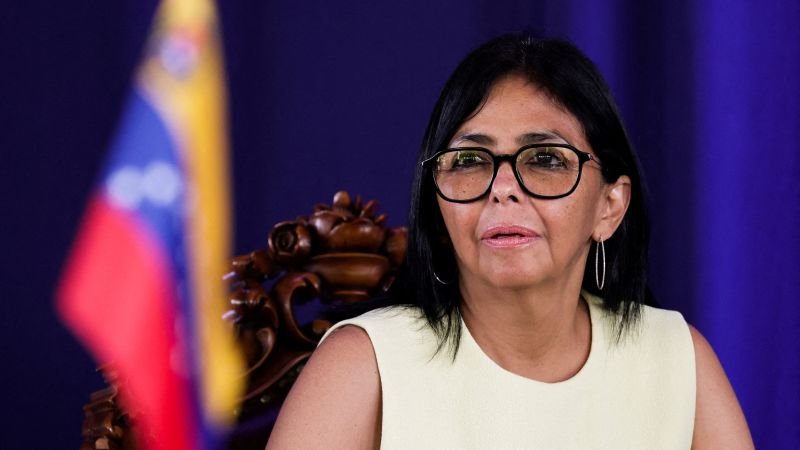
When she addresses the UN General Assembly on Wednesday, Delcy Rodríguez will stand just a 20-minute cab ride from where her deposed predecessor Nicolás Maduro languishes in pre-trial detention.
Looking at the agenda she has followed during her trip to New York, Rodríguez appears to have allowed enough time ahead of her address to try to bring her country out of the isolation it has faced since 2018, when Maduro delivered the last speech at that forum by a Venezuelan head of state.
After landing in the United States on Monday, Rodríguez said she had arrived “with the firmness and hope of a people that believes in dialogue and unity among nations.” The same day, she met with UN Secretary-General António Guterres; Inter-American Development Bank (IDB) President Ilan Goldfajn; World Bank Group President Ajay Banga; and International Monetary Fund (IMF) Managing Director Kristalina Georgieva.
It is unclear what benefits these meetings might bring Rodríguez, still bedeviled by questions of legitimacy because she was not elected to the position she holds.
But time’s passage is working in her favor.
While Donald Trump’s presidency ends in January 2029, there is still no date for Venezuela’s next presidential election. If she withstands pressure from the current US administration, which has many irons in the diplomatic fire, the Chavismo movement of which she is the current torch-bearer will be better positioned to face the future. It still controls the state apparatus, and there are no signs of that changing any time soon.
Rodríguez met with Trump on Tuesday on the sidelines of the General Assembly, during which the leaders “discussed strengthening the bilateral relationship between our countries and advancing a cooperation agenda in strategic areas such as energy, mining, and security,” Rodríguez said in a post on X, alongside a photo of the two.
For now, Rodríguez has in Trump her main and unexpected backer.
Gone are the days when, as Maduro’s vice president in September 2019, she used a UN General Assembly address to accuse Washington of imposing “a new form of state terrorism without using bombs, but rather through banks and insurance companies.” She was referring at the time to US sanctions that prevented the South American country from selling its oil through the global financial system.
The acting president’s trip is also the next step in the process of relaunching diplomatic relations following Maduro’s capture by elite American Delta Force soldiers on January 3.
Since then, Venezuela has reactivated consular relations with Chile, Ecuador, Peru, the Dominican Republic and Israel, and has received visits from two Latin American presidents: Colombia’s Gustavo Petro before he left the Nariño Palace and, more recently, Paraguay’s head of state, Santiago Peña.
Trump has presented Venezuela as his great foreign-policy victory, and repeatedly emphasizes how he is overseeing the country after winning what he now describes as a war. The latest demonstration came Tuesday in his speech before the delegations attending the General Assembly.
“To the victor belong the spoils,” he said, referring to the agreement signed by the Pentagon with private energy company Nabep to gain access to 65 billion barrels of oil from Venezuelan reserves.
This display of dominance contrasts with the stalemate in the war with Iran and the inability to successfully mediate a peace agreement between Russia and Ukraine, all amid the impact of rising fuel prices in the US and a decline in his popularity five weeks before midterm elections.
Rodríguez appears to be taking advantage of this situation to present herself as a reliable partner, willing to leave behind the image projected by Maduro’s government and to bolster the political survival of the Chavismo project at the expense of opposition leader María Corina Machado, who is currently stranded outside Venezuela. According to her spokesman, Machado made three attempts to return to Venezuela while Rodríguez was away, but was refused entry.
But is Washington’s support enough to overlook the fact that Rodríguez does not hold the presidency as the result of free elections? For Brazil’s president, it is not.
Earlier this week, in an interview with CNN, Luiz Inácio Lula da Silva was highly critical of the relationship Washington and Caracas have been forging in recent months. In his view, Trump has demonstrated that he plays a “very dominant role” over the South American country, while stating that “Venezuela’s sovereignty is over.”
During the interview, the Brazilian president said that, if he were in Rodríguez’s position, he would call national elections so that Venezuelans could decide the political direction of their country. In his address to the UN plenary, he once again invoked that same combative discourse and defense of the principle of sovereignty that he displayed in the interview, contrasting with the silence of the other countries in the region over the absence of a firm date for presidential elections in Venezuela.
Rodríguez will have her turn on Wednesday, and there is considerable anticipation surrounding her speech at a forum where global concerns are routinely aired. For many years, Chavismo relied on the condemnation of imperialism to construct its political identity, and consistently invoked it on this stage.
Now, Washington’s imperial ambitions have been deployed much more forcefully through the revival of the Monroe Doctrine – and a fierce initiative to deport as many migrants as possible from US territory, which has particularly affected the Venezuelan community.
Before January 3, Chavismo would have railed forcefully against these policies. For Delcy Rodríguez, this is no longer the case.
CORRECTION: This story has been updated to correct the date when Rodriguez is speaking at the UN General Assembly.


Responses