
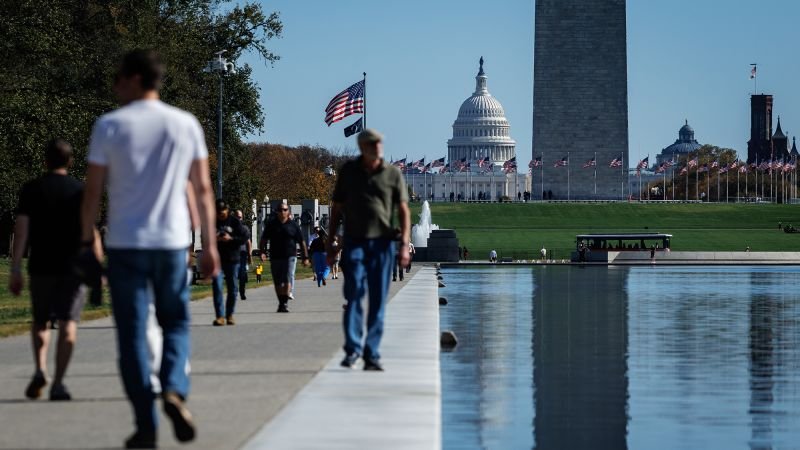
• New Congress: As both parties await the outcome of Senate races in Mississippi and Alaska, questions are brewing about who will lead the new Democratic majority. In the House, the midterms blue wave has put Democrats on the verge of their largest majority in decades.
• Trump digs in: President Donald Trump signaled he would fight back against congressional investigations and potential impeachment votes for members of his administration, saying he’s ordered the Justice Department to “look into” Democrats seeking the probes.
• Staffing shake-up: The president is replacing his chief of staff, opting for hardline immigration adviser Stephen Miller, and has hinted at more post-election personnel changes as he faces a new landscape in Washington.
Updates
(19)
President Donald Trump expressed confidence in Pete Hegseth during a post-election interview with “60 Minutes,” as the defense secretary faces a potential impeachment vote.
During the interview with CBS’ Ross Douthat, which was recorded Friday to air on Sunday’s broadcast, Trump also said he could “very easily” stop attacking Democrats for six months if it allowed the two parties to reach policy deals.
President Donald Trump said he would have the Department of Justice look into threats of “Impeachment and many other forms of punishment” by Democrats against certain members of his administration, companies and donors to his ballroom project as he grapples with a new reality in Congress.
“The Democrats are going around threatening a lot of people, including the Attorney General of the United States, and others, with Impeachment and many other forms of punishment, even though they admit they have no reason to do so, and there have been no impeachable acts committed, or even thought of, by the victims of this illegal process,” Trump wrote on Truth Social on Saturday, adding that it was “extortion at the highest level.”
“The imprisonment should be against these EXTORTIONISTS, and Republicans should get smart, fast! Threatening letters have been sent to many people, all innocent, from Democrat Political Leaders,” Trump continued. “By copy of this statement, I am ordering the Department of Justice to look into this criminal act, immediately!”
CNN has reached out to the White House and the DOJ for comment.
Sen. Richard Blumenthal, who is expected to chair a key Senate investigative panel when Democrats take control of Congress in January, sent letters to a slew of companies and Trump administration officials on Thursday asking them to cooperate with potential investigations.
Among those who received letters were Homeland Security Secretary Markwayne Mullin, Federal Communications Commission Chair Brendan Carr, and several White House ballroom donors, including Amazon, Apple and Google. Crypto companies World Liberty Financial, Binance and Tether also got letters.
Blumenthal warned that the subcommittee will look into “alternative measures to obtain compliance” if the companies and officials do not provide information that the panel requested by January 4, a day after the new Congress convenes. People and companies who received the letters are not obligated to reply until the new Congress is officially in power.
Sen. Elissa Slotkin declined today to rule out running for Senate majority leader after Democrats’ far-reaching wins in the midterms.
The Michigan Democrat, who has long pushed for new leadership inside her party, said it was up to Senate Minority Leader Chuck Schumer to convince Democrats that he has a plan for how they should wield their new power. Asked if she would run for the job, she did not say no.
“I’m not ruling anything out,” she added.
Slotkin was being interviewed at Crooked Con, a post-midterms Democratic conference in Washington, DC.
Schumer has expressed confidence he will continue to lead Senate Democrats.
Earlier today, Sen. Chris Van Hollen of Maryland told the crowd at Crooked Con that there should not be a “coronation” for the next Senate Democratic leader. However, Van Hollen suggested he was unlikely to run for the job, telling CNN it is “not my focus.”
While it is clear that Democrats have flipped control of the House of Representatives, the party is awaiting calls in several key races that will determine the size of its majority.
There are 20 House races that CNN has not yet projected, out of a total 435 seats. These include tight contests in Arizona, Colorado, Florida and Minnesota.
Democrats are on the verge of exceeding the 257 House seats at the start of Barack Obama’s presidency and the 258 at the start of Bill Clinton’s tenure.
Senate: Democrats have also secured a majority in the upper chamber, but votes are still being counted in Mississippi and Alaska’s Senate races to determine the final balance of power.
CNN Sightline rates the Mississippi Senate race as neutral. Democratic nominee Scott Colom has grown his narrow lead over Republican Sen. Cindy Hyde-Smith as counties bring their counts closer to completion. Several advocacy groups have called for greater transparency in the ballot-counting process.
In Alaska, Sightline favors Democrat Mary Peltola, who has a very slight edge over Republican incumbent Sen. Dan Sullivan as of Saturday afternoon. The race has been roiled by a federal investigation into an alleged Democratic scheme to stack the ballot and confuse voters.
Michigan Sen.-elect Abdul El-Sayed called the campaign against him this election cycle “one of the most hideous, most racist campaigns I think we’ve seen since 2008.”
Watch the moment from the Democrat’s speech yesterday at an Arab American leadership summit in Virginia:
Days before the midterms, federal prosecutors ordered Gerald Heikes, a longshot Senate hopeful in Alaska, to appear before a grand jury with any records he has related to political groups and other candidates in the race, according to documents reviewed by CNN.
The subpoena was sent as part of an accelerating criminal probe into whether operatives aligned with Mary Peltola, the Democratic candidate, sought to recruit spoilers into the race — including another candidate who shares a name with the sitting Republican senator.
Heikes’ subpoena, dated one day after a New York Times story alleged Peltola’s campaign was linked to that effort, shows prosecutors asking for communications related to the Democrat’s campaign as well as several PACs and operatives linked to those groups.
The DOJ declined to comment for this story. Peltola has denied any knowledge of efforts to recruit other candidates.
You can read CNN’s full report on the Alaska ballot investigation here.
It’s hard to overstate how factionalized the West Wing has become in the last several days.
Aides have described a workplace filled with tension and infighting, likening it to the “knives out” days of President Donald Trump’s first term. The president announcing Susie Wiles’ departure yesterday will only accelerate the shift in the balance of power in his inner circle.
As the scrutiny on Defense Secretary Pete Hegseth grew following the GOP’s midterm losses, it only highlighted how fractured his relationship with Wiles had become.
For months, people familiar with the matter said, Wiles had raised concerns about his leadership inside the Pentagon and his role in Trump’s Cabinet. Shortly after the president announced her departure, Hegseth was one of the first senior aides to celebrate Stephen Miller’s ascension to chief of staff.
President Donald Trump said he can work with Democrats without insulting them, in an interview that comes as he prepares for the last two years of his presidency with Republicans no longer in control of Congress.
In the interview with “60 Minutes,” which was taped on Friday to air Sunday, Trump said he could “very easily” stop attacking Democrats for six months if it allowed the two parties to reach a deal on policy.
But just seconds earlier in a clip released by CBS News, the president reverted to one of his familiar labels for members of the opposing party.
“I also call many of them ‘Dumbocrats,’” Trump said.
Trump in recent days has signaled that he’s open to working with Democrats on issues like immigration and economic development.
“I think we can do a lot of things together, actually,” Trump told reporters on Friday. “You know, a lot of them are about common sense, also. And I think you’ll see that.”
Trump has also pledged to use his veto power to push Democrats into bipartisan deals.
The son of a man who was fatally shot by an Immigration and Customs Enforcement officer in Houston this year said it was “incredible,” yet “bittersweet” to see this week’s election results and the tributes many Texans left to his father.
Ronaldo Salgado, whose father, Lorenzo Salgado Araujo, was shot and killed by a federal agent on July 7, told CNN’s Victor Blackwell he “never expected” the gesture to spread as far as it did.
Salgado said he left his own “I voted” sticker at his father’s memorial shortly after he cast his ballot and noticed two other people doing the same. By the end of the week, hundreds of stickers covered the memorial.
They include one belonging to James Talarico, the state’s incoming Democratic senator.
Reacting to the Democrats’ rout of the Republican state government in Texas, and pledges by city leaders in Houston to now limit some cooperation with ICE, Salgado said he believes immigrants in the city “will be able to live a little bit more freely, a little bit more at peace.”
Democratic Sen. Chris Van Hollen said today that there should be “no coronation” of the chamber’s next Democratic leader after the party’s sweeping gains in the midterms — though he suggested he was unlikely to seek the post himself.
Looking to the coming days, Van Hollen said it was “really important that people withhold commitments” until they can speak to newly elected Senate Democrats and learn lessons from them. The Maryland Democrat said his highest priority was understanding how the party will use its new power in the Senate to end the war in Iran.
Van Hollen told CNN after he spoke at the event that running for majority leader himself was “not my focus” and that he was instead “seriously kicking the tires on the presidential race.”
Some context: Senate Minority Leader Chuck Schumer has expressed confidence that he will be reelected as majority leader. But several incoming Senate Democrats have vowed not to support him, and Van Hollen’s comments show not every returning member is immediately onboard.
The mention of Schumer’s name drew boos inside the ballroom at Crooked Con.
Democrats’ massive wins in the midterms delivered a historic milestone in Georgia, where a slate of Black women led by Gov.-elect Keisha Lance Bottoms will soon occupy seven of the state’s top eight executive offices.
Joining CNN’s Victor Blackwell this morning in a joint interview with Attorney General-elect Tanya Miller, incoming Secretary of State Penny Brown Reynolds called the outcome “monumental.”
But Miller added that the women won their races by focusing on competence, not identity. “We ran on qualifications. We ran on policy ideas.”
President Donald Trump has repeatedly berated female reporters of color and targeted prominent Black women in positions of power for scrutiny, like Federal Reserve Governor Lisa Cook and New York Attorney General Letitia James.
Reynolds said the pair of Georgia executives “will be the Secretary of State and Attorney General long after Donald Trump is gone. And so he has another two years to go. His concerns about us is irrelevant to us.”
Iranian hardliners who believe Tehran has already emerged victorious in its war with the United States are seizing on President Donald Trump’s midterm losses to demand that he pay a steeper price for an exit from the conflict: a “new world order” that favors the Islamic Republic.
The influential group of conservatives intensified their rhetoric this week, publicly demanding that Washington not be offered compromises in ongoing negotiations.
After the midterm elections saw Trump’s Republican Party suffer a major defeat, Supreme Leader Mojtaba Khamenei warned in a message Wednesday against the “slightest inclination towards submission” – a caution hardliners believe was directed to Iran’s negotiators.
Trump acknowledged in a call with Fox News that the war in Iran was partly to blame for the Republicans’ midterm losses but Vice President JD Vance was more explicit, saying in a lengthy X post Wednesday that “the reason we lost is the war.”
Those admissions appear to have galvanized Iranian hardliners with conservative politicians and media outlets celebrating Trump’s midterm loss as a win for Iran. A hardline outlet, Raja News, published a column saying the US should not be given a “way out” before it “pays the price” for attacking Iran, and Trump should not be allowed to “escape with a rushed agreement.”
The Democrats’ upcoming simple majority in the Senate will enable them to take actions on environmental issues. But the lack of a veto-proof majority means that Democrats’ power will still be somewhat limited, given the need for President Donald Trump’s signature on legislation.
Here are some of the concrete actions that a Democrat-led Senate could take to advance their environmental priorities.
Investigate the war on wind: The Senate has the authority to launch investigations of the Trump administration’s actions. The White House’s energy policies and extensive regulatory rollbacks of clean air, climate and species protection regulations are likely to be targets.
The budget process: Senate Democrats could seek to prevent the administration’s environmental actions through the appropriations process by attaching language to bills that would prohibit any money from being spent to keep coal-fired power plants open, something that the Energy Department has used emergency orders to do. Democrats could also prohibit spending money to build data centers on public lands or only allow their construction after soliciting extensive local public input, Michael Gerrard, an environmental law professor at Columbia University Law School, said.
Since the Democrats will lack a veto-proof majority in the Senate, however, if Trump vetoes such bills, they will serve more as a signal to voters about Democratic priorities rather than becoming laws.
Roll back rollbacks: Democratic senators can also work to pass bills that would accomplish environmental goals, regardless of whether the president signs it. This could include bills aimed at fully staffing environmental agencies after DOGE reduced headcounts.
Read more here about the impact Dems could have on environmental legislation.
As the dust settled on Election Night, Democratic operatives working to elect James Talarico were surprised by the breadth of his victory across Texas’ 254 counties. But even then, one area stood out.
Kaufman County, southeast of Dallas, is the site of two massive data center projects that have sparked local backlash. The largest city in the county, Forney, is already working to outlaw new data centers within its city limits.
The solidly red county was one of 55 counties where a pro-Talarico super PAC, Lone Star Rising PAC, targeted voters within 5 miles of a proposed or approved data center project. The PAC sent them a series of mail pieces and digital ads blaming the project on the Republican nominee, Ken Paxton.
Talarico carried Kaufman County by 1 percentage point as he notched a striking 12-point victory statewide, helping lead Democrats to statewide victory in Texas for the first time since 1994.
It was one of many examples where backlash to data centers fueled Democrats’ staggering victories in the midterms. From statewide races to local ballot initiatives, voters demonstrated sweeping support for a tougher stance toward data centers, if not outright opposition to their continued development.
About a quarter of voters said AI and data centers were “crucial” to their vote in the midterms, trailing higher priorities such as the cost of living and corruption, according to CNN’s Voter Poll. But when voters were asked about building data centers in their communities, they were overwhelmingly opposed by a roughly 3-to-1 margin.
Read more on this in our full article here.
Vote counting continues in Mississippi and Alaska, with their Senate races too early for CNN to call.
Here are the latest developments in these states:
CNN Sightline rates the Mississippi Senate race as neutral, with the contest too close to call. Democratic candidate Scott Colom has grown his narrow lead over Republican candidate Cindy Hyde-Smith.
Several Mississippi-based organizations Friday called for greater transparency in the state’s ongoing ballot-counting process, saying they had run into issues with counties over how much of the work is supposed to be open to the public.
Meanwhile elections expert David Becker said the ongoing ballot-counting process in Mississippi is “entirely normal,” and “exactly what we would expect to see.”
Colom maintains that he is 100% confident he will become the state’s senator-elect, because outstanding ballots are in Democratic-leaning counties.
Earlier, the chairman of the Mississippi’s Republican Party claimed there are still thousands of affidavit ballots left to be counted, arguing that Hyde-Smith has plenty of time to take the lead.
In Alaska, Sightline favors Democrat Mary Peltola, who has a very slight edge over Republican incumbent Sen. Dan Sullivan.
Days before the midterms, federal prosecutors ordered Gerald Heikes, a longshot Senate hopeful in Alaska, to appear before a grand jury with any records he has related to political groups and other candidates in the race, according to documents reviewed by CNN.
The subpoena was sent as part of an accelerating criminal probe into whether operatives aligned with Peltola sought to recruit spoilers into the race – including another candidate who shares a name with the sitting Republican senator.
The Department of Justice declined to comment for this story. Peltola has denied any knowledge of efforts to recruit other candidates.
CNN’s Tori B. Powell, August Phillips, Rebekah Reiss and Curt Devine contributed reporting.
President Donald Trump says he expects to make more changes to his Cabinet, after announcing yesterday that Susie Wiles, the White House chief of staff, would be departing her role.
Wiles’ departure came the same day Trump voiced fury at the strategy that led to Republicans decisively losing majorities in Congress in the midterms, sources said.
Here’s a look at other significant departures that have taken place during Trump’s second term:
Abigail Slater, who ran the antitrust division for the Justice Department, was forced out by the Trump administration in February, sources told CNN. Slater was known to be pushing the administration to be aggressive on tech companies, whose leaders often have the ear of Trump.
Former Homeland Security Secretary Kristi Noem was fired in March amid growing scrutiny over her conduct, including her alleged romantic relationship with her chief adviser, distribution of her department’s cash and her conflicting accounts over fatal incidents involving federal immigration agents.
Weeks later, Joe Kent, who had been serving as the director of the National Counterterrorism Center, announced he was stepping down from his post, citing misgivings about the administration’s war with Iran.
In early April, Attorney General Pam Bondi was fired. Trump had been frustrated with Bondi on multiple fronts, sources said, including her handling of the Jeffrey Epstein files and that she had not investigated or prosecuted enough of his political opponents.
Also in April, it was announced that Labor Secretary Lori Chavez-DeRemer was stepping down from the Trump administration amid an internal investigation into possible misconduct.
In August, Trump announced that White House press secretary Karoline Leavitt would be leaving her role to spend more time with her family.
Leavitt’s replacement Katie Zacharia was fired in October after five days amid several missteps and near-universal backlash to her performance. Her first press conference was described by officials as unusual, awkward, stilted and, at times, uncomfortable.
Also in October, Kimberly Guilfoyle, the US ambassador to Greece, was forced out of her job by the White House following a string of reports about alleged misconduct.
CNN’s Alejandra Jaramillo, Kaitlan Collins, Priscilla Alvarez, Kristen Holmes, Annie Grayer, Lauren Fox, Zachary Cohen, Hannah Rabinowitz, Alicia Wallace, Betsy Klein, Alayna Treene, Kit Maher, Kylie Atwood, Jennifer Hansler and Kevin Liptak contributed to this reporting.
President Donald Trump is moving on to his sixth chief of staff in less than six years as president after replacing Susie Wiles with Stephen Miller.
Wiles holds the record for longest tenure, at less than one year and 22 months. And the position has seen some rather interesting times:
Trump’s first chief of staff, Reince Priebus, logged the shortest tenure ever for a non-interim chief of staff, at a little more than six months. He resigned shortly after new White House communications director Anthony Scaramucci called him a “f**king paranoid schizophrenic, a paranoiac” in an unguarded New Yorker interview and said Priebus would be “asked to resign very shortly.”
Trump’s second chief of staff, John Kelly, was supposed to impose order on a chaotic operation but failed to do so. After leaving the White House, he called Trump a fascist.
No. 3, Mick Mulvaney, served more than a year in the position – but never with the full job title, always as the “acting” chief of staff. And he took the job despite having called Trump a “terrible human being” during the 2016 campaign. After the 2020 election, Mulvaney as a private citizen wrote an infamous op-ed in which he assured Trump would gracefully accept defeat. (Trump did not.)
No. 4, Mark Meadows, has been indicted in both Arizona and Georgia for his efforts to overturn the 2020 election. He pleaded not guilty.
Wiles in 2025 delivered a remarkably unvarnished series of interviews to Vanity Fair which seemed to confirm many of the worst narratives about the Trump White House.
Susie Wiles, the White House chief of staff, is departing the role and will be replaced by Stephen Miller, a longtime aide to President Donald Trump who orchestrated his hardline immigration agenda.
The move, which came three days after Republicans suffered catastrophic losses in the midterm elections, will take effect Monday.
Miller, currently a deputy chief of staff who has been the mastermind behind some of Trump’s most polarizing priorities, has widened his portfolio over the past year to include wide swaths of domestic policy and has advocated for an expansive view of executive power. He has long been viewed as one of Trump’s most influential advisers.
What Trump has said about the staffing shakeup:
More Cabinet changes to come: Trump signaled Wiles’ replacement will not be the last, telling CBS News “I do” when asked if he intended to fire people. “I think they’re good, but I’ll be doing maybe a few changes. I don’t want to mention who,” he said.
Timing of the decision: Speaking to reporters, Trump said his chief of staff’s departure was “not because of the election.” He said: “It’s just time. Sometimes you change,” he said.
Defending Miller’s appointment: “Stephen’s been with me from beginning. He gets it, very good politically, and he’s a very good man,” Trump said, while also praising Wiles for having done a “great job.”
Here’s what lawmakers and observers think about Miller’s appointment:
Rep. Robert Garcia: The ranking Member on the House Oversight Committee said in a statement that “Stephen Miller should lawyer up,” adding that “Oversight Democrats will continue to investigate Miller for his misconduct, and we will fight against his hateful policies in Congress and the courts.”
Former Trump administration adviser Olivia Troye: She told CNN she believes Miller is Trump’s “toughest bulldog.” Troye also described Miller as someone who’s loyal and “actually feared.”
Sen. Thom Tillis: The outgoing Republican senator slammed the appointment, calling it a “colossal mistake” and “the worst of all possible choices.” Tillis has been among a small number of Senate Republicans willing to publicly split with the White House. He has clashed directly with Trump and has been sharply critical of Miller in the past.
Georgia Governor-elect Keisha Lance Bottoms: The Democrat said it is “deeply disappointing” that Trump would elevate Miller, someone who she said “has been so divisive and has been behind so many of the policies that have impacted negatively Americans.”
CNN’s Annie Grayer, Alejandra Jaramillo, Rebekah Reiss and Tori B. Powell contributed reporting.
CNN is monitoring 12 key governor’s races. So far, winners have been projected in 10.
Republicans are projected to win one, while Democrats are currently projected to win nine, according to CNN’s Decision Desk.
The projected Democratic victories include flips of the governor’s office in Georgia, Iowa, Texas, Ohio and Nevada.
Correction: A previous version of this post misstated the percentage of projected Democratic governorships after the midterms. CNN has projected 10 key gubernatorial races so far.
• New Congress: As both parties await the outcome of Senate races in Mississippi and Alaska, questions are brewing about who will lead the new Democratic majority. In the House, the midterms blue wave has put Democrats on the verge of their largest majority in decades.
• Trump digs in: President Donald Trump signaled he would fight back against congressional investigations and potential impeachment votes for members of his administration, saying he’s ordered the Justice Department to “look into” Democrats seeking the probes.
• Staffing shake-up: The president is replacing his chief of staff, opting for hardline immigration adviser Stephen Miller, and has hinted at more post-election personnel changes as he faces a new landscape in Washington.
President Donald Trump expressed confidence in Pete Hegseth during a post-election interview with “60 Minutes,” as the defense secretary faces a potential impeachment vote.
During the interview with CBS’ Ross Douthat, which was recorded Friday to air on Sunday’s broadcast, Trump also said he could “very easily” stop attacking Democrats for six months if it allowed the two parties to reach policy deals.
President Donald Trump said he would have the Department of Justice look into threats of “Impeachment and many other forms of punishment” by Democrats against certain members of his administration, companies and donors to his ballroom project as he grapples with a new reality in Congress.
“The Democrats are going around threatening a lot of people, including the Attorney General of the United States, and others, with Impeachment and many other forms of punishment, even though they admit they have no reason to do so, and there have been no impeachable acts committed, or even thought of, by the victims of this illegal process,” Trump wrote on Truth Social on Saturday, adding that it was “extortion at the highest level.”
“The imprisonment should be against these EXTORTIONISTS, and Republicans should get smart, fast! Threatening letters have been sent to many people, all innocent, from Democrat Political Leaders,” Trump continued. “By copy of this statement, I am ordering the Department of Justice to look into this criminal act, immediately!”
CNN has reached out to the White House and the DOJ for comment.
Sen. Richard Blumenthal, who is expected to chair a key Senate investigative panel when Democrats take control of Congress in January, sent letters to a slew of companies and Trump administration officials on Thursday asking them to cooperate with potential investigations.
Among those who received letters were Homeland Security Secretary Markwayne Mullin, Federal Communications Commission Chair Brendan Carr, and several White House ballroom donors, including Amazon, Apple and Google. Crypto companies World Liberty Financial, Binance and Tether also got letters.
Blumenthal warned that the subcommittee will look into “alternative measures to obtain compliance” if the companies and officials do not provide information that the panel requested by January 4, a day after the new Congress convenes. People and companies who received the letters are not obligated to reply until the new Congress is officially in power.
Sen. Elissa Slotkin declined today to rule out running for Senate majority leader after Democrats’ far-reaching wins in the midterms.
The Michigan Democrat, who has long pushed for new leadership inside her party, said it was up to Senate Minority Leader Chuck Schumer to convince Democrats that he has a plan for how they should wield their new power. Asked if she would run for the job, she did not say no.
“I’m not ruling anything out,” she added.
Slotkin was being interviewed at Crooked Con, a post-midterms Democratic conference in Washington, DC.
Schumer has expressed confidence he will continue to lead Senate Democrats.
Earlier today, Sen. Chris Van Hollen of Maryland told the crowd at Crooked Con that there should not be a “coronation” for the next Senate Democratic leader. However, Van Hollen suggested he was unlikely to run for the job, telling CNN it is “not my focus.”
While it is clear that Democrats have flipped control of the House of Representatives, the party is awaiting calls in several key races that will determine the size of its majority.
There are 20 House races that CNN has not yet projected, out of a total 435 seats. These include tight contests in Arizona, Colorado, Florida and Minnesota.
Democrats are on the verge of exceeding the 257 House seats at the start of Barack Obama’s presidency and the 258 at the start of Bill Clinton’s tenure.
Senate: Democrats have also secured a majority in the upper chamber, but votes are still being counted in Mississippi and Alaska’s Senate races to determine the final balance of power.
CNN Sightline rates the Mississippi Senate race as neutral. Democratic nominee Scott Colom has grown his narrow lead over Republican Sen. Cindy Hyde-Smith as counties bring their counts closer to completion. Several advocacy groups have called for greater transparency in the ballot-counting process.
In Alaska, Sightline favors Democrat Mary Peltola, who has a very slight edge over Republican incumbent Sen. Dan Sullivan as of Saturday afternoon. The race has been roiled by a federal investigation into an alleged Democratic scheme to stack the ballot and confuse voters.
Michigan Sen.-elect Abdul El-Sayed called the campaign against him this election cycle “one of the most hideous, most racist campaigns I think we’ve seen since 2008.”
Watch the moment from the Democrat’s speech yesterday at an Arab American leadership summit in Virginia:
Days before the midterms, federal prosecutors ordered Gerald Heikes, a longshot Senate hopeful in Alaska, to appear before a grand jury with any records he has related to political groups and other candidates in the race, according to documents reviewed by CNN.
The subpoena was sent as part of an accelerating criminal probe into whether operatives aligned with Mary Peltola, the Democratic candidate, sought to recruit spoilers into the race — including another candidate who shares a name with the sitting Republican senator.
Heikes’ subpoena, dated one day after a New York Times story alleged Peltola’s campaign was linked to that effort, shows prosecutors asking for communications related to the Democrat’s campaign as well as several PACs and operatives linked to those groups.
The DOJ declined to comment for this story. Peltola has denied any knowledge of efforts to recruit other candidates.
You can read CNN’s full report on the Alaska ballot investigation here.
It’s hard to overstate how factionalized the West Wing has become in the last several days.
Aides have described a workplace filled with tension and infighting, likening it to the “knives out” days of President Donald Trump’s first term. The president announcing Susie Wiles’ departure yesterday will only accelerate the shift in the balance of power in his inner circle.
As the scrutiny on Defense Secretary Pete Hegseth grew following the GOP’s midterm losses, it only highlighted how fractured his relationship with Wiles had become.
For months, people familiar with the matter said, Wiles had raised concerns about his leadership inside the Pentagon and his role in Trump’s Cabinet. Shortly after the president announced her departure, Hegseth was one of the first senior aides to celebrate Stephen Miller’s ascension to chief of staff.
President Donald Trump said he can work with Democrats without insulting them, in an interview that comes as he prepares for the last two years of his presidency with Republicans no longer in control of Congress.
In the interview with “60 Minutes,” which was taped on Friday to air Sunday, Trump said he could “very easily” stop attacking Democrats for six months if it allowed the two parties to reach a deal on policy.
But just seconds earlier in a clip released by CBS News, the president reverted to one of his familiar labels for members of the opposing party.
“I also call many of them ‘Dumbocrats,’” Trump said.
Trump in recent days has signaled that he’s open to working with Democrats on issues like immigration and economic development.
“I think we can do a lot of things together, actually,” Trump told reporters on Friday. “You know, a lot of them are about common sense, also. And I think you’ll see that.”
Trump has also pledged to use his veto power to push Democrats into bipartisan deals.
The son of a man who was fatally shot by an Immigration and Customs Enforcement officer in Houston this year said it was “incredible,” yet “bittersweet” to see this week’s election results and the tributes many Texans left to his father.
Ronaldo Salgado, whose father, Lorenzo Salgado Araujo, was shot and killed by a federal agent on July 7, told CNN’s Victor Blackwell he “never expected” the gesture to spread as far as it did.
Salgado said he left his own “I voted” sticker at his father’s memorial shortly after he cast his ballot and noticed two other people doing the same. By the end of the week, hundreds of stickers covered the memorial.
They include one belonging to James Talarico, the state’s incoming Democratic senator.
Reacting to the Democrats’ rout of the Republican state government in Texas, and pledges by city leaders in Houston to now limit some cooperation with ICE, Salgado said he believes immigrants in the city “will be able to live a little bit more freely, a little bit more at peace.”
Democratic Sen. Chris Van Hollen said today that there should be “no coronation” of the chamber’s next Democratic leader after the party’s sweeping gains in the midterms — though he suggested he was unlikely to seek the post himself.
Looking to the coming days, Van Hollen said it was “really important that people withhold commitments” until they can speak to newly elected Senate Democrats and learn lessons from them. The Maryland Democrat said his highest priority was understanding how the party will use its new power in the Senate to end the war in Iran.
Van Hollen told CNN after he spoke at the event that running for majority leader himself was “not my focus” and that he was instead “seriously kicking the tires on the presidential race.”
Some context: Senate Minority Leader Chuck Schumer has expressed confidence that he will be reelected as majority leader. But several incoming Senate Democrats have vowed not to support him, and Van Hollen’s comments show not every returning member is immediately onboard.
The mention of Schumer’s name drew boos inside the ballroom at Crooked Con.
Democrats’ massive wins in the midterms delivered a historic milestone in Georgia, where a slate of Black women led by Gov.-elect Keisha Lance Bottoms will soon occupy seven of the state’s top eight executive offices.
Joining CNN’s Victor Blackwell this morning in a joint interview with Attorney General-elect Tanya Miller, incoming Secretary of State Penny Brown Reynolds called the outcome “monumental.”
But Miller added that the women won their races by focusing on competence, not identity. “We ran on qualifications. We ran on policy ideas.”
President Donald Trump has repeatedly berated female reporters of color and targeted prominent Black women in positions of power for scrutiny, like Federal Reserve Governor Lisa Cook and New York Attorney General Letitia James.
Reynolds said the pair of Georgia executives “will be the Secretary of State and Attorney General long after Donald Trump is gone. And so he has another two years to go. His concerns about us is irrelevant to us.”
Iranian hardliners who believe Tehran has already emerged victorious in its war with the United States are seizing on President Donald Trump’s midterm losses to demand that he pay a steeper price for an exit from the conflict: a “new world order” that favors the Islamic Republic.
The influential group of conservatives intensified their rhetoric this week, publicly demanding that Washington not be offered compromises in ongoing negotiations.
After the midterm elections saw Trump’s Republican Party suffer a major defeat, Supreme Leader Mojtaba Khamenei warned in a message Wednesday against the “slightest inclination towards submission” – a caution hardliners believe was directed to Iran’s negotiators.
Trump acknowledged in a call with Fox News that the war in Iran was partly to blame for the Republicans’ midterm losses but Vice President JD Vance was more explicit, saying in a lengthy X post Wednesday that “the reason we lost is the war.”
Those admissions appear to have galvanized Iranian hardliners with conservative politicians and media outlets celebrating Trump’s midterm loss as a win for Iran. A hardline outlet, Raja News, published a column saying the US should not be given a “way out” before it “pays the price” for attacking Iran, and Trump should not be allowed to “escape with a rushed agreement.”
The Democrats’ upcoming simple majority in the Senate will enable them to take actions on environmental issues. But the lack of a veto-proof majority means that Democrats’ power will still be somewhat limited, given the need for President Donald Trump’s signature on legislation.
Here are some of the concrete actions that a Democrat-led Senate could take to advance their environmental priorities.
Investigate the war on wind: The Senate has the authority to launch investigations of the Trump administration’s actions. The White House’s energy policies and extensive regulatory rollbacks of clean air, climate and species protection regulations are likely to be targets.
The budget process: Senate Democrats could seek to prevent the administration’s environmental actions through the appropriations process by attaching language to bills that would prohibit any money from being spent to keep coal-fired power plants open, something that the Energy Department has used emergency orders to do. Democrats could also prohibit spending money to build data centers on public lands or only allow their construction after soliciting extensive local public input, Michael Gerrard, an environmental law professor at Columbia University Law School, said.
Since the Democrats will lack a veto-proof majority in the Senate, however, if Trump vetoes such bills, they will serve more as a signal to voters about Democratic priorities rather than becoming laws.
Roll back rollbacks: Democratic senators can also work to pass bills that would accomplish environmental goals, regardless of whether the president signs it. This could include bills aimed at fully staffing environmental agencies after DOGE reduced headcounts.
Read more here about the impact Dems could have on environmental legislation.
As the dust settled on Election Night, Democratic operatives working to elect James Talarico were surprised by the breadth of his victory across Texas’ 254 counties. But even then, one area stood out.
Kaufman County, southeast of Dallas, is the site of two massive data center projects that have sparked local backlash. The largest city in the county, Forney, is already working to outlaw new data centers within its city limits.
The solidly red county was one of 55 counties where a pro-Talarico super PAC, Lone Star Rising PAC, targeted voters within 5 miles of a proposed or approved data center project. The PAC sent them a series of mail pieces and digital ads blaming the project on the Republican nominee, Ken Paxton.
Talarico carried Kaufman County by 1 percentage point as he notched a striking 12-point victory statewide, helping lead Democrats to statewide victory in Texas for the first time since 1994.
It was one of many examples where backlash to data centers fueled Democrats’ staggering victories in the midterms. From statewide races to local ballot initiatives, voters demonstrated sweeping support for a tougher stance toward data centers, if not outright opposition to their continued development.
About a quarter of voters said AI and data centers were “crucial” to their vote in the midterms, trailing higher priorities such as the cost of living and corruption, according to CNN’s Voter Poll. But when voters were asked about building data centers in their communities, they were overwhelmingly opposed by a roughly 3-to-1 margin.
Read more on this in our full article here.
Vote counting continues in Mississippi and Alaska, with their Senate races too early for CNN to call.
Here are the latest developments in these states:
CNN Sightline rates the Mississippi Senate race as neutral, with the contest too close to call. Democratic candidate Scott Colom has grown his narrow lead over Republican candidate Cindy Hyde-Smith.
Several Mississippi-based organizations Friday called for greater transparency in the state’s ongoing ballot-counting process, saying they had run into issues with counties over how much of the work is supposed to be open to the public.
Meanwhile elections expert David Becker said the ongoing ballot-counting process in Mississippi is “entirely normal,” and “exactly what we would expect to see.”
Colom maintains that he is 100% confident he will become the state’s senator-elect, because outstanding ballots are in Democratic-leaning counties.
Earlier, the chairman of the Mississippi’s Republican Party claimed there are still thousands of affidavit ballots left to be counted, arguing that Hyde-Smith has plenty of time to take the lead.
In Alaska, Sightline favors Democrat Mary Peltola, who has a very slight edge over Republican incumbent Sen. Dan Sullivan.
Days before the midterms, federal prosecutors ordered Gerald Heikes, a longshot Senate hopeful in Alaska, to appear before a grand jury with any records he has related to political groups and other candidates in the race, according to documents reviewed by CNN.
The subpoena was sent as part of an accelerating criminal probe into whether operatives aligned with Peltola sought to recruit spoilers into the race – including another candidate who shares a name with the sitting Republican senator.
The Department of Justice declined to comment for this story. Peltola has denied any knowledge of efforts to recruit other candidates.
CNN’s Tori B. Powell, August Phillips, Rebekah Reiss and Curt Devine contributed reporting.
President Donald Trump says he expects to make more changes to his Cabinet, after announcing yesterday that Susie Wiles, the White House chief of staff, would be departing her role.
Wiles’ departure came the same day Trump voiced fury at the strategy that led to Republicans decisively losing majorities in Congress in the midterms, sources said.
Here’s a look at other significant departures that have taken place during Trump’s second term:
Abigail Slater, who ran the antitrust division for the Justice Department, was forced out by the Trump administration in February, sources told CNN. Slater was known to be pushing the administration to be aggressive on tech companies, whose leaders often have the ear of Trump.
Former Homeland Security Secretary Kristi Noem was fired in March amid growing scrutiny over her conduct, including her alleged romantic relationship with her chief adviser, distribution of her department’s cash and her conflicting accounts over fatal incidents involving federal immigration agents.
Weeks later, Joe Kent, who had been serving as the director of the National Counterterrorism Center, announced he was stepping down from his post, citing misgivings about the administration’s war with Iran.
In early April, Attorney General Pam Bondi was fired. Trump had been frustrated with Bondi on multiple fronts, sources said, including her handling of the Jeffrey Epstein files and that she had not investigated or prosecuted enough of his political opponents.
Also in April, it was announced that Labor Secretary Lori Chavez-DeRemer was stepping down from the Trump administration amid an internal investigation into possible misconduct.
In August, Trump announced that White House press secretary Karoline Leavitt would be leaving her role to spend more time with her family.
Leavitt’s replacement Katie Zacharia was fired in October after five days amid several missteps and near-universal backlash to her performance. Her first press conference was described by officials as unusual, awkward, stilted and, at times, uncomfortable.
Also in October, Kimberly Guilfoyle, the US ambassador to Greece, was forced out of her job by the White House following a string of reports about alleged misconduct.
CNN’s Alejandra Jaramillo, Kaitlan Collins, Priscilla Alvarez, Kristen Holmes, Annie Grayer, Lauren Fox, Zachary Cohen, Hannah Rabinowitz, Alicia Wallace, Betsy Klein, Alayna Treene, Kit Maher, Kylie Atwood, Jennifer Hansler and Kevin Liptak contributed to this reporting.
President Donald Trump is moving on to his sixth chief of staff in less than six years as president after replacing Susie Wiles with Stephen Miller.
Wiles holds the record for longest tenure, at less than one year and 22 months. And the position has seen some rather interesting times:
Trump’s first chief of staff, Reince Priebus, logged the shortest tenure ever for a non-interim chief of staff, at a little more than six months. He resigned shortly after new White House communications director Anthony Scaramucci called him a “f**king paranoid schizophrenic, a paranoiac” in an unguarded New Yorker interview and said Priebus would be “asked to resign very shortly.”
Trump’s second chief of staff, John Kelly, was supposed to impose order on a chaotic operation but failed to do so. After leaving the White House, he called Trump a fascist.
No. 3, Mick Mulvaney, served more than a year in the position – but never with the full job title, always as the “acting” chief of staff. And he took the job despite having called Trump a “terrible human being” during the 2016 campaign. After the 2020 election, Mulvaney as a private citizen wrote an infamous op-ed in which he assured Trump would gracefully accept defeat. (Trump did not.)
No. 4, Mark Meadows, has been indicted in both Arizona and Georgia for his efforts to overturn the 2020 election. He pleaded not guilty.
Wiles in 2025 delivered a remarkably unvarnished series of interviews to Vanity Fair which seemed to confirm many of the worst narratives about the Trump White House.
Susie Wiles, the White House chief of staff, is departing the role and will be replaced by Stephen Miller, a longtime aide to President Donald Trump who orchestrated his hardline immigration agenda.
The move, which came three days after Republicans suffered catastrophic losses in the midterm elections, will take effect Monday.
Miller, currently a deputy chief of staff who has been the mastermind behind some of Trump’s most polarizing priorities, has widened his portfolio over the past year to include wide swaths of domestic policy and has advocated for an expansive view of executive power. He has long been viewed as one of Trump’s most influential advisers.
What Trump has said about the staffing shakeup:
More Cabinet changes to come: Trump signaled Wiles’ replacement will not be the last, telling CBS News “I do” when asked if he intended to fire people. “I think they’re good, but I’ll be doing maybe a few changes. I don’t want to mention who,” he said.
Timing of the decision: Speaking to reporters, Trump said his chief of staff’s departure was “not because of the election.” He said: “It’s just time. Sometimes you change,” he said.
Defending Miller’s appointment: “Stephen’s been with me from beginning. He gets it, very good politically, and he’s a very good man,” Trump said, while also praising Wiles for having done a “great job.”
Here’s what lawmakers and observers think about Miller’s appointment:
Rep. Robert Garcia: The ranking Member on the House Oversight Committee said in a statement that “Stephen Miller should lawyer up,” adding that “Oversight Democrats will continue to investigate Miller for his misconduct, and we will fight against his hateful policies in Congress and the courts.”
Former Trump administration adviser Olivia Troye: She told CNN she believes Miller is Trump’s “toughest bulldog.” Troye also described Miller as someone who’s loyal and “actually feared.”
Sen. Thom Tillis: The outgoing Republican senator slammed the appointment, calling it a “colossal mistake” and “the worst of all possible choices.” Tillis has been among a small number of Senate Republicans willing to publicly split with the White House. He has clashed directly with Trump and has been sharply critical of Miller in the past.
Georgia Governor-elect Keisha Lance Bottoms: The Democrat said it is “deeply disappointing” that Trump would elevate Miller, someone who she said “has been so divisive and has been behind so many of the policies that have impacted negatively Americans.”
CNN’s Annie Grayer, Alejandra Jaramillo, Rebekah Reiss and Tori B. Powell contributed reporting.
CNN is monitoring 12 key governor’s races. So far, winners have been projected in 10.
Republicans are projected to win one, while Democrats are currently projected to win nine, according to CNN’s Decision Desk.
The projected Democratic victories include flips of the governor’s office in Georgia, Iowa, Texas, Ohio and Nevada.
Correction: A previous version of this post misstated the percentage of projected Democratic governorships after the midterms. CNN has projected 10 key gubernatorial races so far.





Responses