
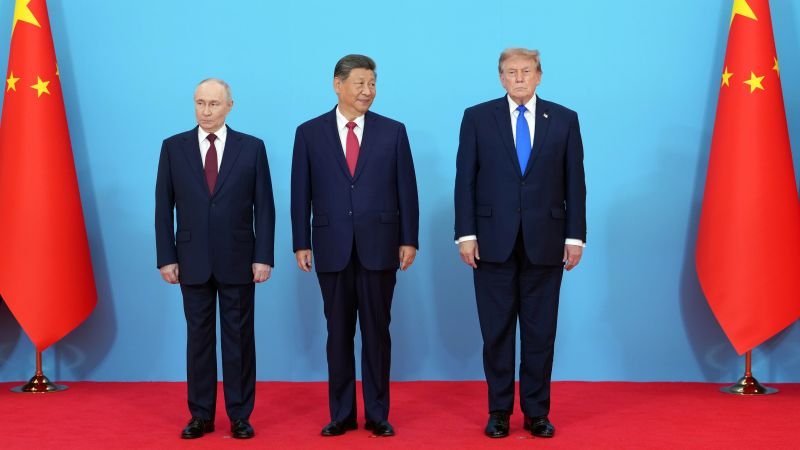
The historic three-way summit between US President Donald Trump, Chinese leader Xi Jinping, and Russian President Vladimir Putin this week may have yielded little immediate diplomatic progress.
But one of the phrases in the leaders’ joint statement — “a nuclear war cannot be won and must never be fought” — carries a historical legacy of its own.
First uttered by former President Ronald Reagan in a 1982 address to the nation, the phrase gained significance in 1985 when Reagan and Soviet Union leader Mikhail Gorbachev included it in a joint statement they made after a summit in Geneva. Allan Myer, a National Security Council staffer who joined Reagan’s speechwriting team after retiring from the Army, recalled to CNN that the statement “was a catalyst that Gorbachev grabbed onto.”
The phrase became known as the Reagan-Gorbachev principle in subsequent decades, gaining a “life of its own,” Myer said.
The two Cold War leaders carried the principle into their October 1986 meeting in Reykjavik, Iceland, where declassified documents show they agreed to eliminate their respective nuclear arsenals before a dispute over missile defense led to the collapse of those negotiations.
Despite the summit’s seeming failure at the time, the US and the Soviet Union/Russia finalized a pair of arms control agreements in subsequent years that got rid of a category of nuclear weapons and forced a mutual reduction in the number of larger nuclear weapons.
Charles Oppenheimer, grandson of atomic bomb creator J. Robert Oppenheimer, pointed to that historical precedent and told CNN that he hopes the “human connection” formed between the three world leaders during this week’s summit will portend policy work in the future to reduce the risk of nuclear war.
Oppenheimer, who recently attended an event commemorating the 40th anniversary of the Reagan-Gorbachev summit, emphasized “how much of a failure (Reykjavik) seemed at the time.”
“But we kind of know with historical hindsight … that led on to the most productive period of arms control,” Oppenheimer argued.
Filmmaker Michael Russell Gunn, who wrote, directed and produced The Brink of War, a drama centered on the Reykjavik negotiations, said the reaffirmation of the mantra that undergirded the 1986 meeting offers a sign of “hope” after the expiration of the Cold War-era arms control agreements in recent years.
Experts in nuclear risk reduction are less optimistic that a breakthrough is on the horizon this time. Reykjavik was preceded by the Geneva summit and intensive written negotiations, whereas this week’s trilateral meeting was the first of its kind.
Tong Zhao, a senior fellow studying nuclear weapons policy at the Carnegie Endowment for International Peace, told CNN the joint reaffirmation of the Reagan-Gorbachev principle “is better than nothing.”
But Zhao argued that this week’s declaration “says more about how little common ground exists among the three leading nuclear powers today than about the extent of their shared interests.”
The only other nuclear commitment in the Trump-Putin-Xi joint statement was to “conduct a dialogue on reducing nuclear risks and preventing the proliferation of nuclear weapons.”
A former top arms control official in the Obama administration, Jon Wolfsthal, told CNN that he believes Trump “failed to use the summit opportunity to actually press either country on real or reliable progress.” While Wolfsthal, now a nuclear policy fellow at PAX sapiens, praised the leaders for the initial meeting, he argued that “talks will not mean much” unless the trio each sets clear goals and direction for the process.
Zhao also emphasized that reducing nuclear risk doesn’t mean the countries will necessarily “restrain their nuclear arms competition.” The leaders did not address the use of nuclear threats to coerce other countries, Zhao added.
Oppenheimer argued that the meeting should nonetheless be a source of “renewed hope” for those who wish to see nuclear weapons reined in. Trump and Xi have publicly stated their desire to eliminate such weapons in the past, and now there is a path for negotiations to begin.
There is no date yet established for the follow-up nuclear talks, but it is expected that the US delegation will be led by the State Department, according to a senior administration official.
CNN’s Kylie Atwood contributed to this report.
This story has been updated with additional reporting.
Davis Winkie’s work at CNN is supported by a partnership between Outrider Foundation and Journalism Funding Partners (JFP). CNN retains full editorial control of the reporting.





Responses