
• Agreement virtually signed: President Donald Trump and Vice President JD Vance both virtually signed the agreement to end a US blockade of Iranian ports, reopen the Strait of Hormuz and start 60 days of nuclear negotiations, a senior US official said. Parliament Speaker Mohammad Bagher Ghalibaf signed the document for the Iranian side, the official said.
• Details unclear: No text has been released yet, with Trump saying it will likely be publicly released after the signing ceremony. Both sides have offered differing accounts on key issues, including the Strait of Hormuz. Iran intends to collect certain “fees” in the critical waterway, while Trump said it would fully reopen Friday without tolls.
• Israel’s response: Prime Minister Benjamin Netanyahu, in his first comments on the US-Iran agreement, said he and Trump “do not always see eye to eye.” Meanwhile, Israel and Iran-backed Hezbollah continued fighting on Monday, with both sides claiming responsibility for strikes in southern Lebanon.
70 Posts
Israel and Iran-backed Hezbollah continued fighting on Monday, even though the United States and Iran have reached an agreement aimed toward ending the war. A formal signing ceremony is scheduled for Friday.
US President Donald Trump and Vice President JD Vance both virtually signed the memorandum of understanding with Tehran, a senior US administration official said. Parliament Speaker Mohammad Bagher Ghalibaf signed the document for the Iranian side, the official said.
A lot of questions remain about the memorandum and how it will play out. The text has not been released, but it does not require Israel’s withdrawal from Lebanon, according a senior US administration official.
Here is the latest news:
Hezbollah said Monday that it targeted Israeli tanks and vehicles with drones, rocket launchers and artillery shells. The Israel Defense Forces, meanwhile, said the Israeli air force “carried out precise strikes” on Hezbollah militants on four occasions.
Prime Minister Benjamin Netanyahu largely avoided addressing the deal directly in remarks Monday and said he and Trump “do not always see eye to eye.” He also made clear that Israel does not intend to withdraw from southern Lebanon, Gaza or Syria.
The memorandum of understanding between the US and Iran is “about a page and a half” long, Vance said. It is a broad framework that leaves details to be worked out during future technical negotiations, he said. Separately, the vice president told NBC News that international nuclear inspectors will be allowed back into Iran under the terms of the MOU.
The text of the memorandum will be released “pretty soon,” Trump said, likely after the formal signing ceremony in Geneva on Friday. The US president, who is in France for a Group of Seven summit, suggested that he would not attend the event.
Iranian President Masoud Pezeshkian said the framework with the US represents an important step toward ending the war and beginning negotiations, but he stressed that a final agreement has not yet been completed.
The United States will keep its current force posture in the Middle East during the technical negotiations, with a planned reduction if a final deal is reached, a senior US administration official said.
Oil prices settled at their lowest level since early March and the Dow clinched a record high Monday. Still, uncertainty lingers about the logistics surrounding the Strait of Hormuz. The Trump administration has offered differing assessments of when the waterway will reopen, but a senior US official said the US “knows where all the mines” are located.
Some US foreign policy hawks are worrying that Trump gave away too much in the name of trying to end the war. They include GOP Sen. Lindsey Graham, who told reporters he is “skeptical” that Iran will drop its nuclear ambitions and said he wants to review the US-Iran agreement himself.
CNN’s David Goldman explains what happened today in the oil markets.
CNN’s Max Saltman, Eyad Kourdi, Alejandra Jaramillo, John Towfighi, Tal Shalev, Mohammed Tawfeeq, Jennifer Hansler, Betsy Klein and Kit Maher contributed reporting to this post.
Vice President JD Vance said Monday that international nuclear inspectors will be allowed back into Iran under the terms of a memorandum of understanding with Tehran.
“Yes, absolutely,” Vance told NBC’s “Nightly News” host Tom Llamas when asked whether inspectors would be permitted to return.
Vance said the return of inspectors is a central component of the memorandum of understanding signed by the United States and Iran.
“That is in fact one of the core parts of the agreement,” Vance said, adding that the memorandum explicitly calls for the International Atomic Energy Agency and the United States to help Iran eliminate its stockpile of highly enriched uranium. “That’s spelled out very clearly in the MOU.”
Asked about the timeline for carrying out that provision, Vance said “that’s one of the things we’re to talk about on Friday, when everybody gets together, signs this agreement, and kicks off the technical negotiations.”
Vice President JD Vance said the Trump administration believes Israel will eventually support the new US-Iran agreement, even as differences remain between Washington and Israeli Prime Minister Benjamin Netanyahu over the path to ending the conflict.
“Well, what we know is that this agreement is going to make Israel safer,” Vance said in an interview with NBC’s “Nightly News” on Monday. “We feel quite confident the Israelis are going to be bought in on this agreement once we get a little further down the road.”
The vice president acknowledged the United States and Israel have not always been aligned.
“I think fundamentally the United States, we have our interests,” Vance said. “We also have aligned interests, but also sometimes we’re going to disagree on issues from time to time, and I think that’s totally reasonable.”
Netanyahu, in his first public remarks on the US-Iran agreement, said earlier Monday that he and President Donald Trump “do not always see eye to eye.”
Israel and Hezbollah continued fighting on Monday, with both the Israeli military and the Lebanese Shiite militant group claiming responsibility for strikes in southern Lebanon.
Hezbollah said in two separate messages on Telegram on Monday that it had targeted Israeli tanks and vehicles with drones, rocket launchers and artillery shells. It said that clashes were “ongoing.”
The Israel Defense Forces, meanwhile, said in a statement that Hezbollah launched “an anti-tank missile and multiple mortar shells at IDF soldiers operating in southern Lebanon.” No Israeli soldiers injured, it said. The military also said that the Israeli air force “carried out precise strikes” on Hezbollah militants on four occasions Monday.
The clashes have continued even though Pakistani Prime Minister Shehbaz Sharif said Sunday that the “peace deal” mediated between Iran and the US includes “the immediate and permanent termination of military operations on all fronts, including in Lebanon.”
US President Donald Trump was furious Sunday when Israel struck a suburb of Beirut, and he conveyed his displeasure to Israeli Prime Minister Benjamin Netanyahu with expletives, a US official told CNN. Trump later posted on social media that there “should be no more attacks by Israel anywhere in Lebanon.”
A US official told CNN that the agreement does not include a requirement that Israel withdraw from Lebanon, and Israel has said it will continue its military occupation of southern Lebanon.
Netanyahu told reporters Monday that he and Trump don’t always “see eye to eye” and that Israel will continue its occupations of Lebanon, Gaza and Syria “for as long as necessary.”
While there are few hard details of what’s actually in the memorandum of understanding between the United States and Iran, some foreign policy hawks are openly worrying that President Donald Trump gave away too much in the name of trying to end the war.
Here’s what some of them have said:
Sen. Lindsey Graham of South Carolina said in a post on X Sunday that he was “somewhat concerned” that Iran’s version of the details didn’t match the Trump administration’s. He also emphasized that Congress must vote on such an agreement.
Mark Levin, a Fox News host, has also been an influential backer of the war, but on Sunday, he seemed to take exception after Trump decried Israel for targeting Hezbollah in Lebanon amid peace negotiations. Since then, he’s repeatedly wondered aloud why the Trump administration won’t release the text.
Former Trump Secretary of State Mike Pompeo said on X Monday: “I pray that any settlement preserves those sacrifices and secures the interests of the American people.”
Marc Thiessen, the former George W. Bush aide whom Semafor reported Trump has leaned on for advice, warned Monday on Fox News that Trump’s emerging framework looks a lot like Obama’s.
The editors of the conservative National Review called it “discouraging” that Trump had indicated Iran would still be allowed to enrich uranium for non-military uses. And they criticized early indicators that the agreement would not rein in Iran’s ballistic missile program.
Now that the US and Iran have reached an agreement aimed at ending the war between them, the next expected developments will come at a formal signing ceremony set to take place in Switzerland on Friday.
CNN’s Nic Robertson takes a look at what the next steps could be in the video below:
Vice President JD Vance told CNN’s Jake Tapper on Monday that the memorandum of understanding between the United States and Iran is “about a page and a half” long, describing it as a broad framework that leaves details to be worked out during future technical negotiations.
“Yes, so the MOU is about a page and a half, so it is a very general document,” the vice president said.
“On a number of issues, we are going to have to figure this stuff out during the technical negotiation phase, but what the MOU does is set up a framework whereby the Iranians get the benefits of the bargain by meeting their obligations under the bargain,” he added.
Vance said that “paragraph one” of the document lays out the expectation that Iran commits to “regional peace and stability,” which he said includes not funding groups the US considers terrorists.
“What paragraph one of the agreement says is effectively that Iran commits itself, just as the United States commits itself, to regional peace and stability,” Vance said.
“Part of that, Jake, is that the Iranians have to stop funding violent terrorist organizations, they have to stop funding regional instability.”
Oil prices settled at their lowest level since early March and the Dow clinched a record high Monday after the United States and Iran announced an agreement to reopen the Strait of Hormuz.
Brent crude, the global oil benchmark, sank 4.76% to $83.17 per barrel, its lowest settle price since March 4. WTI, the US oil benchmark, fell 4.87% to $80.75 per barrel, also its lowest settle price since March 4.
The US-Iran agreement and drop in oil prices were met with relief in the stock market. The Dow gained 469 points, or 0.92%, and closed at a record high of 51,671, surpassing a previous peak set on June 4.
The S&P 500 rose 1.65%, and the tech-heavy Nasdaq Composite surged 3.07% for its best day since March 31. The S&P and Nasdaq are now less than 1% and about 1.5% away from hitting record highs, respectively.
Still, uncertainty lingers about specifics of the US-Iran agreement, logistics surrounding reopening the Strait of Hormuz and whether conflict in the Middle East will be contained.
Oil prices remain above pre-war levels. The 10-year US Treasury yield, which can move based on expectations for inflation, is also above pre-war levels.
Dozens of supporters of Iran-backed militias gathered in Baghdad on Monday to celebrate the agreement between the United States and Iran, calling it a victory for Tehran.
Video obtained by CNN showed supporters assembling in cars at Tahrir Square in central Baghdad before heading to the area in front of the Iranian Embassy.
The gathering appeared to be an organized public show of support for Iran following developments in talks between Washington and Tehran.
The supporters were seen holding Iranian flags and the flags of some Iran-backed militias. They also displayed posters on buildings showing the late Iranian supreme leader, Ayatollah Ali Khamenei, and his son Mojtaba, who succeeded him.
“Death to America,” one supporter was heard shouting. “We are at your service,” others were heard shouting in reference to the Iranian regime.
Hours after nearly every other Israeli official weighed in on the memorandum of understanding between the US and Iran, Prime Minister Benjamin Netanyahu finally spoke about it, saying he and President Donald Trump “do not always see eye to eye.”
In a Monday evening press conference, Netanyahu said such a disagreement “happens in the best of families.”
“President Trump and I do not always see eye to eye,” Netanyahu said. “He is the president of the United States, and I am the prime minister of Israel. I am responsible for Israel’s security interests, and it needs to be done wisely.”
In his opening remarks, Netanyahu largely avoided addressing the deal directly and focused on what he described as the great achievements of Israel’s campaigns against Iran and across the Middle East.
“With or without an agreement, Iran will not have nuclear weapons — not today and not tomorrow. As long as I am prime minister of Israel, it will not happen,” he said.
“The struggle is not over,” he added. “We will need to remain vigilant, strong and determined to defend ourselves, as required.”
Netanyahu also made clear that Israel does not intend to withdraw from southern Lebanon, Gaza or Syria. “We will remain in the security zones for as long as necessary to defend our country,” he said.
Answering questions from reporters, Netanyahu acknowledged uncertainty about the agreement itself.
“We still do not know what the agreement will be,” he said.
Asked whether the deal was reached against his position, Netanyahu stressed his long-standing relationship with Trump.
“Acting wisely requires a great deal of experience and deep familiarity with the American arena. I believe I am doing this in the best possible way,” he said.
Hezbollah said it attacked an Israeli army bulldozer and two tanks in southern Lebanon on Monday evening.
The militant group said in a statement on Telegram that it attacked the three vehicles “with guided missiles and Ababil loitering drones” on the outskirts of Kfar Tabnit. The attack occurred in the same town where Lebanese state media earlier reported an Israeli strike on a car.
CNN has reached out to the Israeli military for comment on both strikes. Israeli Prime Minister Benjamin Netanyahu said in a statement Monday that Israel killed four “terrorists” in Lebanon.
Israeli officials have said that Israel does not intend to withdraw from Lebanon, though Iran and Pakistan have both said the agreement with the US to reopen the Strait of Hormuz and end the American blockade of Iranian ports includes an end to hostilities in Lebanon.
Earlier Monday, Lebanese President Joseph Aoun’s office said he spoke with Iranian Foreign Minister Abbas Araghchi and “welcomed the understanding reached between” Iran and the US, without mentioning Israel.
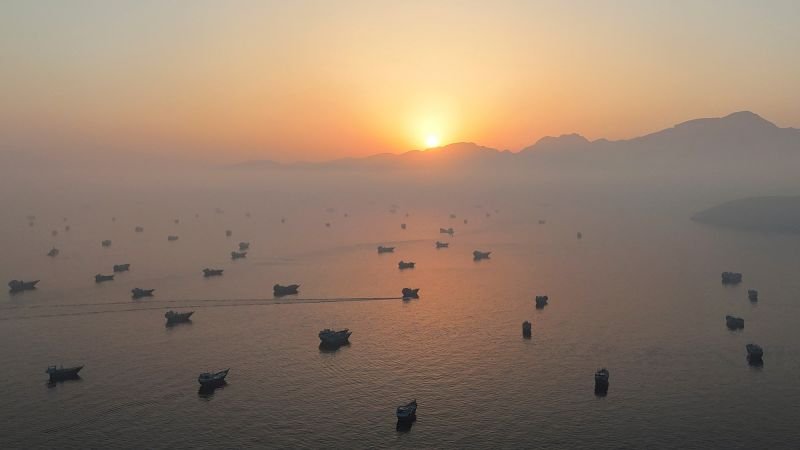
The Trump administration is offering differing assessments on when the Strait of Hormuz will reopen, with President Donald Trump saying it’s “partially” open now and will be fully reopened Friday, while some senior administration officials suggested a return to normal could take more time.
“On Friday, it’ll be completely open,” Trump told reporters during a bilateral meeting with French President Emmanuel Macron on Monday.
“By Friday, everything will be fully open. I think it will adjust very, very quickly,” one official said on a call with reporters, also on Monday, noting that 25 ships are getting through per day and that that will increase to 40 to 50 “pretty quickly.”
“So I think it will return to normal pretty quickly, definitely within 30 days,” the official said.
Another official on the same call said there would be “significant” traffic — but not normal flow — within two weeks.
“You will see significant increase in traffic in the Strait of Hormuz, actually starting already, and that will ramp up slowly over time, to the point where I think a week from now, two weeks from now — we probably won’t return to normal in two weeks — but we will see a significant increase in strait traffic,” the official said.
“We’re already seeing a substantial increase in traffic, but if you think of the traffic pre-conflict as 140 ships or so per day, I think we’ll get a very long way there over the next couple of weeks, but it’s going to take a little time,” the same official later added.
And while Trump declared Monday that “ships are starting to go out now,” he initially announced on Truth Social on Sunday that the strait would open on Friday “upon the signing of the deal.”
Iranian President Masoud Pezeshkian said Monday a memorandum of understanding with the US represents an important step toward ending the war and beginning negotiations, but he stressed that a final agreement has not yet been completed.
“The agreement reached is a significant step towards halting the war and initiating negotiations, and a final agreement has not yet been formalized,” Pezeshkian wrote Monday in a series of posts on X.
He said the Islamic Republic has prepared “for all options” and that the government’s focus, “with or without an agreement,” would remain serving the Iranian people.
Pezeshkian said the memorandum was the result of “months of discussions and continuous follow-ups.” If its provisions are properly implemented, it “can be considered an honorable document for the country,” he added.
The US and Iran have reached an agreement that will end a US blockade of Iranian ports, reopen the Strait of Hormuz and begin 60 days of nuclear negotiations.
The text of the memorandum of understanding between the two countries will be released publicly. US President Donald Trump said it would come “pretty soon” but likely after a formal signing ceremony on Friday, while a senior Trump administration official said it would be put out in the next 24 to 48 hours.
Here is what we know — and don’t know — about the key issues at stake:
Strait of Hormuz
The US said the strait would reopen after the agreement is signed on Friday, with Trump declaring that passage through the waterway would be “permanently toll free.”
But two semi-official Iranian news agencies reported Monday that while Tehran will allow free transit for the 60-day window in which further negotiations will take place, it plans to impose fees after that period. Fars News Agency said Iran “intends to benefit financially from commercial shipping traffic through the Strait.”
Safety considerations will also impact the timing of any reopening. CNN has previously reported that Iran has laid mines in the strait, and negotiators will need to reach agreements on how to remove them.
Ceasefire
Pakistan, which brokered the agreement, said both sides have “declared the immediate and permanent termination of military operations on all fronts, including in Lebanon.”
However, the agreement does not include a requirement that Israel withdraw from Lebanon, a senior US official said on Monday. Israel, which is not party to the agreement, reiterated that its forces are not withdrawing from Lebanon.
The US will keep its current force posture in the Middle East during US-Iran technical negotiations, with a planned reduction if a final deal is reached, a senior US administration official said.
Nuclear issues
The US said Iran made assurances that it would never get a nuclear weapon. But there are no concrete commitments around Iran’s nuclear program or its uranium stockpiles. That can has been kicked down the road.
Sanctions and frozen funds
Iran said the 60-day nuclear negotiations will begin only after the US releases billions of dollars of frozen funds. But a US official said no money would be released without clear commitments by Iran.
The economy
Oil prices fell to their lowest levels in three months on the announcement but remain around $10 a barrel above their pre-war levels. A broader economic recovery will likely take months.
CNN’s Adam Cancryn, Jennifer Hansler and Kevin Liptak contributed reporting to this post, which has been updated.
A senior US administration official told reporters Monday that Oman was “duplicitous” during negotiating efforts with Iran — so they “threw them out” of the mediation role.
“We were very unhappy with the job the Omanis did. We felt they were very duplicitous and almost like employees of the Iranians in the way that they maneuvered, so we kind of threw them out of this process,” the official said.
It’s the latest sign of the Trump administration’s disapproval of a country that has historically been a key interlocutor for the US in the Middle East. In recent weeks, the administration threatened both sanctions and military actions against Oman.
CNN has reached out to the Omani Ministry of Foreign Affairs for comment.
The senior administration official said one of the challenges in negotiating with Iran was establishing “the right channels of communication with the Iranian regime.” They noted that “the old way” involved the supreme leader giving directions to Iran’s National Security Council, through “the political class” and then through Oman.
“We wanted to figure out what the new channels would be to communicate with, and obviously we decided on Pakistan and Qatar,” the official said.
They also noted that the “political mechanism” that had been used in the past “was mostly disabled” because of actions at the start of the war and “most people were hiding in bunkers,” so that also made communication challenging. A number of high-level Iranian figures were killed at the start of the war.
US President Donald Trump just spoke to reporters in Évian-les-Bains, France, where he discussed his recently announced agreement with Iran aimed at ending the war.
Here’s a look at the main developments from his remarks:
Trump, who was speaking alongside French President Emmanuel Macron at this year’s G7 summit, said that the Strait of Hormuz is “already partially opened” and that it will fully open Friday, when the US and Iran are set to formally sign a memorandum of understanding.
Trump said the text of the memorandum of understanding would be released publicly, likely after the formal signing ceremony planned for Friday.
The US leader also suggested that he would not attend that formal signing ceremony, which is set to take place in Switzerland. In his place, US Vice President JD Vance would come to Geneva for the event, Trump said.
CNN’s Kevin Liptak, Elise Hammond and Donald Judd contributed to this reporting.
President Donald Trump said Monday that the Strait of Hormuz is “already partially opened” and that it will fully open Friday, when the US and Iran are set to formally sign a memorandum of understanding.
Though the US president publicly complained about European leaders’ unwillingness to join in the US-Israeli war against Iran, he suggested the strait would reopen without needing much aid from France.
“I don’t think we’re going to need much help, because we have an agreement where it’s going to be open, and it’s toll-free. We had a little argument on that; it’s toll-free,” he said, adding, “I don’t think it’s a bad idea to have a ship or two up here from a few countries.”
A senior US official said that ceasefires can be “a little dirty,” referencing the fire traded between Israel and Hezbollah and implying that it would not greatly impact the impending agreement between the United States and Iran.
“Ceasefires like this are inherently a little dirty. We’ve seen that in Lebanon, where you know there’s a significant reduction in the amount of fire coming from Hezbollah to Israel, and consequently coming from Israel into Lebanon, but it’s not zero,” one senior offiical said.
A senior administration official also told reporters on a Friday call: “Sometimes these ceasefires are a little messy, sometimes they take a little bit of time to take root.”
On the Monday call, the continued challenge of communicating any movement between both sides was also acknowledged as a factor at play.
“We saw even yesterday, there are going to be delays in getting some of the word about the deal through their system,” they said.
President Donald Trump said the text of the memorandum of understanding between the United States and Iran would be released publicly, likely after the formal signing ceremony planned for Friday.
Asked when the agreement would be released at a bilateral meeting with French President Emmanuel Macron, Trump said, “I think pretty soon. I would say — I mean, I want it to be released because it’s a very powerful document.”
“This is a very powerful document and I want it to be released. So probably pretty soon. I would say after sometime after Friday,” he said.
Pakistan’s foreign minister said a formal signing ceremony of the agreement will happen in the Swiss city of Geneva. Trump is in Europe on Monday for the G7 summit.
Senior US administration officials downplayed the prospect of any “side deals” aimed at unfreezing Iranian assets held in Gulf countries, but suggested the US is willing to make some “small gestures” to start to relieve sanctions.
Gulf coalition countries, one senior US official said, have been “very supportive” of the agreement between the US and Iran to begin intensive negotiations on some of the thornier outstanding issues to end the conflict.
Among those issues: Iran has reportedly demanded the release of $12 billion in frozen funds as soon as an interim agreement is signed with the US, and another $12 billion at a later stage.
Asked whether the agreement precluded a third country from immediately unfreezing Iranian assets, the senior official said, “You’re not going to see Qatar or UAE or any of these other countries cut side deals.”
Pointing to “close coordination” with those regional partners, the official added, “The idea that any of these countries would cut side deals with the Iranians, I think, is not just unlikely, but preposterous.”
A second senior official added that the US and Iran are in the “early phases” of “building trust,” but suggested that the US is “prepared to release frozen funds, and we are prepared to relieve sanctions.”
“We’ll do some small gestures of that in the beginning, if they make some small gestures to us that show that they’re willing to meet their commitments,” the official added.
The official declined to provide specifics on what that “small gesture” would be, but the first official later clarified that as of now, “$0 of unfrozen assets have been released by the United States or any other country.”
• Agreement virtually signed: President Donald Trump and Vice President JD Vance both virtually signed the agreement to end a US blockade of Iranian ports, reopen the Strait of Hormuz and start 60 days of nuclear negotiations, a senior US official said. Parliament Speaker Mohammad Bagher Ghalibaf signed the document for the Iranian side, the official said.
• Details unclear: No text has been released yet, with Trump saying it will likely be publicly released after the signing ceremony. Both sides have offered differing accounts on key issues, including the Strait of Hormuz. Iran intends to collect certain “fees” in the critical waterway, while Trump said it would fully reopen Friday without tolls.
• Israel’s response: Prime Minister Benjamin Netanyahu, in his first comments on the US-Iran agreement, said he and Trump “do not always see eye to eye.” Meanwhile, Israel and Iran-backed Hezbollah continued fighting on Monday, with both sides claiming responsibility for strikes in southern Lebanon.
Israel and Iran-backed Hezbollah continued fighting on Monday, even though the United States and Iran have reached an agreement aimed toward ending the war. A formal signing ceremony is scheduled for Friday.
US President Donald Trump and Vice President JD Vance both virtually signed the memorandum of understanding with Tehran, a senior US administration official said. Parliament Speaker Mohammad Bagher Ghalibaf signed the document for the Iranian side, the official said.
A lot of questions remain about the memorandum and how it will play out. The text has not been released, but it does not require Israel’s withdrawal from Lebanon, according a senior US administration official.
Here is the latest news:
Hezbollah said Monday that it targeted Israeli tanks and vehicles with drones, rocket launchers and artillery shells. The Israel Defense Forces, meanwhile, said the Israeli air force “carried out precise strikes” on Hezbollah militants on four occasions.
Prime Minister Benjamin Netanyahu largely avoided addressing the deal directly in remarks Monday and said he and Trump “do not always see eye to eye.” He also made clear that Israel does not intend to withdraw from southern Lebanon, Gaza or Syria.
The memorandum of understanding between the US and Iran is “about a page and a half” long, Vance said. It is a broad framework that leaves details to be worked out during future technical negotiations, he said. Separately, the vice president told NBC News that international nuclear inspectors will be allowed back into Iran under the terms of the MOU.
The text of the memorandum will be released “pretty soon,” Trump said, likely after the formal signing ceremony in Geneva on Friday. The US president, who is in France for a Group of Seven summit, suggested that he would not attend the event.
Iranian President Masoud Pezeshkian said the framework with the US represents an important step toward ending the war and beginning negotiations, but he stressed that a final agreement has not yet been completed.
The United States will keep its current force posture in the Middle East during the technical negotiations, with a planned reduction if a final deal is reached, a senior US administration official said.
Oil prices settled at their lowest level since early March and the Dow clinched a record high Monday. Still, uncertainty lingers about the logistics surrounding the Strait of Hormuz. The Trump administration has offered differing assessments of when the waterway will reopen, but a senior US official said the US “knows where all the mines” are located.
Some US foreign policy hawks are worrying that Trump gave away too much in the name of trying to end the war. They include GOP Sen. Lindsey Graham, who told reporters he is “skeptical” that Iran will drop its nuclear ambitions and said he wants to review the US-Iran agreement himself.
CNN’s David Goldman explains what happened today in the oil markets.
CNN’s Max Saltman, Eyad Kourdi, Alejandra Jaramillo, John Towfighi, Tal Shalev, Mohammed Tawfeeq, Jennifer Hansler, Betsy Klein and Kit Maher contributed reporting to this post.
Vice President JD Vance said Monday that international nuclear inspectors will be allowed back into Iran under the terms of a memorandum of understanding with Tehran.
“Yes, absolutely,” Vance told NBC’s “Nightly News” host Tom Llamas when asked whether inspectors would be permitted to return.
Vance said the return of inspectors is a central component of the memorandum of understanding signed by the United States and Iran.
“That is in fact one of the core parts of the agreement,” Vance said, adding that the memorandum explicitly calls for the International Atomic Energy Agency and the United States to help Iran eliminate its stockpile of highly enriched uranium. “That’s spelled out very clearly in the MOU.”
Asked about the timeline for carrying out that provision, Vance said “that’s one of the things we’re to talk about on Friday, when everybody gets together, signs this agreement, and kicks off the technical negotiations.”
Vice President JD Vance said the Trump administration believes Israel will eventually support the new US-Iran agreement, even as differences remain between Washington and Israeli Prime Minister Benjamin Netanyahu over the path to ending the conflict.
“Well, what we know is that this agreement is going to make Israel safer,” Vance said in an interview with NBC’s “Nightly News” on Monday. “We feel quite confident the Israelis are going to be bought in on this agreement once we get a little further down the road.”
The vice president acknowledged the United States and Israel have not always been aligned.
“I think fundamentally the United States, we have our interests,” Vance said. “We also have aligned interests, but also sometimes we’re going to disagree on issues from time to time, and I think that’s totally reasonable.”
Netanyahu, in his first public remarks on the US-Iran agreement, said earlier Monday that he and President Donald Trump “do not always see eye to eye.”
Israel and Hezbollah continued fighting on Monday, with both the Israeli military and the Lebanese Shiite militant group claiming responsibility for strikes in southern Lebanon.
Hezbollah said in two separate messages on Telegram on Monday that it had targeted Israeli tanks and vehicles with drones, rocket launchers and artillery shells. It said that clashes were “ongoing.”
The Israel Defense Forces, meanwhile, said in a statement that Hezbollah launched “an anti-tank missile and multiple mortar shells at IDF soldiers operating in southern Lebanon.” No Israeli soldiers injured, it said. The military also said that the Israeli air force “carried out precise strikes” on Hezbollah militants on four occasions Monday.
The clashes have continued even though Pakistani Prime Minister Shehbaz Sharif said Sunday that the “peace deal” mediated between Iran and the US includes “the immediate and permanent termination of military operations on all fronts, including in Lebanon.”
US President Donald Trump was furious Sunday when Israel struck a suburb of Beirut, and he conveyed his displeasure to Israeli Prime Minister Benjamin Netanyahu with expletives, a US official told CNN. Trump later posted on social media that there “should be no more attacks by Israel anywhere in Lebanon.”
A US official told CNN that the agreement does not include a requirement that Israel withdraw from Lebanon, and Israel has said it will continue its military occupation of southern Lebanon.
Netanyahu told reporters Monday that he and Trump don’t always “see eye to eye” and that Israel will continue its occupations of Lebanon, Gaza and Syria “for as long as necessary.”
While there are few hard details of what’s actually in the memorandum of understanding between the United States and Iran, some foreign policy hawks are openly worrying that President Donald Trump gave away too much in the name of trying to end the war.
Here’s what some of them have said:
Sen. Lindsey Graham of South Carolina said in a post on X Sunday that he was “somewhat concerned” that Iran’s version of the details didn’t match the Trump administration’s. He also emphasized that Congress must vote on such an agreement.
Mark Levin, a Fox News host, has also been an influential backer of the war, but on Sunday, he seemed to take exception after Trump decried Israel for targeting Hezbollah in Lebanon amid peace negotiations. Since then, he’s repeatedly wondered aloud why the Trump administration won’t release the text.
Former Trump Secretary of State Mike Pompeo said on X Monday: “I pray that any settlement preserves those sacrifices and secures the interests of the American people.”
Marc Thiessen, the former George W. Bush aide whom Semafor reported Trump has leaned on for advice, warned Monday on Fox News that Trump’s emerging framework looks a lot like Obama’s.
The editors of the conservative National Review called it “discouraging” that Trump had indicated Iran would still be allowed to enrich uranium for non-military uses. And they criticized early indicators that the agreement would not rein in Iran’s ballistic missile program.
Now that the US and Iran have reached an agreement aimed at ending the war between them, the next expected developments will come at a formal signing ceremony set to take place in Switzerland on Friday.
CNN’s Nic Robertson takes a look at what the next steps could be in the video below:
Vice President JD Vance told CNN’s Jake Tapper on Monday that the memorandum of understanding between the United States and Iran is “about a page and a half” long, describing it as a broad framework that leaves details to be worked out during future technical negotiations.
“Yes, so the MOU is about a page and a half, so it is a very general document,” the vice president said.
“On a number of issues, we are going to have to figure this stuff out during the technical negotiation phase, but what the MOU does is set up a framework whereby the Iranians get the benefits of the bargain by meeting their obligations under the bargain,” he added.
Vance said that “paragraph one” of the document lays out the expectation that Iran commits to “regional peace and stability,” which he said includes not funding groups the US considers terrorists.
“What paragraph one of the agreement says is effectively that Iran commits itself, just as the United States commits itself, to regional peace and stability,” Vance said.
“Part of that, Jake, is that the Iranians have to stop funding violent terrorist organizations, they have to stop funding regional instability.”
Oil prices settled at their lowest level since early March and the Dow clinched a record high Monday after the United States and Iran announced an agreement to reopen the Strait of Hormuz.
Brent crude, the global oil benchmark, sank 4.76% to $83.17 per barrel, its lowest settle price since March 4. WTI, the US oil benchmark, fell 4.87% to $80.75 per barrel, also its lowest settle price since March 4.
The US-Iran agreement and drop in oil prices were met with relief in the stock market. The Dow gained 469 points, or 0.92%, and closed at a record high of 51,671, surpassing a previous peak set on June 4.
The S&P 500 rose 1.65%, and the tech-heavy Nasdaq Composite surged 3.07% for its best day since March 31. The S&P and Nasdaq are now less than 1% and about 1.5% away from hitting record highs, respectively.
Still, uncertainty lingers about specifics of the US-Iran agreement, logistics surrounding reopening the Strait of Hormuz and whether conflict in the Middle East will be contained.
Oil prices remain above pre-war levels. The 10-year US Treasury yield, which can move based on expectations for inflation, is also above pre-war levels.
Dozens of supporters of Iran-backed militias gathered in Baghdad on Monday to celebrate the agreement between the United States and Iran, calling it a victory for Tehran.
Video obtained by CNN showed supporters assembling in cars at Tahrir Square in central Baghdad before heading to the area in front of the Iranian Embassy.
The gathering appeared to be an organized public show of support for Iran following developments in talks between Washington and Tehran.
The supporters were seen holding Iranian flags and the flags of some Iran-backed militias. They also displayed posters on buildings showing the late Iranian supreme leader, Ayatollah Ali Khamenei, and his son Mojtaba, who succeeded him.
“Death to America,” one supporter was heard shouting. “We are at your service,” others were heard shouting in reference to the Iranian regime.
Hours after nearly every other Israeli official weighed in on the memorandum of understanding between the US and Iran, Prime Minister Benjamin Netanyahu finally spoke about it, saying he and President Donald Trump “do not always see eye to eye.”
In a Monday evening press conference, Netanyahu said such a disagreement “happens in the best of families.”
“President Trump and I do not always see eye to eye,” Netanyahu said. “He is the president of the United States, and I am the prime minister of Israel. I am responsible for Israel’s security interests, and it needs to be done wisely.”
In his opening remarks, Netanyahu largely avoided addressing the deal directly and focused on what he described as the great achievements of Israel’s campaigns against Iran and across the Middle East.
“With or without an agreement, Iran will not have nuclear weapons — not today and not tomorrow. As long as I am prime minister of Israel, it will not happen,” he said.
“The struggle is not over,” he added. “We will need to remain vigilant, strong and determined to defend ourselves, as required.”
Netanyahu also made clear that Israel does not intend to withdraw from southern Lebanon, Gaza or Syria. “We will remain in the security zones for as long as necessary to defend our country,” he said.
Answering questions from reporters, Netanyahu acknowledged uncertainty about the agreement itself.
“We still do not know what the agreement will be,” he said.
Asked whether the deal was reached against his position, Netanyahu stressed his long-standing relationship with Trump.
“Acting wisely requires a great deal of experience and deep familiarity with the American arena. I believe I am doing this in the best possible way,” he said.
Hezbollah said it attacked an Israeli army bulldozer and two tanks in southern Lebanon on Monday evening.
The militant group said in a statement on Telegram that it attacked the three vehicles “with guided missiles and Ababil loitering drones” on the outskirts of Kfar Tabnit. The attack occurred in the same town where Lebanese state media earlier reported an Israeli strike on a car.
CNN has reached out to the Israeli military for comment on both strikes. Israeli Prime Minister Benjamin Netanyahu said in a statement Monday that Israel killed four “terrorists” in Lebanon.
Israeli officials have said that Israel does not intend to withdraw from Lebanon, though Iran and Pakistan have both said the agreement with the US to reopen the Strait of Hormuz and end the American blockade of Iranian ports includes an end to hostilities in Lebanon.
Earlier Monday, Lebanese President Joseph Aoun’s office said he spoke with Iranian Foreign Minister Abbas Araghchi and “welcomed the understanding reached between” Iran and the US, without mentioning Israel.
The Trump administration is offering differing assessments on when the Strait of Hormuz will reopen, with President Donald Trump saying it’s “partially” open now and will be fully reopened Friday, while some senior administration officials suggested a return to normal could take more time.
“On Friday, it’ll be completely open,” Trump told reporters during a bilateral meeting with French President Emmanuel Macron on Monday.
“By Friday, everything will be fully open. I think it will adjust very, very quickly,” one official said on a call with reporters, also on Monday, noting that 25 ships are getting through per day and that that will increase to 40 to 50 “pretty quickly.”
“So I think it will return to normal pretty quickly, definitely within 30 days,” the official said.
Another official on the same call said there would be “significant” traffic — but not normal flow — within two weeks.
“You will see significant increase in traffic in the Strait of Hormuz, actually starting already, and that will ramp up slowly over time, to the point where I think a week from now, two weeks from now — we probably won’t return to normal in two weeks — but we will see a significant increase in strait traffic,” the official said.
“We’re already seeing a substantial increase in traffic, but if you think of the traffic pre-conflict as 140 ships or so per day, I think we’ll get a very long way there over the next couple of weeks, but it’s going to take a little time,” the same official later added.
And while Trump declared Monday that “ships are starting to go out now,” he initially announced on Truth Social on Sunday that the strait would open on Friday “upon the signing of the deal.”
Iranian President Masoud Pezeshkian said Monday a memorandum of understanding with the US represents an important step toward ending the war and beginning negotiations, but he stressed that a final agreement has not yet been completed.
“The agreement reached is a significant step towards halting the war and initiating negotiations, and a final agreement has not yet been formalized,” Pezeshkian wrote Monday in a series of posts on X.
He said the Islamic Republic has prepared “for all options” and that the government’s focus, “with or without an agreement,” would remain serving the Iranian people.
Pezeshkian said the memorandum was the result of “months of discussions and continuous follow-ups.” If its provisions are properly implemented, it “can be considered an honorable document for the country,” he added.
The US and Iran have reached an agreement that will end a US blockade of Iranian ports, reopen the Strait of Hormuz and begin 60 days of nuclear negotiations.
The text of the memorandum of understanding between the two countries will be released publicly. US President Donald Trump said it would come “pretty soon” but likely after a formal signing ceremony on Friday, while a senior Trump administration official said it would be put out in the next 24 to 48 hours.
Here is what we know — and don’t know — about the key issues at stake:
Strait of Hormuz
The US said the strait would reopen after the agreement is signed on Friday, with Trump declaring that passage through the waterway would be “permanently toll free.”
But two semi-official Iranian news agencies reported Monday that while Tehran will allow free transit for the 60-day window in which further negotiations will take place, it plans to impose fees after that period. Fars News Agency said Iran “intends to benefit financially from commercial shipping traffic through the Strait.”
Safety considerations will also impact the timing of any reopening. CNN has previously reported that Iran has laid mines in the strait, and negotiators will need to reach agreements on how to remove them.
Ceasefire
Pakistan, which brokered the agreement, said both sides have “declared the immediate and permanent termination of military operations on all fronts, including in Lebanon.”
However, the agreement does not include a requirement that Israel withdraw from Lebanon, a senior US official said on Monday. Israel, which is not party to the agreement, reiterated that its forces are not withdrawing from Lebanon.
The US will keep its current force posture in the Middle East during US-Iran technical negotiations, with a planned reduction if a final deal is reached, a senior US administration official said.
Nuclear issues
The US said Iran made assurances that it would never get a nuclear weapon. But there are no concrete commitments around Iran’s nuclear program or its uranium stockpiles. That can has been kicked down the road.
Sanctions and frozen funds
Iran said the 60-day nuclear negotiations will begin only after the US releases billions of dollars of frozen funds. But a US official said no money would be released without clear commitments by Iran.
The economy
Oil prices fell to their lowest levels in three months on the announcement but remain around $10 a barrel above their pre-war levels. A broader economic recovery will likely take months.
CNN’s Adam Cancryn, Jennifer Hansler and Kevin Liptak contributed reporting to this post, which has been updated.
A senior US administration official told reporters Monday that Oman was “duplicitous” during negotiating efforts with Iran — so they “threw them out” of the mediation role.
“We were very unhappy with the job the Omanis did. We felt they were very duplicitous and almost like employees of the Iranians in the way that they maneuvered, so we kind of threw them out of this process,” the official said.
It’s the latest sign of the Trump administration’s disapproval of a country that has historically been a key interlocutor for the US in the Middle East. In recent weeks, the administration threatened both sanctions and military actions against Oman.
CNN has reached out to the Omani Ministry of Foreign Affairs for comment.
The senior administration official said one of the challenges in negotiating with Iran was establishing “the right channels of communication with the Iranian regime.” They noted that “the old way” involved the supreme leader giving directions to Iran’s National Security Council, through “the political class” and then through Oman.
“We wanted to figure out what the new channels would be to communicate with, and obviously we decided on Pakistan and Qatar,” the official said.
They also noted that the “political mechanism” that had been used in the past “was mostly disabled” because of actions at the start of the war and “most people were hiding in bunkers,” so that also made communication challenging. A number of high-level Iranian figures were killed at the start of the war.
US President Donald Trump just spoke to reporters in Évian-les-Bains, France, where he discussed his recently announced agreement with Iran aimed at ending the war.
Here’s a look at the main developments from his remarks:
Trump, who was speaking alongside French President Emmanuel Macron at this year’s G7 summit, said that the Strait of Hormuz is “already partially opened” and that it will fully open Friday, when the US and Iran are set to formally sign a memorandum of understanding.
Trump said the text of the memorandum of understanding would be released publicly, likely after the formal signing ceremony planned for Friday.
The US leader also suggested that he would not attend that formal signing ceremony, which is set to take place in Switzerland. In his place, US Vice President JD Vance would come to Geneva for the event, Trump said.
CNN’s Kevin Liptak, Elise Hammond and Donald Judd contributed to this reporting.
President Donald Trump said Monday that the Strait of Hormuz is “already partially opened” and that it will fully open Friday, when the US and Iran are set to formally sign a memorandum of understanding.
Though the US president publicly complained about European leaders’ unwillingness to join in the US-Israeli war against Iran, he suggested the strait would reopen without needing much aid from France.
“I don’t think we’re going to need much help, because we have an agreement where it’s going to be open, and it’s toll-free. We had a little argument on that; it’s toll-free,” he said, adding, “I don’t think it’s a bad idea to have a ship or two up here from a few countries.”
A senior US official said that ceasefires can be “a little dirty,” referencing the fire traded between Israel and Hezbollah and implying that it would not greatly impact the impending agreement between the United States and Iran.
“Ceasefires like this are inherently a little dirty. We’ve seen that in Lebanon, where you know there’s a significant reduction in the amount of fire coming from Hezbollah to Israel, and consequently coming from Israel into Lebanon, but it’s not zero,” one senior offiical said.
A senior administration official also told reporters on a Friday call: “Sometimes these ceasefires are a little messy, sometimes they take a little bit of time to take root.”
On the Monday call, the continued challenge of communicating any movement between both sides was also acknowledged as a factor at play.
“We saw even yesterday, there are going to be delays in getting some of the word about the deal through their system,” they said.
President Donald Trump said the text of the memorandum of understanding between the United States and Iran would be released publicly, likely after the formal signing ceremony planned for Friday.
Asked when the agreement would be released at a bilateral meeting with French President Emmanuel Macron, Trump said, “I think pretty soon. I would say — I mean, I want it to be released because it’s a very powerful document.”
“This is a very powerful document and I want it to be released. So probably pretty soon. I would say after sometime after Friday,” he said.
Pakistan’s foreign minister said a formal signing ceremony of the agreement will happen in the Swiss city of Geneva. Trump is in Europe on Monday for the G7 summit.
Senior US administration officials downplayed the prospect of any “side deals” aimed at unfreezing Iranian assets held in Gulf countries, but suggested the US is willing to make some “small gestures” to start to relieve sanctions.
Gulf coalition countries, one senior US official said, have been “very supportive” of the agreement between the US and Iran to begin intensive negotiations on some of the thornier outstanding issues to end the conflict.
Among those issues: Iran has reportedly demanded the release of $12 billion in frozen funds as soon as an interim agreement is signed with the US, and another $12 billion at a later stage.
Asked whether the agreement precluded a third country from immediately unfreezing Iranian assets, the senior official said, “You’re not going to see Qatar or UAE or any of these other countries cut side deals.”
Pointing to “close coordination” with those regional partners, the official added, “The idea that any of these countries would cut side deals with the Iranians, I think, is not just unlikely, but preposterous.”
A second senior official added that the US and Iran are in the “early phases” of “building trust,” but suggested that the US is “prepared to release frozen funds, and we are prepared to relieve sanctions.”
“We’ll do some small gestures of that in the beginning, if they make some small gestures to us that show that they’re willing to meet their commitments,” the official added.
The official declined to provide specifics on what that “small gesture” would be, but the first official later clarified that as of now, “$0 of unfrozen assets have been released by the United States or any other country.”


Responses