
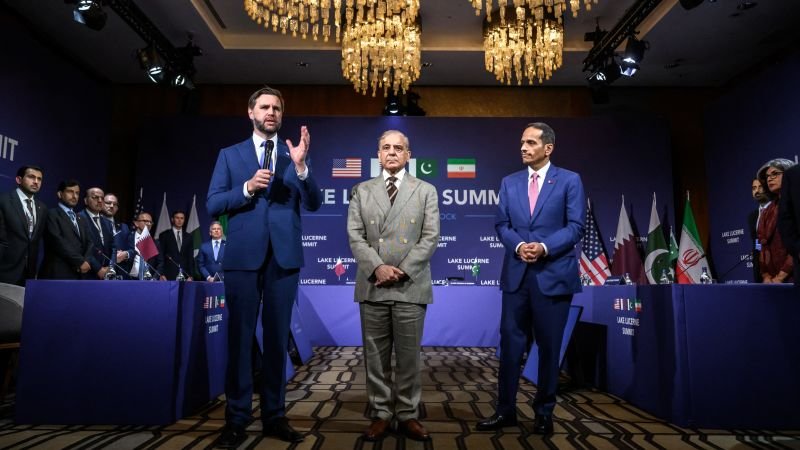
• Switzerland talks: The US says negotiations with Iran are ongoing and expected to last “through the night,” despite President Donald Trump angering Iran’s top negotiator by threatening the Tehran delegation in a Sunday interview. An Iranian source told CNN earlier that the talks had stalled but were not over.
• Strait of Hormuz: In the interview, Trump also told Fox News the US could resume bombing and “take over” the strait if a deal is not reached with Iran. There are renewed tensions over the key waterway even after the countries signed an initial agreement to reopen the strait.
• Lebanon conflict: Fighting between Israel and the Iranian-backed militant group Hezbollah is another key obstacle, with Tehran insisting that deadly Israeli strikes in Lebanon must end before talks can progress.
42 Posts
Oil prices climbed on Sunday after President Donald Trump told Fox News that the US could resume bombing and “take over” the Strait of Hormuz, a critical chokepoint for global energy trade, if a deal is not reached with Iran.
The price of Brent crude rose 1.35% to $81.66 a barrel, and US crude rose 2.4%, to $77.66 a barrel.
Talks in Switzerland between the US and Iran stalled Sunday over the Strait of Hormuz, a ceasefire in Lebanon and Iran’s nuclear program. Negotiations will continue “through the night,” a US official said.
Trump floated the idea of the US collecting tolls if a deal is not reached. The current memorandum of agreement between Washington and Tehran includes a commitment to reopen the waterway without tolls for 60 days.
Trump’s threats come after Iran on Saturday said it would close the strait, accusing the US of a “clear breach of its commitments.”
If negotiations are successful and shipping in the Strait of Hormuz returns to pre-war levels, oil could “flood” the markets, Columbia University researcher Karen Young said Sunday on CNN’s “Fareed Zakaria GPS.”
Lower oil prices also mean lower prices at the pump for American drivers. An average gallon of gas cost Americans about $3.94 on Sunday, according to AAA. That’s down almost 14% from a month ago but remains almost a dollar more expensive than before the war.
Dow futures, meanwhile, were down 0.4%. S&P 500 futures were down 0.4%. Nasdaq futures were down 0.6%.
The US-Iran negotiations in Switzerland are ongoing and the US delegation anticipates “to work through the night,” a US official said Sunday.
Vice President JD Vance and the US delegation have been “engaged in constant meetings and negotiations,” a senior US diplomat engaged in the negotiations told reporters in Switzerland.
“The Iranians are still here and discussions are ongoing. We anticipate continuing to work through the night,” the diplomat said.
The official said discussion topics have included clarifying messaging from Iran on the Strait of Hormuz and building mechanisms to ensure the key waterway will remain open.
“We have also worked through deconfliction mechanisms and enforcing the ceasefire in southern Lebanon,” they said.
The official said there have been robust discussions on “all elements of the nuclear deal” as they work toward building a starting point for technical talks.
US-Iran negotiations in Switzerland have stalled Sunday, according to an Iranian source, after President Donald Trump threatened Tehran’s delegation in an interview and drew a sharp rebuke from Iran’s top negotiator.
As Vice President JD Vance led the US delegation into the Swiss mountain resort of Bürgenstock, he had voiced optimism about the potential to “transform” the country’s relationship with Iran.
But Trump’s remarks to Fox News — in which he said he had warned Iranian officials that they “won’t even make it back” to their country if they don’t make a deal — quickly upended the diplomatic mission.
Here’s where things stand:
Iran’s response: Chief negotiator Mohammad Bagher Ghalibaf denounced the US president’s threat, saying it reflected “desperation” in Washington. An Iranian source in communication with the delegation told CNN that after meetings came to a halt, back-channel efforts were underway in hopes of making the diplomatic parties return.
Lebanon remains an obstacle: Iran has insisted that any ceasefire in the region must include Lebanon, where Israel has been fighting the Iran-backed militant group Hezbollah despite a stated truce. A wave of Israeli strikes at the end of last week marked some of the worst bloodshed in the country since the start of the current conflict. A source told CNN earlier that an emergency session on Lebanon was added to the Swiss talks.
On the ground: Israeli military raids killed at least seven people in Lebanon on Sunday, including a child and two elderly people, Lebanese state media reported. The Israel Defense Forces said it was “not familiar with any IDF activity” in the areas where the raids were reported. Also on Sunday, Israeli Defense Minister Israel Katz insisted his country’s military “will not withdraw from the security zone” in Lebanon.
CNN’s Becky Anderson, Thom Poole, Julia Benbrook, Dana Karni and Sana Noor Haq contributed to this reporting.
It’s not the first time that US President Donald Trump has angered the Iranians and thrown delicate talks into disarray.
His undiplomatic threats Sunday to resume blowing up Iran landed just after Vice President JD Vance said Trump had sent him on a “diplomatic” mission, to “turn over a new leaf to transform our relationship with the people of Iran.”
According to a source familiar with talks inside the classy Bürgenstock Hotel in Switzerland, it was a “bad day for Tweets,” as the Iranians are seemingly withdrawing from the four-way talks with the US and mediators Pakistan and Qatar.
Not long after Trump’s threats, the head of their delegation, Mohammed Ghalibaf wrote on X, “they (US) had better watch their words carefully. Our armed forces are ready to give them a response in a different way.”
An Iranian source told CNN that the US-Iran negotiations are stalled, but not over yet, after the US president’s threats. Back-channel dialogues are ongoing to make the diplomatic parties return, the source added.
What was already high-stakes diplomacy, with Iran saying it is closing the Strait of Hormuz and demanding Trump enforce a ceasefire in Lebanon, has quickly escalated into implicit threats from both sides to return to war.
Trump said he would “hit them (Iran) very hard again” if they don’t rein in their proxy Hezbollah, whom he blames for escalating violence in Lebanon and threatened Vance’s Iranian counterparts they would never get home to their “f**king country” if they don’t open the Strait of Hormuz.
The last time Trump’s interventions derailed talks was in April, when he said Iran would give its highly enriched uranium to the US and never build a nuclear bomb. Iran denied his claims, and slow talks lost momentum.
Back then Pakistani mediators eventually managed to convince the Iranians to keep negotiating, and not for the first time they’ll be back at it again now.
Hezbollah leader Naim Qassem argued that Israel should not continue operating in Lebanon after Israeli Prime Minister Benjamin Netanyahu said that Israeli troops would remain in the country “ as long as necessary.”
“Israel will not stay in Lebanon, even if it increases its crimes. And we will defend (ourselves),” Qassem said in an address on Al-Manar TV on Sunday.
The memorandum of understanding reached by Iran and the US outlines the end of hostilities in Lebanon, but fighting has continued as Israeli forces and Hezbollah fighters clash.
Qassem underlined that the Iran-backed militant group would respond to actions it considers violations of the ceasefire.
“Any ceasefire under the heading of a comprehensive halt to the aggression – we are already committed to it. But we will not accept any violation. Any violation, we will confront. Any violation, we will fight. Any violation, we will deal with as we see fit,” Qassem said.
Israel is set to end public restrictions across the entire country on Sunday, including along the Israel-Lebanon border, in an important sign of the latest ceasefire.
Israel’s Home Front Command announced that the most recent restrictions, which limited gatherings and school activities in northern Israel, will expire at 6:00 a.m. local time on Monday. Since the start of the war with Iran more than three months ago, Israel had regularly imposed limitations on education and the size of public gatherings in communities close to Lebanon.
As of Monday morning, the entire country will have no restrictions affecting schools, work or gatherings.
The Iran war has cost the Department of Defense about $40 billion, according to preliminary numbers in an upcoming analysis from the Center for Strategic and International Studies.
The figure includes the cost of munitions, destroyed equipment and damage to bases, but does not incorporate operational costs that were already factored into the department’s more than $1 trillion fiscal year 2026 budget, Mark Cancian, a senior adviser at CSIS, told CNN.
While the Defense Department bore the brunt of the expenses, the conflict cost other agencies, such as Homeland Security and Veterans Affairs, $1 billion, according to CSIS’ preliminary numbers.
Meanwhile, for consumers: Gas prices rose from an average of less than $3 a gallon around the country to well over $4 during much of the war.
According to an energy cost tracker from Brown University, American households have spent more than $253 more than what they would have paid if there was no war.
Oil hasn’t been coming out of the Middle East for nearly four months. All told, the world lost 1.15 billion barrels of oil supply during the war, according to Kpler.
And annual inflation was over 4% for the first time in three years, driven by energy prices, according to recent data from the Bureau of Labor Statistics.
Prices are now rising faster than the average American paycheck grew over the past year. In other words: Inflation ate your pay raise in April and May, the first time that had happened since 2023.
Read more about the economic fallout from the war.
US-Iran negotiations are stalled, but not over yet, after President Donald Trump’s threats on Sunday, an Iranian source in communication with the delegation in Bürgenstock, Switzerland, told CNN.
Back-channel dialogues are ongoing to make the diplomatic parties return, the source added.
Earlier, Iran’s chief negotiator, Mohammad Bagher Ghalibaf, denounced the “desperation” of the US after Trump threatened the Iranian delegation negotiating in Switzerland today and said the US might “take over” the Strait of Hormuz if it can’t reach a deal with Iran.
A member of Iran’s delegation to talks in Switzerland says a draft agreement for a temporary exemption from US sanctions on Iranian oil and oil derivatives has been completed, according to Iran’s semi-official Fars News Agency.
Hossein Ghorbanzadeh, an economy expert on the Iranian delegation, said the sanctions exemption will soon move toward implementation.
Ghorbanzadeh said the negotiations were primarily focused on implementing Clause 13 of a memorandum and laying the groundwork for discussions on other provisions of the agreement.
According to Ghorbanzadeh, that groundwork centers on five main points, “ending the war on all fronts, lifting the siege, reopening the strait, temporary exemption from sanctions for oil and its derivatives, and releasing Iran’s frozen assets.”
Ghorbanzadeh added that other provisions of the memorandum would not move into the implementation phase until the issue of ending the war in Lebanon is resolved.
The Strait of Hormuz is a key point in today’s US-Iran talks in Switzerland.
On Saturday, Iran said it would close the vital waterway in response the latest Israeli strikes in Lebanon. The US military has denied Tehran’s claim to control the strait, and President Donald Trump is now threatening to “take over” the key shipping lane if a deal with Tehran is not reached.
The flare-up in tensions around the strait comes after an initial US-Iran agreement last week gave global energy markets some hope for a return to normalcy.
Where things stand for consumers: Oil prices came down last week from their war-time highs of above $100 a barrel, and that’s helping lower costs at the pump for Americans.
On Friday, Brent crude, the global benchmark, settled around $80 a barrel, while US crude closed at $77.54 a barrel.
Lower oil prices have corresponded with cheaper gas for US consumers. An average gallon of gas cost Americans about $3.94 on Sunday, according to AAA. That’s down almost 14% from a month ago but remains almost a dollar more expensive than before the war.
If diplomatic efforts succeed and shipping in the Strait of Hormuz is able to return to pre-war levels, a “flood” of oil could enter the markets and continue to lower costs, said Karen Young, a researcher at Columbia University’s Center on Global Energy Policy.
But it remains to be seen whether a lasting peace deal can be reached amid the latest war of words.
Iran’s chief negotiator, Mohammad Bagher Ghalibaf, denounced the “desperation” of the United States after President Donald Trump threatened the Iranian delegation negotiating in Switzerland today and said the US might “take over” the Strait of Hormuz if it can’t reach a deal with Iran.
Ghalibaf also warned that Iran’s military is ready to respond if needed.
“We don’t take the Americans’ threats seriously at all,” he continued. “They had better watch their words carefully. Our armed forces are ready to give them a response in a different way. No matter how much they talk, it is we who take action.”
Republican Sen. Lindsey Graham, a prominent Iran hawk, on Sunday echoed President Donald Trump’s threat to “take over” the Strait of Hormuz if diplomatic efforts with the Iranians fail.
Graham, a close Trump ally, said he spent more than four hours with the president on Friday, in the wake of a preliminary US-Iran agreement that the administration hopes will open up further negotiations to dismantle Iran’s nuclear program.
“If this deal fails, President Trump is going to take the Strait of Hormuz over by force. The United States will control the Strait of Hormuz, will charge a fee for all those who go through to pay for the operation,” Graham told CBS’ “Face the Nation.”
Trump told Fox News on Sunday that the US might “take over” the strategically critical strait and “collect tolls” if it can’t reach a deal with Iran.
Graham also expressed a similar threat that the US would resume bombing in Iran if diplomacy fails: “If Iran contests control of the Strait of Hormuz by the United States, we will obliterate them.”
“If Iran continues to attack Israel and Lebanon, the new policy will be we’ll hit Iran,” he warned.
Global economies have already weighed energy options beyond the Middle East as the war in Iran puts irreversible pressure on the oil industry, according to Karen Young, a researcher at Columbia University’s Center on Global Energy Policy.
Countries won’t be looking back from the advancements they’ve made in green technology, Young said in an interview that aired Sunday on CNN’s “Fareed Zakaria GPS.”
Young said many countries will look to their own resources for energy and what’s accessible. The key will be “not being dependent on any one source, certainly for oil, but for any kind of energy fuel.”
While oil prices have dropped and there has been progress in tankers moving in and out of the Strait of Hormuz, Young cautioned that “we should expect a period of volatility — and that all depends on the ceasefire in place.”
Young also noted that Iran’s Gulf neighbors will invest in pipelines to avoid oil flows through the Strait of Hormuz, which allowed for the transit of 20 million barrels a day before the war began.
The Iranian delegation currently attending talks in Switzerland has lodged a protest after US President Donald Trump threatened its negotiators a short while ago, Iranian state media has reported.
Some context: In a phone call with Fox News today, Trump said that the US might “take over” the Strait of Hormuz if it can’t reach a deal with Iran and threatened the Iranian delegation that has gathered in Switzerland.
CNN has reached out to the White House for more details on what taking over the strait would entail.
CNN’s Julia Benbrook contributed to this reporting.
Officials from Washington and Tehran are meeting alongside Pakistani and Qatari mediators in Switzerland today for negotiations on a potential US-Iran peace deal.
Today’s closed-door talks are centered on the war in Lebanon, the Strait of Hormuz and Iran’s nuclear stockpile, a diplomat briefed on the talks told CNN.
Even as US Vice President JD Vance touted early progress in Switzerland, President Donald Trump threatened the Iranian delegation in an interview on Sunday.
If you’re just joining us, here’s what’s been going on so far today:
Trump’s comments: In a call with Fox News, the president said the US might “take over” the Strait of Hormuz if it can’t reach a deal with Iran and threatened the Iranian delegation that has gathered in Switzerland. “You close it (the Strait of Hormuz) and you won’t have a country,” Trump said he told Iranian officials. “You won’t even make it back to your f**king country.”
Meanwhile, in Bürgenstock: Speaking to reporters before heading into talks at the Swiss mountain resort, Vance said Trump has “committed” his country “to see a full regional ceasefire,” adding that he “feel(s) great” about “where we are in Lebanon.” Vance also said the US is willing to “fundamentally transform” its relations with Iran, touting “great progress over just the last few hours.”
Lebanon looms large: Iran has insisted that any ceasefire in the region must include Lebanon, as stated in the first clause of the initial agreement between Tehran and Washington. A source told CNN earlier that an emergency session on Lebanon was added to the Swiss talks. A diplomat briefed on the talks confirmed it was among the first topics discussed today.
On the ground: Israeli military raids have killed at least seven people in Lebanon today, including a child and two elderly people, Lebanese state media reported. A wave of Israeli strikes at the end of last week marked some of the worst bloodshed in the country since the start of the current conflict. On Sunday, Israeli Defense Minister Israel Katz insisted his country’s military “will not withdraw from the security zone” in Lebanon, where it has been exchanging fire with Hezbollah militants.
CNN’s Becky Anderson, Thom Poole, Julia Benbrook, Dana Karni and Sana Noor Haq contributed to this reporting.
US energy secretary Chris Wright today defended the portion of the 14-point agreement with Iran that allows the country to again export oil and other petroleum products, calling it a “modest benefit” to Iran.
“Yes, the fact that they can sell it to other countries and get paid more easily, that’s a benefit but that’s not a big benefit,” Wright said during an interview with Fox News.
The lifting of oil sanctions has angered some Iran hardliners, including Trump supporters, who’ve argued that it gives away leverage in talks over Iran’s nuclear program. Wright said the administration is acting in good faith with the expectation that Iran will not interfere with the flow of oil entering the global economy.
“Traffic is flowing through the straits quite nicely,” Wright said. He said that in the last 24 hours, 67 ships carrying oil went through the Strait of Hormuz, “about equal to where we were before the conflict.”
Lead oil analyst Matt Smith has told CNN that 100 to 120 oil tankers sailed through the passage between Iran and Oman daily before the war.
In the Fox interview, Wright acknowledged the hesitancy commercial ships may have in crossing the strait.
“Were some of them concerned? Sure,” he said. But, “We can have flow of traffic through the Strait of Hormuz with or without them (Iran), we can destroy their nuclear program.”
President Donald Trump said today the US might “take over” the Strait of Hormuz if it can’t reach a deal with Iran and threatened the Iranian delegation negotiating in Switzerland.
“We may take over the Strait, if we have to,” Trump said during a 20-minute phone call with Fox News. “If they don’t make a deal, we’ll collect tolls.”
On Saturday, Iranian state media reported that Iran’s military command said it will close the strait due to Israel’s alleged violations of the ceasefire in Lebanon, and the US “failing to implement” the first clause of the tentative agreement to end the war.
During the call with Fox News, Trump appeared to threaten a resumption of US bombing in Iran and its negotiators meeting with Vice President JD Vance in Switzerland.
“You close it and you won’t have a country,” Trump said he told Iranian officials about the critical waterway. “You won’t even make it back to your f**king country.”
Trump reiterated that he believes the US could become the “guardian angel” of the strait and take 20% of the oil that passes through.
CNN has reached out to the White House for more details on what taking over the strait would entail.
Trump also threatened Iran again over its proxies in Lebanon.
“Iran must immediately stop their highly paid PROXIES in Lebanon from causing trouble,” Trump wrote on Truth Social Sunday morning. “If they don’t, we’ll hit Iran very hard again, just like we did last week, only harder!!!”
The ongoing negotiations between US and Iranian officials in Switzerland are centered on the war in Lebanon, the choked Strait of Hormuz and Iran’s nuclear stockpile, according to a diplomat briefed on the talks.
The diplomat told CNN the meetings have begun as an “open dialogue with a lot of honesty.”
Participants are also discussing the structure of a 60-day negotiation period triggered by the 14-point memorandum of understanding signed by Tehran and Washington last week.
The conflict in Lebanon between Israel and Hezbollah is being decided in Switzerland with the US, Qatar, Pakistan and Iran — without Lebanon, Israel or Hezbollah being involved.
If this sounds like a recipe for another failed ceasefire, it may indeed be.
Iran has placed Lebanon as one of its top priorities in the negotiations with the US, insisting on absolute cessation of hostilities per the first clause of the previously signed memorandum of understanding.
When fighting flared Friday, Iran delayed its participation in the talks. The US then announced a ceasefire between Israel and Hezbollah. But when fighting erupted again on Saturday, Iran said they were closing the Strait of Hormuz.
Despite Israeli Prime Minister Benjamin Netanyahu’s best efforts to keep the fighting in Lebanon separate from the US ceasefire with Iran, negotiators in Tehran have successfully linked the two. As a result, President Donald Trump has pressured Israel to stop the fighting and imposed restraints on the Israeli military, even after five Israeli soldiers were killed in 24 hours over the weekend.
Israeli strikes in Lebanon have killed dozens of people since the agreement was signed days ago, according to the country’s Ministry of Public Health. Iran’s lead negotiator made clear he would raise what he sees as Israeli violations of the agreement with the US as talks begin.
Israeli President Isaac Herzog tried to push back on Iranian involvement in Lebanon, but it’s a reality that Israel is currently powerless to change.
“Iran should not be involved in the crisis in Lebanon at all. The world must stand up to it and make it clear that Iran cannot be involved in Lebanon,” Herzog said in an interview with Fox News on Sunday.
Instead of Iran being sidelined, Israel and Lebanon have been left out of the negotiations, even as the two countries are set to meet under the auspices of the Trump administration in Washington later this week.
US President Donald Trump has “committed” his country “to see a full regional ceasefire,” Vice President JD Vance just told reporters in Switzerland, adding that he “feel(s) great” about “where we are in Lebanon.”
The US has done “more to stop the conflict in Lebanon than any government anywhere in the world over the last few months,” Vance said, in response to a question about Israel’s fighting in Lebanon.
“Peace is never easy. Peace always requires a little bit of work. It always requires a little bit of give and take,” he added.
Vance acknowledged that there are “going to be sometimes disagreements about precisely how to get (towards regional peace),” but said that “I actually feel great about where we are in Lebanon. There’s still some additional wood to chop, but we’re going to keep on working at it.”
The vice president also said that today’s talks in Switzerland are the beginning of technical negotiations, noting that they will not bring about an immediate resolution.
Today’s gathering is “not going to solve every disagreement, but it’s going to allow us to sit together as teams for the first time, really in history, to figure out what matters most to the respective parties, to settle those issues, to solve those issues and get to a better tomorrow,” he said.
• Switzerland talks: The US says negotiations with Iran are ongoing and expected to last “through the night,” despite President Donald Trump angering Iran’s top negotiator by threatening the Tehran delegation in a Sunday interview. An Iranian source told CNN earlier that the talks had stalled but were not over.
• Strait of Hormuz: In the interview, Trump also told Fox News the US could resume bombing and “take over” the strait if a deal is not reached with Iran. There are renewed tensions over the key waterway even after the countries signed an initial agreement to reopen the strait.
• Lebanon conflict: Fighting between Israel and the Iranian-backed militant group Hezbollah is another key obstacle, with Tehran insisting that deadly Israeli strikes in Lebanon must end before talks can progress.
Oil prices climbed on Sunday after President Donald Trump told Fox News that the US could resume bombing and “take over” the Strait of Hormuz, a critical chokepoint for global energy trade, if a deal is not reached with Iran.
The price of Brent crude rose 1.35% to $81.66 a barrel, and US crude rose 2.4%, to $77.66 a barrel.
Talks in Switzerland between the US and Iran stalled Sunday over the Strait of Hormuz, a ceasefire in Lebanon and Iran’s nuclear program. Negotiations will continue “through the night,” a US official said.
Trump floated the idea of the US collecting tolls if a deal is not reached. The current memorandum of agreement between Washington and Tehran includes a commitment to reopen the waterway without tolls for 60 days.
Trump’s threats come after Iran on Saturday said it would close the strait, accusing the US of a “clear breach of its commitments.”
If negotiations are successful and shipping in the Strait of Hormuz returns to pre-war levels, oil could “flood” the markets, Columbia University researcher Karen Young said Sunday on CNN’s “Fareed Zakaria GPS.”
Lower oil prices also mean lower prices at the pump for American drivers. An average gallon of gas cost Americans about $3.94 on Sunday, according to AAA. That’s down almost 14% from a month ago but remains almost a dollar more expensive than before the war.
Dow futures, meanwhile, were down 0.4%. S&P 500 futures were down 0.4%. Nasdaq futures were down 0.6%.
The US-Iran negotiations in Switzerland are ongoing and the US delegation anticipates “to work through the night,” a US official said Sunday.
Vice President JD Vance and the US delegation have been “engaged in constant meetings and negotiations,” a senior US diplomat engaged in the negotiations told reporters in Switzerland.
“The Iranians are still here and discussions are ongoing. We anticipate continuing to work through the night,” the diplomat said.
The official said discussion topics have included clarifying messaging from Iran on the Strait of Hormuz and building mechanisms to ensure the key waterway will remain open.
“We have also worked through deconfliction mechanisms and enforcing the ceasefire in southern Lebanon,” they said.
The official said there have been robust discussions on “all elements of the nuclear deal” as they work toward building a starting point for technical talks.
US-Iran negotiations in Switzerland have stalled Sunday, according to an Iranian source, after President Donald Trump threatened Tehran’s delegation in an interview and drew a sharp rebuke from Iran’s top negotiator.
As Vice President JD Vance led the US delegation into the Swiss mountain resort of Bürgenstock, he had voiced optimism about the potential to “transform” the country’s relationship with Iran.
But Trump’s remarks to Fox News — in which he said he had warned Iranian officials that they “won’t even make it back” to their country if they don’t make a deal — quickly upended the diplomatic mission.
Here’s where things stand:
Iran’s response: Chief negotiator Mohammad Bagher Ghalibaf denounced the US president’s threat, saying it reflected “desperation” in Washington. An Iranian source in communication with the delegation told CNN that after meetings came to a halt, back-channel efforts were underway in hopes of making the diplomatic parties return.
Lebanon remains an obstacle: Iran has insisted that any ceasefire in the region must include Lebanon, where Israel has been fighting the Iran-backed militant group Hezbollah despite a stated truce. A wave of Israeli strikes at the end of last week marked some of the worst bloodshed in the country since the start of the current conflict. A source told CNN earlier that an emergency session on Lebanon was added to the Swiss talks.
On the ground: Israeli military raids killed at least seven people in Lebanon on Sunday, including a child and two elderly people, Lebanese state media reported. The Israel Defense Forces said it was “not familiar with any IDF activity” in the areas where the raids were reported. Also on Sunday, Israeli Defense Minister Israel Katz insisted his country’s military “will not withdraw from the security zone” in Lebanon.
CNN’s Becky Anderson, Thom Poole, Julia Benbrook, Dana Karni and Sana Noor Haq contributed to this reporting.
It’s not the first time that US President Donald Trump has angered the Iranians and thrown delicate talks into disarray.
His undiplomatic threats Sunday to resume blowing up Iran landed just after Vice President JD Vance said Trump had sent him on a “diplomatic” mission, to “turn over a new leaf to transform our relationship with the people of Iran.”
According to a source familiar with talks inside the classy Bürgenstock Hotel in Switzerland, it was a “bad day for Tweets,” as the Iranians are seemingly withdrawing from the four-way talks with the US and mediators Pakistan and Qatar.
Not long after Trump’s threats, the head of their delegation, Mohammed Ghalibaf wrote on X, “they (US) had better watch their words carefully. Our armed forces are ready to give them a response in a different way.”
An Iranian source told CNN that the US-Iran negotiations are stalled, but not over yet, after the US president’s threats. Back-channel dialogues are ongoing to make the diplomatic parties return, the source added.
What was already high-stakes diplomacy, with Iran saying it is closing the Strait of Hormuz and demanding Trump enforce a ceasefire in Lebanon, has quickly escalated into implicit threats from both sides to return to war.
Trump said he would “hit them (Iran) very hard again” if they don’t rein in their proxy Hezbollah, whom he blames for escalating violence in Lebanon and threatened Vance’s Iranian counterparts they would never get home to their “f**king country” if they don’t open the Strait of Hormuz.
The last time Trump’s interventions derailed talks was in April, when he said Iran would give its highly enriched uranium to the US and never build a nuclear bomb. Iran denied his claims, and slow talks lost momentum.
Back then Pakistani mediators eventually managed to convince the Iranians to keep negotiating, and not for the first time they’ll be back at it again now.
Hezbollah leader Naim Qassem argued that Israel should not continue operating in Lebanon after Israeli Prime Minister Benjamin Netanyahu said that Israeli troops would remain in the country “ as long as necessary.”
“Israel will not stay in Lebanon, even if it increases its crimes. And we will defend (ourselves),” Qassem said in an address on Al-Manar TV on Sunday.
The memorandum of understanding reached by Iran and the US outlines the end of hostilities in Lebanon, but fighting has continued as Israeli forces and Hezbollah fighters clash.
Qassem underlined that the Iran-backed militant group would respond to actions it considers violations of the ceasefire.
“Any ceasefire under the heading of a comprehensive halt to the aggression – we are already committed to it. But we will not accept any violation. Any violation, we will confront. Any violation, we will fight. Any violation, we will deal with as we see fit,” Qassem said.
Israel is set to end public restrictions across the entire country on Sunday, including along the Israel-Lebanon border, in an important sign of the latest ceasefire.
Israel’s Home Front Command announced that the most recent restrictions, which limited gatherings and school activities in northern Israel, will expire at 6:00 a.m. local time on Monday. Since the start of the war with Iran more than three months ago, Israel had regularly imposed limitations on education and the size of public gatherings in communities close to Lebanon.
As of Monday morning, the entire country will have no restrictions affecting schools, work or gatherings.
The Iran war has cost the Department of Defense about $40 billion, according to preliminary numbers in an upcoming analysis from the Center for Strategic and International Studies.
The figure includes the cost of munitions, destroyed equipment and damage to bases, but does not incorporate operational costs that were already factored into the department’s more than $1 trillion fiscal year 2026 budget, Mark Cancian, a senior adviser at CSIS, told CNN.
While the Defense Department bore the brunt of the expenses, the conflict cost other agencies, such as Homeland Security and Veterans Affairs, $1 billion, according to CSIS’ preliminary numbers.
Meanwhile, for consumers: Gas prices rose from an average of less than $3 a gallon around the country to well over $4 during much of the war.
According to an energy cost tracker from Brown University, American households have spent more than $253 more than what they would have paid if there was no war.
Oil hasn’t been coming out of the Middle East for nearly four months. All told, the world lost 1.15 billion barrels of oil supply during the war, according to Kpler.
And annual inflation was over 4% for the first time in three years, driven by energy prices, according to recent data from the Bureau of Labor Statistics.
Prices are now rising faster than the average American paycheck grew over the past year. In other words: Inflation ate your pay raise in April and May, the first time that had happened since 2023.
Read more about the economic fallout from the war.
US-Iran negotiations are stalled, but not over yet, after President Donald Trump’s threats on Sunday, an Iranian source in communication with the delegation in Bürgenstock, Switzerland, told CNN.
Back-channel dialogues are ongoing to make the diplomatic parties return, the source added.
Earlier, Iran’s chief negotiator, Mohammad Bagher Ghalibaf, denounced the “desperation” of the US after Trump threatened the Iranian delegation negotiating in Switzerland today and said the US might “take over” the Strait of Hormuz if it can’t reach a deal with Iran.
A member of Iran’s delegation to talks in Switzerland says a draft agreement for a temporary exemption from US sanctions on Iranian oil and oil derivatives has been completed, according to Iran’s semi-official Fars News Agency.
Hossein Ghorbanzadeh, an economy expert on the Iranian delegation, said the sanctions exemption will soon move toward implementation.
Ghorbanzadeh said the negotiations were primarily focused on implementing Clause 13 of a memorandum and laying the groundwork for discussions on other provisions of the agreement.
According to Ghorbanzadeh, that groundwork centers on five main points, “ending the war on all fronts, lifting the siege, reopening the strait, temporary exemption from sanctions for oil and its derivatives, and releasing Iran’s frozen assets.”
Ghorbanzadeh added that other provisions of the memorandum would not move into the implementation phase until the issue of ending the war in Lebanon is resolved.
The Strait of Hormuz is a key point in today’s US-Iran talks in Switzerland.
On Saturday, Iran said it would close the vital waterway in response the latest Israeli strikes in Lebanon. The US military has denied Tehran’s claim to control the strait, and President Donald Trump is now threatening to “take over” the key shipping lane if a deal with Tehran is not reached.
The flare-up in tensions around the strait comes after an initial US-Iran agreement last week gave global energy markets some hope for a return to normalcy.
Where things stand for consumers: Oil prices came down last week from their war-time highs of above $100 a barrel, and that’s helping lower costs at the pump for Americans.
On Friday, Brent crude, the global benchmark, settled around $80 a barrel, while US crude closed at $77.54 a barrel.
Lower oil prices have corresponded with cheaper gas for US consumers. An average gallon of gas cost Americans about $3.94 on Sunday, according to AAA. That’s down almost 14% from a month ago but remains almost a dollar more expensive than before the war.
If diplomatic efforts succeed and shipping in the Strait of Hormuz is able to return to pre-war levels, a “flood” of oil could enter the markets and continue to lower costs, said Karen Young, a researcher at Columbia University’s Center on Global Energy Policy.
But it remains to be seen whether a lasting peace deal can be reached amid the latest war of words.
Iran’s chief negotiator, Mohammad Bagher Ghalibaf, denounced the “desperation” of the United States after President Donald Trump threatened the Iranian delegation negotiating in Switzerland today and said the US might “take over” the Strait of Hormuz if it can’t reach a deal with Iran.
Ghalibaf also warned that Iran’s military is ready to respond if needed.
“We don’t take the Americans’ threats seriously at all,” he continued. “They had better watch their words carefully. Our armed forces are ready to give them a response in a different way. No matter how much they talk, it is we who take action.”
Republican Sen. Lindsey Graham, a prominent Iran hawk, on Sunday echoed President Donald Trump’s threat to “take over” the Strait of Hormuz if diplomatic efforts with the Iranians fail.
Graham, a close Trump ally, said he spent more than four hours with the president on Friday, in the wake of a preliminary US-Iran agreement that the administration hopes will open up further negotiations to dismantle Iran’s nuclear program.
“If this deal fails, President Trump is going to take the Strait of Hormuz over by force. The United States will control the Strait of Hormuz, will charge a fee for all those who go through to pay for the operation,” Graham told CBS’ “Face the Nation.”
Trump told Fox News on Sunday that the US might “take over” the strategically critical strait and “collect tolls” if it can’t reach a deal with Iran.
Graham also expressed a similar threat that the US would resume bombing in Iran if diplomacy fails: “If Iran contests control of the Strait of Hormuz by the United States, we will obliterate them.”
“If Iran continues to attack Israel and Lebanon, the new policy will be we’ll hit Iran,” he warned.
Global economies have already weighed energy options beyond the Middle East as the war in Iran puts irreversible pressure on the oil industry, according to Karen Young, a researcher at Columbia University’s Center on Global Energy Policy.
Countries won’t be looking back from the advancements they’ve made in green technology, Young said in an interview that aired Sunday on CNN’s “Fareed Zakaria GPS.”
Young said many countries will look to their own resources for energy and what’s accessible. The key will be “not being dependent on any one source, certainly for oil, but for any kind of energy fuel.”
While oil prices have dropped and there has been progress in tankers moving in and out of the Strait of Hormuz, Young cautioned that “we should expect a period of volatility — and that all depends on the ceasefire in place.”
Young also noted that Iran’s Gulf neighbors will invest in pipelines to avoid oil flows through the Strait of Hormuz, which allowed for the transit of 20 million barrels a day before the war began.
The Iranian delegation currently attending talks in Switzerland has lodged a protest after US President Donald Trump threatened its negotiators a short while ago, Iranian state media has reported.
Some context: In a phone call with Fox News today, Trump said that the US might “take over” the Strait of Hormuz if it can’t reach a deal with Iran and threatened the Iranian delegation that has gathered in Switzerland.
CNN has reached out to the White House for more details on what taking over the strait would entail.
CNN’s Julia Benbrook contributed to this reporting.
Officials from Washington and Tehran are meeting alongside Pakistani and Qatari mediators in Switzerland today for negotiations on a potential US-Iran peace deal.
Today’s closed-door talks are centered on the war in Lebanon, the Strait of Hormuz and Iran’s nuclear stockpile, a diplomat briefed on the talks told CNN.
Even as US Vice President JD Vance touted early progress in Switzerland, President Donald Trump threatened the Iranian delegation in an interview on Sunday.
If you’re just joining us, here’s what’s been going on so far today:
Trump’s comments: In a call with Fox News, the president said the US might “take over” the Strait of Hormuz if it can’t reach a deal with Iran and threatened the Iranian delegation that has gathered in Switzerland. “You close it (the Strait of Hormuz) and you won’t have a country,” Trump said he told Iranian officials. “You won’t even make it back to your f**king country.”
Meanwhile, in Bürgenstock: Speaking to reporters before heading into talks at the Swiss mountain resort, Vance said Trump has “committed” his country “to see a full regional ceasefire,” adding that he “feel(s) great” about “where we are in Lebanon.” Vance also said the US is willing to “fundamentally transform” its relations with Iran, touting “great progress over just the last few hours.”
Lebanon looms large: Iran has insisted that any ceasefire in the region must include Lebanon, as stated in the first clause of the initial agreement between Tehran and Washington. A source told CNN earlier that an emergency session on Lebanon was added to the Swiss talks. A diplomat briefed on the talks confirmed it was among the first topics discussed today.
On the ground: Israeli military raids have killed at least seven people in Lebanon today, including a child and two elderly people, Lebanese state media reported. A wave of Israeli strikes at the end of last week marked some of the worst bloodshed in the country since the start of the current conflict. On Sunday, Israeli Defense Minister Israel Katz insisted his country’s military “will not withdraw from the security zone” in Lebanon, where it has been exchanging fire with Hezbollah militants.
CNN’s Becky Anderson, Thom Poole, Julia Benbrook, Dana Karni and Sana Noor Haq contributed to this reporting.
US energy secretary Chris Wright today defended the portion of the 14-point agreement with Iran that allows the country to again export oil and other petroleum products, calling it a “modest benefit” to Iran.
“Yes, the fact that they can sell it to other countries and get paid more easily, that’s a benefit but that’s not a big benefit,” Wright said during an interview with Fox News.
The lifting of oil sanctions has angered some Iran hardliners, including Trump supporters, who’ve argued that it gives away leverage in talks over Iran’s nuclear program. Wright said the administration is acting in good faith with the expectation that Iran will not interfere with the flow of oil entering the global economy.
“Traffic is flowing through the straits quite nicely,” Wright said. He said that in the last 24 hours, 67 ships carrying oil went through the Strait of Hormuz, “about equal to where we were before the conflict.”
Lead oil analyst Matt Smith has told CNN that 100 to 120 oil tankers sailed through the passage between Iran and Oman daily before the war.
In the Fox interview, Wright acknowledged the hesitancy commercial ships may have in crossing the strait.
“Were some of them concerned? Sure,” he said. But, “We can have flow of traffic through the Strait of Hormuz with or without them (Iran), we can destroy their nuclear program.”
President Donald Trump said today the US might “take over” the Strait of Hormuz if it can’t reach a deal with Iran and threatened the Iranian delegation negotiating in Switzerland.
“We may take over the Strait, if we have to,” Trump said during a 20-minute phone call with Fox News. “If they don’t make a deal, we’ll collect tolls.”
On Saturday, Iranian state media reported that Iran’s military command said it will close the strait due to Israel’s alleged violations of the ceasefire in Lebanon, and the US “failing to implement” the first clause of the tentative agreement to end the war.
During the call with Fox News, Trump appeared to threaten a resumption of US bombing in Iran and its negotiators meeting with Vice President JD Vance in Switzerland.
“You close it and you won’t have a country,” Trump said he told Iranian officials about the critical waterway. “You won’t even make it back to your f**king country.”
Trump reiterated that he believes the US could become the “guardian angel” of the strait and take 20% of the oil that passes through.
CNN has reached out to the White House for more details on what taking over the strait would entail.
Trump also threatened Iran again over its proxies in Lebanon.
“Iran must immediately stop their highly paid PROXIES in Lebanon from causing trouble,” Trump wrote on Truth Social Sunday morning. “If they don’t, we’ll hit Iran very hard again, just like we did last week, only harder!!!”
The ongoing negotiations between US and Iranian officials in Switzerland are centered on the war in Lebanon, the choked Strait of Hormuz and Iran’s nuclear stockpile, according to a diplomat briefed on the talks.
The diplomat told CNN the meetings have begun as an “open dialogue with a lot of honesty.”
Participants are also discussing the structure of a 60-day negotiation period triggered by the 14-point memorandum of understanding signed by Tehran and Washington last week.
The conflict in Lebanon between Israel and Hezbollah is being decided in Switzerland with the US, Qatar, Pakistan and Iran — without Lebanon, Israel or Hezbollah being involved.
If this sounds like a recipe for another failed ceasefire, it may indeed be.
Iran has placed Lebanon as one of its top priorities in the negotiations with the US, insisting on absolute cessation of hostilities per the first clause of the previously signed memorandum of understanding.
When fighting flared Friday, Iran delayed its participation in the talks. The US then announced a ceasefire between Israel and Hezbollah. But when fighting erupted again on Saturday, Iran said they were closing the Strait of Hormuz.
Despite Israeli Prime Minister Benjamin Netanyahu’s best efforts to keep the fighting in Lebanon separate from the US ceasefire with Iran, negotiators in Tehran have successfully linked the two. As a result, President Donald Trump has pressured Israel to stop the fighting and imposed restraints on the Israeli military, even after five Israeli soldiers were killed in 24 hours over the weekend.
Israeli strikes in Lebanon have killed dozens of people since the agreement was signed days ago, according to the country’s Ministry of Public Health. Iran’s lead negotiator made clear he would raise what he sees as Israeli violations of the agreement with the US as talks begin.
Israeli President Isaac Herzog tried to push back on Iranian involvement in Lebanon, but it’s a reality that Israel is currently powerless to change.
“Iran should not be involved in the crisis in Lebanon at all. The world must stand up to it and make it clear that Iran cannot be involved in Lebanon,” Herzog said in an interview with Fox News on Sunday.
Instead of Iran being sidelined, Israel and Lebanon have been left out of the negotiations, even as the two countries are set to meet under the auspices of the Trump administration in Washington later this week.
US President Donald Trump has “committed” his country “to see a full regional ceasefire,” Vice President JD Vance just told reporters in Switzerland, adding that he “feel(s) great” about “where we are in Lebanon.”
The US has done “more to stop the conflict in Lebanon than any government anywhere in the world over the last few months,” Vance said, in response to a question about Israel’s fighting in Lebanon.
“Peace is never easy. Peace always requires a little bit of work. It always requires a little bit of give and take,” he added.
Vance acknowledged that there are “going to be sometimes disagreements about precisely how to get (towards regional peace),” but said that “I actually feel great about where we are in Lebanon. There’s still some additional wood to chop, but we’re going to keep on working at it.”
The vice president also said that today’s talks in Switzerland are the beginning of technical negotiations, noting that they will not bring about an immediate resolution.
Today’s gathering is “not going to solve every disagreement, but it’s going to allow us to sit together as teams for the first time, really in history, to figure out what matters most to the respective parties, to settle those issues, to solve those issues and get to a better tomorrow,” he said.





Responses