
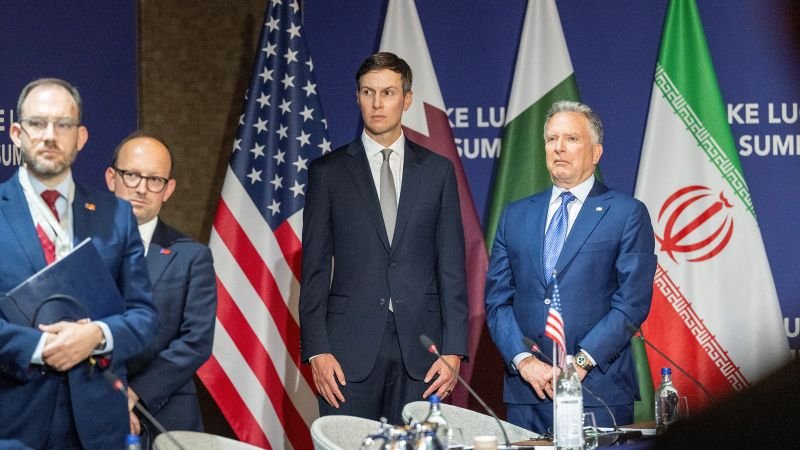
The day after President Donald Trump signed a memorandum of understanding with Iran, opening a 60-day window to negotiate a deal over the country’s nuclear program, Jared Kushner and Steve Witkoff got on the phone to brief skeptical Republican leaders.
The terms of the 14-point document were vague and open to interpretation, sparking concern across Washington about what exactly the president had just signed on to and what concessions had been made to Tehran.
Kushner and Witkoff, Trump’s son-in-law and special envoy, respectively, had spent months leading backchannel talks on Iran, and now sought to reassure Republicans on the merits of the agreement and the process to come. According to a person familiar with the call, as a sign of progress, Witkoff referenced a secret trip he and Kushner had just taken to the secluded Oak Ridge nuclear lab, where they met with technical experts, many of whom Witkoff said were on standby ready to join the effort.
Witkoff also said he expected negotiations on “the toughest issue” — Iran’s nuclear program — to begin immediately, according to a person familiar with the call.
Three weeks later, not only have technical talks only barely begun, but the entire agreement appears to be in tatters. There have been skirmishes since the signing of the MOU, but the latest flare-up poses the biggest threat to the fragile agreement that Trump has now declared “over.”
After Iran fired on ships in the Strait of Hormuz on Tuesday, the US retaliated with its own strikes, to which Tehran vowed to respond. On Wednesday, the US launched another round of strikes, hours after Trump promised to do so while denouncing Iran’s leadership.
“I’m not sure I want to make a deal with them,” Trump mused at a press conference at the NATO summit in Ankara, before asserting that he does not believe war with Iran will start again.
With the prospect of renewed fighting in the region, the gap between the administration’s stated goals in Iran, including the removal of its enriched nuclear material, and the likelihood they can be achieved — let alone in 60 days — continues to widen.
That’s all raised big questions about how much was accomplished with the signing of the MOU; what exactly was agreed to; and whether Witkoff and Kushner, along with Vice President JD Vance, overstated the amount of diplomatic progress they’d made amid escalating oil prices and growing pressure to end the war.
“The MOU didn’t actually resolve anything,” said Nate Swanson, a former career State Department official who spent a decade as a senior adviser on Iran policy to successive administrations and worked on the Iran negotiations in spring 2025. The agreement, he said, was “almost entirely aspirational.”
Richard Nephew, who was director for Iran at the National Security Council from 2011 to 2013, said he anticipated such flare-ups “both because (of) misinterpretations of the underlying deal, and because none of the core issues have been resolved.”
“You could even argue the MOU made things worse,” Nephew added, particularly on the Strait of Hormuz. Although the administration has stressed that Iran cannot have control of the critical waterway, the MOU itself does not lay out a clear process for how to achieve that.
“There still seems to be this persistent focus on this big Phase 2 deal, where the reality of the situation is they really just need to codify and clarify the strait before moving on to other things. They have not done that,” Swanson told CNN. “I don’t know whose fault that is, if that’s Vance, Witkoff, Kushner, Trump, I don’t know, but it’s a clear mistake somewhere in the chain of command.”
Nephew said he “squarely put” blame for the vague MOU “on the inexperience of the US negotiating team.”
Throughout their Iran discussions, Kushner and Witkoff have kept their circle tight, relying heavily on political appointees and advisers, reflecting a longstanding distrust within the Trump administration of career civil servants.
Multiple former US officials familiar with the effort tell CNN that many of the career government employees with the expertise needed to negotiate a complex agreement with Iran, including experts on nuclear issues, were consulted only intermittently in the months leading up to the signing of the MOU and not meaningfully incorporated into the early decision-making process or broader diplomatic effort led by Kushner and Witkoff. Many career officials have also been driven out of the government.
Compared to the years of inter-agency work that went into the Obama-era Iran nuclear deal that was reached a decade ago, the process under Kushner and Witkoff has appeared dramatically different, described by some sources as more ad hoc.
Under Obama, experts across the government played central roles in shaping and testing technical aspects of the 2015 Iran nuclear deal, which took years to negotiate. That process was tightly coordinated by the National Security Counsel at the White House. But Trump last year stripped down his NSC and sidelined national security experts ahead of his decision to start the war in February.
The White House acknowledges its different approach compared with previous nuclear negotiations but defended the decision as necessary to limit leaks and keep sensitive diplomatic discussions tightly held.
“People who complain to CNN about feeling left out clearly cannot be trusted with sensitive information and are not included in national security conversations,” White House spokeswoman Anna Kelly told CNN in a statement earlier in the week.
Kelly also pushed back on the notion that Kushner and Witkoff have not engaged technical experts across the government.
“There have been vast consultations across the interagency, as well as with the IAEA, over the course of these negotiations,” Kelly said, referencing the UN’s nuclear watchdog agency. “Now, experts from the National Security Council, State Department, Treasury Department, War Department, Energy Department, and more make up our technical team that are negotiating a final deal.”
Nestled into the mountains of east Tennessee, the Oak Ridge National Laboratory is home to some of the world’s foremost nuclear weapons experts, many of whom were surprised on June 4 when parts of the sprawling 35,000-acre campus were locked down and surrounded by security personnel, local police and what looked to some like armed Secret Service agents, according to a person familiar with the visit.
After months of leading talks on Iran, Witkoff and Kushner were closing in on a deal to allow for negotiations on its nuclear program, and were ready to meet with technical experts who would likely serve a key role in the next phase of nuclear talks, according to a US official — if they ever got that far.
During their trip, Kushner and Witkoff met inside a SCIF in the classified part of the main building. Discussions focused on how to deal with the nuclear enriched material from Iran, how gas centrifuges work, monitoring and verification, and potential down-blending of nuclear material, multiple sources said. Technical experts at the lab were told “to be on call, ready to travel to go to the negotiations if and when called upon,” according to the source familiar with the visit, who added that it was the first time experts at the lab had received those instructions.
Before the most recent strikes, sources told CNN, that the diplomatic operation had evolved in recent weeks, with greater outreach to subject-matter experts across the government.
Work has also begun on one of the most technically complicated pieces of any possible deal: bringing nuclear material from Iran back to the US. According to two sources with direct knowledge of the issue, preparations are underway for the possibility that Iranian nuclear material will be brought to the US for processing and down-blending at two potential sites, the Y-12 National Security Complex near Oak Ridge, and another facility at the Savannah River Site in Georgia.
For any of that to actually happen, the US will need to engage in a lengthy technical negotiation with an Iranian team that has decades of experience.
“They basically have had the same team roughly since 2013,” said Swanson, who was a career diplomat for nearly 20 years. He noted that Iranian foreign minister Abbas Araghchi has led those talks for almost the entire time.
“They just have this unique advantage and knowledge of how this has worked in the past,” Swanson said.
Nephew echoed this and suggested that it could lead to Kushner and Witkoff’s team being outmaneuvered by Iran.
“The Iranians will bring a 20-odd-person delegation, and they’ll have people there who literally know the stuff backwards, and that’s how you get hornswoggled,” he said.
Questions about Witkoff’s fitness for the job of Trump’s top envoy trace back to the earliest days of the effort, when Witkoff was first handed responsibility for the Iran negotiations and began assembling a team to pursue them.
Before the Trump administration even took office in January 2025, Witkoff, a longtime friend of Trump and fellow New York real estate developer, became Trump’s de facto point man on some of the most urgent foreign policy challenges facing the incoming administration, including Gaza and the war in Ukraine.
Yet for someone who’s never worked in government, Witkoff’s expansive portfolio raised questions in Washington and abroad over whether he is truly equipped to operate at such a high level on the world stage.
In describing Witkoff’s early operating style when he first began working on the Iran issue in 2025, one source with direct knowledge said Witkoff appeared engaged but only sporadically, and without a coordinated process around him.
The source described Witkoff in the early stages of his involvement as smart but intermittent, juggling multiple crises, and often approaching Iran through a real estate or financial frame. Witkoff tended to look at Iran’s nuclear program as a bad investment, the source said, and suggested the solution could involve creating incentives to effectively buy out Iran so that it would exit that program.
“The problem with that argument, though, is that this isn’t just a financial calculation for the Iranians; it’s a national security investment,” the source added.
While Witkoff asked “the right questions” and appeared to read materials, the larger issue, the source said, was inconsistency and lack of sustained follow through.
“Sometimes when you get in briefings with him, it was just kind of all over the place,” the source said. “He was always short for time, be quick and out and you’re like, ‘Well, we didn’t really even talk about anything.’” The source said Witkoff was “most responsive on Signal,” the encrypted messaging app, than he was in briefings because of his time constraints.
Despite the stalled movement on the negotiations the administration has said it cares about most — the denuclearization of Iran — the White House continues to show confidence in Witkoff and Kushner.
“How many deals have those criticizing Special Envoy Witkoff and Mr. Kushner closed? How many times have they even been in the room for such negotiations?” Kelly, the White House spokesperson, said in a statement to CNN. “In addition to the above, both have extremely successful careers in business making deals. Mr. Kushner has also worked on USMCA, the GCC dispute, criminal justice reform, Operation Warp Speed, and bringing the World Cup and Olympics to the United States. None of their critics have accomplished anything close.”
CNN’s Davis Winkie contributed to this report.
Davis Winkie’s work at CNN is supported by a partnership between Outrider Foundation and Journalism Funding Partners (JFP). CNN retains full editorial control of the reporting.




Responses