
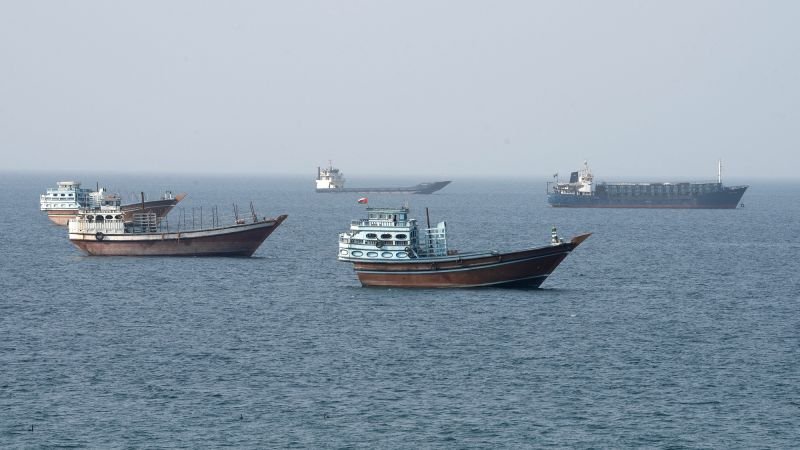
• Oil price rise: Brent crude futures — the global oil benchmark — has reached its highest level since July as hopes of a resolution to the war fade. Iran’s parliament speaker has reiterated key demands of the US before it will reopen the critical Strait of Hormuz.
• Threat to US ally: Oman has yet to respond to President Donald Trump’s repeated threat to attack the country if it intervenes in efforts in the strait, where a vessel was struck by an “unknown projectile,” according to the UK’s maritime agency.
• Expanding conflict: Elsewhere, Yemen’s Iran-backed Houthis said today they had again targeted Saudi Aramco’s Jazan refinery on the Red Sea coast in Saudi Arabia. Clashes near the Bab al-Mandeb strait have intensified in recent weeks after a Houthi-declared blockade of Saudi shipping.
17 Posts
US President Donald Trump posted an image on social media today showing the Strait of Hormuz labeled as “New US Territory.”
This comes after Trump said on Friday that he plans to declare the Strait a US territory after “we finish defeating Iran.”
Trump has repeatedly claimed the US “owns” the Strait of Hormuz, parts of which form the territorial seas of Iran and Oman. However, maritime law experts point out claiming a territory is not this simple.
“Under US law, claiming territory by a Presidential declaration (or) decree is not enough. There are important constitutional requirements that must be cleared first,” Jason Chuah, Professor of Maritime Law at City, University of London and Distinguished Fellow, Maritime Institute of Malaysia, told CNN.
While the occupation of a territory might give the occupying state control over the area, he said, “on its own, it does not convey legal title.”
Simon Baughen, Professor of Shipping Law at Swansea University, said the path toward claiming Hormuz as a US territory was unlikely to come to fruition.
A more likely outcome, Baughen suggested, could be that the US, Iran and Oman agree to open the Strait of Hormuz and charge tolls to vessels passing through the waterway.
But, he said: “That is also illegal under customary international law and also the provisions of the 1982 UNCLOS (United Nations Convention on the Law of the Sea) Treaty.”
Neither Iran nor Oman has absolute rights over the Strait of Hormuz, Chuah pointed out. “Freedom of navigation prevails. That is the law,” he said.
“A navy can control a waterway. It cannot, merely by controlling it, rewrite the law of title,” Chuah added.
The United States has criticized Israeli strikes on a Syrian airbase early on Tuesday.
“We are deeply concerned that the confirmed Israeli airstrikes on Abu al-Duhur Airbase constitute an unnecessary escalation that does not advance regional stability,” said the Trump administration envoy on Syria, Tom Barrack.
He added that Washington was encouraging all parties to prioritize “logical discourse” over further military incidents.
Israel has not confirmed it carried out the strikes on the air base, which is near Idlib in north-western Syria and has few serviceable aircraft.
Barrack said on X that the government in Damascus had neither adopted a predatory posture nor maintained proxy forces. “It has, in fact, repeatedly indicated a preference for de-escalation with Israel.”
The Syrian Foreign Ministry described the strikes as “an unjustified aggression, a blatant violation of Syria’s sovereignty and territorial integrity, and a dangerous escalation that threatens security and stability in the region.”
It said Israel was seeking to “drag the region toward further tension and instability.”
Barrack has mediated direct talks between Syria and Israel in an effort to make sure that an uneasy truce is sustained, especially in southern Syria where Israeli forces continue to occupy strategic heights on Syrian soil.
The two sides have yet to reach agreement on a more lasting peace settlement.
US President Donald Trump has praised Syia’s leader Ahmad al Sharaa, who led an uprising that ousted long-time president Bashar al Assad 18m months ago.
US President Donald Trump posted an image on social media Tuesday showing the Strait of Hormuz labeled as “New US Territory.”
The picture of a map includes a circle around the strategic waterway, which is located between Iran and Oman at the entrance to the Persian Gulf, with the words “New US Territory” displayed over the area.
The president’s Truth Social post came one day after he said declaring the strait a US territory was a “great idea.”
“I mean we control it,” Trump told reporters in the Oval Office when asked what he meant last week when he said he would soon declare the strait to be US territory.
“We control it with the blockade, and I like the idea of declaring it a territory,” the president added.
The Strait of Hormuz has emerged as a key bargaining chip in the war with Iran. The strategically vital strait has been effectively closed by Iran since fighting began in late February, disrupting a major route for global oil shipments.
Experts have said neither side has full control of the waterway.
Iran’s parliament speaker and key negotiator, Mohammad Bagher Ghalibaf, issued a list of demands today in exchange for Tehran reopening the Strait of Hormuz.
He also called on the US to implement the “other terms” Washington committed to as part of the memorandum of understanding, which expired yesterday.
Here’s a look at what Iran and the US previously agreed to:
Washington and Tehran agreed on the “immediate and permanent termination of military operations on all fronts, including in Lebanon.”
They said they would not “initiate any war or any military operation against each other,” or threaten or use any force against each other.
The parties agreed to “respect each other’s sovereignty and territorial integrity and to refrain from interfering in each other’s internal affairs.”
The US agreed to end its naval blockade of Iranian ports within 30 days of signing the agreement.
In exchange, Iran would make “its best efforts” to “ensure the safe passage of commercial vessels with no charge” through the Strait of Hormuz for 60 days.
The US agreed to work with partners to develop a plan “for the reconstruction and economic development” of Iran, including a fund of least $300 billion.
It would also make efforts to eliminate “all types of sanctions” against Iran, including those implemented by the United Nations.
Until those sanctions were terminated, the US agreed to issue waivers for the export of Iranian crude oil, petroleum products and derivatives.
The US also agreed to unfreeze Iranian funds and assets that had previously been frozen.
Iran agreed that it “shall not procure or develop nuclear weapons.”
Washington and Tehran “also agreed to discuss the issue of enrichment” related to Iran’s “nuclear needs.”
CNN’s Billy Stockwell, Alayna Treene, Kevin Liptak and Mostafa Salem contributed to this reporting.
Iran’s parliament speaker Mohammad Bagher Ghalibaf issued another list of demands today, saying the US needs to fulfill them before Tehran reopens the Strait of Hormuz.
Here’s what else is going on in the Middle East today:
Oil prices climbed to the highest level since July today, as traders’ hopes of a swift resolution to the US-Iran conflict fade. Brent crude futures, the global oil benchmark, were up 0.1% to $91 a barrel early this morning ET.
Yemen’s Iran-backed Houthis have said they targeted Saudi Aramco’s Jazan refinery, a major crude oil refinery located on the Red Sea coast in southwestern Saudi Arabia. CNN cannot independently verify the claim, and there has been no immediate comment from Saudi authorities.
The UK Maritime Trade Operations (UKMTO) said it received a report that a vessel was struck by an “unknown projectile” in the Strait of Hormuz on Tuesday, causing one casualty on board. Further details on the casualty have not yet been given.
Separately, Ghalibaf will lead a “high level parliamentary delegation” to Iraq tomorrow, according to Iranian state media. Officials will discuss strengthening Iran-Iraq relations, border security, economic cooperation and counterterrorism, among other topics, the broadcaster IRIB reported.
CNN’s Billy Stockwell, Aida Karimi, Anna Cooban, Helen Regan and Lucas Lilieholm contributed to this reporting.
Iran’s parliament speaker has today issued a list of demands that the US needs to fulfill before Tehran reopens the Strait of Hormuz, including lifting sanctions on Iranian oil and ending “all military threats and operations.”
The Strait of Hormuz has been a crucial bargaining chip throughout the US-Israeli war with Iran. It’s been effectively closed by Iran since the fighting began in late February.
The waterway, passing between Iran and Oman, serves as the main route for shipping crude from oil-rich countries such as Saudi Arabia, Iraq and Kuwait to the rest of the world.
Iran controls the strait’s northern side. About 20 million barrels of oil, or about one-fifth of daily global production, used to flow through the strait every day, according to the US Energy Information Administration, which calls the channel a “critical oil chokepoint.” According to the EIA, “very few alternative options exist to move oil out of the strait if it is closed.”
The strait also carries about one-fifth of global trade in liquefied natural gas.
Energy analysts have warned that oil and natural gas prices are likely to remain elevated until the strait is passable, even as Saudi Arabia and the United Arab Emirates seek to expand other routes to get their crude to market.
CNN’s Billy Stockwell and Aida Karimi contributed to this reporting.
Oil prices and government borrowing costs climbed higher on Tuesday as traders’ hopes of a swift resolution to the US-Iran conflict fade.
Brent crude futures, the global oil benchmark, was up 0.1% to $91 a barrel early morning ET – its highest level since late July. WTI futures, the US benchmark, rose 0.7% to $85.
Washington and Tehran agreed in June to a 60-day ceasefire, allowing time to negotiate a more durable peace deal while active fighting subsided and the Strait of Hormuz could be reopened.
But that agreement, which had already effectively collapsed, officially expired on Monday with no sign of a breakthrough and as tensions have escalated. On Monday, President Trump threatened to bomb Oman, a US ally, if it interfered with US efforts in the strait – sparking further concern among traders that a peace deal may still be far off.
US government bond yields – essentially, the interest the government must pay to borrow money from investors – were rising Tuesday as traders anticipate that a prolonged US-Iran conflict will keep energy prices high, in turn, boosting the odds that central banks will raise interest rates to keep inflation in check. Other factors, including enormous public debt piles, are also contributing to elevated yields.
The yield on the US 30-year Treasury bond rose to an intraday high of 5.33% on Tuesday, its highest level in nearly two decades, according to Reuters. The yield on the German government’s 10-year bond hit a 15-year high, the publication said.
Deutsche Bank analysts said on Tuesday that 30-year government bond yields had “hit multi-year highs across several countries, (showing) how the fiscal pressures on governments aren’t going away.”
Iran’s parliament speaker Mohammad Bagher Ghalibaf issued a list of demands today it said the US needed to meet before the Strait of Hormuz reopens, such as lifting sanctions on Iranian oil and ending military threats.
Traffic through the critical waterway, through which one-fifth of global crude oil typically flows, has been greatly reduced since the start of the war. Mirroring previous demands made by Tehran, Iran’s state-run Islamic Republic News Agency (IRNA) cited Ghalibaf’s conditions as:
Lifting the US blockade on Iranian ports
Releasing Iran’s frozen assets
Lifting Iranian oil sanctions
Ending all military threats and operations
Earlier today, a vessel was struck by an “unknown projectile” in the strait, causing one casualty onboard, according to a report made to the UK Maritime Trade Operations (UKMTO).
The Iranian official also called on the US to implement the “other terms” Washington committed to as part of the Memorandum of Understanding (MOU) reached between the two nations in June.
That agreement was aimed at stopping hostilities and paving the way for a “final deal” to end the war within 60 days – a deadline which expired yesterday – and settle complicated issues such as Iran’s nuclear program.
Yemen’s Iran-backed Houthis said Tuesday it had targeted Saudi Aramco’s Jazan refinery, a major crude oil refinery located on the Red Sea coast in southwestern Saudi Arabia.
The Houthi-run Saba news agency said the drone attack was “in response to the violation of Yemeni airspace over the Saada and Hajjah governorates,” citing an unnamed “military source.”
CNN cannot independently verify the militant group’s claim, and there has been no immediate comment from Saudi authorities.
This is not the first time the group has claimed an attack on the Jazan refinery. Earlier this month, the Houthis said they had targeted the site after Saudi authorities said a fire had broken out at a facility belonging to the refinery.
Clashes have intensified near the Bab al-Mandeb strait, a key maritime chokepoint, in recent weeks after the Houthis declared a blockade of Saudi shipping in the Red Sea. Saudi Arabia is the main backer of Yemeni government forces.
On Monday, the Houthi group said it had attacked what it described as a Saudi military ship and four escort vessels in the Red Sea with ballistic missiles, following a weekend of escalation in the region.
CNN’s Mostafa Salem contributed reporting.
President Donald Trump’s repeated threats to bomb Oman if it gets in the way of his country’s efforts in the Strait of Hormuz is not helping the United States improve its relations with Gulf countries, an Israeli analyst and Iran-watcher said Tuesday.
Iran says it is finalizing a deal with Oman on new shipping routes through the Strait of Hormuz, and Citrinowicz said Trump is worried that such a deal would allow Iran control over the waterway.
“President Trump is fearing that if there will be such an agreement, the Gulf States will follow this agreement, thus pressuring the US to lift the maritime blockade,” said Citrinowicz, the former head of the Iran branch of Israeli military intelligence.
Iran, he said, will not capitulate under economic pressure from the US.
Iran’s parliament speaker Mohammad Bagher Ghalibaf will lead a “high level parliamentary delegation” to Iraq on Wednesday, according to Iranian state media.
Ghalibaf has played a key role as lead negotiator in several rounds of talks since the US and Israel launched a war against Iran in February.
The delegation is scheduled to meet with senior Iraqi officials for meetings on “strengthening bilateral relations, border security, counterterrorism efforts, expanding economic cooperation, and advancing the implementation of agreements between the two countries,” state broadcaster IRIB reported.
The meetings will also explore “joint initiatives to promote stability and security across West Asia.”
The visit comes at a tense moment for the region with the framework diplomatic agreement between the US and Iran, which was meant to end the war, expiring Monday and no resolution to the conflict in sight.
Iraq’s Kurdistan Regional Government (KRG) Prime Minister Masrour Barzani on Monday also accused Iran of launching drone attacks targeting his office and the residence of the head of the Kurdish intelligence agency Parastin. Tehran denied the allegation and suggested the incident may have been a “false flag” operation.
Oman is a “critical negotiator with Iran” and it “doesn’t make a ton of sense” to make more enemies by threatening to bomb the country, Democratic Sen. Mark Kelly said early Tuesday.
Rising costs of gas, diesel, fertilizer and food prices will only continue if Trump “doesn’t find a way out of this,” he said.
Kelly said Trump has not “been able to articulate to the American people what this is all about and how this is in our best interest as a country” and so “until he figures out a way out of this, we’re going to just see a compounding number of problems.”
As Donald Trump’s critics see it, he’s striking out badly on foreign policy.
But the president is still taking mighty swings.
His long-broken memorandum of understanding with Iran reached its 60-day expiration date on Monday. Instead of celebrating a nuclear deal that might have justified his war, Trump vented his frustration by finding some of America’s friends to punish and rekindling his relationship with North Korea’s Kim Jong Un.
Trump had on Sunday announced the US would scale back military drills with South Korea, a US ally since the 1950s, citing the cost; the fact that Seoul declined to participate in the war on Iran; and a desire not to upset Kim — a tyrant.
On Monday, Trump threatened to bomb Oman, apparently for negotiating with Iran to get shipping moving through the Strait of Hormuz — which was also a requirement of the MOU once hailed by Trump as the greatest-ever Middle East peace deal.
Once again, Trump seemed to be deliberately turning everything the world once thought it knew about American power and foreign policy values upside down.
Read the full analysis about Trump’s chaotic foreign policy here.
The UK Maritime Trade Operations (UKMTO) said it received a report that a vessel was struck by an “unknown projectile” in the Strait of Hormuz on Tuesday, causing one casualty onboard.
The vessel was “conducting an outbound transit” of the critical waterway at the time, the UKMTO said.
“The impact caused damage to the engine room and resulted in a crew casualty. The remaining crew are currently being assisted by the Omani Coast Guard,” it said.
Further details on the casualty have not been given.
The incident came as traffic remains depressed in the strait, with at least three commercial ships passing through over the last 24 hours, MarineTraffic data showed on Monday.
US special envoy Jared Kushner, President Donald Trump’s son-in-law, claimed that “progress could come quite soon” in Gaza if both sides cooperate.
Kushner said Hamas could disarm soon but indicated the US would support further Israeli military action in the territory if the group does not.
Here’s what to know about what happened Monday:
Gaza news
Kushner told Fox News his meeting with Benjamin Netanyahu, in which he pressed him to move forward with the US-backed Gaza ceasefire plan, as “very, very good,” saying they were able to address “some valid concerns” raised by the Israeli prime minister.
Kushner said that Hamas officials “said all the right things” in their meeting on Sunday, but “it’s very, very hard to trust, you know, a terrorist organization that committed these terrible atrocities.”
Netanyahu told Kushner that Israel would not withdraw any of its forces in Gaza or allow reconstruction to begin until the complete disarmament of Hamas, according to a senior Israeli official.
US-Iran tension
Oman has not responded to Trump’s threat to “bomb” the country if it “gets in the way” of US efforts in the Strait of Hormuz. But it isn’t the first time Trump has threatened Oman, which is a US ally. In May, the president said: “Oman will behave just like everybody else, or we’ll have to blow ‘em up.”
Talks between Iran and Oman regarding the strait are complex but continuing “in all seriousness,” Iran’s Foreign Ministry spokesperson Esmaeil Baghaei said. He pointed to several “actors trying to exert influence on this process” as a reason for the delay in a deal.
Vessel movements through key shipping channels remains depressed. MarineTraffic data shows at least three commercial ships passed through the Strait of Hormuz over the last 24 hours. The US said it redirected 64 commercial vessels as of August 17.
Iraq’s Kurdistan Regional Government Prime Minister Masrour Barzani accused Iran of launching drone attacks targeting his office and the residence of the head of the Kurdish intelligence agency Parastin. Tehran denied the allegation and suggested the incident may have been a “false flag” operation.
Trump pushed back on reports of dwindling supplies and low morale on the USS Abraham Lincoln, calling recent reporting from CNN “fake news.” The carrier has been deployed for more than 250 days after being redirected to the Middle East.
Trump also suggested that he and North Korean leader Kim Jong Un have recently communicated, a day after announcing that he plans to reduce military exercises with key regional ally South Korea over a lack of help in Iran.
CNN’s Mostafa Salem, Mohammed Tawfeeq and Eyad Kourdi, Jennifer Hansler, Molly English, Alayna Treene, Tal Shalev and Avery Schmitz contributed to this report.
President Donald Trump pushed back on reports of dwindling supplies and low morale on the USS Abraham Lincoln Monday, calling recent reporting from CNN “fake news.”
Trump told reporters in the Oval Office that there was enough food on the aircraft carrier, despite sailors and family members telling CNN the ship has experienced intermittent food shortages, low supplies of hygiene items and problems with the water system.
Since the Lincoln left its home port of San Diego last November, the aircraft carrier has been deployed for more than 250 days after being redirected to the Middle East to support US operations in the war with Iran, now entering its sixth month. The ship may break a record for the longest trip away from its home port for a US carrier since the Vietnam War.
US special envoy Jared Kushner claimed that “progress could come quite soon” in Gaza if both sides cooperate, but indicated the US would support further Israeli military action in the territory if Hamas does not disarm.
“If Hamas actually gives over the weapons in the tunnels willingly over the next 60 to 90 days, that obviously would be the elimination of a huge security threat for Israel, almost an unthinkable achievement,” Kushner said in an interview with Fox News after meeting with Israeli Prime Minister Benjamin Netanyahu Monday.
Kushner said that Hamas officials “said all the right things” in their meeting on Sunday, but “it’s very, very hard to trust, you know, a terrorist organization that that committed these terrible atrocities.”
“We had a very cordial meeting,” he said. “And so we’re going to give them a chance to perform, but it’s going to have to be based on actions and steps.”
Kushner described the nearly four-hour-long meeting with Netanyahu on Monday as “very, very good.” He said they were able to address “some valid concerns” raised by the Israeli prime minister.
“We were able to go through some of the misunderstandings and misinformation,” such as on Israel’s right to defend itself and Gaza’s reconstruction, Kushner said.
• Oil price rise: Brent crude futures — the global oil benchmark — has reached its highest level since July as hopes of a resolution to the war fade. Iran’s parliament speaker has reiterated key demands of the US before it will reopen the critical Strait of Hormuz.
• Threat to US ally: Oman has yet to respond to President Donald Trump’s repeated threat to attack the country if it intervenes in efforts in the strait, where a vessel was struck by an “unknown projectile,” according to the UK’s maritime agency.
• Expanding conflict: Elsewhere, Yemen’s Iran-backed Houthis said today they had again targeted Saudi Aramco’s Jazan refinery on the Red Sea coast in Saudi Arabia. Clashes near the Bab al-Mandeb strait have intensified in recent weeks after a Houthi-declared blockade of Saudi shipping.
US President Donald Trump posted an image on social media today showing the Strait of Hormuz labeled as “New US Territory.”
This comes after Trump said on Friday that he plans to declare the Strait a US territory after “we finish defeating Iran.”
Trump has repeatedly claimed the US “owns” the Strait of Hormuz, parts of which form the territorial seas of Iran and Oman. However, maritime law experts point out claiming a territory is not this simple.
“Under US law, claiming territory by a Presidential declaration (or) decree is not enough. There are important constitutional requirements that must be cleared first,” Jason Chuah, Professor of Maritime Law at City, University of London and Distinguished Fellow, Maritime Institute of Malaysia, told CNN.
While the occupation of a territory might give the occupying state control over the area, he said, “on its own, it does not convey legal title.”
Simon Baughen, Professor of Shipping Law at Swansea University, said the path toward claiming Hormuz as a US territory was unlikely to come to fruition.
A more likely outcome, Baughen suggested, could be that the US, Iran and Oman agree to open the Strait of Hormuz and charge tolls to vessels passing through the waterway.
But, he said: “That is also illegal under customary international law and also the provisions of the 1982 UNCLOS (United Nations Convention on the Law of the Sea) Treaty.”
Neither Iran nor Oman has absolute rights over the Strait of Hormuz, Chuah pointed out. “Freedom of navigation prevails. That is the law,” he said.
“A navy can control a waterway. It cannot, merely by controlling it, rewrite the law of title,” Chuah added.
The United States has criticized Israeli strikes on a Syrian airbase early on Tuesday.
“We are deeply concerned that the confirmed Israeli airstrikes on Abu al-Duhur Airbase constitute an unnecessary escalation that does not advance regional stability,” said the Trump administration envoy on Syria, Tom Barrack.
He added that Washington was encouraging all parties to prioritize “logical discourse” over further military incidents.
Israel has not confirmed it carried out the strikes on the air base, which is near Idlib in north-western Syria and has few serviceable aircraft.
Barrack said on X that the government in Damascus had neither adopted a predatory posture nor maintained proxy forces. “It has, in fact, repeatedly indicated a preference for de-escalation with Israel.”
The Syrian Foreign Ministry described the strikes as “an unjustified aggression, a blatant violation of Syria’s sovereignty and territorial integrity, and a dangerous escalation that threatens security and stability in the region.”
It said Israel was seeking to “drag the region toward further tension and instability.”
Barrack has mediated direct talks between Syria and Israel in an effort to make sure that an uneasy truce is sustained, especially in southern Syria where Israeli forces continue to occupy strategic heights on Syrian soil.
The two sides have yet to reach agreement on a more lasting peace settlement.
US President Donald Trump has praised Syia’s leader Ahmad al Sharaa, who led an uprising that ousted long-time president Bashar al Assad 18m months ago.
US President Donald Trump posted an image on social media Tuesday showing the Strait of Hormuz labeled as “New US Territory.”
The picture of a map includes a circle around the strategic waterway, which is located between Iran and Oman at the entrance to the Persian Gulf, with the words “New US Territory” displayed over the area.
The president’s Truth Social post came one day after he said declaring the strait a US territory was a “great idea.”
“I mean we control it,” Trump told reporters in the Oval Office when asked what he meant last week when he said he would soon declare the strait to be US territory.
“We control it with the blockade, and I like the idea of declaring it a territory,” the president added.
The Strait of Hormuz has emerged as a key bargaining chip in the war with Iran. The strategically vital strait has been effectively closed by Iran since fighting began in late February, disrupting a major route for global oil shipments.
Experts have said neither side has full control of the waterway.
Iran’s parliament speaker and key negotiator, Mohammad Bagher Ghalibaf, issued a list of demands today in exchange for Tehran reopening the Strait of Hormuz.
He also called on the US to implement the “other terms” Washington committed to as part of the memorandum of understanding, which expired yesterday.
Here’s a look at what Iran and the US previously agreed to:
Washington and Tehran agreed on the “immediate and permanent termination of military operations on all fronts, including in Lebanon.”
They said they would not “initiate any war or any military operation against each other,” or threaten or use any force against each other.
The parties agreed to “respect each other’s sovereignty and territorial integrity and to refrain from interfering in each other’s internal affairs.”
The US agreed to end its naval blockade of Iranian ports within 30 days of signing the agreement.
In exchange, Iran would make “its best efforts” to “ensure the safe passage of commercial vessels with no charge” through the Strait of Hormuz for 60 days.
The US agreed to work with partners to develop a plan “for the reconstruction and economic development” of Iran, including a fund of least $300 billion.
It would also make efforts to eliminate “all types of sanctions” against Iran, including those implemented by the United Nations.
Until those sanctions were terminated, the US agreed to issue waivers for the export of Iranian crude oil, petroleum products and derivatives.
The US also agreed to unfreeze Iranian funds and assets that had previously been frozen.
Iran agreed that it “shall not procure or develop nuclear weapons.”
Washington and Tehran “also agreed to discuss the issue of enrichment” related to Iran’s “nuclear needs.”
CNN’s Billy Stockwell, Alayna Treene, Kevin Liptak and Mostafa Salem contributed to this reporting.
Iran’s parliament speaker Mohammad Bagher Ghalibaf issued another list of demands today, saying the US needs to fulfill them before Tehran reopens the Strait of Hormuz.
Here’s what else is going on in the Middle East today:
Oil prices climbed to the highest level since July today, as traders’ hopes of a swift resolution to the US-Iran conflict fade. Brent crude futures, the global oil benchmark, were up 0.1% to $91 a barrel early this morning ET.
Yemen’s Iran-backed Houthis have said they targeted Saudi Aramco’s Jazan refinery, a major crude oil refinery located on the Red Sea coast in southwestern Saudi Arabia. CNN cannot independently verify the claim, and there has been no immediate comment from Saudi authorities.
The UK Maritime Trade Operations (UKMTO) said it received a report that a vessel was struck by an “unknown projectile” in the Strait of Hormuz on Tuesday, causing one casualty on board. Further details on the casualty have not yet been given.
Separately, Ghalibaf will lead a “high level parliamentary delegation” to Iraq tomorrow, according to Iranian state media. Officials will discuss strengthening Iran-Iraq relations, border security, economic cooperation and counterterrorism, among other topics, the broadcaster IRIB reported.
CNN’s Billy Stockwell, Aida Karimi, Anna Cooban, Helen Regan and Lucas Lilieholm contributed to this reporting.
Iran’s parliament speaker has today issued a list of demands that the US needs to fulfill before Tehran reopens the Strait of Hormuz, including lifting sanctions on Iranian oil and ending “all military threats and operations.”
The Strait of Hormuz has been a crucial bargaining chip throughout the US-Israeli war with Iran. It’s been effectively closed by Iran since the fighting began in late February.
The waterway, passing between Iran and Oman, serves as the main route for shipping crude from oil-rich countries such as Saudi Arabia, Iraq and Kuwait to the rest of the world.
Iran controls the strait’s northern side. About 20 million barrels of oil, or about one-fifth of daily global production, used to flow through the strait every day, according to the US Energy Information Administration, which calls the channel a “critical oil chokepoint.” According to the EIA, “very few alternative options exist to move oil out of the strait if it is closed.”
The strait also carries about one-fifth of global trade in liquefied natural gas.
Energy analysts have warned that oil and natural gas prices are likely to remain elevated until the strait is passable, even as Saudi Arabia and the United Arab Emirates seek to expand other routes to get their crude to market.
CNN’s Billy Stockwell and Aida Karimi contributed to this reporting.
Oil prices and government borrowing costs climbed higher on Tuesday as traders’ hopes of a swift resolution to the US-Iran conflict fade.
Brent crude futures, the global oil benchmark, was up 0.1% to $91 a barrel early morning ET – its highest level since late July. WTI futures, the US benchmark, rose 0.7% to $85.
Washington and Tehran agreed in June to a 60-day ceasefire, allowing time to negotiate a more durable peace deal while active fighting subsided and the Strait of Hormuz could be reopened.
But that agreement, which had already effectively collapsed, officially expired on Monday with no sign of a breakthrough and as tensions have escalated. On Monday, President Trump threatened to bomb Oman, a US ally, if it interfered with US efforts in the strait – sparking further concern among traders that a peace deal may still be far off.
US government bond yields – essentially, the interest the government must pay to borrow money from investors – were rising Tuesday as traders anticipate that a prolonged US-Iran conflict will keep energy prices high, in turn, boosting the odds that central banks will raise interest rates to keep inflation in check. Other factors, including enormous public debt piles, are also contributing to elevated yields.
The yield on the US 30-year Treasury bond rose to an intraday high of 5.33% on Tuesday, its highest level in nearly two decades, according to Reuters. The yield on the German government’s 10-year bond hit a 15-year high, the publication said.
Deutsche Bank analysts said on Tuesday that 30-year government bond yields had “hit multi-year highs across several countries, (showing) how the fiscal pressures on governments aren’t going away.”
Iran’s parliament speaker Mohammad Bagher Ghalibaf issued a list of demands today it said the US needed to meet before the Strait of Hormuz reopens, such as lifting sanctions on Iranian oil and ending military threats.
Traffic through the critical waterway, through which one-fifth of global crude oil typically flows, has been greatly reduced since the start of the war. Mirroring previous demands made by Tehran, Iran’s state-run Islamic Republic News Agency (IRNA) cited Ghalibaf’s conditions as:
Lifting the US blockade on Iranian ports
Releasing Iran’s frozen assets
Lifting Iranian oil sanctions
Ending all military threats and operations
Earlier today, a vessel was struck by an “unknown projectile” in the strait, causing one casualty onboard, according to a report made to the UK Maritime Trade Operations (UKMTO).
The Iranian official also called on the US to implement the “other terms” Washington committed to as part of the Memorandum of Understanding (MOU) reached between the two nations in June.
That agreement was aimed at stopping hostilities and paving the way for a “final deal” to end the war within 60 days – a deadline which expired yesterday – and settle complicated issues such as Iran’s nuclear program.
Yemen’s Iran-backed Houthis said Tuesday it had targeted Saudi Aramco’s Jazan refinery, a major crude oil refinery located on the Red Sea coast in southwestern Saudi Arabia.
The Houthi-run Saba news agency said the drone attack was “in response to the violation of Yemeni airspace over the Saada and Hajjah governorates,” citing an unnamed “military source.”
CNN cannot independently verify the militant group’s claim, and there has been no immediate comment from Saudi authorities.
This is not the first time the group has claimed an attack on the Jazan refinery. Earlier this month, the Houthis said they had targeted the site after Saudi authorities said a fire had broken out at a facility belonging to the refinery.
Clashes have intensified near the Bab al-Mandeb strait, a key maritime chokepoint, in recent weeks after the Houthis declared a blockade of Saudi shipping in the Red Sea. Saudi Arabia is the main backer of Yemeni government forces.
On Monday, the Houthi group said it had attacked what it described as a Saudi military ship and four escort vessels in the Red Sea with ballistic missiles, following a weekend of escalation in the region.
CNN’s Mostafa Salem contributed reporting.
President Donald Trump’s repeated threats to bomb Oman if it gets in the way of his country’s efforts in the Strait of Hormuz is not helping the United States improve its relations with Gulf countries, an Israeli analyst and Iran-watcher said Tuesday.
Iran says it is finalizing a deal with Oman on new shipping routes through the Strait of Hormuz, and Citrinowicz said Trump is worried that such a deal would allow Iran control over the waterway.
“President Trump is fearing that if there will be such an agreement, the Gulf States will follow this agreement, thus pressuring the US to lift the maritime blockade,” said Citrinowicz, the former head of the Iran branch of Israeli military intelligence.
Iran, he said, will not capitulate under economic pressure from the US.
Iran’s parliament speaker Mohammad Bagher Ghalibaf will lead a “high level parliamentary delegation” to Iraq on Wednesday, according to Iranian state media.
Ghalibaf has played a key role as lead negotiator in several rounds of talks since the US and Israel launched a war against Iran in February.
The delegation is scheduled to meet with senior Iraqi officials for meetings on “strengthening bilateral relations, border security, counterterrorism efforts, expanding economic cooperation, and advancing the implementation of agreements between the two countries,” state broadcaster IRIB reported.
The meetings will also explore “joint initiatives to promote stability and security across West Asia.”
The visit comes at a tense moment for the region with the framework diplomatic agreement between the US and Iran, which was meant to end the war, expiring Monday and no resolution to the conflict in sight.
Iraq’s Kurdistan Regional Government (KRG) Prime Minister Masrour Barzani on Monday also accused Iran of launching drone attacks targeting his office and the residence of the head of the Kurdish intelligence agency Parastin. Tehran denied the allegation and suggested the incident may have been a “false flag” operation.
Oman is a “critical negotiator with Iran” and it “doesn’t make a ton of sense” to make more enemies by threatening to bomb the country, Democratic Sen. Mark Kelly said early Tuesday.
Rising costs of gas, diesel, fertilizer and food prices will only continue if Trump “doesn’t find a way out of this,” he said.
Kelly said Trump has not “been able to articulate to the American people what this is all about and how this is in our best interest as a country” and so “until he figures out a way out of this, we’re going to just see a compounding number of problems.”
As Donald Trump’s critics see it, he’s striking out badly on foreign policy.
But the president is still taking mighty swings.
His long-broken memorandum of understanding with Iran reached its 60-day expiration date on Monday. Instead of celebrating a nuclear deal that might have justified his war, Trump vented his frustration by finding some of America’s friends to punish and rekindling his relationship with North Korea’s Kim Jong Un.
Trump had on Sunday announced the US would scale back military drills with South Korea, a US ally since the 1950s, citing the cost; the fact that Seoul declined to participate in the war on Iran; and a desire not to upset Kim — a tyrant.
On Monday, Trump threatened to bomb Oman, apparently for negotiating with Iran to get shipping moving through the Strait of Hormuz — which was also a requirement of the MOU once hailed by Trump as the greatest-ever Middle East peace deal.
Once again, Trump seemed to be deliberately turning everything the world once thought it knew about American power and foreign policy values upside down.
Read the full analysis about Trump’s chaotic foreign policy here.
The UK Maritime Trade Operations (UKMTO) said it received a report that a vessel was struck by an “unknown projectile” in the Strait of Hormuz on Tuesday, causing one casualty onboard.
The vessel was “conducting an outbound transit” of the critical waterway at the time, the UKMTO said.
“The impact caused damage to the engine room and resulted in a crew casualty. The remaining crew are currently being assisted by the Omani Coast Guard,” it said.
Further details on the casualty have not been given.
The incident came as traffic remains depressed in the strait, with at least three commercial ships passing through over the last 24 hours, MarineTraffic data showed on Monday.
US special envoy Jared Kushner, President Donald Trump’s son-in-law, claimed that “progress could come quite soon” in Gaza if both sides cooperate.
Kushner said Hamas could disarm soon but indicated the US would support further Israeli military action in the territory if the group does not.
Here’s what to know about what happened Monday:
Gaza news
Kushner told Fox News his meeting with Benjamin Netanyahu, in which he pressed him to move forward with the US-backed Gaza ceasefire plan, as “very, very good,” saying they were able to address “some valid concerns” raised by the Israeli prime minister.
Kushner said that Hamas officials “said all the right things” in their meeting on Sunday, but “it’s very, very hard to trust, you know, a terrorist organization that committed these terrible atrocities.”
Netanyahu told Kushner that Israel would not withdraw any of its forces in Gaza or allow reconstruction to begin until the complete disarmament of Hamas, according to a senior Israeli official.
US-Iran tension
Oman has not responded to Trump’s threat to “bomb” the country if it “gets in the way” of US efforts in the Strait of Hormuz. But it isn’t the first time Trump has threatened Oman, which is a US ally. In May, the president said: “Oman will behave just like everybody else, or we’ll have to blow ‘em up.”
Talks between Iran and Oman regarding the strait are complex but continuing “in all seriousness,” Iran’s Foreign Ministry spokesperson Esmaeil Baghaei said. He pointed to several “actors trying to exert influence on this process” as a reason for the delay in a deal.
Vessel movements through key shipping channels remains depressed. MarineTraffic data shows at least three commercial ships passed through the Strait of Hormuz over the last 24 hours. The US said it redirected 64 commercial vessels as of August 17.
Iraq’s Kurdistan Regional Government Prime Minister Masrour Barzani accused Iran of launching drone attacks targeting his office and the residence of the head of the Kurdish intelligence agency Parastin. Tehran denied the allegation and suggested the incident may have been a “false flag” operation.
Trump pushed back on reports of dwindling supplies and low morale on the USS Abraham Lincoln, calling recent reporting from CNN “fake news.” The carrier has been deployed for more than 250 days after being redirected to the Middle East.
Trump also suggested that he and North Korean leader Kim Jong Un have recently communicated, a day after announcing that he plans to reduce military exercises with key regional ally South Korea over a lack of help in Iran.
CNN’s Mostafa Salem, Mohammed Tawfeeq and Eyad Kourdi, Jennifer Hansler, Molly English, Alayna Treene, Tal Shalev and Avery Schmitz contributed to this report.
President Donald Trump pushed back on reports of dwindling supplies and low morale on the USS Abraham Lincoln Monday, calling recent reporting from CNN “fake news.”
Trump told reporters in the Oval Office that there was enough food on the aircraft carrier, despite sailors and family members telling CNN the ship has experienced intermittent food shortages, low supplies of hygiene items and problems with the water system.
Since the Lincoln left its home port of San Diego last November, the aircraft carrier has been deployed for more than 250 days after being redirected to the Middle East to support US operations in the war with Iran, now entering its sixth month. The ship may break a record for the longest trip away from its home port for a US carrier since the Vietnam War.
US special envoy Jared Kushner claimed that “progress could come quite soon” in Gaza if both sides cooperate, but indicated the US would support further Israeli military action in the territory if Hamas does not disarm.
“If Hamas actually gives over the weapons in the tunnels willingly over the next 60 to 90 days, that obviously would be the elimination of a huge security threat for Israel, almost an unthinkable achievement,” Kushner said in an interview with Fox News after meeting with Israeli Prime Minister Benjamin Netanyahu Monday.
Kushner said that Hamas officials “said all the right things” in their meeting on Sunday, but “it’s very, very hard to trust, you know, a terrorist organization that that committed these terrible atrocities.”
“We had a very cordial meeting,” he said. “And so we’re going to give them a chance to perform, but it’s going to have to be based on actions and steps.”
Kushner described the nearly four-hour-long meeting with Netanyahu on Monday as “very, very good.” He said they were able to address “some valid concerns” raised by the Israeli prime minister.
“We were able to go through some of the misunderstandings and misinformation,” such as on Israel’s right to defend itself and Gaza’s reconstruction, Kushner said.




Responses