
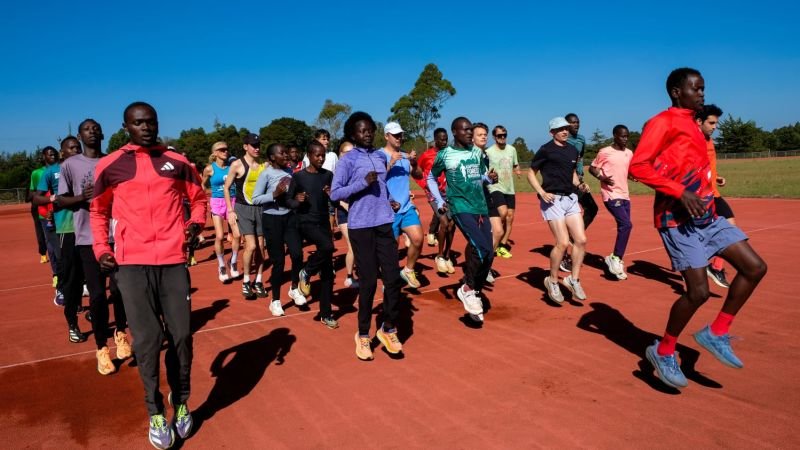
Portuguese entrepreneur Pedro Queirós could spend his vacation relaxing on a beach with his family, but instead, every year since 2021, he has chosen to spend at least a month at a training camp in a small Kenyan town, running for a few hours a day around 8,000 feet above sea level.
“I’m an amateur runner, I don’t have sponsors, I’m not paid,” the 45-year-old told CNN. “But I love the sport, and Kenya is the only place that gives me the opportunity to become the athlete I’ve always dreamed of being.”
Queirós’s running romance is one that many will recognize. He ran his first 5K (3.1-mile race) a decade ago and fell in love. He pushed the distance, started reading about the sport’s history, researched nutrition and bought a GPS smartwatch.
By the end of the Covid pandemic, as he prepared for the London Marathon, he became curious about a Kenyan town he’d read about: Iten. Kenyan runners have collectively won 38 Olympic gold medals, mostly in long-distance events. Some of the best have trained in Iten.
“I started becoming curious,” Queirós said. “What are they doing differently in Africa? And what does it take to be a champion?”
It took just one stay at the training camp to answer the question. He said that after six weeks at Iten’s High-Altitude Training Center his performance improved dramatically, with his marathon time dropping to a very respectable 2 hours and 38 minutes. It’s the reason why he’s been back eight times since, always before a physical challenge, whether a long-distance race or climbing some of the world’s highest peaks. It’s the kind of performance-boosting impact that has earned Iten its nickname, the “home of champions.”
Today, the High-Altitude Training Center is a small campus with accommodation, a gym, a swimming pool, a sauna, a private tarmac track and nature on every side. It welcomes up to 90 people in high season, half of them international visitors. It’s one of roughly a dozen training centers in Iten now — but when it launched, it was pioneering.
“When I thought about opening the training center in 1997, there was nothing in Iten,” long-distance runner and three-time Olympian Lornah Kiplagat said of the former agricultural outpost 200 miles northwest of Nairobi. “No hotel, no roads, and certainly no tourists.”
At the time, the Rift Valley-native was 23 and had just started to compete abroad, winning the Los Angeles Marathon, the 25 Berlin, Zurich’s Greifenseelauf, USA’s Boilermaker Road Race and the Netherlands’ Tilburg Ten Miles all that same year. She was training everywhere from Albuquerque, New Mexico, to Davos, Switzerland. “I realized that there was objectively no better place to train than home,” she said.
Iten’s altitude is well above the roughly 6,000 feet of some of the world’s most famous high-altitude training bases, forcing the body to adapt to lower oxygen levels and dramatically improving endurance and stamina. The climate averages around 18 degrees Celsius (64.4 degrees Fahrenheit) year-round, and the terrain is challenging but beautiful.
In 1999, Kiplagat opened the training center, inviting some local peers to train with her on Iten’s famous red clay roads. She also opened the center to Kenyan girls, to encourage them to take up running, even casually, in a safe space.
“As a group, we were winning big competitions, and Western media started to wonder where we were training,” she said. “Of course, we mentioned the High-Altitude Training Center. Most had never heard of it before. That’s how, step by step, we became known worldwide for producing some of the best distance runners in the world.”
Since 2004, the center has opened to international athletes, including British three-time London Marathon winner Paula Radcliffe and Olympic gold medalists Mo Farah and Sifan Hassan. But it took a global pandemic to truly make the center a global destination.
Covid-19 lockdowns led to a surge in popularity for running. Afterward, “Runcations” and “race-cations” took off, with runners increasingly traveling abroad specifically to run. Hotels and businesses adapted. So did Kiplagat.
“Running became so popular, we were receiving so many requests from recreational runners too. So, we decided to open our doors to welcome them as well,” she said.
As did the rest of the town. Compared to when she opened the center, Iten is now unrecognizable, Kiplagat said. Queirós has witnessed the changes over the past five years: “The only thing that hasn’t changed is the altitude. The town is bigger, more crowded, and the people coming to train are far more diverse.”
Today, staying at the HATC and having access to its gym, track and sauna costs around 50 euros ($57) per day. While some choose to follow their own program, or to join groups of other athletes training there for free, people like Queirós prefer to pay for the center’s coaches and pacers for around 5 euros ($6) per session. The center has five full-time coaches, and a wide network of pacers around the town.
According to figures compiled by former academic and now-environment officer Joyce Kenei, annual sports tourists in Iten rose from around 300 in 2010 to more than 3,000 by 2025. An entire sports-tourism economy has grown around them: training camps, accommodation, businesses and support services.
Sports brands have discovered Iten’s potential too. Decathlon’s running label Kiprun has opened 42 House, a residential training facility supporting elite runners. Half of the training centers founded in Iten since the HATC opened were started by foreigners, Kenei told CNN.
But Kiplagat stays grounded in her model — one of the only ones, she says, that gives back to the town. The center has trained nearly 300 local students for free, many of whom went on to win full scholarships to Ivy League schools in the US.
“We really built a system that’s equally welcoming to both locals and internationals, and really pushes everyone to be at their best,” she said.
“Western media show the chaotic part of the country,” she added. “But I take great pride in Kenya, and I love the role the High Altitude Training Center plays in showing it to travelers.”





Responses