
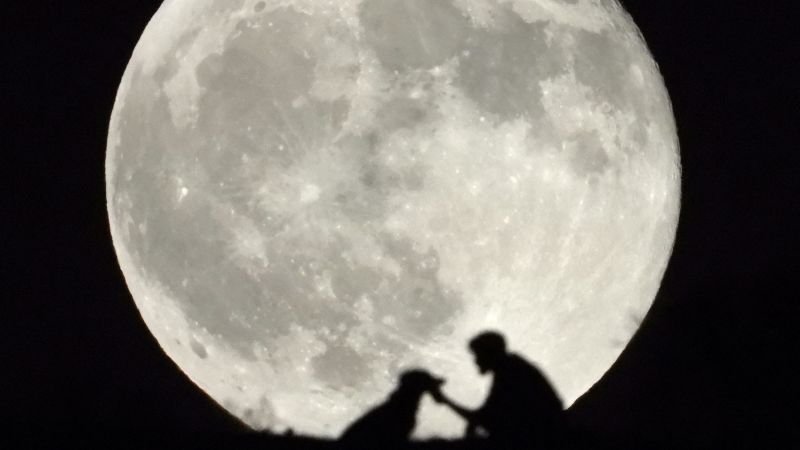
August’s full sturgeon moon will align with a partial lunar eclipse this week, producing a stunning cosmic sight for sky-gazers.
A lunar eclipse occurs when the Earth’s shadow, or umbra, falls upon the moon. When the umbra darkens the entire lunar orb, it creates a total lunar eclipse. But when there is a portion of the moon that remains outside Earth’s umbra, it’s called a partial lunar eclipse. This week’s event will be a partial lunar eclipse, but it will be near-total, with Earth’s shadow covering 96% of the moon.
Lunar eclipses always occur during a full moon when Earth is positioned between the sun and moon. This week’s partial lunar eclipse will begin at 10:34 p.m. ET Thursday and reach its maximum point at 12:13 a.m. ET Friday, according to EarthSky. The peak of the full moon, or the point at which the moon appears fullest, will occur at 12:18 a.m. ET Friday, according to The Old Farmer’s Almanac.
Observers across North and South America will be able to view most or all of the partial lunar eclipse, as it occurs during evening and overnight hours.
During total lunar eclipses, the moon often appears to have a more red-orange hue because shorter wavelengths, such as those that appear violet and blue, scatter through Earth’s atmosphere, while longer wavelengths, which appear as red and orange hues, pass right through.
But during the partial lunar eclipse, “because a small sliver of the moon is going to be illuminated by the sun, it won’t turn that deep, dark orange color,” said Noah Petro, chief of the Planetary Geology, Geophysics and Geochemistry Lab at NASA’s Goddard Space Flight Center in Greenbelt, Maryland.
The number of annual lunar eclipses varies, but most years feature two.
“Some years, we actually get three,” said Pamela Gay, senior scientist at the Planetary Science Institute. “Some years, we unfortunately get zero.” But usually, “there’s two good opportunities,” for the sun, moon and Earth to line up perfectly, Gay said.
The first lunar eclipse of the year occurred in March, Petro noted. The special event was a total lunar eclipse, with the best viewing from Australia and other Pacific regions.
Unlike solar eclipses, lunar eclipses are safe to view without any special devices. But there are things to consider when trying to achieve the best viewing experience.
If there are any nearby bright lights, they will diminish your experience, Petro said. Find a “nearby park or any kind of open space that you can go to have an unobstructed view of the night sky.”
The event offers an opportunity to show appreciation for the cosmos, Gay said. “Set yourself up a hammock, pull out a pair of binoculars, go out and enjoy the entire experience,” she advised.
The sturgeon moon’s name can be traced to Algonquin-speaking nations and other Native American groups near the Great Lakes, as lake sturgeons were an important food source and caught in abundance at this time of year, according to the Farmers’ Almanac.
Other Indigenous groups refer to the August full moon by different names. While the Assiniboine of the Northern Great Plains know it as the black cherries moon, the Eastern Woodlands nations refer to it as the green corn moon, according to the Farmers’ Almanac.
There are four more full moons in 2026. November and December will host supermoons, when the satellite is near the closest point to Earth in its orbit and appears bigger and brighter than usual.
Here’s the list of the remaining full moons, according to the Farmers’ Almanac.
September 26: Harvest moon
October 26: Hunter’s moon
November 24: Beaver moon
December 23: Cold moon
Sign up for CNN’s Wonder Theory science newsletter. Explore the universe with news on fascinating discoveries, scientific advancements and more.




Responses