
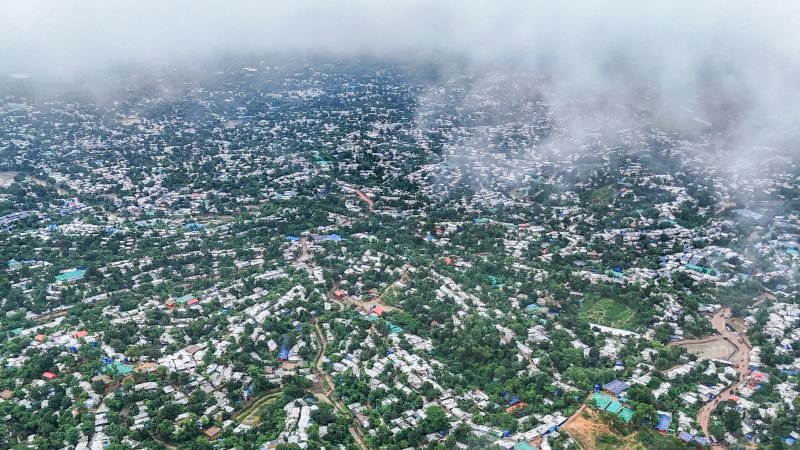
Cox’s Bazar, Bangladesh —
Abdul Nur last heard from his son Jani Alom in early June, weeks before the 15-year-old boy was forced onto a boat embarking on one of the world’s most dangerous sea crossings.
“Oh ba,” a teary and panicked Alom said over the phone, his father recounted to CNN. Alom used the word for “father” in Rohingya, the language spoken by the ethnic group of the same name.
“I am going to be put on a boat to Malaysia.”
The boy had been abducted one evening two months earlier while walking home from school in the Bangladeshi refugee camp where the family has lived for nearly a decade, alongside more than one million other Rohingya exiled from western Myanmar.
The Rohingya are a stateless Muslim minority from Myanmar’s Rakhine state, who have faced decades of state-sponsored persecution, violence and what the US has classified as genocide.
Each year, thousands of Rohingya refugees, many of them women and children, pack into the crammed cargo holds of old fishing trawlers departing from Bangladesh or Myanmar to cross rough, open waters in the Bay of Bengal and the Andaman Sea in search of safety or opportunity in Indonesia or Malaysia.
These crossings have taken place for more than a decade but have sharply increased in recent years amid a bloody civil war in Myanmar and deteriorating conditions in the Cox’s Bazar camps, fueling a lucrative market for smugglers who facilitate these risky journeys.
Before Alom made that final call to his father, Nur had collected donations from relatives and neighbors in the camp in Cox’s Bazar to pay the roughly $2,800 in ransom his abductors demanded.
But his son never came home.
Nur now believes Alom was among more than 500 people aboard two boats which vanished off the coast of Myanmar in July – the latest victims of a perilous maritime route where, according to UN figures, roughly one in seven people who attempt the trip do not make it.
It’s a route which keeps getting busier.
Last year, nearly 900 Rohingya refugees were reported missing or dead in the Andaman Sea and Bay of Bengal out of roughly 6,500 who attempted the crossing, which has “the highest mortality rate worldwide of any route for refugee and migrant sea journeys,” according to the UN Refugee Agency.
In the first half of this year, 820 people have been reported dead or missing at sea, almost twice as many people as during the same period last year. Roughly 5,700 people have attempted the journey as of the end of June — close to the total for all of 2025.
However, the numbers are only estimates because many journeys go unseen and ships sink quietly without survivors.
While many go willingly, a rising number of people are being trafficked onto these ships, where abuse, exploitation and disease are rampant, according to advocates and interviews with refugee families.
There has been a “significant increase in abductions” in the Cox’s Bazar refugee camp, with gangs extorting the relatives of abductees for ransom, said Chris Lewa, director of the Arakan Project, a Rohingya advocacy group.
While not everyone who is kidnapped is put on a boat, she said the growth in the maritime smuggling industry has created demand for more passengers to take these risky journeys, leading to some people being trafficked.
Nur said in that final call, an unknown man who he fears was a trafficker took the phone from Alom and said, “Your son has been sold here and will be sent to Malaysia.”
He and his family came to Cox’s Bazar in search of safety in 2017, having escaped their village in the middle of the night and traveled for seven days on foot to reach Bangladesh, Nur said.
But now he is overwhelmed with grief over the disappearance of his son, a quiet and respectful seventh-grader who loved to play football with his friends.
“Every corner of our shelter reminds me of him,” Nur, 55, told CNN from his home in the refugee camp, showing the small table where his son used to study.
Several camps over from Nur’s tent, through muddy paths dotted with plastic structures, another family sits in similar anguish.
Hamid Ullah, 20, a teacher at the local high school, was taken from the camp at the beginning of May, his family told CNN. While they begged for money to pay an initial $1,200 ransom for Ullah’s release, they were unable to raise a further $3,200 traffickers demanded later.
Ullah’s mother, Bibi Jan, said when she finally spoke to her son, he told her he was being forced onto a boat bound for Malaysia.
“I asked him, “My son, will you come back? The sea is so dangerous. You could die,’” she said.
The family has not received any information about Ullah since. When they later heard of the boats that disappeared, the family was stricken with grief.
“Sometimes I hold and smell his shirt because it reminds me of him,” Jan said.
The boats which recently vanished set sail from Myanmar in late June, according to a UN statement issued in mid-July. One of the ships, carrying about 250 people, lost contact shortly after departure. Another, with about 280 passengers, is believed to have sunk roughly a week later off the country’s central coast.
Unlike most crossings, which take place between November and April, these ships departed during monsoon season, when the seas are prone to unpredictable storms and high swells.
The passengers were mostly Rohingya people, including some who had traveled from the Cox’s Bazar camp, according to the UN.
A communications blackout in Myanmar and a lack of survivors makes it difficult to get firsthand information about the ships, said Lewa.
Based on discussions with her contacts, which are consistent with CNN’s interviews with victims’ families, Lewa said the passengers were taken from Bangladesh and northern Rakhine state to the village of Tha Mee Hla, along Myanmar’s Mayu River, where they waited until the boat was ready depart from the coastal village of Sin Tet Maw.
The two boats departed on June 29, Lewa said. They were meant to leave earlier but were delayed due to the security situation in the war-torn state, which is violently controlled by the Arakan Army, one of the rebel groups fighting the junta.
Despite the risks of sailing during monsoon season, Lewa said, she believes there was pressure from the smugglers on the boat operators to depart anyway.
The first boat departed in the morning and capsized within just 12 hours, Lewa said.
The bodies of approximately 10 Rohingya people who were believed to have been passengers on this boat were reportedly found along the coastline of northern Rakhine, according to various reports.
Police in Bangladesh said they recovered five bodies along the southern coast in the first two weeks of July, which they said could be linked to the migrant boats, local media reported.
The second boat, which left in the evening, sailed for about nine days and capsized on July 8 in the Andaman Sea, off the Ayeyarwady coast, according to Lewa and the UN statement.
Lewa said she had received reports that fishermen in Ayeyarwady and Mon state, which lies further south along the coast, found several dead bodies in the ocean.
The second boat may have been close to its destination in southern Myanmar, Lewa said; from there, the refugees would have likely crossed into Malaysia via Thailand through the forest.
The double shipwreck comes after another migrant boat which left from southern Bangladesh sank in mid-April, leaving 250 people missing. Miraculously, nine people were rescued from the ocean.
One survivor told Reuters news agency the passengers were packed into storage compartments meant for fish and nets, causing at least 30 people to suffocate to death before the boat capsized.
The rising toll of people lost at sea at least partly reflects the grim conditions in Cox’s Bazar, a place that was meant to be a refuge but where rampant crime and violence, scarce resources and a lack of opportunities have made many desperate to flee – even at great risk.
“They don’t see any solution for their future,” Lewa said. “So they take a chance.”
Refugees are legally restricted from working or studying outside the camps, leaving them heavily reliant on international humanitarian assistance for basic needs like food. Much of this help had been coming through USAID until it was sharply slashed last year.
In June the UN, in coordination with the Bangladesh government, appealed to the international community for $710.5 million to meet “the most urgent needs of Rohingya refugees and local host communities” – a “hyper-prioritized” number despite growing needs.
Torrential rains and landslides frequently hit the hilly and densely populated camps, killing and displacing residents and leaving streets waterlogged for months of the year.
Refugees are abducted almost every day by armed groups operating inside the camp, who kidnap people — including young children — and extort their families for money, according to reports from within the camp.
Just a handful of Rohingya have been resettled in third countries like the US, and voluntary, safe repatriation to conflict-ridden Myanmar remains out of reach.
“The future outlook is pretty bleak,” said Shahariar Sadat, executive director of the Centre for Peace and Justice at BRAC University in Dhaka, Bangladesh.
Sadat, who oversees a research unit in Cox’s Bazar, said he’s seen firsthand the effects of overcrowding and international aid cuts on the camps, through increased crime, as well as diminished education, health care, and basic services such as food and clean water.
Recently the World Food Programme cut its monthly food assistance for all refugees, giving $7 to “food insecure” households and $10 to “highly food insecure” ones while reserving the previous handout of $12 for only those marked as “extremely food insecure.”
Sadat said people are often lured onto the ships by the false promise of financial stability at the other end.
Refugees who reach Malaysia and Indonesia face increasingly hostile receptions and are largely banned from working; neither country is a signatory to the UN Refugee Convention.
Malaysian Prime Minister Anwar Ibrahim said last month his government had struck a deal with Myanmar to take back roughly 5,000 Rohingya asylum seekers currently living in Malaysia.
Shab Mia boarded the boat in the hope that he could earn enough in Malaysia to provide a better life for his 6-month-old daughter.
Back at the refugee camp, his only work was carrying goods for shopkeepers and transporting relief supplies for other refugees, his wife Rubina Akther told CNN, cradling their baby inside the family’s shelter. On a good day, he’d earn the equivalent of about $1 or $1.50, she said, but many days he earned nothing at all.
Mia left the refugee camp in June to return to Rakhine state, the home he had escaped years earlier. He called Akther on June 23, days before the boats left, and asked her to take good care of their daughter.
She hasn’t heard from him since.
“Every night, my daughter falls asleep without her father beside her,” Akther said.
“She is too young to understand why he never came back, but one day she will ask me where her father is. I don’t know how I will answer her because I am still waiting for him myself. Until I know the truth, I cannot stop hoping, and I cannot stop crying.”
Like Akthur, Nur can’t help but hold onto hope that his son may still be out there.
“Every day we wait and pray that he is still alive.”





Responses