
Brett McGurk is a CNN global affairs analyst who served in senior national security positions under Presidents George W. Bush, Barack Obama, Donald Trump and Joe Biden.
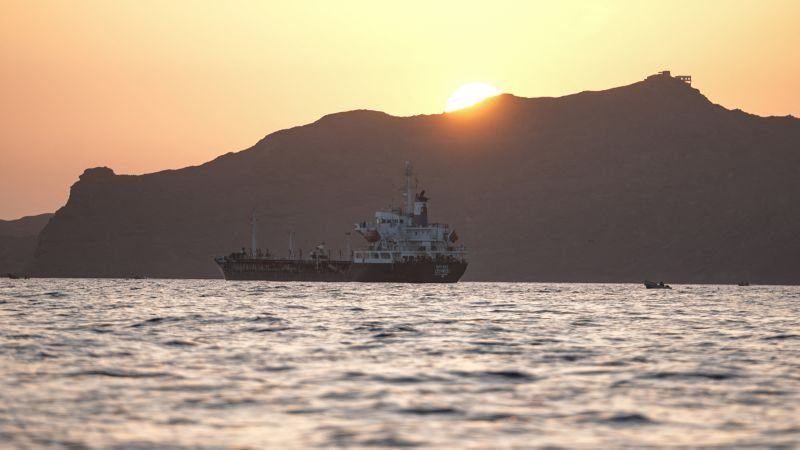
The Bab al-Mandeb Strait is a narrow passage of water separating the Arabian Peninsula from Africa. From the north, it connects the Red Sea to the Gulf of Aden and Indian Ocean. From the south, it provides access through the Suez Canal to the Mediterranean.
Before the current wars, this passage carried about 30% of global container traffic.
Cars, furniture, food, energy — all moving through a passage only about 20 miles wide at its narrowest point. Without it, ships traveling between Asia and Europe must go around southern Africa and the Cape of Good Hope, adding thousands of miles, days of travel and higher prices for goods.
The ongoing conflict with Iran has focused attention on the Strait of Hormuz and the world’s dependency on its energy traffic. Iran has attacked ships in Hormuz to increase pressure on Washington to stop the war and sue for peace. It’s a tactic that Iran honed years ago in the Bab al-Mandeb — and is positioned to repeat after a new offensive by its aligned militant force in Yemen just last week.
Bab al-Mandeb translates literally as the “Gate of Tears.” Some legends attribute the name to ancient earthquakes and floods that separated Africa from Arabia, killing untold thousands. Whatever the precise origin, it’s not known for much good.
I recently learned all this firsthand while working in the Biden administration.
Since 1979, Iran’s revolutionary government has sought to expand its ideology and influence across the Middle East, principally through its Islamic Revolutionary Guard Corps and its elite Quds Force — literally, Jerusalem Force — which trains and equips armed groups across the region.
Hezbollah in Lebanon. Hamas and Palestinian Islamic Jihad in Gaza. Militias in Iraq that have repeatedly attacked American forces, Israel and Saudi Arabia. And increasingly, the Houthis in Yemen.
The strategy is straightforward: Build armed networks in weak or fractured states, giving Tehran strategic depth and leverage without having to fight directly itself.
The United States, Israel and US-anchored regional partnerships, particularly with Saudi Arabia, have long been central targets.
“Death to America, Death to Israel, Curse the Jews.”
Yemen, directly south of Saudi Arabia, was divided between North and South during the Cold War, and unified only in 1990. But unification never fully resolved deep political, tribal and regional divisions.
The Houthi movement emerged in northern Yemen in the late 1980s and 1990s from a Zaydi Shiite revival movement. Under Hussein al-Houthi, it became political and militant, fighting repeated wars against Yemen’s central government.
The group later adopted the name Ansar Allah with an Iranian-inspired official slogan was anything but subtle:
“God is great. Death to America. Death to Israel. Curse the Jews. Victory to Islam.”
In 2014, the Houthis seized Yemen’s capital, Sana’a, driving the government south and eventually prompting a Saudi-led military intervention.
Iran did not create the Houthis, who retain their own interests and ambitions. But Iranian weapons, missile components, drones, training and technical expertise helped turn a local insurgency into a globally relevant force.
Shortly before Joe Biden entered office, after I had been named his Middle East coordinator, Yemen was a front-burner issue.
I received calls from senators, humanitarian organizations and activists urging us to do whatever it took to stop the war.
The civil war was entering its seventh year, and the humanitarian situation was horrific, particularly in areas controlled by the Houthis, who poured resources into the war while relying on international organizations to sustain civilians under their control.
President Donald Trump had designated the Houthis a Foreign Terrorist Organization. Aid groups warned this put relief operations in legal jeopardy and might worsen the humanitarian crisis, which was exacerbated by Saudi airstrikes against the Houthis in Sanaa and other areas they controlled.
In response, the Biden administration revoked the designation, ended US support for Saudi offensive operations — including certain arms sales — and appointed a special envoy to pursue a ceasefire and political settlement.
At roughly the same time, the US military withdrew regional assets, moving air defenses out of Saudi Arabia and destroyers and carrier strike groups out of the Middle East. Washington’s focus turned towards diplomacy but without the hard power backing that’s often necessary for diplomacy to succeed.
As the US pulled back, Iran doubled down.
It supplied the Houthis through maritime and overland smuggling routes. Iranian and Hezbollah personnel also helped assemble and manufacture sophisticated weapons, as Houthi attacks into Saudi Arabia intensified.
In April 2022, the United States helped broker a truce, enabled partly by President Biden’s visit to Saudi Arabia that summer. There was hope the truce might open space for a more permanent political settlement.
In retrospect, however, the truce shifted advantage toward the Houthis. Iran continued training and equipping its proxy for use in a broader regional strategy.
In 2023, shortly after Hamas’s October 7 massacres and Israel’s response in Gaza, Iran’s armed partners joined the conflict from multiple directions.
Hezbollah fired from Lebanon, while Iran-backed militias in Iraq and Syria attacked American forces, eventually killing Americans.
From Yemen, the Houthis fired ballistic missiles and drones toward Israel and attacked commercial shipping in the Red Sea and Bab al-Mandeb. Claiming to pressure Israel over Gaza, they instead attacked ships having nothing to do with the conflict with an aim to disrupt a major commercial corridor.
On January 10, 2024, I met Iranian officials secretly in Oman to contain the regional escalation.
The night before, the Houthis launched their largest attack yet against commercial ships and US-led naval forces in the Red Sea, using drones, anti-ship cruise missiles and ballistic missiles. It was the biggest attack against the US Navy since World War II.
There were no casualties solely on account of the skill of our sailors and advanced missile defenses.
Iran’s point was not subtle. It would back its regional ambitions and diplomacy with attacks against us while denying direct responsibility.
The meeting in Oman failed.
The following night, President Biden ordered the first major US strikes on Houthi military targets, with support from the UK, Australia, Bahrain, Canada and the Netherlands. The campaign continued in various forms for more than a year.
Washington had learned the hard way that the quiet in Yemen had concealed an important strategic shift.
During the years in which the civil war largely stopped, Iran had helped create an armed force capable not simply of threatening Saudi Arabia or fighting a civil war inside Yemen, but of reaching Israel and holding global commerce hostage whenever it chose to do so by shutting down the Bab al-Mandeb.
Last year, President Trump restored the terrorist designation of the Houthis, and escalated US attacks against the group. After seven weeks of American strikes, Oman brokered an understanding: The United States would stop bombing Houthi targets and the Houthis would stop attacking US vessels.
The agreement did not cover Israel or Saudi Arabia, but it appeared to impose some quiet. For a time.
Then, last week, the map changed again.
In a rapid offensive down Yemen’s Red Sea coast, Houthi forces seized new ground directly overlooking the Bab al-Mandeb. Then, they reportedly crossed onto Mayyun Island — also known as Perim — which sits in the middle of the strait. CNN’s Nic Robertson had just visited the area and reported on its vulnerability.
Now, Houthi conventional weapons — artillery and rockets — can strike at ships, not just longer-range drones and missiles.
For now, ships are still passing through Bab al-Mandeb. Trump has said the Houthis claim not to want a confrontation with us and will let ships through.
The Houthis do not have to close the strait tomorrow, however. Their ability to hold the passage hostage provides Tehran an added piece of leverage.
Is this the new status quo?
Not necessarily. The front lines in Yemen often shift. There are reports that government forces are preparing a counterattack and that Washington may provide intelligence information. CENTCOM commander Adm. Brad Cooper was just in Saudi Arabia to review the situation.
Whatever happens next, however, the Houthis have reminded the world once again that they are positioned to remain — with Iran’s direct backing — a wildcard in any regional competition for power and influence.
And Washington should never again mistake quiet for peace.




Responses