
EDITOR’S NOTE: Call to Earth is a CNN editorial series committed to reporting on the environmental challenges facing our planet, together with the solutions. Rolex’s Perpetual Planet Initiative has partnered with CNN to drive awareness and education around key sustainability issues and to inspire positive action.
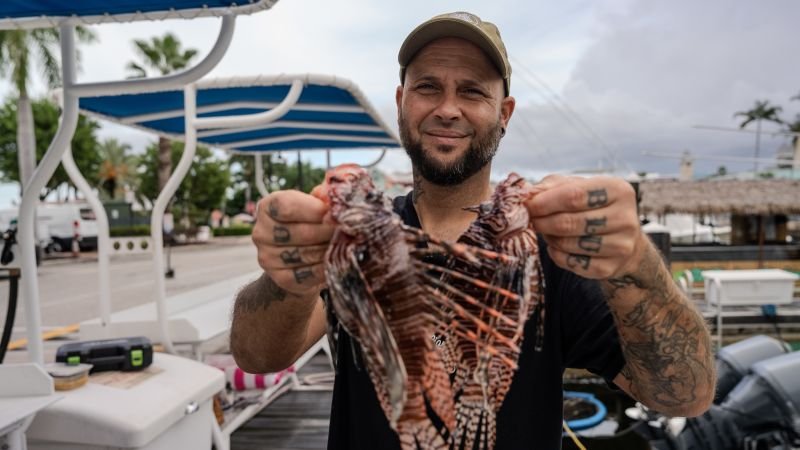
Most content creators are out to make a killing. For Nate Sorensen and the Lionfish Extermination Corp., the killing is the point.
You may have come across Sorensen on Instagram or TikTok, cruising the Florida coastline. Recording his scuba dives with an underwater camera, he narrates his own adventures. “Boom!” he says, delighted, spearing a lionfish through the head. “Boom!” “Boom!” Comic-style graphics overlay footage and video game sound effects send up mishaps. By the time he’s done, dozens will be dead.
A lethal marauder with puppy dog energy, Sorensen’s quest to kill the invasive species stalking Florida’s coral reefs has earned him and his nonprofit tens of millions of views. The gamified culling is part of the appeal. It’s repetitive, addictive — and decidedly guilt-free.
The venomous lionfish is a big problem around the state’s coastline, across the Caribbean and encroaching north up the Eastern Seaboard. First detected in the 1980s after its possible release from an aquarium, the red lionfish population has exploded in the last 15 years, according to the NOAA. (The species can reproduce every four days and females release up to 2 million eggs in a year.)
9 photos
Without the same predators or streetwise prey found in its native South Pacific and Indian Ocean, the lionfish’s voracious appetite is destroying food webs. It eats more than 70 species of small fish and invertebrates. That includes the food of native predators, the young of those predators, species that clean coral and keep the reef healthy, and other species fished commercially.
“Once you remove all of these, what is left?” Sorensen said. “The reef eventually fails, and it fails pretty dramatically.”
Sorensen estimates one lionfish will eat 10 fish a day, though he said he cut open the belly of one and found 75 fish inside. Scale either figure up over a lionfish’s 15-year lifespan and that’s a lot of fish.
“We’ve fileted them open and there are thick, heavy chunks of fat around their organs,” he said. “They’re almost getting sick because they eat so much.”
Yes, lionfish have it so easy in the Sunshine State that they become obese. In dense populations they can consume up to 460,000 prey per acre annually and have reduced prey populations by up to 90% at some sites.
“They’re the number one predator on our reefs and they don’t belong here,” Sorensen said.
Sorensen is a tattoo artist by trade and an avowed vegan (he says he makes an exception for lionfish). He began hunting in Florida at Boynton Beach, close to home. It started as a hobby, like many other local divers, who are encouraged by the state to remove lionfish. They can only be hunted by pole spear, so divers must comb the reef, hunting lionfish one at a time.
Around the Covid-19 lockdown of 2020, he purchased a small boat, The Lion Slayer, to access more remote populations, and an underwater scooter to cover more ground. Sorensen and his scuba instructor wife, Rachel Taub, set up a nonprofit, the Lionfish Extermination Corp., which solicits donations, sells merchandise and sells lionfish to restaurants, to finance the operation.
Pretty quickly, Sorensen said he and Alex Borsutzky, his dive partner and the boat’s captain, were bringing in 100 pounds of lionfish a day. When their catch shrank, they expanded their reach, hunting along a stretch of the Atlantic from Jupiter down to Key Biscayne.
Sorensen started posting raw footage from his dives on social media in 2018. “It didn’t really catch on,” he admitted. But once his camerawork improved and he started adding narration, explaining what he was doing and why, he found an audience on Instagram, then joined TikTok in 2023, followed by Facebook and YouTube. Part of the motivation was to spread the word, he said, but also because the platforms paid for high-performing content — money that could feed back into the nonprofit.
“Even people that are squeamish, that don’t want to see an animal get removed and shot with a spear, are into it, because they know that we’re protecting all these fish,” Sorensen said.
The Lionfish Extermination Corp. has 2.5 million followers and counting across various accounts. Along with the culling, Sorensen shares educational updates on local marine laws, and we see him cleaning up detritus left by fishing activities. Much of the appeal lies in him reveling in the wonders of Florida’s reefs: fluorescent green moray eels, spotted eagle rays, turtles and nurse sharks.
One repeat fixture is a goliath grouper called Wilbur. Borzutsky befriended the ginormous, grumpy-looking fish in 2013, and Sorensen nearly a decade ago. When the two dive at Boynton Beach he’ll approach them, even letting them pet him.
Wilbur is “an ambassador for the species,” said Sorensen. “Their numbers are vastly depleted,” he explained, “but just like sharks, they are extremely important to the environment. Without these large predators the health of the reef takes a nasty turn.”
Behind Sorensen’s viral content are 16-hour dive days. It is arduous, dangerous work. Lionfish have 18 venom-covered spines, which, though unlikely to be fatal for adult humans, causes extreme discomfort, and in rare cases, paralysis.
“Agonizing” is the word Sorensen uses. He’s felt the effect of the neurotoxin more than once, the worst time when he was spiked in the pinky finger. “I was in torment. It’s literal hell for four hours. It feels like you had your finger smashed with a hammer.”
But he keeps returning to the ocean day in, day out. “The only thing that keeps me going is the fact that (lionfish) are killing these fish needlessly, and they need a predator,” he said. “And since there’s no predator, we have to be.”
Florida has a healthy cohort of lionfish hunters. But are they really making a difference?
The NOAA predicts the lionfish population will grow. That does not mean the situation is hopeless. A study over a decade ago found that complete lionfish eradication is not required for native species recovery, just a significant reduction in lionfish density. Meanwhile, a study in the western Caribbean estimated a single diver could reduce lionfish numbers by 90% in an area of 1,000 square meters (10,800 square feet) in 2.5 dive hours.
“There’s some evidence that culling does reduce the local density of (lion)fish on the reefs,” said Alastair Harborne, an associate professor at Florida International University and specialist in coral reef fishes
Like Sorensen, he relocated to Florida in 2016. “Since moving here, there does seem to be fewer lionfish in shallow water than you might potentially expect,” Harborne said. He hypothesized it could be down to hunting, but also the population has potentially reached an equilibrium with Floridian reefs, after exploding in the 2000s.
The state may feel encouraged that its policies are working. There is no daily catch limit, the hunting season runs year-round, and recreational divers don’t require a license to hunt. Commercial divers do require a license, and the state has supported an artisanal fishing business that supplies restaurants with lionfish, used in everything from sushi to tacos. (Sorensen said he can sell his bigger fish for up to $20 per pound.)
“Harvesting lionfish is currently the most effective measure we have to reduce their population,” the Florida Fish and Wildlife Conservation Commission (FWC) told CNN in a statement.
The FWC estimates over 1 million lionfish have been harvested since 2010 by a mix of amateurs and professionals. In recent years, commercial hunting in Florida has decreased, while recreational hunting has increased, it said. To boost outreach and participation, it organizes invitational hunts called derbies and established the summerlong Lionfish Challenge a decade ago, awarding prizes to divers for their hauls. Last year, over 500 participants removed more than 30,000 lionfish between May and September. The 2026 winners will be announced later this month.
Amid a rise in popularity, Sorensen cautioned wannabe lionfish hunters. “Do not even attempt it unless you have the right equipment,” he said. “If you spear one and don’t have any way to get it off the spear, don’t hunt them. If you don’t have a container to put them in, don’t remove them. It’s not playing, it’s not a funny matter. These things are extremely dangerous.”
Despite his words of caution, he’s hoping to bring his growing audience with him, encouraging divers to join him at invitational hunts and community events. And for those who’d rather help from afar, or just watch him at work, he aspires to hunt more across the Caribbean, get more people eating lionfish, and maybe even a reality TV show some day.
“We’re just here to spread awareness,” Sorensen said. “That’s our main goal: to get millions and millions of people to know about this problem.”
Everyone interviewed for this article agreed lionfish are in Florida to stay. The species is simply too resilient. Mature adults can live at depths up to 1,000 feet, well beyond the range of divers. It can live in brackish water — posing a threat to fish spawning in mangroves and estuaries — and its egg sacs drift large distances, dispersing the population rapidly. As ocean temperatures rise, there’s reason to believe lionfish will be able to survive farther north along the Eastern Seaboard.
“You’re never going to be able to remove all of them,” Sorensen admitted, “but if we — not just us, but the thousands of people doing this — hadn’t been doing this since the ’80s, there would be nothing but lionfish at this point.”




Responses