
Note: This story first appeared in The Beautiful Game by CNN Sports, our biweekly newsletter on all things global soccer – men’s and women’s. To subscribe, click here.
Hello everyone, Spanish Editor Patrick here. Ben is enjoying a well-earned mini-vacation on the Emerald Isle, hence I am taking the reins for one edition so that Mr. Church can enjoy as many stouts and joyous conversations as Ireland can offer up before he returns on Monday. Sláinte to you, pal.
In today’s edition of the newsletter, we will be looking at the somewhat quick return of our dear old friend International Soccer – we thought we left you behind for a while after the World Cup, but somehow, you’re back.
We’ll also take a look at an ugly incident that shows women still have to fight for their place in soccer, hear from Kylian Mbappé on his chances for the Ballon d’Or, look at the North Korean under-20 women’s team, and we’re debuting a new recurring segment – with your help – about why you love your soccer club.
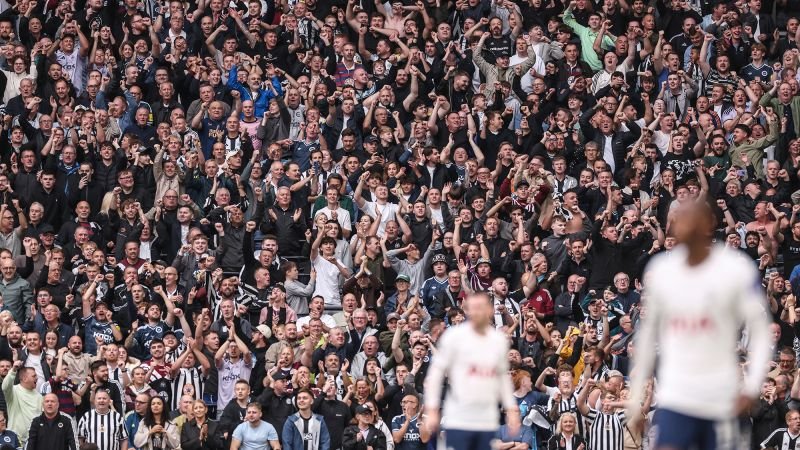
Anyways, plenty to get into today, but let’s begin with something that’s become a talker here in the UK: Will fans be able to drink beer in stadiums again?
If you’re reading from the US, you might be shocked to find out that you can’t drink beer in the stands at soccer matches in a few big leagues across Europe (e.g. Spain’s La Liga, France’s Ligue 1 and England’s Premier League), but that might soon be changing in the United Kingdom if the prime minister has his way.
UK PM Andy Burnham recently told reporters that he felt the current laws on the books banning alcohol in the stands at the top five tiers in the English game were “discriminatory” in nature, given that fans can drink in many of the other spectator sports in the country (rugby, tennis and cricket, for example).
“I don’t think it’s fair for football fans to be singled out,” Burnham said while at the United Nations in New York, according to the BBC. “I think that legislation dates to an era where football was very different.
“And I do believe there is a case to remove that discrimination. There are different ways it could be done. It could happen on a trial basis.”
The legislation Burnham refers to – the Sporting Events Act 1985 – was introduced by Margaret Thatcher’s government to help combat violence around the game in England and Wales. The home secretary at the time said alcohol was a “major contributory factor in violent and disorderly behavior,” so the ban was introduced. While hooliganism and fan violence were a big issue in the 1980s and 90s, incidents gradually declined until today where English fans largely have a much better reputation abroad.
Burnham might face some difficulties in repealing or altering the law though given the UK Football Policing Unit (UKFPC) told the BBC that any changes would mean “challenges” to the “safety of staff and fans at football games” and to police work.
The UKFPC added that soccer matches see far more “violence and criminal behaviour from their supporters” compared to other sports.
“It would be irresponsible to fuel this by allowing greater alcohol consumption during games,” it concluded.
Still, a lot of support for a repeal is arising from certain circles, with the Football Supporters’ Association calling the Sports Events Act of 1985 “outdated,” with its president Tom Greatrex saying, “We welcome the prime minister’s comments and totally agree that the legislation … deserves to be reviewed.”
Beer is currently allowed to be sold in England’s Women’s Super League following successful trials in its competitions, so the precedent is there, but it remains to be seen how far this will go given there does not appear to be any official movement to change the law.
I guess it’s still off to the pubs (shoutout to the Salmon and Ball in Bethnal Green) before kickoffs.
These are the words of North Korea’s under-20 midfielder Choe Rim-jong after securing a ticket to the U20 Women’s World Cup final against Spain.
It might be a surprise to some, given the Asian nation’s reclusive nature, but North Korea is a women’s soccer powerhouse, particularly on the junior level.
North Korea is the defending champion and has won three U20 Women’s World Cups in total, also finishing runner-up once in 2008. Oddly, the senior team’s best finish at a Women’s World Cup is the quarterfinals in 2007.
Now, after a 3-0 victory over Colombia in the semifinals, the under-20s are back in the final, ready to reign supreme over the junior levels in the hope of a better senior run next year at the World Cup in Brazil.
While we are witnessing big growth in both the quality and interest in the women’s game, we unfortunately are still experiencing some events that are holding women’s participation in the Beautiful Game back.
Major League Soccer (MLS) team Columbus Crew fired Federico Higuaín, the head coach of their reserve team, following an incident in a game that a referees’ association deemed “physical abuse and sexism” toward a female referee.
Higuaín – who was appointed head coach of the franchise’s reserve squad, Crew 2, in January 2025 – squeezed and refused to let go of a female referee’s hand during a recent MLS NEXT Pro match and told the official, “Don’t forget this is a man’s game.”
MLS NEXT Pro subsequently investigated the incident and suspended Higuaín for two matches before the Crew let him go.
Kylian Mbappé fell short of winning the World Cup in the summer, and he – quite annoyingly for me as a madridista – failed to win anything with Real Madrid last year, too, so many might be asking why he deserves to win the Ballon d’Or.
Well, he sat down with CNN Sports’ Amanda Davies to make his argument for why he should win soccer’s most prestigious individual award, saying that the prize should go to the best individual player in the world.
Click the video above or here to watch. Also if you want to read all about what Mbappé had to tell CNN Sports (or watch the full interview), click here.
New CNN Sports intern Fraser Godden has compiled a couple of men’s internationals you should watch over the weekend.
Men’s UEFA Nations League, Group A3: England vs. Spain
When? Saturday – 2:45 p.m. ET / 7:45 p.m. local time
Where? Wembley Stadium, London, England
World champion Spain might have hoped for an easier return to international soccer to celebrate its World Cup triumph against Argentina just two months ago. Instead, La Roja visits Wembley to take on England in a repeat of the Euro 2024 final, which Spain won 2-1.
Fans will be hoping for a match that closer reflects the 2026 Bronze Medal match rather than the final given the 6-4 goalfest that played out between the Three Lions and France in Miami.
England manager Thomas Tuchel selected a 27-man squad for the upcoming fixtures against Spain, Czech Republic and Croatia but has been rocked by withdrawals from Cole Palmer, Marcus Rashford, Declan Rice, Tino Livramento and Kobbie Mainoo.
La Roja – looking to extend its record-breaking 38-match unbeaten run in competitive fixtures – called up stars Lamine Yamal and Ferran Torres but will be without full-back Pedro Porro through injury.
(Spanish editor’s note: Fraser will be on site Saturday to capture some color for Monday’s newsletter, so stay tuned.)
Men’s International Friendlies: USMNT vs. Peru
When? Saturday – 4:30 p.m. ET (local time)
Where? Inter.co Stadium, Orlando, Florida, United States
The US Men’s National Team (USMNT) returns to the field following its heartbreaking World Cup loss to Belgium in the round of 16, taking on Peru in Orlando with the next generation very much the focus of the camp.
Mauricio Pochettino’s men will take on the 50th-ranked nation with a fresh squad after the Argentine boss selected 13 uncapped players and eight teenagers – including 16-year-old Philadelphia Union sensation Cavan Sullivan – for the matches against Peru, Chile, Mexico and Canada.
The squad is bolstered by call ups for experienced players, such as Tyler Adams and Antonee Robinson, but finds itself without Ricardo Pepi through injury and with some relatively shocking omissions (Christian Pulisic and World Cup hero Folarin Balogun are also out). Only Gio Reyna has scored 10 or more goals in the squad, so this definitely looks like experimentation time for Pochettino.
New to soccer fandom? Well, those match recommendations above should help to find out what to watch and why, but if you are a long-time fan (or jumped into the game fervently just recently), you likely have a favorite club that you will watch no matter what, even if you know it’s likely to end in frustration or numbness.
Today, we begin a new segment on the soccer love of your life with intrepid intern Fraser, who is a die-hard fan of a Scottish team you have likely never heard of.
It’s highly irregular for a born and bred Glaswegian to not support one of the two big teams in Scotland, such has been the dominance of Celtic and Rangers in Scottish soccer.
Yes, they’re giants of the game and enjoy regular, if not constant, success – but where’s the fun in that?
My love for Ayr United in the second-tier Scottish Championship is far more exhilarating, in my opinion, and is something that will never be broken. I’ve invested far too much time and emotions in my “wee” team from the Ayrshire coast.
My connection with “The Honest Men” – inspired by Ayrshire’s own Robert Burns’ famous poem, “Tam O’Shanter” – goes back long before I can remember. Before I could protest, I was wrapped in a black-and-white babygrow by my Ayr United-obsessed father. And that was that. From that point on, it was part of my identity, whether I liked it or not.
Every other Saturday in my childhood involved trips down to Somerset Park on the train to watch part-time soccer players battle the unforgiving wind and rain of the west coast of Scotland. I loved it.
At that time, Ayr bounced between the second and third tiers of Scottish soccer and the thrill of a promotion or relegation battle from one season to the next drew me in from an early age.
Admittedly, supporting a small team had its difficulties as a youngster. “Why support them if they’re rubbish?” or “When was the last time they won anything?” were standard responses to my declaration of love for Ayr. But that made me defiant. The day Ayr qualifies for the Champions League will taste even sweeter, let me tell you. Just look at Bodø/Glimt. If that squad can do it, why can’t ours?
Since attending my first match as a three-year-old, I’ve enjoyed the highest of highs – winning League One on the final day and reaching the semifinal of the League Cup and earning a trip to Hampden to play our bitter rival – and endured the lowest of lows (losing to our bitter rival at Hampden in said League Cup semifinal).
But that’s why I love my club. There truly is no greater feeling than standing on the old-style terracing at Somerset Park with the wind battering my face while Ayr United plays the Beautiful Game.
Are you a huge fan of a soccer club? Do you have heartbreaking tales and glorious triumphs or experiences to share? Well, send us your story and we could feature you in a future edition of The Beautiful Game.
If it seems like the international break has rushed up on us quite suddenly, it’s probably because it has. The World Cup wrapped up on July 19 and the Premier League kicked off just over a month later.
As fans were just beginning to digest the celebrated return of the club game, the break for national teams pressed pause on domestic leagues roughly five weeks after they began, with Germany’s Bundesliga playing just four games and both France’s Ligue 1 and the Premier League five each – quite a paltry offering for club-soccer starved fans.
Additionally, the break is three weeks long as opposed to the usual two. Why though? Well, it’s actually probably a good thing they did it.
The FIFA Council approved the lengthened break in March 2023 as part of its plan to rejig its international calendar and lessen disruptions to domestic leagues following the newly-expanded World Cup this year. The result is that, instead of three international breaks in the first half of the club season, we now have two. Also, the total number of weeks club seasons will be paused is five as opposed to six.
The idea, ironically, is to allow the players more rest as they won’t have to fly around the world as many weeks (e.g. an Asian or South American player on a European team would likely face brutal travel schedules). The result means an extended three-week first international break that allows teams to play up to four matches, which we are now beginning.
So what to make of it all? I’m not sure really. If you like international soccer like me, it’s not too bad, but if you miss the domestic club game, this is likely going to be a rough three weeks – though you (and the players) will suffer less in the long run.




Responses