
Lexington, Kentucky —
Perched on a stool at a high-top table, his back against a window at the farthest recess of a very crowded room, Bill Farish wears a white ballcap, a vest over a blue-checked shirt and a pair of khakis. He rests his chin on his left hand and, every now and again, he casually raises his index finger.
To his right sits Cherie DeVaux, trainer of Golden Tempo, the 2026 Kentucky Derby and Belmont Stakes winner. To his left sits Terry Finley, president of West Point Thoroughbreds and part owner of Always Dreaming, the 2017 Derby winner.
At the table directly in front of them, Marshawn Lynch – wearing a pair of three-quarter-length sweats and a T-shirt – sips on some Hennessy.
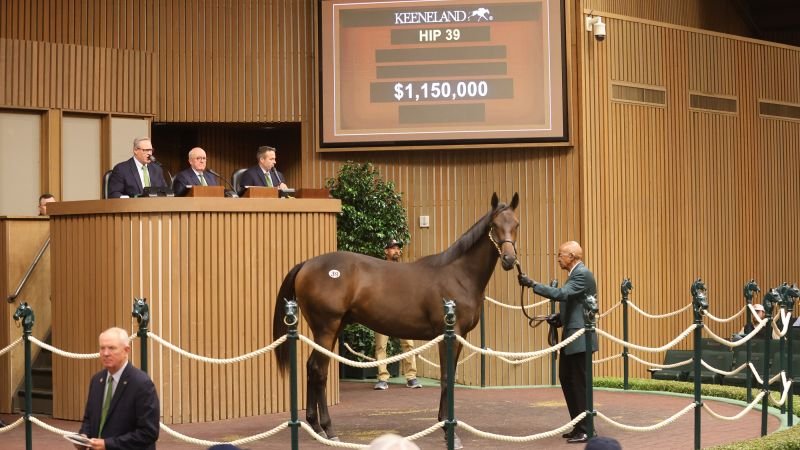
They are all staring at a striking dark bay colt foaled on May 6 of last year. Hip 39, as the horse is known, has just been walked up a chute and onto a stage, and the cacophony created by a roomful of people clearly has him agitated.
Just a few days ago, the son of 2016 Derby winner Nyquist roamed freely around the fields of nearby Gainesway Farm, a 1,500-acre pastoral equine playground whose history predates US independence.
Now, Hip 39 is one of 4,642 horses up for sale at the annual September Yearling Sale at Keeneland racetrack.
The sale is everything the Derby is not. All business, no pretense. These are true horse people, and whether blessed with generational wealth or fresh money, they are here to do work, not to be seen. People distractedly pluck hors d’oeuvres or cocktails from servers walking around with trays, more interested in the breeding information on their iPads than the catering.
There are no Instagrammable photo ops or fancy hats, just people in jeans, T-shirts, cowboy boots and shorts. Former Philadelphia Phillies slugger Jayson Werth, in a wrinkled T-shirt and camouflage shorts, is nearly unrecognizable, his famous cascade of hair tucked under a ballcap. And when DeVaux sits alongside Lynch to talk horses, a woman nervously approaches their table to ask for a picture – of the horse trainer, not the former Super Bowl-winning, five-time Pro Bowl running back.
But this is where the first Saturday in May gets its start. It takes money to nourish a Derby dream at the Keeneland sales, but here, the real currency is hope.
“Any one of them,” DeVaux says, “could be the one.”
Today, she hopes her next Derby winner might be Hip 39. Which is why Farish, the general manager of Lane’s End Farm and part of a four-group partnership that includes DeVaux’s Belladonna Racing, keeps raising his finger.
Each seemingly meaningless twitch signals a bid worth between $50,000 and $100,000, depending on the auctioneer’s ask. After less than two minutes of bidding, Farish has twitched his way to securing Hip 39 for $1.2 million. Later in the day, the partnership will nab two more colts for $375,000 and $800,000 respectively, and by the end of the two-week sale, will have purchased 20 horses for a cool $15.48 million.
And not a single one of them has ever so much as felt a saddle on his back.
Lexington is the sort of place where the arrival of your luggage at a baggage claim carousel is accompanied by the bugle strains of the call to the post, where Citation Boulevard hugs the north edges of the city and Man o’War Boulevard the south. Louisville, a 75-mile ride west, might be the country’s epicenter of racing, but Lexington is about the horses.
The university’s Big Blue Nation is outnumbered only by the big bluebloods. Generational wealth with an eye for thoroughbreds took root here long ago, drawn by the limestone-rich soil and lush bluegrass that is especially good for foals. Most of the people who own the farms got rich elsewhere first – the Farish family’s roots go back to the Texas oil rush – and then got richer breeding, selling and racing horses.
Theirs is the sort of money that comes without ostentation, where people don’t flaunt their wealth but it’s clear they have it.
“We’re getting ready to leave a little early,” a man says into his phone while heading to the valet parking area near the sale. “Can you call the pilot and let them know we’re ready to go?”
Minutes later, another man – wearing a fedora and martini-glass shirt while toting his wheezing bulldog on a pink leash – follows and heads to his high-end SUV.
“It’s crazy,” says Werth, no pauper himself. “A horse sells for $400,000 and you’re thinking, ‘Only $400,000? What’s wrong with it?’ Someone just spent $400,000 on a freaking horse.”
Kentuckians had been racing for decades before Keeneland opened its doors, cutting dirt ovals in the early 1800s after the city banned racing in the street. Keeneland hosted its first race in 1936, but the track’s trajectory changed during World War II, when railroad restrictions prevented local breeders from shipping their horses north to the sale in Saratoga, New York.
To accommodate local horse owners, Keeneland erected a tent for a makeshift auction. The first sale, in 1943, went so well – 312 horses sold for an average of $2,979 – that the next year, after Lexington-based Fasig-Tipton decided to shutter its own sales paddock, the local group bought, deconstructed and rebuilt its sales arena.
It’s the same one used today. At the first September yearling sale inside the pavilion, 92 horses were purchased for a grand total of $419,100.
During this year’s two-week sale, buyers purchased 2,856 horses for a world-record $536,737,900. Seventy yearlings sold for more than $1 million, another world record, and one, a colt from leading sire Into Mischief, went for $3.7 million.
Though Keeneland still has big races with attractive purses – its annual Blue Grass Stakes is a key qualifier for Derby contenders and this weekend, it will host the Breeders’ Cup for the fourth time – it has just 32 days of live racing in the spring and fall.
The real business is in the sales.
“Lots of people in Lexington, they love racing, but they walk by these doors, and they have no idea what goes on in here,” says Tony Lacy, Keeneland vice president of sales. “This is horse racing’s NBA or NFL Draft.”
At 11 a.m. on Monday, just two hours before the sale officially begins, DeVaux is out in front of Barn 29. She “slept in” today, which means she woke up at 5:30 in the morning.
Yearlings arrive at Keeneland based on where they are placed in what’s known as the books. Created by the Keeneland sales team, the books set the schedule for the two-week sale and sort the horses into a sort of pedigree ranking. The perceived best horses, and likely the most expensive, are for sale in Book 1 on Monday and Tuesday. Book 2 is Wednesday, all the way down to Book 12.
In an event where everything comes with a price tag, even the simple slotting of horses can prove perilous. Lacy has heard plenty of kvetching from breeders who believe their horses to be undervalued in the book, and thereby potentially undervalued in the sale.
“My hair was not this gray a week ago,” he says with a shake of his head.
Because it is now Monday, DeVaux is evaluating horses in Book 4. (Book 1 horses arrived on Friday). Her husband, bloodstock agent David Ingordo, has created what’s called a short list, spending months “here, there and everywhere,” as DeVaux puts it, on farms eyeing up many of the horses since they were foals.
From his searches, he whittles down the available horses to the ones the team is interested in purchasing. On Monday, the team is considering 12 of the 185 horses available.
Since winning the Derby and Belmont, DeVaux’s opportunities have grown monumentally. She has tried to stay true to herself, relying as always on her husband’s knowledge and her own instincts, and not get wide-eyed as opportunities that once eluded her now practically fall at her feet.
“Now that we’ve done it once, people want us to prove that we can do it again,” she says.
It helps that DeVaux is decisive. She is as self-assured about what she likes in a horse as she is about what she wants in the remodel of her New Orleans home.
“Contractors hate me,” she says with a laugh.
Horse folks not so much. DeVaux is greeted warmly by the various sellers and breeders as she views their horses and wastes no one’s time. Where some trainers might ask a groom to walk a horse multiple times, DeVaux is usually good with an up and back.
She eyes whether their feet flop or land nicely and looks for broad backsides that house the literal horsepower to race. She considers age, whether the horse was a late or early foal, when sizing up its maturity and body development, and values temperament as much as conformation. A year ago, she knocked a horse off the team’s short list, unhappy that it grew too agitated during the morning viewing.
She also looks for something that can’t be measured, a glimmer in the eye or a spark of personality. She ends each check by petting the horse and giving it a little talking-to.
“I like that one,” she says of one as he walks away. “He’s plucky.”
Every horse is vetted for soundness, the buyers given detailed reports about its health, but DeVaux trusts herself as much as anyone. Despite eyeing hundreds of horses, she can recall each one by memory, barely needing to refer to her notes. Grabbing a quick bite to eat before the sale, she pulls up photos of the yearlings she’s considered as if they’re baby pictures, cooing over their “big fat faces.”
There is, of course, no guarantee of anything. DeVaux’s ride to glory came via Golden Tempo, a homebred, which means he was born and raised by his owner and never sold at auction.
“Nobody would have bought him at the sale,” DeVaux says. “If you looked at him, no one would have been interested.”
In six starts, he has three wins, including two legs of the Triple Crown, and has earned $4.75 million.
On the other end of the return-on-investment spectrum is Green Monkey. Sold as a two-year-old in 2006 for a record $16 million, the horse raced three times, never finishing better than third.
“What’s that saying about a piece of art?” asks Curt Ramsey, Lane’s End director of equine operations, as he watches DeVaux evaluate his horses. “It’s worth what someone is willing to pay for it.”
Ryan Mahan sits in a courtyard outside the pavilion, enjoying a break after running his mouth for an hour straight. Next November will be his 50th working at Keeneland. He’s held a number of jobs during those five decades, but for the last 25 has provided the literal hum to the sales as the lead auctioneer.
Mahan’s love of horses comes naturally. His stepfather, Robert Copelan, who recently turned 100 years young, worked as a racetrack vet and Mahan tagged along while he made his rounds. In 1973, Mahan held the halter of a Derby entrant while Copelan treated a troublesome abscess with hot compresses. The horse healed. His name was Secretariat.
Mahan thought he wanted to follow in Copelan’s footsteps, but when he came to his first sale, he grew wide-eyed at what he calls the “belly-to-belly commerce” side of horse racing. He went to auctioneer school.
“It’s kind of like karaoke,” he says. “You know you’re going to feel stupid when it’s your turn, but if there are 200 people in class, they all feel stupid, too,” and started his career selling goats and chickens at small farm auctions before graduating to thoroughbreds. In 2001, when lead auctioneer Tom Caldwell passed away, Mahan took over at Keeneland.
It is a unique job, requiring both unflappable steadiness and the flair of a showman. Mahan knows many of the breeders and buyers personally and isn’t afraid to needle them to keep the bidding going. “Don’t stop now,” he says mid-auction of a horse that has reached $950,000.
“I don’t care if it’s $2,000 or $2 million, you have a minute to decide because the guy next to you is going to bid, and then it’s over,” Mahan says. “It’s very high risk so the least I can do is make it fun.”
Mahan’s longevity is true to Keeneland’s commitment to tradition. While it’s adjusted to suit the times – bids can be made both by phone and online – it prefers to keep things both highbrow and unchanged. In 2026, the man known as Beast Mode sipped his Hennessy from a similar perch that housed Queen Elizabeth in 1984.
Those who work the sales are as much a part of the fabric as the place itself. A few years ago, someone asked Mahan how he might get into the business. “Well,” Mahan told him, “the newest guy we hired, we call him Pup. He’s 60.”
The consistency is as practical as it is parochial. To watch a horse sale is to witness a well-choreographed dance, or an orchestra in perfect concert. Mahan and the public address announcer sit at a raised rostrum directly behind the sale ring and in front of the pavilion full of people. The horses exit one of the 55 barns on the back of the property and are led to a paddock area to parade in front of interested buyers.
When it’s their turn, the yearlings are led into the sales ring by a groom and handed over to a showman, a veritable horse whisperer who can calm stressed-out yearlings as they whinny, pace and sometimes downright refuse to walk into the ring (in that case, they’re often backed in, so they don’t know what’s coming).
The spotters stand at the end of each of the aisles of the theatre-like seating area, with their backs to the horses and their eyes scanning the crowd for the slightest tick of movement to signal a bid.
Everyone has their tell. Farish flicks his finger. Others tip a cap or slide a pin. Back in his day, legendary trainer D. Wayne Lukas would use a pen in his pocket to signal his interest – once he removed it, he was out of the bidding – while famed trainer Bob Baffert simply waves. When a spotter eyes a bid, he gives a loud call to Mahan who drumbeats the auction forward.
Another spotter sits behind Mahan in a raised plexiglass booth, looking out at the paddock area that the horses have just exited. Buyers are equal parts superstitious and surreptitious. Some sit in the same spot to make their bids; others only work with certain spotters – Mahan once pulled spotter Bo Black away from his lunch mid-bite because a purchaser would only bid if Black was in front of him.
And more than a few prefer to keep their action private, never entering the ring at all lest anyone else gloms onto their interest. They make their bids from the paddocks to the man in the box.
All the while, someone mans a phone for internet bids, all of it funneled to Mahan, who keeps the auction going.
It feels and looks like organized chaos, a rinse-and-repeat of white noise that churns on for hours with no break. No sooner does Hip 1 walk out after being sold (for $700,000) than the public address announcer runs through the bona fides of Hip 2 as the horse enters the ring.
Once a horse is sold, another green-blazered courier heads to the purchaser, handing over a paper receipt that looks like it’s straight out of a 1980s Radio Shack, complete with a white, yellow and pink copy.
After the gavel drops on Hip 39, a courier arrives almost immediately at Farish, Finley and DeVaux’s table. Finley signs the receipt, takes his yellow copy and folds it, before casually shoving it in his back pocket, as if he just bought a stereo with an eight-track player, and not a million-dollar horse.
“It’s the game,” he says. “Out of all of these horses, maybe we know the names of five or six of them. Maybe.”
Bob Baffert grabs a water out of a nearby cooler to keep the searing heat and humidity at bay.
No North American trainer has acquired more expensive horseflesh in the 21st century than Baffert, including a $10 million 2-year-old that came into his barn earlier this year.
But Baffert’s introduction to the Keeneland Sales was far different. He motions toward a cement wall outside a nearby barn.
“That’s where we watched the horses the first time I came here,” says the two-time Triple Crown winner.
It was 1988 and Baffert, who was just starting to pivot away from training quarter horses to thoroughbreds, only got to Lexington after worming his way onto the private plane of wealthy track owner, R.D. Hubbard. From his perch on the wall, Baffert keyed in on Hip 1752, a big gray, but with no real buying partners, convinced a fellow quarter horse trainer to go in with him. The man agreed but said he would go no higher than $20,000.
When the bidding escalated beyond his threshold, Baffert’s money man backed out, but the trainer, too far gone on the horse, kept raising his hand. When the gavel dropped, he had agreed to pay $30,000.
“I was thinking, please someone offer $30,001,” Baffert says. “But no one did.”
After signing for the sale, Baffert was almost immediately summoned to the sales office. He had no credit on file and had to prove he could pay for the horse. He pulled a check out of his wallet, and only after the sales team called his bank to verify he was good for the money did Baffert get the horse.
Hip 1752 became Thirty Slews. He won the Breeders’ Cup Sprint, Baffert’s first Grade 1 race win (he now has 266), and earned $825,000 across his career.
“When I first came here, I thought, ‘This is ridiculous.’ You could buy a house for the prices and make payments for 30 years,” Baffert says. “But when you win the Kentucky Derby, you say, ‘Oh, I get it.’ You can’t put a price on that feeling, or the price on the feeling you get when any horse wins a race. That’s what makes this all worth it.”
It is the entirety of it, really. Werth, the ex-Phillies and Nationals slugger, came to Keeneland for the first time in 2022. With his baseball career over, he was looking for a similar adrenaline rush, and a friend turned him on to horse racing.
He knew less than nothing about horses but went to the sale anyway. During the third session, he aimlessly crossed the paddock area and turned left, running into trainer Danny Gargan. The two chatted, and Werth explained that he was interested in buying a filly. Gargan talked him into keying in on a colt he liked, guessing rightly that Werth’s celebrity status would add some cachet to the purchase.
Werth put up 10% of the $325,000 to purchase Hip 391, who would become Dornoch and led Werth to the 2024 Belmont Stakes winner’s circle.
“If I turned right, who knows?” says Werth as he watches the horses for sale. “I might be playing golf in Ireland. This whole thing is absurd. It’s like buying a Little Leaguer and hoping he makes the World Series, but it is such a rush. That’s why we’re here.”
Having a little self-control amid the madness
After securing the first three horses they bid on, the Faris-Finley-DeVaux group’s luck stalled.
They finished as underbidders (one notch below the purchasers) a few times and opted to back out on others. They set their max price on one yearling at $1.4 million; it went for $2.3, and they quit at $1.4 million on another that went for $100,000 more.
“You have to have a little self-control,” DeVaux says. “It’s hard. I mean, I’m the queen of one more bid, but you can’t think that way. You really can’t.”
As day one of the sale winds down, Ingordo decides to switch things up. He heads out to the paddock area, leaning up against a rail directly in front of the spotter perched at the window. He eyes up Hip 181, a dark brown colt, and does the bidding himself. Ingordo bids aggressively, but a Japanese gentleman next to him, his phone pressed to his ear the entire time, one-ups him.
The horse sells for $2.1 million and, as the giddy winner grins and yells into his phone, Ingordo shrugs.
“Thought we had him,” he says.
The team shuffles to the exits. It’s 6:30 p.m., five-and-a-half hours after the sale started and nearly 12 hours since DeVaux got to the track. Back home, someone is preparing food for the team, but they will not eat leisurely.
There are 15 more days of sales, with 4,458 more horses to consider.
And one of them just might be the one.



Responses