
5 photos
EDITOR’S NOTE: Call to Earth is a CNN editorial series committed to reporting on the environmental challenges facing our planet, together with the solutions. Rolex’s Perpetual Planet Initiative has partnered with CNN to drive awareness and education around key sustainability issues and to inspire positive action.
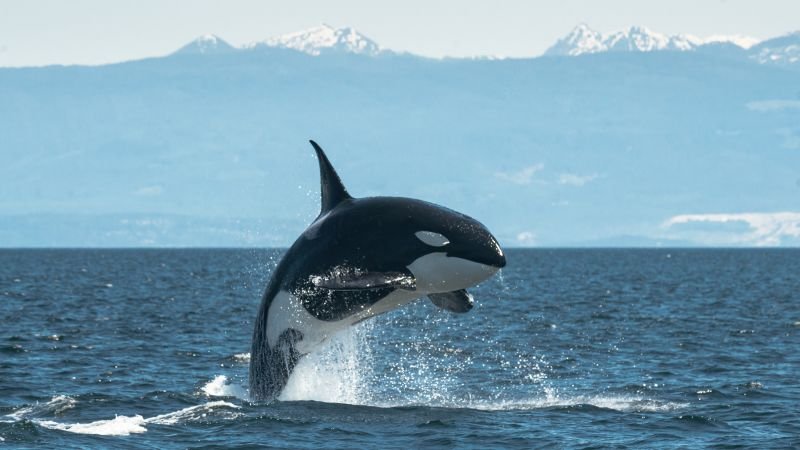
Seventy-six orcas arrived in the Salish Sea in September — the last of an endangered population known as southern resident killer whales.
Every year, the few score left enter Admiralty Inlet and head toward Puget Sound, Washington, which they’ll move in and out of from late summer until early winter. One of the most endangered whales, and one of few orca communities that rely on fish, they make the journey into the fjords to hunt Chinook salmon. But their ears are ringing. Noise pollution from heavily trafficked maritime shipping lanes affects their ability to hunt, communicate and echolocate. Moreover, vessels pose a deadly collision risk.
Scientists didn’t realize the southern resident was a different, genetically distinct group of orcas to the more populous Bigg’s killer whale until the 1970s. The first survey, conducted in 1974, found just 71 whales, peaking at 97 in 1996 but declining to 79 in 2001. The southern resident was listed as endangered in 2005.
“Underwater noise is a pervasive threat,” said Rachel Aronson, program director of Quiet Sound, an initiative within Maritime Blue, which promotes sustainable maritime practices.
“When it’s loud underwater, it gets harder for (southern resident killer whales) to find food. Sometimes they will hunt and miss, so they’ve expended energy but gotten nothing back. Sometimes they just forgo hunting, which is a problem, especially if they’re a female who is building up to a pregnancy or nursing a baby.”
A 2024 study found that for every one decibel increase in maximum noise level, females were 58% less likely to pursue prey, and males and females were 12.5% less likely to capture prey.
Washington is a trade-dependent state, where 40% of jobs are tied to international commerce, so balancing maritime industries with wildlife conservation is a delicate act.
Following a similar model to its Canadian counterpart, the Echo Program, in 2022 Quiet Sound introduced a voluntary slow down program for ships along a 20-mile stretch coming into Seattle, Tacoma and Everett, Washington’s three largest ports.
Slower ships mean less noise pollution. Aronson said so far this season there’s been a 73% participation rate, and underwater noise has reduced by as much as 50% since the voluntary slow-down was introduced.
But tracking the whereabouts of killer whales — specifically southern residents — to keep them from harm remains a challenge.
Ahead of the whales’ migration to Puget Sound this year, Quiet Sound teamed up with SMRU Consulting and Microsoft to launch an AI-powered acoustic buoy to listen out for them.
SMRU Consulting, a subsidiary of the University of St Andrews, in the UK, has developed a series of smart buoys since 2014. They have been used to monitor wildlife in Scotland, the US East Coast and the Pacific Northwest in areas where human presence may cause a disturbance.
Cormac Booth, managing director, said that while marine acoustic monitoring has been around for decades, the gap between data collection and analysis was once many months. As technology has evolved, “we’ve moved away from that after-the-fact archival approach,” he said. Today, “it’s about being able to provide reliable insights of what is happening now, allowing people to make decisions now.”
In July 2025, SMRU Consulting and Microsoft entered a partnership to create and test whether AI on board a buoy could correctly identify killer whale and humpback whale calls.
“Underwater monitoring produces far more audio than people can review manually. The speed of processing this amount of data in near-real time is where AI helps most,” said Juan Lavista Ferres, chief data scientist and corporate vice president of Microsoft, and lab director of the Microsoft AI for Good Lab.
Microsoft equipped an SMRU buoy with Water SPARROW (Solar-Powered Acoustic and Remote Recording Observation Watch), an aquatic version of its wildlife monitoring AI. The open-source edge computing solution was launched in 2024 and is already used in camera traps to processes images, audio and sensor data for species identification.
Working with Quiet Sound, Microsoft and SMRU Consulting launched their Communications Acoustics Buoy (CAB) in July and positioned it in the Haro Strait, spanning the Canada-US border.
“This area you can get the biggest bang for your buck for southern residents,” said Jason Wood, principal scientist and deputy director of technology at SMRU Consulting.
The buoy features three hydrophones anchored underwater, with Microsoft’s system floating in the buoy and SMRU’s analysis system below the surface. Wood said Microsoft and SMRU are engaged in a “bake off” to see if the AI or SMRU’s system will detect southern resident killer whale signals with the greatest accuracy.
“The results so far are encouraging,” said Ferres. “As the team has adapted the models to the underwater sounds of Puget Sound and collected more field data, false positives have decreased to a level where Water SPARROW can now operate as a functional detection system.”
Wood said due to the risk of false positives, the buoy had not begun sending its finding to WRAS (Whale Report Alert System), a conservation tool managed by Ocean Wise to alert mariners of whale locations and prevent ship strikes. This could change.
WRAS is multimodal, relying on human sightings, thermal imaging and hydrophones to composite a map of whale locations. Commercial marine pilots receive a text alert when a phone is within 10 nautical miles of a whale sighting, said Aronson.
“We want mariners to have this real-time awareness and be able to check in advance of their arrival somewhere,” she said. “It can take these large vessels five miles to slow down, so having this awareness region-wide is really important.”
Wood acknowledged that each detection method has its limitations: human sightings are predominantly during the daytime; thermal imaging is limited mostly to the surface; and hydrophones work when whales are calling. But he was hopeful that introducing these disparate datasets to an AI in the future could yield better species detection — and more actionable data.
Ferres said one of Microsoft’s goals is to provide more information on the seasonal patterns of killer whales to support wildlife management and conservationists — a model that could be extended to other species in the Salish Sea.
He also said a goal is to make Water SPARROW open source, like its landbound predecessor, so it can be put in the hands of more conservationists and installed on other compatible buoys.
“Given the endangered state of this population, it’s not a matter of whether these AI-enabled buoys can be rolled out more broadly, but when,” said Ferres. “Conservation of these whales depends on it.”




Responses