
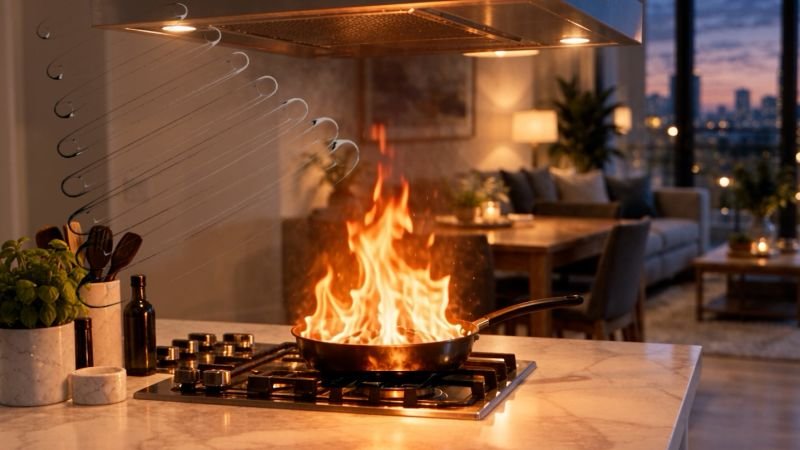
Forget water: An Ohio company has found a way to fight fires with sound waves. The technology could extinguish a blaze without drenching your home or business.
Each year, there are around 330,000 home fires in the US, resulting in 2,600 civilian deaths. While the number of home fires has halved since 1980, fire fighters today are facing new challenges.
Modern homes experience more grease-related fires, with more people cooking with oil than in the past. Lithium-ion batteries are becoming increasingly common — which the US Department of Commerce says have caused more than 200,000 fires since 2011
Now, Sonic Fire Tech has developed a technology it says can extinguish fires without drawing on strained municipal water supplies or causing water damage — using low-frequency sound waves.
The company has developed an acoustic generator that can be housed inside a building, and produces high-pressure infrasound waves. These travel through a dedicated ducting system, much like plumbing or HVAC. Sonic Fire Tech says the sound waves vibrate oxygen molecules and push them away faster than the fuel can use them. Since fire needs oxygen to sustain itself, without it, the flames starve.
“We want to fight fires without the inconveniences of conventional suppression,” co-founder and CEO of Sonic Fire Tech Geoff Bruder said. “A traditional sprinkler triggers when it senses heat between 135 and 165 degrees Fahrenheit, which takes at least three minutes of burning fire. And then, it unleashes 8 to 24 gallons of water per minute into the room it’s installed in.”
Sonic Fire Tech’s system activates the moment it detects heat. Because sound waves cause no damage to the building, there’s no reason to wait; if it’s a false alarm, there’s no harm done. The sound waves are below the audible range of 20 Hz, so humans and pets can’t hear them.
“What makes our system especially promising is that it can suppress grease fires — something water-based systems can’t do,” Bruder said. The estimated installation cost for a 3,500 square feet home is $30,000 or around $8.50 per square foot.
The US Defense Advanced Research Projects Agency (DARPA) has previously studied the idea of using sound to suppress fires, and a decade ago students at George Mason University found a way to miniaturize the technology.
But Bruder says his background helped take it to the next level. “I’m an aerospace engineer. I started my career at NASA, working on power systems for planetary missions,” he said. There, he converted “heat energy into acoustic waves, then into power and cooling for a lander designed to survive on Venus.” That expertise was what lawyer Michael Thomas, the company’s co-founder and board chairman, was looking for to develop the technology, which he had been studying “as a side-project” since the 2000s.
In 2019, after connecting on LinkedIn, the two founded Sonic Fire Tech, working “nights and weekends” around their full-time jobs on an early prototype. In 2025, they raised $3.5 million in funding, before a $15 million round in August 2026, led by the O.H.I.O. Fund.
Dr. Michael J. Gollner, an associate professor of mechanical engineering at the University of California, Berkeley, who is chair of the Research Advisory Board of the NFPA Fire Protection Research Foundation, is familiar with the concept of using sound waves to extinguish fires. In 2015, he judged a thesis by a Berkeley student working on a similar technology. He sees promise, with limits.
“At small scales and directed very close, the technology works well,” Gollner explained. “But whether it’s as efficient on big flames and in the long term still has to be proven.”
He added that, despite the damage they can cause to a building once activated, “water suppression sprinklers are terribly efficient, and this new technology still needs to prove that it’s more efficient than this.”
Today, Sonic Fire Tech employs around 20 people and is working toward certification. Interior fire suppression is already mandated in hundreds of local jurisdictions in the US, which gives the company a defined path to approval: in the short term, the Authority Having Jurisdiction — for example fire marshals — can approve individual installations.
Sonic Fire Tech holds three permits in LA County and has begun its first installation in Altadena. This comes in the wake of the deadly Eaton Fire in 2025, which exposed infrastructure gaps where water shortages and dry hydrants hindered emergency response teams. The company has signed two reseller agreements with California home builders.
In the longer term, a national lab must test and certify the system before it can be an option that architects and home builders can use for new homes — and potentially for businesses and data centers too. Bruder said certification testing was expected to begin this autumn, and they expect the first fire and safety certification in 2027.
Last year, the San Bernardino County Fire Protection District participated in demonstrations with Sonic Fire Tech to evaluate the technology, including in-house simulation and wearable acoustic suppression backpacks.
“Our personnel got to observe the technology and its capabilities, including possible applications for use by firefighters,” said Ryan Beckers, the San Bernardino County Fire Protection District public information officer. “We found the technology intriguing, particularly as a potential alternative to water-based home and industrial business sprinkler systems.”
Beyond interior suppression, Sonic Fire Tech wants to eventually use sound waves to fight wildfires. In recent years, the US, and particularly California, has experienced devastating fires that have become easier to ignite and harder to contain as the result of a worsening climate crisis. The company hopes to alleviate the strain on water supplies without contributing to the environmental pollution associated with chemical retardants, which are often laden with toxic metals.
Sonic Fire Tech has started a research project with the Cal Poly Wildland-Urban Interface (WUI) Fire Institute, the first step toward the full-scale testing insurers have asked for.
“The fire situation in California really put people’s minds onto fire as a problem,” Bruder said. “The state really turned their attention to us once they realized how big a problem fire was and that water was not always going to be available.”





Responses