
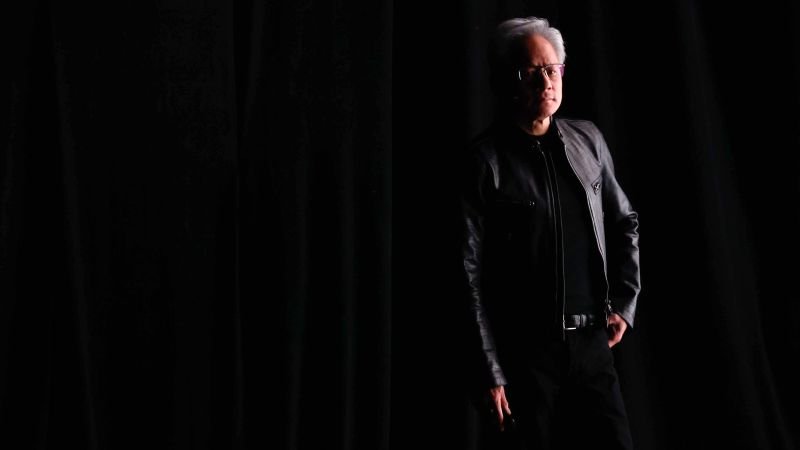
Big Tech CEOs have an aura of invincibility.
A small handful of men have amassed extraordinary power and run a collection of the world’s most valuable tech companies that make cutting-edge products fueling global markets and the economy. They’ve seldom been tested and never brought down. OpenAI tried and failed to fire its CEO Sam Altman. Elon Musk hung on to power after badly damaging Tesla’s reputation during his stint in politics.
That invincibility myth was shattered Thursday when Jensen Huang, Nvidia’s CEO for 33 years, ally of the President of the United States and cofounder of the world’s most valuable AI company, resigned.
Many business leaders have been taken down by scandals like Huang’s – the downfall of former CEOs of American Apparel, Boeing, Cisco, McDonald’s and Hewlett-Packard all played out in somewhat similar fashion.
But none come close to the magnitude and significance of Huang’s ouster.
“This is one of a kind,” said Jeffrey Sonnenfeld, senior associate dean for leadership studies at the Yale School of Management. “In the corporate world, this is by far the biggest fall.”
It sends a clear message: If Huang can be forced out, any leader can.
Huang appeared untouchable.
He very well may have been – up until this week, before his infidelity spilled out into public view and could no longer be ignored by the board.
Nvidia and Huang had been synonymous for decades. He maintained an extraordinarily flat organization, with 60 direct reports and no clear succession plan. He boasted that the company was structured such that he was uniquely qualified to run it.
Huang’s genius was the stuff of legend. He correctly predicted in 2013 – a decade before ChatGPT – that the company’s graphics processors would serve as the foundation for AI. He was right, and his company became the first ever to be worth $5 trillion on the stock market.
So the board failed to challenge Huang, despite numerous missteps and bad bets along the way. It was apparently unfazed by reports dating back more than a year about Nvidia’s odd relationship with Megaspeed – the major Nvidia customer run by Alice Huang, the alleged Chinese agent with whom Jensen Huang had a relationship. The board failed to investigate Huang when the New York Times reported last month that US intelligence feared Alice Huang may be a spy, or when photos of its CEO and Alice Huang were plastered all over the internet.
It took the scandal becoming an unavoidable topic of public conversation this week for the board to hire an outside counsel to investigate. It took another revelation – by The New York Times that Huang had an alleged affair with an executive who reports to him – to ultimately force him to resign.
That made the board negligent in its duties, said Nell Minow, chair of corporate governance advisory firm ValueEdge Advisors.
“The single biggest failure of corporate boards is succession planning, and there’s no evidence that was done here,” said Minow. “We love to think about superstar CEOs and founders, but they’re never as special as they think they are.”
Huang’s aura of invincibility stems from one of his favorite boasts: Nvidia’s humble 1993 founding during a meeting held at a Denny’s – and how its shaky beginnings forced him to repeatedly save the company from near extinction. He made the company’s motto: “Our company is 30 days from going out of business.”
But the board misjudged that past success as evidence of Huang’s unique talents, Minow said.
The biggest risk for the life of a company, she argued, is not failure – because when a company is on the verge of destruction, everyone is working together and problem solving. Instead, the biggest risk is when the company is doing spectacularly well: No one can sustain that hockey stick-like growth, and the board starts attributing success to intangible things like its uniquely talented leaders.
“That puts a lot of pressure on the snowflake genius from Denny’s,” Minow said. “It’s like a baseball team with a winning streak no one can explain. The whole team starts wearing lucky socks. Nvidia’s board thought it had its lucky CEO.”
Huang may have wielded incredible power at Nvidia, but more recent tech founders have worked to place a buffer around themselves even more durable than Huang’s.
Huang is an outlier among his tech CEO peers: He controls just 3.6% of his company’s shares. Many founders, including Meta CEO Mark Zuckerberg, Tesla and SpaceX CEO Elon Musk and soon-to-be public Anthropic CEO Dario Amodei all have dual class stock arrangements that give them significantly more voting power over common shareholders – and effectively unilateral power over their corporations’ governance.
Even those stronger insulators are permeable. Shareholders aren’t powerless against dual class stock structures or seemingly untouchable CEOs: They can bombard companies with lawsuits – which have already started against Nvidia.
And it’s not clear that even a CEO as wealthy and powerful as Musk could survive a scandal like Huang’s. Musk’s friendly, hand-picked Tesla board began a CEO replacement search and successfully pressured him to return his focus to the company after spending much of 2024 and 2025 engaged almost exclusively in the political spotlight, damaging Tesla’s global brand in the process.
“There’s a lot of myth-making in tech that there’s one person who is uniquely qualified to run the company,” said Sonnenfeld. “That’s not true: They have human frailties, they’re imperfect, and they’re replaceable.”
Nvidia board’s decision here was cut and dry: Anyone else at Nvidia would have been let go if they had engaged in Huang’s alleged conduct. Huang may have put his company’s trade secrets at risk of theft by a foreign competitor. He lost trust with Nvidia’s customers and demonstrated a lack of candor with his board. Huang lost the legitimacy to lead.
So that means the CEO – even the visionary leader of the chipmaking bedrock of AI – can be held responsible, just like any other employee who may have violated the company’s code of conduct.
And, on Thursday, he was kicked out of the company he built.





Responses