
EDITOR’S NOTE: Call to Earth is a CNN editorial series committed to reporting on the environmental challenges facing our planet, together with the solutions. Rolex’s Perpetual Planet Initiative has partnered with CNN to drive awareness and education around key sustainability issues and to inspire positive action.
Politicians recently received an old enemy at the Capitol.
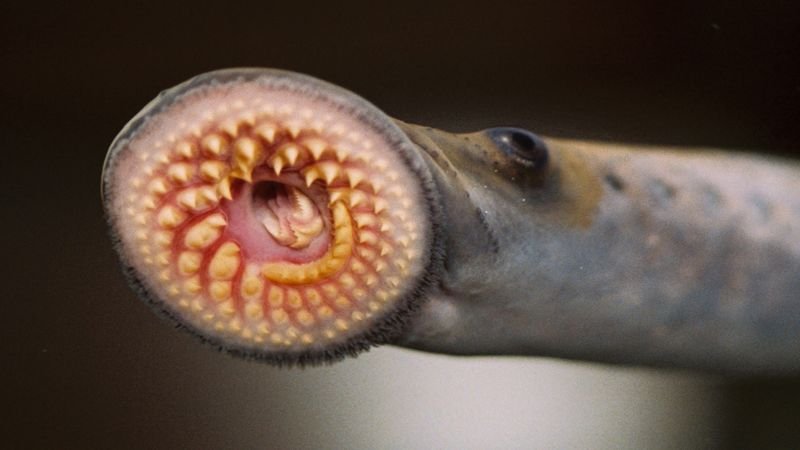
Half a dozen guests arrived fresh from their journey from the Great Lakes. They flashed their teeth for the cameras and posed alongside policymakers from Florida to California. There were no handshakes, but one did suck on the palm of Representative Bill Huizenga.
“It definitely gets your attention,” said the House member from Michigan.
In a Congress riven by divides as deep and chilly as the Great Lakes themselves, both sides of the aisle agree: invasive sea lampreys must go.
“I’ve been in politics in one element or another for my entire life,” said Greg McClinchey, director of policy and legislative affairs at the Great Lakes Fishery Commission (GLFC). “I have never had an issue that unifies like this.”
The June meet and greet was the latest organized by the GLFC to remind policymakers that this threat only remains dormant because of government funding, from both the US and Canada.
11 photos
The invasive species, native to the Atlantic Ocean, has plagued the Great Lakes since entering Lake Ontario the mid-1800s, before moving into the upper Great Lakes in the 1920s. It had a devastating impact on the lakes’ trout, salmon and whitefish populations.
Sea lampreys don’t have a vampiric reputation for nothing. They are a parasite, latching on to fish with their suction cup mouth and rings of teeth. They don’t eat flesh but suck their prey dry, reducing it to a husk. One lamprey consumes around 40 pounds (18 kg) of fish in 12-18 months, and females can lay 100,000 eggs in a single spawning season.
The commission was established by a treaty signed between the US and Canada in 1954 partly to mitigate the lamprey problem. A moonshot project to control the population succeeded in 1957, when a chemical compound was developed called TFM (3-trifluoromethyl-4-nitrophenol), which kills lamprey larvae, without harming most native fish. Since then, “lampricide” has been applied from spring to fall to spawning areas in lake tributaries, killing young lampreys before they can enter the lakes, beyond the reach of scientists.
If left uncontrolled, it’s estimated lampreys could collapse the Great Lakes’ fish stocks — and with it, a multibillion-dollar fishing industry — in just five years, says the GLFC.
Around 9 million need to be killed every year just to prevent a population explosion. Eradicating invasive lampreys entirely “is a very real possibility we continue to work towards,” said McClinchley, but “not something that’s on the cards today.”
In fact, seven decades after the moonshot, all that good work was nearly undone. Worse still, new invasive species have arrived — and controlling them may require another moonshot.
The GLFC has only recently recovered from Covid-19. During lockdown in 2020 and 2021, staff had to maintain social distance, which meant fewer treatments took place and the commission was unable to implement its full control program.
The lamprey population “skyrocketed” by 300% in some areas, said McClinchley. “It did make (our) case.”
“We call it ‘the forbidden experiment’ here in the office,” he added. “We have always said that if we don’t keep controlling sea lamprey that they will bounce back — they’re a coiled menace. But we never dared to do (it).”
The GLFC says fishing on the Great Lakes supports 75,000 jobs, and estimates the rise in lampreys during the pandemic caused a $2 billion hit to the economy.
“That squares with what our members lived through,” said Vito Figliomeni, executive director of the Ontario Commercial Fisheries’ Association. Figliomeni, who is a strong supporter of lamprey control and advises the GLFC, said commercial fishers saw more marked and damaged fish from lampreys, and more pressure on fish stocks during the pandemic.
“For family operators working on thin margins, ($2 billion) isn’t an abstraction — it’s income, and it’s the question of whether the next generation stays in business,” he added.
Through subsequent lampricide treatments the problem was reined in by the GLFC. In December 2025 it announced it had reduced sea lamprey numbers to pre-pandemic levels, though in Lake Superior the population remained elevated.
The Covid-19 crisis highlighted that even with effective solutions, the Great Lakes remain precariously balanced.
Lampricide works because the larvae are unable to metabolize the compound, which disrupts their energy production, resulting in death. Nearly 70 years after its introduction, there’s no sign that lampreys have developed any resistance to it, says the GLFC.
That has not stopped the commission from searching for alternative controls, which make use of dams, bubble barriers and acoustic barriers in rivers around the lakes. The GLFC is also employing a novel concept called FishPass to replace the Union Street Dam in Traverse City, on the edge of Lake Michigan.
The new dam will extend over the Boardman River, with a channel alongside it for select fish to pass up and downstream. The under-construction channel will be equipped with various ways of filtering out lampreys, containing them and preventing them from moving upstream.
The goal is for the process to be fully automated, said McClinchley, who added that the GLFC is investigating a variety of technologies, including video shape recognition, to see which work best, before rolling out a combination on the channel.
Sea lampreys are only one of 186 invasive species among 3,000 species in the Great Lakes.
Some have found a use. Rainbow smelt was accidentally introduced in the early 1900s and became the largest quota species in Lake Erie, according to the Great Lakes Foods Company of Chatham, Ontario, which exclusively fishes for smelt.
Others, like the quagga mussel and zebra mussel, are a plague. The mussels arrived in ballast water from commercial vessels in the 1980s, and since then have impacted the survival of fish eggs, caused toxic algae blooms, and outcompeted native mussels. There’s currently no way to safely eliminate them from the Great Lakes.
“Zebra and quagga mussels have done more damage to our members’ livelihoods than almost anything else on the lakes,” said Figliomeni.
“They strip the nutrients and plankton out of the water column and collapse the food web that whitefish and other species depend on. In Lake Huron, the whitefish decline has tracked almost in lockstep with the rise in mussel biomass.”
Invasive mussels are also a suspected factor in the rise of avian botulism die-offs in recent decades. They concentrate botulism, and another invasive species, the round goby, eats the mussels. Scientists have theorized that poisoned gobies become paralyzed and easy prey for birds, which then die from the toxin.
Legislation is before Congress that would task the commission with finding a control. The bipartisan bill, dubbed the “Save Great Lakes Fish Act of 2025,” proposes a $500 million budget spread across 10 years to find a solution.
Figliomeni said an effective control “would be genuinely transformative” for the lakes’ fishers: “It’s the difference between managing a decline and actually having a shot at reversing it.”
On June 3, the US-Canadian Committee of Advisors to the GLFC — a group consisting of Indigenous, commercial, recreational, academic, agency, environmental, and public fishery interests — unanimously passed a resolution supporting the act, and urged the US Congress to pass the legislation into law.
There is no timeline for when, or if, Congress will act, said McClinchley.
“We need Congress to make a decision … Once that happens, our commissioners have already signaled their desire to help find a ‘second moonshot,’” he said.
Representative Huizenga, who is also co-chair of the Bipartisan Great Lakes Task Force, said, “The Great Lakes aren’t a Republican issue or a Democratic issue. They’re an economic engine, a source of drinking water for millions of people, and part of our way of life here in Michigan. Protecting them is something we can all rally around.”
Should the second moonshot succeed, it could have implications beyond the Great Lakes, for a blight spreading though freshwater bodies across North America and Europe. But how to achieve it remains uncertain.
Back in the 1950s, scientists conducted pickle jar experiments to find ways to kill lampreys. That wasn’t hard, said McClinchley. Killing them while keeping everything else alive was.
Thousands of compounds were formulated and tested in a war that was part ingenuity, part perseverance. Science has moved on since, but a similarly dogged spirit may be required.
“There is always a way to solve problems,” said McClinchley.
“It will take work, discipline, and resources, but failure can’t be an option. The cost to the Great Lakes is just too great.”




Responses