
Belleville, Pennsylvania —
Main Street is bustling on a Wednesday afternoon in late September. Cars mix with horse-and-buggy carriages on the road, many coming and going from the weekly Sale Day — a market spread over 10 acres with livestock, fruits and vegetables, flowers and other goods for available to purchase. Lively conversations in English and Pennsylvania Dutch fill the barn where a produce auction stretches until lunchtime; bids for a pint of bright red cherry tomatoes run from 90 cents to $1.30.
As dozens of people mix and mingle through the afternoon — Amish and other Plain people, so named for their simple way of dressing, as well as “English,” as they refer to folks outside of their community — there are no direct indications that a measles outbreak is raging in the area. Only one woman has a mask on, which she says she’s been wearing any time she’s left home since the start of the Covid-19 pandemic. One vendor is closed for “unexpected family obligations,” and one regular auction attendee is mourned after her recent sudden death after having “flu-like symptoms.” Tourists are visiting from Brooklyn.
But less than a mile away at the Central Pennsylvania Clinic, measles is front and center.
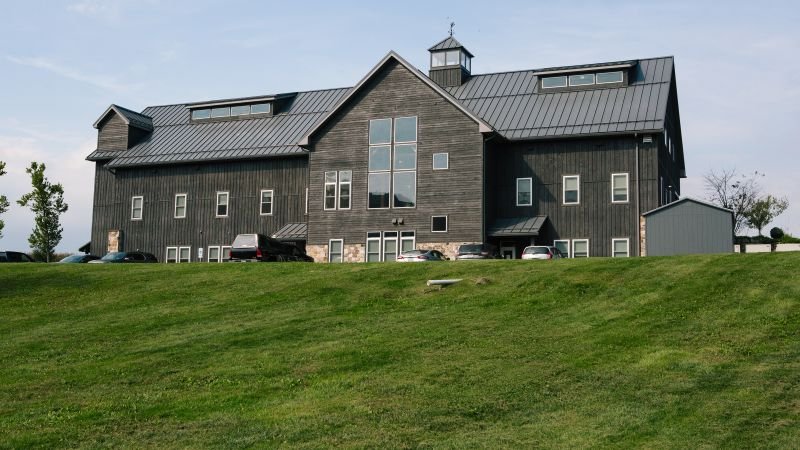
A turn off of Main Street quickly opens up to an idyllic rural valley, filled with lush farms set to a backdrop of rolling green mountains. An unlined road leads across a babbling river to reveal a striking gray building up on a hill, a massive barn raised in the traditional style that uses only wood pegs — no nails — to hold the structure together.
The front door is locked, with a photo and description of measles hanging in the window, along with a notice asking visitors to “ring doorbell for service.” Dr. Katherine Mascia swings the door open with a big smile and a quick question: “Any measles symptoms today?”
Beneath the genuine smile is true heartbreak. A massive measles outbreak in the area — now the deadliest and nearly the largest the United States has had in decades — is bringing significant pain and suffering to the families she cares for.
“In the five years that I’ve worked here, I don’t think we’ve had so many patients admitted to the hospital all within the span of a few weeks,” Mascia said. “We might usually have maybe one patient who’s admitted for their complex care needs, but to have so many all at the same time, it’s really unprecedented.”
About 1,000 measles cases have been reported by the Pennsylvania Department of Health since the outbreak started in April, nearly surpassing the record number recorded in South Carolina during an outbreak that started last year and that became the largest in the US since 1992. The clinic’s home of Mifflin County is one the hardest-hit, near the epicenter in neighboring Lancaster County.
The patients who the Central Pennsylvania Clinic serves are especially vulnerable to the severe effects of a measles infection. The nonprofit is centered around caring for children and adults with genetic disorders that are especially common among the Amish and broader Plain community, a group that also tends to have lower vaccination rates than average.
The Plain people are known for their caution toward government and other nonreligious authority.
But as measles tears through many of their hometowns in central Pennsylvania, the national conversation has become paradoxically politically charged.
Leaders from the federal government and the Pennsylvania government have clashed over the response, with much of the debate centered around the five deaths that have come during this outbreak. Disputes over the definition of what counts as a measles death and how news of the deaths is shared with the public have disrupted public health response plans.
Meanwhile, the Central Pennsylvania Clinic’s staff is focused on how to best keep everyone safe and healthy. They’re leaning on the clinic’s well-forged foundation of trust. It has taken persistence and patience — sometimes years — for the clinic to build those relationships, and the strength of that trust has faced some of its greatest tests over the past few months.
When Pennsylvania reported a measles-associated death in an 18-year-old in Mifflin County, Mascia said, the clinic started to get tons of calls — from patients they knew and other members of the broader community — who just wanted to know what happened. They weren’t paying attention to what government officials were arguing about on social media, she said. They wanted a clear understanding of how the young person died.
“I’m quite honored that they’re calling us and asking those questions. It helps me feel like they really trust us,” Mascia said. “But it puts pressure on us, too.”
She said she reached out to the county coroner directly to get a formal statement on the cause of death, and she references that statement when patients have questions.
“We want to keep that line of communication open with the community, and it’s so important to provide accurate information and be consistent with the messaging,” she said.
Central Pennsylvania Clinic leaders have been thinking about and planning for a measles outbreak in the community since the start of the West Texas outbreak in January 2025, Mascia said. Their patients are vulnerable, and their offices, while incredibly well-equipped in many ways, are not built to treat measles patients.
“We don’t have advanced ventilation systems, and we don’t have negative-pressure rooms, so if a person who is infected with measles comes in, our entire building is compromised for two hours,” Mascia said.
Pennsylvania requires a throat swab, a blood sample and a urine sample to confirm a measles case — arduous tasks for both ill patients, who often had to take a taxing horse and buggy ride to the clinic, and for clinic staff who have to work within the constraints of their facility.
The rear entrance to the clinic building, which also hosts a federally qualified health center, has become a makeshift triage center for people with suspected measles cases. The back parking lot is large enough for cars and buggies to spread out, and clinic staffers meet families at the door, where they can lead the patient into a small storage barn to collect urine samples.
It was important to have a logistical plan to keep operations safe, Mascia said, but she pointedly explains that the most critical way to protect their patients is to raise vaccination rates.
The measles-mumps-rubella (MMR) vaccine is extremely effective. One dose is 93% effective against measles, and the recommended second dose bumps that protection up to 97% — and the immunity is lifelong. Extensive research has also demonstrated the vaccine’s safety.
Childhood vaccination rates have been falling nationwide, with a record share of parents opting to exempt their new kindergartners from the required shots last school year.
Vaccination rates tend to be lower among Plain people, but it’s not because of an inherent opposition, experts say.
There are certain shared values within the community, but there are also varied individual beliefs and opinions about vaccines, as there would in any broad group of people, Mascia said. Consistency in the clinic’s messaging around vaccination has been the key to raising coverage rates.
If the patients sense any type of coercion from doctors or if they feel forced into a decision about something like a vaccination, they’ll completely disengage from all health care – an outcome that would be particularly troublesome for the vulnerable patients they care for.
“We share that it’s our strong recommendation that everyone be fully vaccinated,” Mascia said. “And if they’re not interested, we repeat our recommendation and say ‘we’re here to help if and when you change your mind.’”
In the Amish and broader Plain community, the experience of a neighbor and advice from a family member carry significantly more weight than findings from a study published in the most prestigious medical journal or recommendations from the leading clinical society, said Dr. Helge Hartung, who joined the Central Pennsylvania Clinic last year.
The Central Pennsylvania Clinic has uniquely carved out space for opportunities to build that kind of rapport – but it takes time.
Two hours are blocked off for new patient visits, and every visit after that is scheduled for an hour. The main exam room is extra large, with space to fit the whole family — the average of which includes seven children — for conversations that affect every member. There’s time and space to answer questions, Mascia said, and her well-informed patients come with many of them.
“What I’m seeing are families trying to weigh all the information that they are getting from us, from the community, from other sources,” she said. “They are families truly trying to make the best decision for their child.”
A few years ago, the federal government stopped providing MMR shots to the clinic through Vaccines for Children, a federally funded program that provides routine immunizations at no cost to children who might not otherwise be able to afford them. The government told Mascia that it was withdrawing because of the lack of demand for the shots, she said. But cost is a key consideration for many of her patients when making health care decisions, and she worried about the families who did want to get vaccinated but couldn’t afford it after this change.
The state government has since stepped up to help keep the clinic’s small in-house pharmacy sufficiently stocked with MMR vaccines, and the timing has been critical.
Mascia says she hasn’t pushed the issue of vaccination much more than usual since the measles outbreak started — just the standard consistent messaging — but the requests from families have noticeably increased.
The Pennsylvania Department of Health has hosted nearly 200 pop-up vaccination clinics where workers have given thousands of MMR doses since the start of the measles outbreak this spring.
Government-sponsored programs like this would typically deter most Plain people, but the Central Pennsylvania Clinic has built up enough trust in the community that simply hosting vaccination events in the clinic building has been enough to drive significant turnout.
More than two dozen people were vaccinated at a pop-up clinic it hosted in mid-August, and 73 more were vaccinated at a second one in mid-September. Interest in the September pop-up spiked significantly after the death in Mifflin County was reported.
“That shows me that this community does care about preventing those serious consequences,” Mascia said. “They want to do what they can, and they know that our strongest tool is through vaccinations.”
Vaccinating a hundred people within the Belleville community “is considered very successful,” the state health department said.
“One of the most important strategies for building trust is recognizing that a successful response must include the people who Pennsylvanians turn to in their daily lives for guidance, like primary care doctors, pharmacists, faith leaders, and community leaders,” the state health department said in an email to CNN. “The Central Pennsylvania Clinic has been an integral part of the Belleville community for more than a decade, caring for the medical needs of these Pennsylvanians and creating lasting relationships. Their partnership in hosting these vaccination clinics provides a layer of trust that DOH can build upon to help residents understand the unmatched protection available through the MMR vaccine.”
The Central Pennsylvania Clinic also aims to meet patients where they are — both philosophically and physically.
Doctors and nurses regularly make house visits to see patients whose health conditions or financial situations make it difficult to travel to the offices. But patients have increasingly requested home visits because fear of infection during the measles outbreak has made them afraid to leave their homes.
Clinic staff is happy to travel to patients’ homes to administer MMR vaccines when requested, too. Sometimes the visits are coordinated to be at a certain hour or to a certain part of the property, to avoid raising eyebrows among neighbors.
Hartung, who leads the clinic’s home care program, knows a family who skipped going to church for more than month to avoid possible measles exposures to their vulnerable infant. As soon as the baby turned 6 months, they requested a home visit for an early vaccination.
“The first thing the mother said was, ‘Now we can go to church again,’” Hartung said. “If they’re missing church, it goes to show you how significant the fear and concern is.”
But the measles outbreak has added even more layers of complication to the home visit operation. Instead of mapping the most efficient route between homes, Hartung is now planning his home visit schedule based on the patients’ vulnerability to an infection. It adds dozens of miles and significantly more time between appointments.
“In a normal time, we might do it by distance, a straightforward route. Now we’re really looking at the most vulnerable sequence, just in case there is a measles encounter that we didn’t anticipate,” he said. “We, of course, are all vaccinated, but we always worry that we might actually become a vector, so we plan that out the best we can.”
Hartung says he knows that he’s gained a patient’s trust when they start calling him by his last name. When formal titles are dropped, it’s a sign that he has found his way in.
“When they’re very formal, it could go either way,” he said. “It’s great to hear, ‘Hartung, what do you think?’”
Mascia recently needed to send a young patient to the emergency department, where the family learned that the closest newborn intensive care unit was full and had to be diverted to another hospital system. There have been only a few other times that patients have been diverted to a different hospital system due to a lack of available beds, Mascia said, but the typically rare event has been happening much more frequently during this measles outbreak.
And in recent weeks, Mascia says, there’s been a marked increase in patients cancelling appointments or simply not showing up to the clinic.
“Sometimes it’s a sudden, eerie kind of stillness,” she said. “Whenever there’s a missed appointment, I’m always concerned that something really severe happened. Right now, you just have to assume the patient has measles.”
The clinic almost always has the time and space to reschedule or fit in a new appointment, but missed appointments aren’t always rescheduled, and gaps in care can lead to serious consequences for her patients.
“It’s very important to keep on top of these conditions to make sure patients have the best possible outcomes,” Mascia said. Young children can rapidly outgrow dosages for important medications or miss the chance to manage a condition with physical therapy before needing surgery.
Measles has also kept the broader community away from fundraising events that are critical to keeping the nonprofit up and running.
The vast majority of the Central Pennsylvania Clinic’s operating budget comes from direct community donations, many of which happen at large auctions that take place a few times throughout the year. Plain families will put handmade quilts, baked goods, farm equipment and sometimes livestock up for sale and gift their earnings back to the clinic.
Clinic executive director Louise Yoder said that a few of the most recent auctions were a bit less successful – and measles was one of the main reasons why.
“People are sick and not wanting to go to events like this,” she said.
Part of the clinic’s goal in providing culturally competent care to the community is an understanding that finances can be restrictive for many patients.
The team works with local hospitals to negotiate special rates for their patients who are Amish or members of the broader Plain community, a group whose philosophical beliefs keep them from enrolling in formal health insurance plans. But the measles outbreak is raising the stakes.
“With the sheer number of hospital stays and ICU admissions that we’re seeing because of measles, I do wonder about the financial toll on this community,” Mascia said. “It concerns me.”
Like other medically underserved populations with barriers to care, the clinic’s patients often wait to seek care until their condition is very serious.
“We’ve received many, many calls from sick measles patients, and sometimes you wish they would have called you sooner,” she said. “It’s just heartbreaking. It’s a preventable illness, and to just see so much suffering, that’s the most intense part.”




Responses