
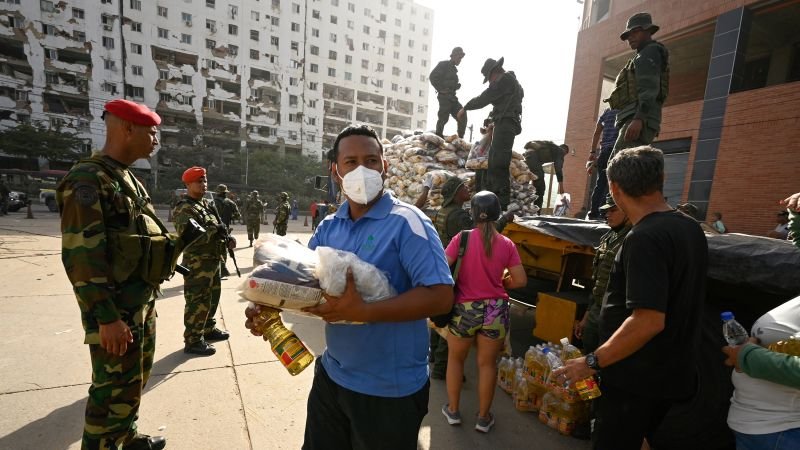
• Death toll soars: At least 1,430 people died in this week’s devastating twin earthquakes in Venezuela, the country’s top lawmaker said in an update Saturday. Rescuers are racing against a dwindling clock to find survivors. A lack of heavy machinery and constant aftershocks are complicating efforts.
• Global response: A US official said one of the runways at the international airport near Caracas is now operational, easing a key bottleneck for the influx of aid pouring in from other countries. In addition to supplies, the US and other nations have sent specialized search and rescue teams to help on the ground.
• Mounting frustration: Hospitals are struggling to treat the injured after decades of neglect for Venezuela’s healthcare system. Residents have grown frustrated by the slow pace of operations as they endure an anguished wait for word on loved ones.
• Here’s how you can help earthquake victims.
• Sigue nuestra cobertura en español.
37 Posts
Following the twin earthquakes that struck Venezuela, more than 2,000 rescuers from about 20 countries have arrived to support search and rescue efforts.
As rescue teams race against time to find survivors in the rubble, here’s how some people were pulled to safety:
The US rescue team and local firefighters pulled a mother and her nine-month-old child from the rubble.
Both sustained minor injuries, the Urban Search and Rescue Team of Fairfax county, Virginia, said in a post on X.
Rescuers from El Salvador managed to free a 15-year-old and her dog who were trapped inside a collapsed building in the city of Catia La Mar in hard-hit La Guaira state.
The team had to “break through several walls” to reach Camila Sofía Medina Rivas and her dog Chanel, El Salvador’s President Nayib Bukele said.
The president shared images showing the teen on a stretcher wearing an oxygen mask and waving to the crowd.
Bukele also shared an audio clip of what appeared to be a conversation between Camila and a rescuer.
“We are here to do everything possible to help you,” the rescuer is heard saying, after Camila told him she could only move her legs in the small space where she was trapped. “We want you to stay energized so you can help us make as much noise as possible.”
The Colombian search and rescue team extracted an 11-year-old boy from the rubble after more than six hours of work.
“Moisés is safe! After six hours of an intense operation, the USAR COL-1 team from Colombia rescued alive the 11-year-old boy who was trapped under the rubble in La Guaira, Venezuela,” reported the Colombian Ministry of Foreign Affairs on X.
The ministry posted a video showing Moisés on a stretcher.
The fire department from the Ecuadorian capital Quito reported Saturday that, in collaboration with a team from El Salvador, they managed to locate and rescue Marlene, an 80-year-old woman who had been trapped for more than 60 hours in the rubble of a building in the Playa Grande area.
The department shared footage of the rescue on its X account, along with a video showing the moment when a rescuer speaks to the woman. “We are going to help you, we came from Ecuador to help you, stay calm, we are with you, okay?” he says.
Local authorities told journalists in the area that a cat named Lola was rescued from a collapsed building in the Chacao municipality of Caracas and was identified by the information on her tag.
Through her tag, they “were able to identify who she belonged to; unfortunately, the owner passed away,” Chacao authorities said, adding that the owner’s children will care of the cat.
CNN’s Osmary Hernández, Magdalena Sofía Vitores Moreno, Issy Ronald, and Ana María Cañizares contributed reporting.
A man who was pulled to safety from under the debris of a destroyed building in La Guaira on Saturday, appeared to be in joyous disbelief as a team of rescuers saved his life.
A video posted by Spain’s Unidad Militar de Emergencias, or Military Emergency Unit, shows the survivor, Antonio, as he’s referred to in the video, sitting up and smiling after being pulled up from rubble, legs first.
“Antonio” then remains speechless and in awe while others around him yell, “Antonio! Antonio, welcome!”
He is the second victim that the Spanish team rescued alive on Saturday after having spent nearly three days trapped in the wreckage of Venezuela’s devastating earthquakes.
The rescue effort in Venezuela will reach a grim inflection point tonight. As of this evening, 72 hours will have passed since the two deadly earthquakes on Wednesday – a critical window for rescuing those still trapped under rubble.
After three days, the chances of someone surviving without water decrease rapidly. However, some studies indicate that many rescues of survivors can still take place within the first five or six days following a disaster.
David Emmanuel Villa Tejeda, who is in Caracas with the Mexican rescue team Los Topos, or Moles, said the situation on the ground is “difficult” since the damaged buildings are very tall and there are so many to search.
“It’s difficult because the earthquakes came one after another, and weren’t very deep,” Villa Tejeda told journalists accompanying the rescue efforts in Venezuela, “That’s what caused so many buildings to fall.”
The outlook is negative, at least in the building where he was working in the capital. He said that, because of the way the structure collapsed, “it’s becoming very difficult to find them alive.”
Nonetheless, Tejeda is holding on to hope. His team has been in situations where “we’ve pulled out people after 10 days, under the rubble, still alive.”
Loyce Pace, the Red Cross’ Regional Director for the Americas, told CNN that the frequent aftershocks following the earthquakes are affecting the rescue efforts for survivors trapped in collapsed buildings.
“I don’t know if people are aware of how constant this threat has been,” said Pace. A Venezuelan official said earlier Saturday that there have been at least 430 successive aftershocks since the two major earthquakes.
“There are continuous tremors every time I talk on the phone with my team there,” Pace continued. “It is something quite constant and quite frightening. This means our teams must be very careful when entering these communities to assess the damage or provide services.”
Rescue teams deployed to Venezuela continue to pull survivors from the rubble about 70 hours after the country was hit by devastating twin earthquakes.
Video posted by the Salvadoran government shows rescue workers pulling a 29-year-old woman from under debris where the “Nautilus Building” in La Guaira, Venezuela, once stood.
A Spanish rapid-response team, Unidad Militar de Emergencias, also pulled a woman from under building rubble on Saturday. Video posted by the rescue team shows workers cheering after saving another person who had been trapped under a residential building in La Guaira for nearly 72 hours.
Countries around the Caribbean Sea are particularly vulnerable to major earthquakes because of the tectonic plates in the region.
Earthquakes are measured by magnitude on a logarithmic scale — so each whole number increase translates to 32 times more energy released by the quake. This means the second 7.5 magnitude quake that hit Venezuela on Wednesday was actually twice as large as the first, which had a magnitude of 7.2 and happened about 40 seconds earlier.
Satellite imagery of Venezuela taken before and after the earthquakes shows the scale of destruction in Macuto, a seaside city in the hard-hit state of La Guaira. In the first set of images released by Planet Labs on Saturday, one can see the rubble of the Hotel Eduard, a large waterfront hotel.
A senior US official says one of the runways at Simón Bolívar International Airport near Caracas is now operational, easing some of the challenge in getting foreign assistance into Venezuela as search and rescue efforts continue.
This comes as Venezuela’s National Assembly President Jorge Rodríguez confirmed that the death toll from Wednesday’s devastating earthquake has risen to at least 1,430 people. At least 3,238 people have been injured and 3,142 families have lost their homes, according to Rodríguez.
Here’s what else to know this afternoon:
Help from afar: Across 17 flights, over 1,600 rescuers from around the world have arrived in Venezuela today to support search and rescue efforts. Rescuers are coming from countries including Mexico, the United States, El Salvador, Switzerland, Colombia, Spain, Ecuador, Chile, the Dominican Republic and Panama. Venezuela’s acting President Delcy Rodríguez confirmed that 10 more countries are set to join the search and rescue operations.
More on the US aid: Mobile hospitals were arriving in Venezuela today, , according to the senior official, and the US is also working to get more Starlink terminals into the country, where a lack of connectivity is adding to the agonizing wait for news on loved ones.
Electricity restoration: Venezuelan authorities said workers have managed to restore 60% of the electricity supply in La Guaira, the coastal state hit hardest by the twin earthquakes.
Emergency hotline: The Venezuelan government has activated a new earthquake hotline to report missing people or request assistance, the presidency announced Saturday. The hotline number is 0800-RESCATE (0800-7372282) and will be added to the VenApp platform.
Venezuela in photos: See more images from the journalists documenting the search and rescue efforts in the aftermath of the disaster.
CNN”s Caroll Alvarado, Jennifer Hansler, Marlon Sorto, Mauricio Torres, Max Saltman and Uriel Blanco contributed to this report.
National Assembly President Jorge Rodríguez outlined the continuing rescue effort underway in earthquake-hit Venezuela in an address on Saturday, including the level of international aid flowing into the country.
According to Rodríguez, so far Venezuela has received:
21 international aid delegations comprised of more than 2,000 aid workers
96 search and rescue dogs
40 cargo vehicles
32 transport vehicles
103.7 metric tons of equipment
3 metric tons of medicine
Separately, Rodríguez said that the Venezuelan government had mobilized 30,000 people to aid the rescue efforts, including military personnel, police, doctors, paramedics and psychologists.
The death toll from the earthquakes in Venezuela has risen to at least 1,430 people, according to National Assembly President Jorge Rodríguez on Saturday.
At least 3,238 people have been injured, Rodríguez said, and 3,142 families have lost their homes.
The lawmaker added that the country has experienced at least 430 aftershocks in the wake of the two main earthquakes on Wednesday.
This post has been updated with additional details.
Workers have managed to restore 60% of the electricity supply in heavily-affected La Guaira state, according to Venezuelan authorities.
Acting President Delcy Rodríguez announced the electricity restoration early Saturday morning in a video issued by the Ministry of Communications. Rodríguez added that the government should be able to restore more electric transmission once workers are able to repair damaged infrastructure in the mountains of La Guaira.
La Guaira, a state on Venezuela’s northern coast famous for its tourist destinations and resorts, was struck harder than any other region of the country by the two earthquakes earlier this week. The government declared the state a disaster zone on June 25.
Miami-Dade Fire Rescue’s Urban Search and Rescue teams have joined the US’ earthquake relief efforts in Venezuela, military officials said on X.
“Today, @usairforce C-17 Globemaster aircraft are transporting two @MiamiDadeFire search and rescue teams to Venezuela. These skilled responders will join @StateDept -led U.S. government earthquake relief efforts,” the military said Saturday.
According to Miami-Dade Fire Rescue, the rescue team being deployed to Venezuela is Florida Task Force 1. The team consists of 80-members, including six canine teams.
The Venezuelan government has activated a new earthquake hotline to report missing persons or request assistance, after two major quakes struck the country Wednesday, the presidency announced Saturday.
The hotline number is 0800-RESCATE (0800-7372282) and will be added to the VenApp platform, the presidency said, citing acting President Delcy Rodríguez.
The purpose of these services is to centralize the emergency response, the presidency said, adding that volunteers can now register for search and rescue operations.
It’s midday in Venezuela, where search and rescue teams have been at work for hours in their race against the clock to find remaining survivors of this week’s devastating earthquakes.
Venezuelans are enduring an anguished wait for word on loved ones, and in some communities, residents themselves are leading the search through the rubble.
See more photos from our coverage here.
A senior Trump administration official said there are “great communications right now with the interim authorities” in Venezuela on both the political and military side in the wake of the devastating earthquakes.
“We have a unique relationship, obviously, with the interim authorities, and we’re working very closely with them to address the needs, to get the logistics up and running,” the official told reporters on Saturday morning.
The official said that, as of Saturday morning, one of the runways at Simón Bolívar International Airport near Caracas is operational, allowing an increase in assistance, and credited this to US coordination with the interim Venezuelan government. The other runway remains “completely cracked and inoperable,” they noted.
Mobile hospitals are arriving today, the US is working to get more Starlink terminals to Venezuela, and a further surge of humanitarian supplies is planned, the official said. Two 80-person US search and rescue teams have helped find survivors in the rubble, they added.
Asked about reports of restricted access to some of the hardest hit areas, the official suggested it was a communication issue that “a big coordination problem has obviously been the airfields.”
“You’ve got a lot of different groups from all around the world trying to land at the same airfield, you know, trying to get a picture of what air assets are open, trying to get limited ground logistics to get over there, so that’s something that you deal with in every single one of these situations,” they said.
The official also said the USS Fort Lauderdale “is now in position, and so we’re able to airlift people to use the medical facilities as necessary on that vessel, and to use it to do command and control on logistics, and to use their airlift.”
On Friday night, rescue workers managed to open a gap in the rubble of a collapsed apartment block, known as the Petunia Building, in Los Palos Grandes, eastern Caracas, to advance the search for people trapped inside.
When Chacao Mayor Gustavo Duque announced this, it raised the hopes and expectations of families waiting outside for news of their loved ones while diggers tried to shift the rubble.
Among those waiting is Fanny, the mother of 24-year-old Antonio Nassri; she has been waiting near the disaster zone since shortly after the earthquake and has fainted several times.
Another, Susana, lives in the neighboring building and told CNN “all my neighbors” are still trapped under the rubble, listing their names.
Her own building suffered structural damage during the quakes so she is staying with family who live in a house.
“My husband, my daughter, and I were there. It was terrible. We kept falling to the floor; things were falling on us,” she recalled.
“We couldn’t get up. I mean, no matter how much we wanted to take cover under a beam or something… …or a column. We couldn’t. The movement was awful—very violent—and it lasted a long time and was very intense.”
Meanwhile, Neida Pernilla, who lives in a nearby building, said her apartment was destroyed too.
“It’s like we were all born again. Like a horror movie,” she told CNN. “Walking into my house yesterday and seeing it destroyed… it’s not easy. I don’t know when I’ll be able to go back. All my walls collapsed; everything is twisted. That’s just material stuff; right now, the important thing is that we’re alive.”
Scavenging was reported Friday in several buildings in La Guaira, the state in Venezuela hardest hit by Wednesday’s earthquakes, according to a CNN team at the scene.
They saw people entering damaged buildings and emerging with boxes and bags, while others, including minors, waited outside on the street. The incidents unfolded without violence.
Footage from Reuters showed similar scenes in La Guaira of groups entering damaged commercial buildings and taking food, water and clothing.
Venezuela’s acting president Delcy Rodríguez has been speaking today about the ongoing search and rescue efforts following Wednesday’s twin earthquakes.
Speaking during a broadcast on state television earlier, she said 10 more countries will be joining to help the search for survivors.
“Rescuers have come from all over the country to help in the search for those Venezuelan men and women who are still alive,” she said.
More than 1,600 rescuers from various parts of the world arrived in Venezuela earlier today to support search and rescue efforts.
They arrived on 17 flights, said Oliver Blanco, Venezuela’s vice minister for Europe and North America.
“An additional 25 flights are expected to arrive in the next 24 hours. We appreciate the support and solidarity of the international community during these uncertain times for Venezuelans,” Blanco added in a message on X.
Team from countries including Mexico, the United States, El Salvador, Switzerland, Colombia, Spain, Ecuador, Chile, the Dominican Republic, and Panama have joined the search.
Several Venezuelan footballers were killed or impacted by Wednesday’s powerful earthquakes.
Yimvert Berroteran, a promising young talent, was among the hundreds of people who died, the Venezuelan national team and the Venezuelan Football Federation (FVF) said Friday.
The 18-year-old played at the U-17 World Cup in Doha a few months ago and recently for the U-20 national team.
The earthquake also claimed the lives of young players Víctor Palacios and Razan Sijaa, according to FVF and their respective clubs.
Meanwhile, the partner of Zulia FC defender, Héctor Bello, died while protecting their toddler during the earthquake, the player said on social media.
His daughter and her aunt are currently in the hospital, he said.
Frequent aftershocks following the two major earthquakes on Wednesday are affecting efforts to rescue survivors trapped inside collapsed buildings, said aid coordinator Loyce Pace.
“I don’t know if people realize how constant this threat has been,” Pace, the Red Cross’ director for the Americas, told Victor Blackwell on CNN This Morning earlier.
Such frequent aftershocks also mean that people must be careful when re-entering their homes, she added. “People want to get back home, they want to feel safe again and yet there’s some insecurity to their infrastructure, these buildings that are literally falling down so we have to be quite careful in the weeks ahead,” she said.
Many people are still sleeping outside because of the threat, and although some temporary shelters are being established, it will take time to ensure everyone can access them, she said.
In the wake of such enormous damage and continuing aftershocks, “there is so much anxiety right now that’s circulating in the community, even among our volunteers,” Payce added
Some Red Cross volunteers have missing family members or have lost their homes but “started working immediately” to assist the relief effort, she said. With international teams arriving, she hopes there can be “staff on the ground who can take over for them.”
“It’s really too much, honestly,” she added.
• Death toll soars: At least 1,430 people died in this week’s devastating twin earthquakes in Venezuela, the country’s top lawmaker said in an update Saturday. Rescuers are racing against a dwindling clock to find survivors. A lack of heavy machinery and constant aftershocks are complicating efforts.
• Global response: A US official said one of the runways at the international airport near Caracas is now operational, easing a key bottleneck for the influx of aid pouring in from other countries. In addition to supplies, the US and other nations have sent specialized search and rescue teams to help on the ground.
• Mounting frustration: Hospitals are struggling to treat the injured after decades of neglect for Venezuela’s healthcare system. Residents have grown frustrated by the slow pace of operations as they endure an anguished wait for word on loved ones.
• Here’s how you can help earthquake victims.
• Sigue nuestra cobertura en español.
Following the twin earthquakes that struck Venezuela, more than 2,000 rescuers from about 20 countries have arrived to support search and rescue efforts.
As rescue teams race against time to find survivors in the rubble, here’s how some people were pulled to safety:
The US rescue team and local firefighters pulled a mother and her nine-month-old child from the rubble.
Both sustained minor injuries, the Urban Search and Rescue Team of Fairfax county, Virginia, said in a post on X.
Rescuers from El Salvador managed to free a 15-year-old and her dog who were trapped inside a collapsed building in the city of Catia La Mar in hard-hit La Guaira state.
The team had to “break through several walls” to reach Camila Sofía Medina Rivas and her dog Chanel, El Salvador’s President Nayib Bukele said.
The president shared images showing the teen on a stretcher wearing an oxygen mask and waving to the crowd.
Bukele also shared an audio clip of what appeared to be a conversation between Camila and a rescuer.
“We are here to do everything possible to help you,” the rescuer is heard saying, after Camila told him she could only move her legs in the small space where she was trapped. “We want you to stay energized so you can help us make as much noise as possible.”
The Colombian search and rescue team extracted an 11-year-old boy from the rubble after more than six hours of work.
“Moisés is safe! After six hours of an intense operation, the USAR COL-1 team from Colombia rescued alive the 11-year-old boy who was trapped under the rubble in La Guaira, Venezuela,” reported the Colombian Ministry of Foreign Affairs on X.
The ministry posted a video showing Moisés on a stretcher.
The fire department from the Ecuadorian capital Quito reported Saturday that, in collaboration with a team from El Salvador, they managed to locate and rescue Marlene, an 80-year-old woman who had been trapped for more than 60 hours in the rubble of a building in the Playa Grande area.
The department shared footage of the rescue on its X account, along with a video showing the moment when a rescuer speaks to the woman. “We are going to help you, we came from Ecuador to help you, stay calm, we are with you, okay?” he says.
Local authorities told journalists in the area that a cat named Lola was rescued from a collapsed building in the Chacao municipality of Caracas and was identified by the information on her tag.
Through her tag, they “were able to identify who she belonged to; unfortunately, the owner passed away,” Chacao authorities said, adding that the owner’s children will care of the cat.
CNN’s Osmary Hernández, Magdalena Sofía Vitores Moreno, Issy Ronald, and Ana María Cañizares contributed reporting.
A man who was pulled to safety from under the debris of a destroyed building in La Guaira on Saturday, appeared to be in joyous disbelief as a team of rescuers saved his life.
A video posted by Spain’s Unidad Militar de Emergencias, or Military Emergency Unit, shows the survivor, Antonio, as he’s referred to in the video, sitting up and smiling after being pulled up from rubble, legs first.
“Antonio” then remains speechless and in awe while others around him yell, “Antonio! Antonio, welcome!”
He is the second victim that the Spanish team rescued alive on Saturday after having spent nearly three days trapped in the wreckage of Venezuela’s devastating earthquakes.
The rescue effort in Venezuela will reach a grim inflection point tonight. As of this evening, 72 hours will have passed since the two deadly earthquakes on Wednesday – a critical window for rescuing those still trapped under rubble.
After three days, the chances of someone surviving without water decrease rapidly. However, some studies indicate that many rescues of survivors can still take place within the first five or six days following a disaster.
David Emmanuel Villa Tejeda, who is in Caracas with the Mexican rescue team Los Topos, or Moles, said the situation on the ground is “difficult” since the damaged buildings are very tall and there are so many to search.
“It’s difficult because the earthquakes came one after another, and weren’t very deep,” Villa Tejeda told journalists accompanying the rescue efforts in Venezuela, “That’s what caused so many buildings to fall.”
The outlook is negative, at least in the building where he was working in the capital. He said that, because of the way the structure collapsed, “it’s becoming very difficult to find them alive.”
Nonetheless, Tejeda is holding on to hope. His team has been in situations where “we’ve pulled out people after 10 days, under the rubble, still alive.”
Loyce Pace, the Red Cross’ Regional Director for the Americas, told CNN that the frequent aftershocks following the earthquakes are affecting the rescue efforts for survivors trapped in collapsed buildings.
“I don’t know if people are aware of how constant this threat has been,” said Pace. A Venezuelan official said earlier Saturday that there have been at least 430 successive aftershocks since the two major earthquakes.
“There are continuous tremors every time I talk on the phone with my team there,” Pace continued. “It is something quite constant and quite frightening. This means our teams must be very careful when entering these communities to assess the damage or provide services.”
Rescue teams deployed to Venezuela continue to pull survivors from the rubble about 70 hours after the country was hit by devastating twin earthquakes.
Video posted by the Salvadoran government shows rescue workers pulling a 29-year-old woman from under debris where the “Nautilus Building” in La Guaira, Venezuela, once stood.
A Spanish rapid-response team, Unidad Militar de Emergencias, also pulled a woman from under building rubble on Saturday. Video posted by the rescue team shows workers cheering after saving another person who had been trapped under a residential building in La Guaira for nearly 72 hours.
Countries around the Caribbean Sea are particularly vulnerable to major earthquakes because of the tectonic plates in the region.
Earthquakes are measured by magnitude on a logarithmic scale — so each whole number increase translates to 32 times more energy released by the quake. This means the second 7.5 magnitude quake that hit Venezuela on Wednesday was actually twice as large as the first, which had a magnitude of 7.2 and happened about 40 seconds earlier.
Satellite imagery of Venezuela taken before and after the earthquakes shows the scale of destruction in Macuto, a seaside city in the hard-hit state of La Guaira. In the first set of images released by Planet Labs on Saturday, one can see the rubble of the Hotel Eduard, a large waterfront hotel.
A senior US official says one of the runways at Simón Bolívar International Airport near Caracas is now operational, easing some of the challenge in getting foreign assistance into Venezuela as search and rescue efforts continue.
This comes as Venezuela’s National Assembly President Jorge Rodríguez confirmed that the death toll from Wednesday’s devastating earthquake has risen to at least 1,430 people. At least 3,238 people have been injured and 3,142 families have lost their homes, according to Rodríguez.
Here’s what else to know this afternoon:
Help from afar: Across 17 flights, over 1,600 rescuers from around the world have arrived in Venezuela today to support search and rescue efforts. Rescuers are coming from countries including Mexico, the United States, El Salvador, Switzerland, Colombia, Spain, Ecuador, Chile, the Dominican Republic and Panama. Venezuela’s acting President Delcy Rodríguez confirmed that 10 more countries are set to join the search and rescue operations.
More on the US aid: Mobile hospitals were arriving in Venezuela today, , according to the senior official, and the US is also working to get more Starlink terminals into the country, where a lack of connectivity is adding to the agonizing wait for news on loved ones.
Electricity restoration: Venezuelan authorities said workers have managed to restore 60% of the electricity supply in La Guaira, the coastal state hit hardest by the twin earthquakes.
Emergency hotline: The Venezuelan government has activated a new earthquake hotline to report missing people or request assistance, the presidency announced Saturday. The hotline number is 0800-RESCATE (0800-7372282) and will be added to the VenApp platform.
Venezuela in photos: See more images from the journalists documenting the search and rescue efforts in the aftermath of the disaster.
CNN”s Caroll Alvarado, Jennifer Hansler, Marlon Sorto, Mauricio Torres, Max Saltman and Uriel Blanco contributed to this report.
National Assembly President Jorge Rodríguez outlined the continuing rescue effort underway in earthquake-hit Venezuela in an address on Saturday, including the level of international aid flowing into the country.
According to Rodríguez, so far Venezuela has received:
21 international aid delegations comprised of more than 2,000 aid workers
96 search and rescue dogs
40 cargo vehicles
32 transport vehicles
103.7 metric tons of equipment
3 metric tons of medicine
Separately, Rodríguez said that the Venezuelan government had mobilized 30,000 people to aid the rescue efforts, including military personnel, police, doctors, paramedics and psychologists.
The death toll from the earthquakes in Venezuela has risen to at least 1,430 people, according to National Assembly President Jorge Rodríguez on Saturday.
At least 3,238 people have been injured, Rodríguez said, and 3,142 families have lost their homes.
The lawmaker added that the country has experienced at least 430 aftershocks in the wake of the two main earthquakes on Wednesday.
This post has been updated with additional details.
Workers have managed to restore 60% of the electricity supply in heavily-affected La Guaira state, according to Venezuelan authorities.
Acting President Delcy Rodríguez announced the electricity restoration early Saturday morning in a video issued by the Ministry of Communications. Rodríguez added that the government should be able to restore more electric transmission once workers are able to repair damaged infrastructure in the mountains of La Guaira.
La Guaira, a state on Venezuela’s northern coast famous for its tourist destinations and resorts, was struck harder than any other region of the country by the two earthquakes earlier this week. The government declared the state a disaster zone on June 25.
Miami-Dade Fire Rescue’s Urban Search and Rescue teams have joined the US’ earthquake relief efforts in Venezuela, military officials said on X.
“Today, @usairforce C-17 Globemaster aircraft are transporting two @MiamiDadeFire search and rescue teams to Venezuela. These skilled responders will join @StateDept -led U.S. government earthquake relief efforts,” the military said Saturday.
According to Miami-Dade Fire Rescue, the rescue team being deployed to Venezuela is Florida Task Force 1. The team consists of 80-members, including six canine teams.
The Venezuelan government has activated a new earthquake hotline to report missing persons or request assistance, after two major quakes struck the country Wednesday, the presidency announced Saturday.
The hotline number is 0800-RESCATE (0800-7372282) and will be added to the VenApp platform, the presidency said, citing acting President Delcy Rodríguez.
The purpose of these services is to centralize the emergency response, the presidency said, adding that volunteers can now register for search and rescue operations.
It’s midday in Venezuela, where search and rescue teams have been at work for hours in their race against the clock to find remaining survivors of this week’s devastating earthquakes.
Venezuelans are enduring an anguished wait for word on loved ones, and in some communities, residents themselves are leading the search through the rubble.
See more photos from our coverage here.
A senior Trump administration official said there are “great communications right now with the interim authorities” in Venezuela on both the political and military side in the wake of the devastating earthquakes.
“We have a unique relationship, obviously, with the interim authorities, and we’re working very closely with them to address the needs, to get the logistics up and running,” the official told reporters on Saturday morning.
The official said that, as of Saturday morning, one of the runways at Simón Bolívar International Airport near Caracas is operational, allowing an increase in assistance, and credited this to US coordination with the interim Venezuelan government. The other runway remains “completely cracked and inoperable,” they noted.
Mobile hospitals are arriving today, the US is working to get more Starlink terminals to Venezuela, and a further surge of humanitarian supplies is planned, the official said. Two 80-person US search and rescue teams have helped find survivors in the rubble, they added.
Asked about reports of restricted access to some of the hardest hit areas, the official suggested it was a communication issue that “a big coordination problem has obviously been the airfields.”
“You’ve got a lot of different groups from all around the world trying to land at the same airfield, you know, trying to get a picture of what air assets are open, trying to get limited ground logistics to get over there, so that’s something that you deal with in every single one of these situations,” they said.
The official also said the USS Fort Lauderdale “is now in position, and so we’re able to airlift people to use the medical facilities as necessary on that vessel, and to use it to do command and control on logistics, and to use their airlift.”
On Friday night, rescue workers managed to open a gap in the rubble of a collapsed apartment block, known as the Petunia Building, in Los Palos Grandes, eastern Caracas, to advance the search for people trapped inside.
When Chacao Mayor Gustavo Duque announced this, it raised the hopes and expectations of families waiting outside for news of their loved ones while diggers tried to shift the rubble.
Among those waiting is Fanny, the mother of 24-year-old Antonio Nassri; she has been waiting near the disaster zone since shortly after the earthquake and has fainted several times.
Another, Susana, lives in the neighboring building and told CNN “all my neighbors” are still trapped under the rubble, listing their names.
Her own building suffered structural damage during the quakes so she is staying with family who live in a house.
“My husband, my daughter, and I were there. It was terrible. We kept falling to the floor; things were falling on us,” she recalled.
“We couldn’t get up. I mean, no matter how much we wanted to take cover under a beam or something… …or a column. We couldn’t. The movement was awful—very violent—and it lasted a long time and was very intense.”
Meanwhile, Neida Pernilla, who lives in a nearby building, said her apartment was destroyed too.
“It’s like we were all born again. Like a horror movie,” she told CNN. “Walking into my house yesterday and seeing it destroyed… it’s not easy. I don’t know when I’ll be able to go back. All my walls collapsed; everything is twisted. That’s just material stuff; right now, the important thing is that we’re alive.”
Scavenging was reported Friday in several buildings in La Guaira, the state in Venezuela hardest hit by Wednesday’s earthquakes, according to a CNN team at the scene.
They saw people entering damaged buildings and emerging with boxes and bags, while others, including minors, waited outside on the street. The incidents unfolded without violence.
Footage from Reuters showed similar scenes in La Guaira of groups entering damaged commercial buildings and taking food, water and clothing.
Venezuela’s acting president Delcy Rodríguez has been speaking today about the ongoing search and rescue efforts following Wednesday’s twin earthquakes.
Speaking during a broadcast on state television earlier, she said 10 more countries will be joining to help the search for survivors.
“Rescuers have come from all over the country to help in the search for those Venezuelan men and women who are still alive,” she said.
More than 1,600 rescuers from various parts of the world arrived in Venezuela earlier today to support search and rescue efforts.
They arrived on 17 flights, said Oliver Blanco, Venezuela’s vice minister for Europe and North America.
“An additional 25 flights are expected to arrive in the next 24 hours. We appreciate the support and solidarity of the international community during these uncertain times for Venezuelans,” Blanco added in a message on X.
Team from countries including Mexico, the United States, El Salvador, Switzerland, Colombia, Spain, Ecuador, Chile, the Dominican Republic, and Panama have joined the search.
Several Venezuelan footballers were killed or impacted by Wednesday’s powerful earthquakes.
Yimvert Berroteran, a promising young talent, was among the hundreds of people who died, the Venezuelan national team and the Venezuelan Football Federation (FVF) said Friday.
The 18-year-old played at the U-17 World Cup in Doha a few months ago and recently for the U-20 national team.
The earthquake also claimed the lives of young players Víctor Palacios and Razan Sijaa, according to FVF and their respective clubs.
Meanwhile, the partner of Zulia FC defender, Héctor Bello, died while protecting their toddler during the earthquake, the player said on social media.
His daughter and her aunt are currently in the hospital, he said.
Frequent aftershocks following the two major earthquakes on Wednesday are affecting efforts to rescue survivors trapped inside collapsed buildings, said aid coordinator Loyce Pace.
“I don’t know if people realize how constant this threat has been,” Pace, the Red Cross’ director for the Americas, told Victor Blackwell on CNN This Morning earlier.
Such frequent aftershocks also mean that people must be careful when re-entering their homes, she added. “People want to get back home, they want to feel safe again and yet there’s some insecurity to their infrastructure, these buildings that are literally falling down so we have to be quite careful in the weeks ahead,” she said.
Many people are still sleeping outside because of the threat, and although some temporary shelters are being established, it will take time to ensure everyone can access them, she said.
In the wake of such enormous damage and continuing aftershocks, “there is so much anxiety right now that’s circulating in the community, even among our volunteers,” Payce added
Some Red Cross volunteers have missing family members or have lost their homes but “started working immediately” to assist the relief effort, she said. With international teams arriving, she hopes there can be “staff on the ground who can take over for them.”
“It’s really too much, honestly,” she added.


Responses