
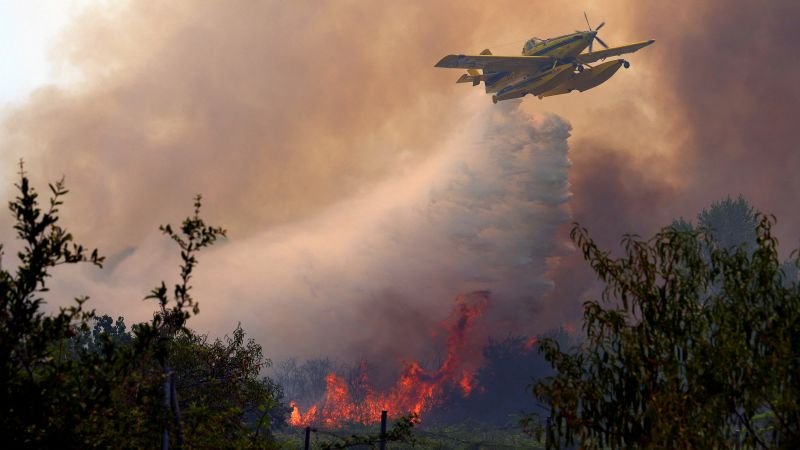
• Wildfires spread: Firefighters are battling wildfires close to the cities of Bordeaux, France, and Madrid, Spain. French President Emmanuel Macron said the fires are “contained” in the Landes region and “stabilized” in the neighboring Gironde region. But he warned France is still battling the most severe blazes since World War II. Track the wildfires here.
• Thousands evacuated: Spanish authorities say more than 63,000 people have been evacuated from their homes near Madrid. The wildfires are “the most painful expression of the climate emergency,” Spain’s prime minister said.
• Extreme weather: The wildfires in France are so intense they have created “fire clouds,” a phenomenon that authorities say has never been seen there before. Temperatures will climb to above-average highs across fire-ravaged areas of France and Spain over the next week, with no signs of rainfall in sight.
You can get your forecast in the CNN Weather app.
40 Posts
Wildfires in France are causing the concentrations of dangerous air pollutants in Bordeaux to spike well above safe levels, Dr Richard Pope, an atmospheric scientist, told CNN on Monday.
Residents in Bordeaux told CNN they are grappling with smoke and poor air quality stemming from the wildfires raging in southwestern France. Some have voluntarily fled despite no evacuation waring in place for the city. “There’s a smell of smoke and ashes everywhere,” one resident said.
Meanwhile in Spain, smoke is moving away from Madrid’s metropolitan area, reducing air quality concerns in the city “for now,” Pope said. Nevertheless, he added that across both countries the “widespread smoke observed from space has degraded air quality and increased health risks for millions.”
Emergency crews continue to battle wildfires ravaging parts of Spain and France.
Blackhawk helicopters are assisting in containing the wildfires in southwestern France. French President Emmanuel Macron said the blazes are “contained” in the Landes region and “stabilized” in the neighboring Gironde region.
Earlier, French fire authorities said, “the wildfire will burn for “a number of weeks, likely several months” before it’s fully extinguished.
Meanwhile Spain, fires have forced at least 63,152 people to evacuate their homes in the central Spanish regions of Madrid, Toledo and Avila, the interior ministry said.
If you’re just joining us, here’s what else you should know.
Several important strategic sites linked to France’s defense industry and nuclear deterrent lie close to the fires ripping through the area to the west of Bordeaux. ArianeGroup, the aerospace and defense company which owns those factories, told CNN that all affected sites have been evacuated.
Bordeaux residents are grappling with smoke and poor air quality, with some having voluntarily fled the Southwest city despite no evacuation warning in place for the city.
French authorities over the weekend warned tourists not to travel to the Southwest but sought to reassure visitors that other regions remain unaffected by the flames.
In Spain, wildfire survivors have shared firsthand accounts of their ordeals. One woman said she watched the flames from afar before they closed in, forcing her to flee. Another said her home and treasured belongings were destroyed and that her family received no help or information from local authorities.
Prince William said the wildfires hitting Spain, France and the United Kingdom were a “stark reminder” of the challenges posed by an “increasingly extreme climate.”
Satellite images provided by Vantor show the stark impact the wildfires in France:
CNN’s Issy Ronald, Mustafa Qadri, Avery Schmitz, Billy Stockwell, Pierre Bairin, Hira Humayun, Lauren Said-Moorhouse, Joseph Ataman, Michael Rios and Daniel Olivares Gallego contributed to this report.
Wildfires have forced at least 63,152 people to evacuate their homes in the central Spanish regions of Madrid, Toledo and Avila, Spain’s interior ministry said Monday.
The ministry has also temporarily suspended harvesting work with agricultural machinery in those three regions.
The fire in the province of Avila has burned more than 50,000 hectares (190 square miles), making it the largest fire in Spain’s history, the Minister for the Ecological Transition Sara Aagesen said.
In that province alone, more than 25,000 people have been evacuated and over 8,700 are confined to their homes.
The fire in France’s southwest Landes region has been “contained,” President Emmanuel Macron said tonight, according to CNN affiliate BFMTV.
“The fire is contained, which is good news for the Landes,” BFMTV quoted Macron as saying during his visit to Gironde, the neigboring region hit hardest by the wildfires. The fires in Landes, which began on Thursday, have burned more than 3,600 hectares (14 sqaure miles) and destroyed 198 buildings.
In Gironde – the region that includes Bordeaux, Macron said that the fires have been “stabilized.”
“But it remains intense, and we must be extremely cautious over the coming hours and days,” he added.
During his visit to Gironde, Macron visited the Departmental Fire and Rescue Operational Center (CODIS) in Bordeaux, where wildfire responders briefed him on the situation.
As wildfires burn west of Bordeaux, one of France’s most famous wine-producing regions, concerned oenophiles have called wine expert Nicolle Croft to voice concern over the fate of 2026 vintage.
“A lot of people are contacting me from around the world hearing all these terrible stories, but actually the vineyards are not impacted at the moment,” Croft, a tour guide based in Bordeaux, told CNN. “But we’re all very upset because there are people losing homes.”
Croft said at this time of year, the grapes aren’t yet large enough to absorb wildfire smoke — a phenomenon known in winemaking as “smoke taint.”
Phil Crews, a winemaker and chemist at the University of California, Santa Cruz, explained that unripe grapes aren’t as vulnerable to smoke taint. Young grapes lack sugars that would otherwise bind with bitter-tasting phenols in wildfire smoke.
“If you don’t have the sugars in the pulp of the grapes,” Crews said, “you don’t have the problem.”
Prince William said today the wildfires hitting Spain, France and the United Kingdom were a “stark reminder” of the challenges posed by an “increasingly extreme climate.”
William, who is known for his global advocacy work aimed at protecting nature and the environment, added that these events were also a reminder of the “importance of protecting both people and nature.”
Bordeaux residents are grappling with smoke and poor air quality stemming from the wildfires raging in southwestern France, with some having voluntarily fled despite no evacuation waring in place for the city.
“There’s a smell of smoke and ashes everywhere,” Bordeaux resident Ira Szmuk told CNN’s Linda Kinkade. She said the last few days were worse than today, describing the situation as a “horrible feeling you can’t breathe with.”
Despite no evacuation order in place for the city of Bordeaux, some residents have chosen to leave because of the air quality — ahead of the anticipated exodus ahead of if and when evacuation orders do come.
Szmuk said that anything requiring setting foot outside needs to be done in the morning before the winds change direction and blow toward Bordeaux.
“Once the wind changes in direction, it’s almost impossible to be outside,” she told Kinkade. Szmuk said she went outside for a few minutes yesterday and when she came back, her clothes and hair smelled like she had been sat besides “a barbecue for a couple of hours.”
But that presents a challenge for those grappling with the sweltering heat, and don’t have air conditioning or the option to open their windows. Even with windows closed, the smell from the blaze still lingers, and people are struggling to sleep, she said.
“I don’t see how — especially if you have little kids — how you can stay in this situation right now,” she said.
A 67-year-old woman whose home was destroyed in Spain’s wildfires says her family received no help or information from local authorities after the blaze destoyed treasured belongings, including a more than 100-year-old christening gown passed down through generations.
“Help from the authorities? None. Communication? None. Alarms, alerts, any concern for us? None,” said Paloma Calles Zamora, from San Martín de Valdeiglesias, a town in the Madrid region.
Calles Zamora said her husband, a musician and keen photographer, also lost his guitars and camera equipment when their house burnt down on Thursday last week.
“Family photos, things I inherited from my mother — there was a whole life in that house, and that life is gone,” she said. “But we will start again.”
In the Madrid region alone, about 28,000 hectares (108 square miles) have burnt in the wildfires, and more than 55,000 people have been evacuated or confined to their homes, according to the president of the Community of Madrid.
On Friday morning, Spanish authorities said they had evacuated more than 10,000 people from a cluster of towns about 75 kilometers (47 miles) west of Madrid. Some of those included elderly care home residents and holidaymakers visiting campsites.
On Thursday, Spain declared a national emergency in Madrid after several wildfires broke out.
Madrid authorities said that as a level three national emergency has been declared, the management of the wildfire falls under the responsibility of the national government, not the local authority.
Blackhawk helicopters are helping battle the wildfires in southwestern France.
CNN video shows two Black Hawk helicopters from the Czech Republic scooping water from Arachon Bay near Bordeaux to help fight fires that have burned about 42,000 hectares nearby.
Specialized planes have also been used to help battle wildfires on the outskirts of Paris by scooping up water from the river Seine.
Authorities in France over the weekend warned tourists not to travel to the country’s wildfire-hit southwest but sought to reassure visitors that other regions remain unaffected by the flames.
Sophie Brocas, prefect of the badly affected French region of Gironde, said on Sunday, “I urge tourists not to come,” while advising those already there to consider an alternative destination, according to CNN affiliate BFMTV.
Meanwhile, Éléonore Caroit, France’s minister for international partnerships, urged tourists not to cancel their holiday plans and emphasized that most of the country remains untouched.
In Spain, Madrid region’s local government warned against trips to impacted areas, including reservoirs “near the affected spaces.” But no blanket travel ban has been issued.
The UK’s Foreign Office called on those in affected areas, including Spain’s Ávila and Madrid regions and France’s Gironde and Landes regions, to follow instructions from local authorities and emergency services “at all times.”
It has not warned against travel to the two countries but rather suggests tourists should check with their accommodation and travel provider before traveling.
Meanwhile, the US Embassy in Spain issued updated advice for US citizens in affected parts of the country on Saturday, warning against all “unnecessary travel.”
The embassy also shared advice from local authorities, who asked those in harm’s way to keep indoors with doors and windows closed, avoid outdoor exercise, consider wearing a mask when outside and stay hydrated.
CNN’s Joseph Ataman and Daniel Olivares Gallego contributed reporting.
Images shared by Vantor show how the Gironde wildfire has torn through farmland in western France. The photos, showing the fires on July 24, reveal them burning outside of Le Porge, a coastal village in France.
Several important strategic sites linked to France’s defense industry and nuclear deterrent, lie close to the wildfires currently ripping through the area to the west of Bordeaux.
Western Bordeaux, the area of the city most exposed to the wildfires, has a high concentration of defense and aerospace industries.
Factories integral to the production and fueling of France’s M51 submarine-launched ballistic missiles – are located in Le Haillan and Saint-Médard-en-Jalles, two of the areas pre-emptively evacuated by authourities on Saturday.
ArianeGroup, the aerospace and defense company which owns those factories, told CNN all affected sites have been evacuated “and all necessary measures have been taken to secure them.” The company is working closely with local and national authorities, it added.
The research center which hosts France’s Laser Mégajoule – a huge device which simulates nuclear tests – is also located near Bordeaux. The facility, which has no nuclear material and poses no radiological risk, has been completely closed due to the wildfires, France’s Alternative Energies and Atomic Energy Commission (CEA) told CNN. Its local security teams are mobilized and can be reinforced if necessary, the CEA added.
Protecting sites like these from the wildfires is the second most important priority for firefighters after saving lives, said Marc Vemeuelen, director of Gironde’s Fire and Rescue Service, yesterday.
And firefighters have undertaken “earthworks and engineering work around a number of sensitive sites to create firebreaks, to remove any vegetation cover to ensure the fire had no fuel there,” the prefect of Gironde, Sophie Brocas, said in a press conference on Saturday, according to CNN affiliate BFMTV.
The French army added earlier today that experts and resources are being deployed to secure industrial sites as part of the firefighting efforts in the area.
CNN’s Laura Paddison contributed reporting
A 40-year-old woman living in a mountainous village in the east of Spain described watching flames from afar before they closed in on her home.
“Around midnight, hell began. From the mountain opposite us, we watched the flames descend towards our home,” said Daniela Privantu, who lives in the mountainous area of La Vall d’Uixó, near Valencia.
The flames were stopped about 100 meters (around 328 feet) from Privantu’s home after firefighters used water from a nearby swimming pool to help contain the blaze.
Privantu said she fled with her family, three dogs and home documents. She is now staying at her boyfriend’s parents’ home and hopes to return to La Vall d’Uixó later Monday or on Tuesday.
In the Madrid region alone, about 28,000 hectares (108 square miles) have burned in the wildfires, and more than 55,000 people have been evacuated or confined to their homes, according to the president of the Community of Madrid.
If you’re just joining us, we’re tracking the devastating wildfires burning in Spain and France.
Temperatures will climb above-average highs across fire-ravaged areas the next several days, and there are no signs of substantial rainfall in sight to relieve the parched conditions.
Europe is experiencing above-normal wildfire activity this summer after scorching temperatures dried out the vegetation so much that the landscape is like a tinderbox.
Here’s the latest:
Spain
In the Madrid region alone, about 28,000 hectares (108 square miles) have burned in the wildfires, and more than 55,000 people have been evacuated or confined to their homes, the president of the Community of Madrid said.
These wildfires are not “a succession of isolated events” but “the most painful expression of a climate emergency,” Spain’s Prime Minister Pedro Sánchez said.
Spanish residents say wildfires are making everyday life impossible. Evacuees relocated to a temporary shelter that houses 250 people, are waiting to return to their homes.
France
The wildfire will burn for “a number of weeks, likely several months” before it’s fully extinguished, France fire authorities have said.
An “unprecedented” 13,566 fires or fire outbreaks have been recorded in France since the start of the season, according to French Interior Minister Laurent Nuñez.
Nuñez said the fire in the southwestern region of Gironde — which has already burned 42,000 hectares — is “stabilized” but “not contained.”
French President Emmanuel Macron was due to travel today to the part of southwestern France hardest hit by the fires
CNN’s Joseph Ataman, Issy Ronald, Laura Paddison, Pau Mosquera, Chris Dolce and Duarte Mendonca contributed to this report.
Europe has always experienced wildfires, but they are getting worse, scientists say.
Wildfires are caused by a tangle of factors, and most often ignited by humans, but the climate crisis — driven by humans burning fossil fuels — is setting the stage for more frequent and more intense blazes.
A key reason is heat, and Europe is the fastest-warming continent. Hot, dry weather sucks moisture from the plants and soils, parching the landscape.
Western Europe endured its hottest June on record this year, as it sweltered in a record-breaking heat wave that would have been “virtually impossible” without climate change, according to a scientific analysis.
This week, the region will experience its fourth heatwave, with temperatures set to spike to around 100 degrees Fahrenheit.
The intense heat dried out vegetation — which was plentiful after Europe’s unusually wet winter — turning the land into a tinderbox.
Already in 2026, France has experienced 3.4 times as many fires as its annual average, and Spain has seen 1.7 times as many, according to data from Copernicus, Europe’s climate change service.
The current fires “are exactly what we expected,” said Juli G. Pausas, at the Centre for Research on Desertification in Valencia, Spain. “For decades, it has been warned that if we continue to drive up temperatures, the consequences could be very serious, including a significant increase in the frequency, size and intensity of wildfires.”
CNN’s Becky Pennington contributed to this post.
An “unprecedented” 13,566 fires or fire outbreaks have been recorded in France since the start of the season, Interior Minister Laurent Nuñez said earlier today.
The wildfires have also burned a total of 116,085 hectares across the country, he added, in a “completely unprecedented season” that is “far from over.”
This compares to the 70,000 hectares burned by fires in France over the entire season in 2022.
Nuñez said the fire in the southwestern region of Gironde — which has already burned 42,000 hectares — is “stabilized” but “not contained.”
“It did not spread overnight,” he added. “It is ongoing, there are still ground crews fighting the fire.”
Some 2,500 firefighters, 18 aircraft, and 1,500 military personnel have been deployed.
Firefighters are battling to keep the wildfires burning through the Gironde region from threatening the French city of Bordeaux, which is home to the country’s sixth-largest metropolitan population.
Several surrounding towns have been evacuated but the city itself is currently not threatened by the fires, Mayor Thomas Cazenave told BFMTV, though one resident described staying inside with the windows shut to keep the smoke out, and the sky turning yellow.
About 1 million people live within the city’s metropolitan area, according to census data, and about 270,000 of those live within the city itself, according to World Population Review.
Important settlements have existed here since the Roman times, when it was described by the writer Ausonius as one of Gaul’s great educational centers.
That rich history, cultivated over centuries of acting as a port and hub of cultural exchange, is visible throughout the city, much of which is a UNESCO World Heritage site.
The region is particularly famous for the wine it produces, a tradition which also dates back to the Roman era. The varieties of wine produced in the area, which include Margaux, Sauternes and Médoc, are known as some of the best and most popular in the world.
For now, the 2026 vintage of these wines is safe, one local expert told CNN. Vineyards haven’t been impacted by the fires at the moment, and the grapes are not yet large enough to absorb wildfire smoke – a phenomenon known in winemaking as “smoke taint,” said Nicolle Croft, a wine expert and tour guide based in Bordeaux.
Europe is experiencing more wildfires than normal this summer after scorching temperatures dried out the vegetation so much that the landscape is like a tinderbox.
If any spark catches, the vegetation is so dry that flames will more easily spread across it. That situation has been compounded by a wet winter that provided new vegetation, meaning there is more potential kindling, too.
This year, the continent has seen far more land burnt than the annual average for the same period, according to data from the European Forest Fire Information System (EFFIS). Still, as of July 22, slightly less land had burnt across the continent than during the same period last year, which was the worst on record.
In France, however, the situation is unprecedented. The country has already recorded more than 300 wildfires this year, compared to an annual average of 93, according to the EFFIS.
The climate crisis is driving hotter, drier weather, which sets the stage for fiercer fire seasons as it parches the landscape, sucking waters from rivers, lakes and soil.
In France, soil moisture is the lowest it has ever been this early in the summer season, and is approaching the lowest levels ever recorded, according to weather service Météo-France.
CNN’s Max Saltman contributed reporting.
These wildfires are not “a succession of isolated events” but “the most painful expression of a climate emergency,” Spain’s Prime Minister Pedro Sánchez said today.
The effects of the climate crisis are making “sixth-generation wildfires more ferocious, heatwaves more frequent, and our territory more vulnerable,” Sánchez said, giving the technical name for the most extreme type of wildfires, which can generate their own weather and destroy thousands of hectares in an hour.
The climate crisis is driving hotter, drier weather, which sets the stage for fiercer fire seasons as it parches the landscape, sucking waters from rivers, lakes and soil, turning vegetation into kindling.
Europe has experienced a particularly hot summer this year, and the record-breaking June heat waves which struck the continent in June would have been “virtually impossible” without a human-driven climate crisis, according to an analysis by World Weather Attribution.
Sánchez also visited Castellón today, an area of eastern Spain where blazes are currently raging, while fires near Madrid also continue to burn.
Sánchez also repeated his calls for a national pact to combat the climate crisis, saying he “will not tire” of asking other parties and members of civil society to join since it “is a national priority in the face of extreme heat.”
French President Emmanuel Macron will travel later today to the part of southwestern France hardest hit by the ongoing wildfires, according to his office.
He will meet with emergency workers in Gironde to “convey the nation’s support, as well as with elected officials, to thank them for their unwavering commitment,” according to the Elysee Palace.
Macron earlier chaired a crisis meeting to discuss France’s response to the wildfires, as they continue to spread near to Bordeaux.
• Wildfires spread: Firefighters are battling wildfires close to the cities of Bordeaux, France, and Madrid, Spain. French President Emmanuel Macron said the fires are “contained” in the Landes region and “stabilized” in the neighboring Gironde region. But he warned France is still battling the most severe blazes since World War II. Track the wildfires here.
• Thousands evacuated: Spanish authorities say more than 63,000 people have been evacuated from their homes near Madrid. The wildfires are “the most painful expression of the climate emergency,” Spain’s prime minister said.
• Extreme weather: The wildfires in France are so intense they have created “fire clouds,” a phenomenon that authorities say has never been seen there before. Temperatures will climb to above-average highs across fire-ravaged areas of France and Spain over the next week, with no signs of rainfall in sight.
You can get your forecast in the CNN Weather app.
Wildfires in France are causing the concentrations of dangerous air pollutants in Bordeaux to spike well above safe levels, Dr Richard Pope, an atmospheric scientist, told CNN on Monday.
Residents in Bordeaux told CNN they are grappling with smoke and poor air quality stemming from the wildfires raging in southwestern France. Some have voluntarily fled despite no evacuation waring in place for the city. “There’s a smell of smoke and ashes everywhere,” one resident said.
Meanwhile in Spain, smoke is moving away from Madrid’s metropolitan area, reducing air quality concerns in the city “for now,” Pope said. Nevertheless, he added that across both countries the “widespread smoke observed from space has degraded air quality and increased health risks for millions.”
Emergency crews continue to battle wildfires ravaging parts of Spain and France.
Blackhawk helicopters are assisting in containing the wildfires in southwestern France. French President Emmanuel Macron said the blazes are “contained” in the Landes region and “stabilized” in the neighboring Gironde region.
Earlier, French fire authorities said, “the wildfire will burn for “a number of weeks, likely several months” before it’s fully extinguished.
Meanwhile Spain, fires have forced at least 63,152 people to evacuate their homes in the central Spanish regions of Madrid, Toledo and Avila, the interior ministry said.
If you’re just joining us, here’s what else you should know.
Several important strategic sites linked to France’s defense industry and nuclear deterrent lie close to the fires ripping through the area to the west of Bordeaux. ArianeGroup, the aerospace and defense company which owns those factories, told CNN that all affected sites have been evacuated.
Bordeaux residents are grappling with smoke and poor air quality, with some having voluntarily fled the Southwest city despite no evacuation warning in place for the city.
French authorities over the weekend warned tourists not to travel to the Southwest but sought to reassure visitors that other regions remain unaffected by the flames.
In Spain, wildfire survivors have shared firsthand accounts of their ordeals. One woman said she watched the flames from afar before they closed in, forcing her to flee. Another said her home and treasured belongings were destroyed and that her family received no help or information from local authorities.
Prince William said the wildfires hitting Spain, France and the United Kingdom were a “stark reminder” of the challenges posed by an “increasingly extreme climate.”
Satellite images provided by Vantor show the stark impact the wildfires in France:
CNN’s Issy Ronald, Mustafa Qadri, Avery Schmitz, Billy Stockwell, Pierre Bairin, Hira Humayun, Lauren Said-Moorhouse, Joseph Ataman, Michael Rios and Daniel Olivares Gallego contributed to this report.
Wildfires have forced at least 63,152 people to evacuate their homes in the central Spanish regions of Madrid, Toledo and Avila, Spain’s interior ministry said Monday.
The ministry has also temporarily suspended harvesting work with agricultural machinery in those three regions.
The fire in the province of Avila has burned more than 50,000 hectares (190 square miles), making it the largest fire in Spain’s history, the Minister for the Ecological Transition Sara Aagesen said.
In that province alone, more than 25,000 people have been evacuated and over 8,700 are confined to their homes.
The fire in France’s southwest Landes region has been “contained,” President Emmanuel Macron said tonight, according to CNN affiliate BFMTV.
“The fire is contained, which is good news for the Landes,” BFMTV quoted Macron as saying during his visit to Gironde, the neigboring region hit hardest by the wildfires. The fires in Landes, which began on Thursday, have burned more than 3,600 hectares (14 sqaure miles) and destroyed 198 buildings.
In Gironde – the region that includes Bordeaux, Macron said that the fires have been “stabilized.”
“But it remains intense, and we must be extremely cautious over the coming hours and days,” he added.
During his visit to Gironde, Macron visited the Departmental Fire and Rescue Operational Center (CODIS) in Bordeaux, where wildfire responders briefed him on the situation.
As wildfires burn west of Bordeaux, one of France’s most famous wine-producing regions, concerned oenophiles have called wine expert Nicolle Croft to voice concern over the fate of 2026 vintage.
“A lot of people are contacting me from around the world hearing all these terrible stories, but actually the vineyards are not impacted at the moment,” Croft, a tour guide based in Bordeaux, told CNN. “But we’re all very upset because there are people losing homes.”
Croft said at this time of year, the grapes aren’t yet large enough to absorb wildfire smoke — a phenomenon known in winemaking as “smoke taint.”
Phil Crews, a winemaker and chemist at the University of California, Santa Cruz, explained that unripe grapes aren’t as vulnerable to smoke taint. Young grapes lack sugars that would otherwise bind with bitter-tasting phenols in wildfire smoke.
“If you don’t have the sugars in the pulp of the grapes,” Crews said, “you don’t have the problem.”
Prince William said today the wildfires hitting Spain, France and the United Kingdom were a “stark reminder” of the challenges posed by an “increasingly extreme climate.”
William, who is known for his global advocacy work aimed at protecting nature and the environment, added that these events were also a reminder of the “importance of protecting both people and nature.”
Bordeaux residents are grappling with smoke and poor air quality stemming from the wildfires raging in southwestern France, with some having voluntarily fled despite no evacuation waring in place for the city.
“There’s a smell of smoke and ashes everywhere,” Bordeaux resident Ira Szmuk told CNN’s Linda Kinkade. She said the last few days were worse than today, describing the situation as a “horrible feeling you can’t breathe with.”
Despite no evacuation order in place for the city of Bordeaux, some residents have chosen to leave because of the air quality — ahead of the anticipated exodus ahead of if and when evacuation orders do come.
Szmuk said that anything requiring setting foot outside needs to be done in the morning before the winds change direction and blow toward Bordeaux.
“Once the wind changes in direction, it’s almost impossible to be outside,” she told Kinkade. Szmuk said she went outside for a few minutes yesterday and when she came back, her clothes and hair smelled like she had been sat besides “a barbecue for a couple of hours.”
But that presents a challenge for those grappling with the sweltering heat, and don’t have air conditioning or the option to open their windows. Even with windows closed, the smell from the blaze still lingers, and people are struggling to sleep, she said.
“I don’t see how — especially if you have little kids — how you can stay in this situation right now,” she said.
A 67-year-old woman whose home was destroyed in Spain’s wildfires says her family received no help or information from local authorities after the blaze destoyed treasured belongings, including a more than 100-year-old christening gown passed down through generations.
“Help from the authorities? None. Communication? None. Alarms, alerts, any concern for us? None,” said Paloma Calles Zamora, from San Martín de Valdeiglesias, a town in the Madrid region.
Calles Zamora said her husband, a musician and keen photographer, also lost his guitars and camera equipment when their house burnt down on Thursday last week.
“Family photos, things I inherited from my mother — there was a whole life in that house, and that life is gone,” she said. “But we will start again.”
In the Madrid region alone, about 28,000 hectares (108 square miles) have burnt in the wildfires, and more than 55,000 people have been evacuated or confined to their homes, according to the president of the Community of Madrid.
On Friday morning, Spanish authorities said they had evacuated more than 10,000 people from a cluster of towns about 75 kilometers (47 miles) west of Madrid. Some of those included elderly care home residents and holidaymakers visiting campsites.
On Thursday, Spain declared a national emergency in Madrid after several wildfires broke out.
Madrid authorities said that as a level three national emergency has been declared, the management of the wildfire falls under the responsibility of the national government, not the local authority.
Blackhawk helicopters are helping battle the wildfires in southwestern France.
CNN video shows two Black Hawk helicopters from the Czech Republic scooping water from Arachon Bay near Bordeaux to help fight fires that have burned about 42,000 hectares nearby.
Specialized planes have also been used to help battle wildfires on the outskirts of Paris by scooping up water from the river Seine.
Authorities in France over the weekend warned tourists not to travel to the country’s wildfire-hit southwest but sought to reassure visitors that other regions remain unaffected by the flames.
Sophie Brocas, prefect of the badly affected French region of Gironde, said on Sunday, “I urge tourists not to come,” while advising those already there to consider an alternative destination, according to CNN affiliate BFMTV.
Meanwhile, Éléonore Caroit, France’s minister for international partnerships, urged tourists not to cancel their holiday plans and emphasized that most of the country remains untouched.
In Spain, Madrid region’s local government warned against trips to impacted areas, including reservoirs “near the affected spaces.” But no blanket travel ban has been issued.
The UK’s Foreign Office called on those in affected areas, including Spain’s Ávila and Madrid regions and France’s Gironde and Landes regions, to follow instructions from local authorities and emergency services “at all times.”
It has not warned against travel to the two countries but rather suggests tourists should check with their accommodation and travel provider before traveling.
Meanwhile, the US Embassy in Spain issued updated advice for US citizens in affected parts of the country on Saturday, warning against all “unnecessary travel.”
The embassy also shared advice from local authorities, who asked those in harm’s way to keep indoors with doors and windows closed, avoid outdoor exercise, consider wearing a mask when outside and stay hydrated.
CNN’s Joseph Ataman and Daniel Olivares Gallego contributed reporting.
Images shared by Vantor show how the Gironde wildfire has torn through farmland in western France. The photos, showing the fires on July 24, reveal them burning outside of Le Porge, a coastal village in France.
Several important strategic sites linked to France’s defense industry and nuclear deterrent, lie close to the wildfires currently ripping through the area to the west of Bordeaux.
Western Bordeaux, the area of the city most exposed to the wildfires, has a high concentration of defense and aerospace industries.
Factories integral to the production and fueling of France’s M51 submarine-launched ballistic missiles – are located in Le Haillan and Saint-Médard-en-Jalles, two of the areas pre-emptively evacuated by authourities on Saturday.
ArianeGroup, the aerospace and defense company which owns those factories, told CNN all affected sites have been evacuated “and all necessary measures have been taken to secure them.” The company is working closely with local and national authorities, it added.
The research center which hosts France’s Laser Mégajoule – a huge device which simulates nuclear tests – is also located near Bordeaux. The facility, which has no nuclear material and poses no radiological risk, has been completely closed due to the wildfires, France’s Alternative Energies and Atomic Energy Commission (CEA) told CNN. Its local security teams are mobilized and can be reinforced if necessary, the CEA added.
Protecting sites like these from the wildfires is the second most important priority for firefighters after saving lives, said Marc Vemeuelen, director of Gironde’s Fire and Rescue Service, yesterday.
And firefighters have undertaken “earthworks and engineering work around a number of sensitive sites to create firebreaks, to remove any vegetation cover to ensure the fire had no fuel there,” the prefect of Gironde, Sophie Brocas, said in a press conference on Saturday, according to CNN affiliate BFMTV.
The French army added earlier today that experts and resources are being deployed to secure industrial sites as part of the firefighting efforts in the area.
CNN’s Laura Paddison contributed reporting
A 40-year-old woman living in a mountainous village in the east of Spain described watching flames from afar before they closed in on her home.
“Around midnight, hell began. From the mountain opposite us, we watched the flames descend towards our home,” said Daniela Privantu, who lives in the mountainous area of La Vall d’Uixó, near Valencia.
The flames were stopped about 100 meters (around 328 feet) from Privantu’s home after firefighters used water from a nearby swimming pool to help contain the blaze.
Privantu said she fled with her family, three dogs and home documents. She is now staying at her boyfriend’s parents’ home and hopes to return to La Vall d’Uixó later Monday or on Tuesday.
In the Madrid region alone, about 28,000 hectares (108 square miles) have burned in the wildfires, and more than 55,000 people have been evacuated or confined to their homes, according to the president of the Community of Madrid.
If you’re just joining us, we’re tracking the devastating wildfires burning in Spain and France.
Temperatures will climb above-average highs across fire-ravaged areas the next several days, and there are no signs of substantial rainfall in sight to relieve the parched conditions.
Europe is experiencing above-normal wildfire activity this summer after scorching temperatures dried out the vegetation so much that the landscape is like a tinderbox.
Here’s the latest:
Spain
In the Madrid region alone, about 28,000 hectares (108 square miles) have burned in the wildfires, and more than 55,000 people have been evacuated or confined to their homes, the president of the Community of Madrid said.
These wildfires are not “a succession of isolated events” but “the most painful expression of a climate emergency,” Spain’s Prime Minister Pedro Sánchez said.
Spanish residents say wildfires are making everyday life impossible. Evacuees relocated to a temporary shelter that houses 250 people, are waiting to return to their homes.
France
The wildfire will burn for “a number of weeks, likely several months” before it’s fully extinguished, France fire authorities have said.
An “unprecedented” 13,566 fires or fire outbreaks have been recorded in France since the start of the season, according to French Interior Minister Laurent Nuñez.
Nuñez said the fire in the southwestern region of Gironde — which has already burned 42,000 hectares — is “stabilized” but “not contained.”
French President Emmanuel Macron was due to travel today to the part of southwestern France hardest hit by the fires
CNN’s Joseph Ataman, Issy Ronald, Laura Paddison, Pau Mosquera, Chris Dolce and Duarte Mendonca contributed to this report.
Europe has always experienced wildfires, but they are getting worse, scientists say.
Wildfires are caused by a tangle of factors, and most often ignited by humans, but the climate crisis — driven by humans burning fossil fuels — is setting the stage for more frequent and more intense blazes.
A key reason is heat, and Europe is the fastest-warming continent. Hot, dry weather sucks moisture from the plants and soils, parching the landscape.
Western Europe endured its hottest June on record this year, as it sweltered in a record-breaking heat wave that would have been “virtually impossible” without climate change, according to a scientific analysis.
This week, the region will experience its fourth heatwave, with temperatures set to spike to around 100 degrees Fahrenheit.
The intense heat dried out vegetation — which was plentiful after Europe’s unusually wet winter — turning the land into a tinderbox.
Already in 2026, France has experienced 3.4 times as many fires as its annual average, and Spain has seen 1.7 times as many, according to data from Copernicus, Europe’s climate change service.
The current fires “are exactly what we expected,” said Juli G. Pausas, at the Centre for Research on Desertification in Valencia, Spain. “For decades, it has been warned that if we continue to drive up temperatures, the consequences could be very serious, including a significant increase in the frequency, size and intensity of wildfires.”
CNN’s Becky Pennington contributed to this post.
An “unprecedented” 13,566 fires or fire outbreaks have been recorded in France since the start of the season, Interior Minister Laurent Nuñez said earlier today.
The wildfires have also burned a total of 116,085 hectares across the country, he added, in a “completely unprecedented season” that is “far from over.”
This compares to the 70,000 hectares burned by fires in France over the entire season in 2022.
Nuñez said the fire in the southwestern region of Gironde — which has already burned 42,000 hectares — is “stabilized” but “not contained.”
“It did not spread overnight,” he added. “It is ongoing, there are still ground crews fighting the fire.”
Some 2,500 firefighters, 18 aircraft, and 1,500 military personnel have been deployed.
Firefighters are battling to keep the wildfires burning through the Gironde region from threatening the French city of Bordeaux, which is home to the country’s sixth-largest metropolitan population.
Several surrounding towns have been evacuated but the city itself is currently not threatened by the fires, Mayor Thomas Cazenave told BFMTV, though one resident described staying inside with the windows shut to keep the smoke out, and the sky turning yellow.
About 1 million people live within the city’s metropolitan area, according to census data, and about 270,000 of those live within the city itself, according to World Population Review.
Important settlements have existed here since the Roman times, when it was described by the writer Ausonius as one of Gaul’s great educational centers.
That rich history, cultivated over centuries of acting as a port and hub of cultural exchange, is visible throughout the city, much of which is a UNESCO World Heritage site.
The region is particularly famous for the wine it produces, a tradition which also dates back to the Roman era. The varieties of wine produced in the area, which include Margaux, Sauternes and Médoc, are known as some of the best and most popular in the world.
For now, the 2026 vintage of these wines is safe, one local expert told CNN. Vineyards haven’t been impacted by the fires at the moment, and the grapes are not yet large enough to absorb wildfire smoke – a phenomenon known in winemaking as “smoke taint,” said Nicolle Croft, a wine expert and tour guide based in Bordeaux.
Europe is experiencing more wildfires than normal this summer after scorching temperatures dried out the vegetation so much that the landscape is like a tinderbox.
If any spark catches, the vegetation is so dry that flames will more easily spread across it. That situation has been compounded by a wet winter that provided new vegetation, meaning there is more potential kindling, too.
This year, the continent has seen far more land burnt than the annual average for the same period, according to data from the European Forest Fire Information System (EFFIS). Still, as of July 22, slightly less land had burnt across the continent than during the same period last year, which was the worst on record.
In France, however, the situation is unprecedented. The country has already recorded more than 300 wildfires this year, compared to an annual average of 93, according to the EFFIS.
The climate crisis is driving hotter, drier weather, which sets the stage for fiercer fire seasons as it parches the landscape, sucking waters from rivers, lakes and soil.
In France, soil moisture is the lowest it has ever been this early in the summer season, and is approaching the lowest levels ever recorded, according to weather service Météo-France.
CNN’s Max Saltman contributed reporting.
These wildfires are not “a succession of isolated events” but “the most painful expression of a climate emergency,” Spain’s Prime Minister Pedro Sánchez said today.
The effects of the climate crisis are making “sixth-generation wildfires more ferocious, heatwaves more frequent, and our territory more vulnerable,” Sánchez said, giving the technical name for the most extreme type of wildfires, which can generate their own weather and destroy thousands of hectares in an hour.
The climate crisis is driving hotter, drier weather, which sets the stage for fiercer fire seasons as it parches the landscape, sucking waters from rivers, lakes and soil, turning vegetation into kindling.
Europe has experienced a particularly hot summer this year, and the record-breaking June heat waves which struck the continent in June would have been “virtually impossible” without a human-driven climate crisis, according to an analysis by World Weather Attribution.
Sánchez also visited Castellón today, an area of eastern Spain where blazes are currently raging, while fires near Madrid also continue to burn.
Sánchez also repeated his calls for a national pact to combat the climate crisis, saying he “will not tire” of asking other parties and members of civil society to join since it “is a national priority in the face of extreme heat.”
French President Emmanuel Macron will travel later today to the part of southwestern France hardest hit by the ongoing wildfires, according to his office.
He will meet with emergency workers in Gironde to “convey the nation’s support, as well as with elected officials, to thank them for their unwavering commitment,” according to the Elysee Palace.
Macron earlier chaired a crisis meeting to discuss France’s response to the wildfires, as they continue to spread near to Bordeaux.





Responses