
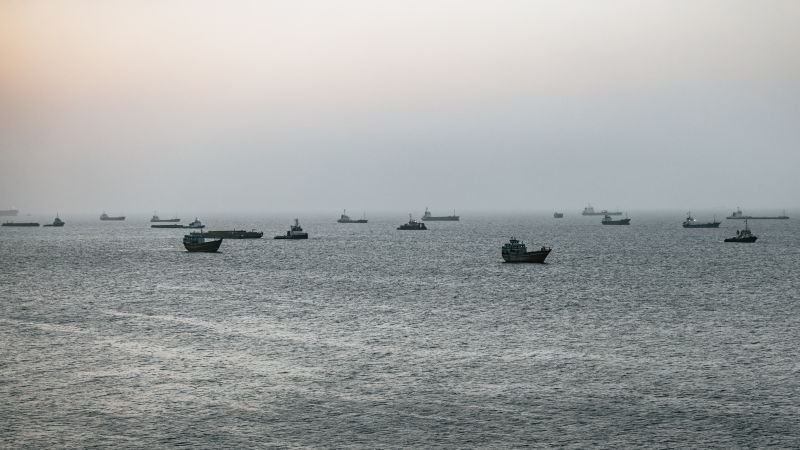
• Oil prices fall: US oil prices have fallen to their lowest level since the start of the Iran war after a surge as fighting shut down the Strait of Hormuz. In recent days, however, prices have declined amid optimism that the US-Iran agreement will reopen the strait. Traffic in the vital waterway has also doubled over the past 24 hours to its highest level since late February, according to MarineTraffic data.
• Diplomatic push: US Secretary of State Marco Rubio is in the Persian Gulf region, looking to sell the US-Iran agreement to the United Arab Emirates, Kuwait and Bahrain — countries likely to be among its biggest skeptics.
• Nuclear monitoring: The fate of Iran’s nuclear program has emerged as an obstacle to achieving a long-term deal after Tehran rejected remarks by a senior UN official that inspectors would have full access to its sites. Several Trump administration officials also claimed that Iran approved trips to nuclear areas by International Atomic Energy Agency members.
31 Posts
United States Secretary of State Marco Rubio is on a sales trip, looking to get Gulf nations on board with the US-Iran agreement to end the war. Technical talks with Iran are set to move ahead, Rubio said, but the fate of Iran’s nuclear program has emerged a clear obstacle to achieving a long-term ceasefire deal.
Closer to home, US President Donald Trump met with NATO Secretary General Mark Rutte in the Oval Office ahead of a summit with the alliance in two weeks.
If you’re just reading in, here’s what to know:
Rubio said he was visiting Kuwait, the United Arab Emirates and Bahrain to solicit their input and thank them “for the incredible support they gave us throughout this process.” Notably, he did not visit Israeli Prime Minister Benjamin Netanyahu.
The top US diplomat stressed the US would not “undermine” its Persian Gulf allies in the negotiations with Iran and described his conversations as “very frank, honest, important.”
Upcoming technical talks with Iran as part of ongoing negotiations will be held at the expert level with “work groups on various subjects” starting June 30, according to Rubio.
Rubio stressed that nuclear inspectors should be allowed into Iran “as soon as possible,” telling reporters “that’s a commitment (Iran) made, and it’s one they need to keep.” It comes after Tehran rejected remarks by a senior UN official that inspectors would have full access to its sites.
Trump, in remarks alongside Rutte, decried a bipartisan rebuke from the Senate of his war with Iran and dismissed the possibility that the US was responsible for striking an Iranian elementary school early in the war.
The Trump administration is requesting $87.6 billion in supplemental funding, most of it to replenish resources depleted by the war in Iran, according to a letter obtained by CNN.
Two people were killed in an Israeli drone strike in Kfar Rumman, southern Lebanon, on Wednesday, according to Lebanese state media.
It comes as the second day of US-mediated talks between Israel and Lebanon took place at the US State Department, a State Department official said. The latest round of working level talks began Tuesday and is scheduled to last through Thursday.
A key goal of those negotiations is for the Lebanese Armed Forces to “be able to control more and more of their own territory” over Hezbollah, Rubio said, but he didn’t explicitly call for the withdrawal of Israeli forces.
Vessel traffic in the Strait of Hormuz has doubled over the past 24 hours to its highest level since late February, according to CNN’s review of MarineTraffic data. At least 34 vessels exited the strait into the Gulf of Oman. Before the war, an average of 110 vessels transited the waterway.
US oil prices fell to their lowest level since the war with Iran began. West Texas Intermediate (WTI), the US benchmark, fell 4.4% to just below $70 per barrel. Brent crude, the global benchmark, fell 4.6% to $73.50 per barrel.
CNN’s John Towfighi, Jennifer Hansler, Avery Schmitz, Kevin Liptak, Nadeen Ebrahim, Annie Grayer, Michael Rios, Charbel Mallo, Dana Karni and Sana Noor Haq contributed reporting to this post.
NATO Secretary General Mark Rutte declined to say if he agreed with President Donald Trump that Iran should have ballistic missiles.
Trump said last week that he supports Iran having access to “some” conventional ballistic missiles, which, he said, “aren’t the problem,” even though he has previously called to eliminate the threat of Iran’s ballistic missile program.
Asked about the matter by CNN’s Kaitlan Collins outside the White House on Wednesday, Rutte said he couldn’t “comment on everything,” and instead wanted to focus on Iran’s nuclear capability.
“What is important here is for NATO – that we always had a consistent position as an alliance with the United States, all the 32 nations – that Iran should never get its hands on the nuclear capability,” he said.
The Trump administration is requesting $87.6 billion in supplemental funding from Congress to replenish resources depleted from the Iran war and to complete restoration projects in Washington DC, according to a letter obtained by CNN.
The bulk of the request comes from the Defense Department, which is asking Congress to appropriate over $67.1 billion to address operation costs as a result of the Iran war. Defense Secretary Pete Hegseth has been meeting with lawmakers in the lead up to the formal ask.
Other agencies are also asking Congress for more funding as the result of the war, including over $2 billion to the Department of Homeland Security to help the Coast Guard specifically, over $90 million from the Department of Energy for a classified request related to operation in Iran, and $40 million from the Department of Justice.
The request from the Office of Management and Budget to House Speaker Mike Johnson formalizes demands that will test Republican support for the war effort.
But the request goes beyond the Iran war.
The Department of the Interior is asking Congress for $500 million for the construction account within the National Park Service to help restore the Seawall and the World War II Memorial. The Department of Agriculture is seeking $11 billion to provide economic assistance to farmers and for agricultural producers who faced damages from winter storms.
Beyond funding requests, the administration is also asking Congress to permanently allow the sale of an ethanol-gas blend, E15, at the pumps year-round, among other rule changes.
NATO Secretary General Mark Rutte praised President Donald Trump’s leadership during the Iran war, saying his actions have degraded the country’s nuclear capability.
Speaking to the press alongside Trump in the Oval Office, Rutte also credited the president for an increase in defense spending by NATO allies.
At the same time, Rutte walked a diplomatic tightrope by defending Europe’s support to the US during the Iran war after Trump said he was “disappointed” with some allies for not doing enough.
The NATO chief highlighted that as many as 5,000 US military planes took off from Europe during the war.
President Donald Trump decried a bipartisan rebuke from the Senate of his war with Iran, saying the timing of the vote this week was inconvenient.
“We’re doing great in our negotiations with Iran, right in the middle of one of the key things, which we’re going to get anyway,” he told reporters in the Oval Office, describing the progress he said was interrupted by the vote.
The Senate adopted a resolution on Tuesday directing the president to remove military forces from the conflict with Iran, a significant rebuke to Trump and a strong message that the war lacks support in Congress.
President Donald Trump again dismissed the possibility that the US was responsible for striking an Iranian elementary school early in the war, questioning whether an ongoing investigation would ever determine who was responsible.
The US is still probing the specifics of the strike that killed more than 100 children. Preliminary findings have indicated that it was an American missile that hit the school.
Defense Secretary Pete Hegseth on Wednesday said the US has “taken the investigation very seriously” and would release the findings when concluded, “whatever that outcome is.”
But Trump cast doubt on the US taking any blame, telling reporters that he doesn’t personally believe that the missile was American.
Normally a staunch supporter of Israel, US Secretary of State Marco Rubio did not visit the key US ally on his tour of the three Arab states in the Persian Gulf, in what analysts described as yet another snub of Israeli Prime Minister Benjamin Netanyahu amid negotiations with Iran.
US President Donald Trump has grown increasingly frustrated with the Israeli leader, primarily over Israel’s actions in Lebanon, where clashes between Israel and the Iranian-backed Hezbollah militia have threatened the nascent agreement.
Today, a key visit to the Middle East that would normally include a stop in Israel is underway — without Netanyahu’s input.
“The fact that Rubio is not arriving to Israel again shows that there is a tension between the US and Israel,” Danny Citrinowitz, former head of the Iran branch of Israel’s military intelligence, told CNN. The move “highlighted the fact that the US does not see Israel as a part of negotiations toward an agreement, but they definitely see the Gulf states” as part of it, he added.
State Department spokesperson Tommy Pigott said Rubio’s trip was meant to thank Persian Gulf allies for their support and mark the resumption of operations at the US Embassy in Kuwait.
“Secretary Rubio has been to Israel as secretary multiple times, and speaks with officials from Israel often, as he does with our partners and allies across the region,” Pigott said.
Though the Israeli leader has been largely silent on the deal, pro-Netanyahu media figures have ripped the agreement, which could lead to the easing of economic sanctions on Tehran while delaying talks on the issues that were Israel’s declared war goals — including Iran’s nuclear program and its ballistic missile arsenal.
Yossi Mekelberg, an associate fellow with the Middle East and North Africa Program at the Chatham House think tank in London, told CNN that Israel is dealing with a “flip-flopping” administration that operates on what serves its interests best.
Experts have said that Israel more than once emerged as a potential spoiler in the US-Iran agreement, leading to sharp rebukes from both Trump and US Vice President JD Vance.
The implication is that Netanyahu “is not a player in negotiations,” Mekelberg said, even if he pretends to be.
CNN’s Jennifer Hansler contributed reporting to this post.
Vessel traffic in the Strait of Hormuz doubled over the past 24 hours to its highest level since late February, according to CNN’s review of MarineTraffic data.
At least 34 vessels exited the strait into the Gulf of Oman, including at least 14 tankers and 20 cargo ships. An additional 20 vessels entered the Persian Gulf, including nine tankers and 11 cargo ships.
Before the war, an average of 110 vessels transited the Strait of Hormuz every day.
This spike in shipping volume comes as Secretary of State Marco Rubio urges the Persian Gulf’s Arab countries to support the US-Iran peace deal framework.
The Trump administration will “always prioritize wrongfully detained Americans everywhere in the world,” Secretary of State Marco Rubio said Wednesday, even as the two Americans designated by the State Department as wrongfully detained in Iran do not appear to be part of the ongoing negotiations with Tehran.
Asked about the detained in Americans in Iran, Rubio said, “That’s always an issue we’ll raise in every form that it becomes available.”
“I don’t want to discuss any specific cases. That complicates them. And that’s not just true with Iran, that’s true in other parts of the world as well,” he told reporters in Kuwaut.
“But just know that the issue of wrongfully detained Americans, we have an entire office that’s dedicated to that. We raise it in every form and in every opportunity we get, and we make it our highest priority,” Rubio said.
Two Americans imprisoned in Iran — Reza Valizadeh and Kamran Hekmati — have been listed by the State Department as wrongfully detained. The agency made the designation for Valizadeh, a journalist, in 2025 and Hekmati, who ran a jewelry business, in 2026. Both are dual US-Iranian citizens.
Two people were killed in an Israeli drone strike in Kfar Rumman, southern Lebanon, on Wednesday, according to Lebanese state media, as Israeli and Lebanese officials pressed through fraught negotiations to end hostilities between Israel and Hezbollah.
The pair were killed after a drone strike on a “four-wheel” vehicle on the outskirts of Dabsha, near Kfar Rumman, Lebanon’s National News Agency (NNA) reported. Footage from the aftermath showed clouds of dark gray smoke rolling over a stretch of land in the south.
Responding to questions about the strike, the IDF said a vehicle “carrying suspects was identified crossing the Security Zone in the Ali al-Taher Ridge area, posing a threat to IDF soldiers.” The Israeli air force “struck the suspects in order to remove the threat,” the IDF said.
Israel’s bombing campaign in Lebanon, after Iran-backed Hezbollah fired projectiles into northern Israel in early March, has strained efforts for a definitive peace deal in the region. On Wednesday, Israeli Defense Minister Israel Katz warned that “under no circumstances” would troops withdraw from occupied positions in Lebanon, even if the US demanded as much.
In Washington, meanwhile, the Israeli and Lebanese ambassadors met for a second day of US-mediated talks — after a fragile truce between Israel and Hezbollah materialized earlier this month, the terms of which both parties have disputed.
Israeli strikes in Lebanon have killed at least 4,192 people and injured 12,171 others since March 2, the Lebanese Ministry of Public Health reported Tuesday.
In that time, Hezbollah has fired more than 7,000 rockets, missiles and drones toward Israel, according to Israeli Foreign Minister Gideon Saar. Thirty-six Israeli soldiers and four civilians have been killed, according to a CNN tally of figures published by Israeli officials.
CNN’s Eyad Kourdi contributed to this report.
Secretary of State Marco Rubio said a key goal of ongoing negotiations between Israel and Lebanon is for the Lebanese Armed Forces to “be able to control more and more of their own territory” over Hezbollah, but did not explicitly call for the withdrawal of Israeli forces.
“The whole reason Israel is in Lebanon is because Hezbollah launches rockets and drones from there. They’ve made that clear,” Rubio told reporters Wednesday in Kuwait amid ongoing US-mediated talks between Israel and Lebanon at the State Department.
“The more of that area the Lebanese Armed Forces is able to secure, the less of it’s in Hezbollah’s control, the less Israel will be in Lebanon. But obviously that’s the process we’re walking through right now with these talks,” the top US diplomat said.
He noted that the capacity of the Lebanese Armed Forces would have to be built up, and that “this is not going to happen overnight.”
“I remind everybody that Israel was conducting operations in southern Lebanon well before this operation happened, and so this is something we all want to see resolved for the future of Lebanon,” he said.
The latest round of talks at the State Department began on Tuesday and are expected to last through Thursday.
US Secretary of State Marco Rubio said Wednesday that upcoming technical talks with Iran as part of ongoing negotiations will be held at the expert level with “work groups on various subjects.”
He said he believes they will start on June 30, and that they, “are at the staff level, experts on nuclear energy, as an example, on sanctions, and so forth.”
“There’s individuals from the State Department that will be involved in those talks, along with people from the Department of Energy, and so forth. That’s what the technical level is,” he told reporters in Kuwait.
The top US diplomat also stressed that nuclear inspectors should be allowed into Iran “as soon as possible,” telling reporters “that’s a commitment (Iran) made, and it’s one they need to keep.”
US Secretary of State Marco Rubio stressed Wednesday that the US would not “undermine” its Persian Gulf allies in the negotiations with Iran and said he “didn’t sense any doubts about our security assurances” to the region.
Rubio reiterated that he was visiting Kuwait, the United Arab Emirates and Bahrain to solicit their input and thank them “for the incredible support they gave us throughout this process.”
“We want to reiterate and begin to talk to them and engage them on conversations about every decision that’s made with regards to this negotiation,” he told reporters in Kuwait.
“We’re not going to do anything that undermines the security of our allies, our long-standing allies in the region,” he said.
Rubio described his conversations as “very frank, honest, important.”
“I think we’re very strongly aligned,” Rubio told reporters. He said that the US will be “completely aligned with our partners in the Gulf” on Iran’s missile program.
The top US diplomat said they “didn’t even have to talk about” security assurances “because they’re real, they’re not promises, they’re actual, they exist.”
“We have existing relationships with these countries that go back many, many decades,” Rubio said. “We have troop presence in these countries; we have assets in these countries.”
Iran expert Ali Vaez explains to CNN’s Becky Anderson why there has been backlash against Iranian negotiators from hard-liners in Tehran.
The second day of US-mediated talks between Israel and Lebanon is underway at the US State Department, a State Department official said Wednesday.
“Israel and Lebanon are negotiating as two sovereign states with the goal of finding long-lasting peace and security. Our shared goal is to end the cycle of violence for good,” the official said. “The talks continue to advance a comprehensive peace and security between the two countries.”
This latest round of working level talks began on Tuesday and is schedule to last through Thursday. There are expected to be both political and military track discussions.
Secretary of State Marco Rubio on Tuesday continued to try to delink the ongoing talks from the US-Iran negotiations, even as Iran has publicly insisted they are connected.
“It’s separate because Lebanon is a sovereign country,” Rubio said upon his arrival in the United Arab Emirates. “When it comes to Lebanon, and what’s happening inside of Lebanon, we’re going to negotiate and deal directly with the Lebanese government.”
“There’s an Iranian issue with regards to Lebanon,” he said, “and that is their support and sponsorship of Hezbollah.”
Iran has repeatedly threatened to leave its negotiations with the US over strikes by Israel in Lebanon during the nominal ceasefire. Israel says the strikes are in self-defense against Hezbollah.
US oil prices fell Wednesday to their lowest level since the war with Iran began.
West Texas Intermediate (WTI), the US benchmark, fell 4.4% to just below $70 per barrel. This is the first time WTI has dipped below that level since the war began nearly four months ago.
Brent crude, the global benchmark, fell 4.6% to $73.50 per barrel on Wednesday, also its lowest level since the war with Iran began.
Oil prices surged during the war as fighting shut down the Strait of Hormuz. But prices have declined in recent days as traders lean into optimism that the US-Iran agreement will open the key waterway as well as reports of a slight uptick in ship traffic.
Still, traders are keeping an eye that traffic continues flowing through the strait, as well as whether fighting will remain contained across the Middle East.
The United States has resumed operations at its embassy in Kuwait more than three months after closing it due to the war in Iran.
According to a State Department spokesperson, “effective at midnight on June 24, 2026, the US Embassy in Kuwait resumed operations following a suspension caused by Iranian attacks.”
“The Embassy will immediately resume emergency services for American citizens, with other services phased in gradually,” the spokesperson said.
Secretary of State Marco Rubio is in Kuwait as part of a trip to three Arab countries along the Persian Gulf. He saw the American flag raised at the embassy on Tuesday.
The US suspended operations at the embassy in early March, noting at the time that “while there have been no reported injuries to US personnel, the safety of Americans abroad remains the highest priority of the US Department of State.”
The full closure of the embassy spoke to the high level of risk faced by US personnel on the ground. The embassy had been hit several times by suspected Iranian drones.
Many US diplomatic facilities in the region are operating with only emergency personnel after staff were put on ordered or authorized departure during the war.
The fate of Iran’s nuclear program has emerged a clear obstacle to achieving a long-term ceasefire deal again on Wednesday, after Tehran rejected remarks by a senior UN official that inspectors would have full access to its sites.
Earlier this week, several Trump administration officials — including the US president — repeated claims that Iran’s delegation approved trips to nuclear areas by members of the International Atomic Energy Agency (IAEA). The head of the IAEA, Rafael Mariano Grossi, insisted Wednesday that inspectors would visit.
But Iranian officials say any UN checks will only be determined once a final deal materializes. Technical-level talks between the US and Iran are set to resume next week, according to Pakistan’s Foreign Ministry.
At the same time, Israel’s defense minister warned that Israeli forces will not withdraw from Lebanon under any circumstances, even if the US demands it.
Here’s what else you need to know:
Rubio meets UAE president on gulf tour: US Secretary of State Marco Rubio met with United Arab Emirates President Sheikh Mohamed bin Zayed Al Nahyan as part of a diplomatic push to reassure Persian Gulf allies about the fraught agreement with Iran.
“Under no circumstances will we withdraw”: Defense Minister Israel Katz warned that “under no circumstances” would Israeli troops retreat from Lebanon, saying he has made Israel’s position clear to his US counterpart.
Tehran primed for “security agreements” with gulf states: Iran’s chief negotiator announced that the country is “ready for security agreements with Islamic countries,” including those in the Persian Gulf. Mohammad Bagher Ghalibaf heralded “sustainable economic cooperation” at a conference in Azerbaijan. The United Arab Emirates, Bahrain and Kuwait were among the states most heavily targeted by Iran during the war.
Oil prices decline: The global benchmark price fell below $76 a barrel — the price it was trading at before the war began — as investors become increasingly encouraged that oil tanker traffic through the Strait of Hormuz could soon return to normal.
Qatar to resume pre-war gas production: Qatari officials will restart pre-war production of liquefied natural gas within a “few weeks,” according to the country’s prime minister, after several Iranian strikes strained energy output at a key facility. The gulf nation is responsible for around one-fifth of global LNG exports, the US Energy Information Administration said.
Israel will not withdraw from Lebanon, the country’s defense minister said on Wednesday, even the US demands it.
“We have made it clear that under no circumstances will we withdraw, and as of this moment – and this is a diplomatic achievement – there is no American demand for Israel to withdraw from Lebanon,” said Israel Katz, speaking at the MUNI EXPO conference in Tel Aviv.
Katz said he had made Israel’s position clear to his US counterpart, and Israeli Prime Minister Benjamin Netanyahu had said as much to US President Donald Trump.
Katz’s comments come on the second day of talks between Israel and Lebanon under the auspices of the Trump administration.
Katz had already said that Israel would not pull its forces back in southern Lebanon, but his latest comments make his position explicit even if it’s a US demand. CNN previously reported that Israel is considering “symbolic” withdrawals from occupied territory in southern Lebanon as part of the talks as a “gesture” to the Lebanese government.
Lebanon expressed its openness to discuss with Israel the security arrangements it may propose but insisted that the country will evaluate and discuss what it deems acceptable and what it doesn’t.
“We expect that the Israeli side may propose security arrangements, and we will discuss what is acceptable amongst them and what is not. And I am not pessimistic,” said Lebanese Prime Minister Nawaf Salam, according to the prime minister’s office post on X.
Salam stressed the county’s demands to release Lebanese prisoners from Israel and the need to resolve the border related issues.
Israeli disputes with the Lebanese government do not exceed “a few border issues that can be resolved through short negotiations,” said Israeli Foreign Minister Gideon Saar on Wednesday.
The Lebanese prime minister distinguished between the Switzerland talks and the Washington talks, referring to the latter as “the least costly path for Lebanon.”
The Lebanese and Israeli negotiating teams started their fifth round of discussions in DC on Tuesday. Israel’s ambassador to the US warned that the talks are “heading toward a train wreck” because of Iranian influence in Lebanon.
CNN previously reported that Israel is considering “symbolic” withdrawals from occupied territory in southern Lebanon as part of the talks as a “gesture” to the Lebanese government.
• Oil prices fall: US oil prices have fallen to their lowest level since the start of the Iran war after a surge as fighting shut down the Strait of Hormuz. In recent days, however, prices have declined amid optimism that the US-Iran agreement will reopen the strait. Traffic in the vital waterway has also doubled over the past 24 hours to its highest level since late February, according to MarineTraffic data.
• Diplomatic push: US Secretary of State Marco Rubio is in the Persian Gulf region, looking to sell the US-Iran agreement to the United Arab Emirates, Kuwait and Bahrain — countries likely to be among its biggest skeptics.
• Nuclear monitoring: The fate of Iran’s nuclear program has emerged as an obstacle to achieving a long-term deal after Tehran rejected remarks by a senior UN official that inspectors would have full access to its sites. Several Trump administration officials also claimed that Iran approved trips to nuclear areas by International Atomic Energy Agency members.
United States Secretary of State Marco Rubio is on a sales trip, looking to get Gulf nations on board with the US-Iran agreement to end the war. Technical talks with Iran are set to move ahead, Rubio said, but the fate of Iran’s nuclear program has emerged a clear obstacle to achieving a long-term ceasefire deal.
Closer to home, US President Donald Trump met with NATO Secretary General Mark Rutte in the Oval Office ahead of a summit with the alliance in two weeks.
If you’re just reading in, here’s what to know:
Rubio said he was visiting Kuwait, the United Arab Emirates and Bahrain to solicit their input and thank them “for the incredible support they gave us throughout this process.” Notably, he did not visit Israeli Prime Minister Benjamin Netanyahu.
The top US diplomat stressed the US would not “undermine” its Persian Gulf allies in the negotiations with Iran and described his conversations as “very frank, honest, important.”
Upcoming technical talks with Iran as part of ongoing negotiations will be held at the expert level with “work groups on various subjects” starting June 30, according to Rubio.
Rubio stressed that nuclear inspectors should be allowed into Iran “as soon as possible,” telling reporters “that’s a commitment (Iran) made, and it’s one they need to keep.” It comes after Tehran rejected remarks by a senior UN official that inspectors would have full access to its sites.
Trump, in remarks alongside Rutte, decried a bipartisan rebuke from the Senate of his war with Iran and dismissed the possibility that the US was responsible for striking an Iranian elementary school early in the war.
The Trump administration is requesting $87.6 billion in supplemental funding, most of it to replenish resources depleted by the war in Iran, according to a letter obtained by CNN.
Two people were killed in an Israeli drone strike in Kfar Rumman, southern Lebanon, on Wednesday, according to Lebanese state media.
It comes as the second day of US-mediated talks between Israel and Lebanon took place at the US State Department, a State Department official said. The latest round of working level talks began Tuesday and is scheduled to last through Thursday.
A key goal of those negotiations is for the Lebanese Armed Forces to “be able to control more and more of their own territory” over Hezbollah, Rubio said, but he didn’t explicitly call for the withdrawal of Israeli forces.
Vessel traffic in the Strait of Hormuz has doubled over the past 24 hours to its highest level since late February, according to CNN’s review of MarineTraffic data. At least 34 vessels exited the strait into the Gulf of Oman. Before the war, an average of 110 vessels transited the waterway.
US oil prices fell to their lowest level since the war with Iran began. West Texas Intermediate (WTI), the US benchmark, fell 4.4% to just below $70 per barrel. Brent crude, the global benchmark, fell 4.6% to $73.50 per barrel.
CNN’s John Towfighi, Jennifer Hansler, Avery Schmitz, Kevin Liptak, Nadeen Ebrahim, Annie Grayer, Michael Rios, Charbel Mallo, Dana Karni and Sana Noor Haq contributed reporting to this post.
NATO Secretary General Mark Rutte declined to say if he agreed with President Donald Trump that Iran should have ballistic missiles.
Trump said last week that he supports Iran having access to “some” conventional ballistic missiles, which, he said, “aren’t the problem,” even though he has previously called to eliminate the threat of Iran’s ballistic missile program.
Asked about the matter by CNN’s Kaitlan Collins outside the White House on Wednesday, Rutte said he couldn’t “comment on everything,” and instead wanted to focus on Iran’s nuclear capability.
“What is important here is for NATO – that we always had a consistent position as an alliance with the United States, all the 32 nations – that Iran should never get its hands on the nuclear capability,” he said.
The Trump administration is requesting $87.6 billion in supplemental funding from Congress to replenish resources depleted from the Iran war and to complete restoration projects in Washington DC, according to a letter obtained by CNN.
The bulk of the request comes from the Defense Department, which is asking Congress to appropriate over $67.1 billion to address operation costs as a result of the Iran war. Defense Secretary Pete Hegseth has been meeting with lawmakers in the lead up to the formal ask.
Other agencies are also asking Congress for more funding as the result of the war, including over $2 billion to the Department of Homeland Security to help the Coast Guard specifically, over $90 million from the Department of Energy for a classified request related to operation in Iran, and $40 million from the Department of Justice.
The request from the Office of Management and Budget to House Speaker Mike Johnson formalizes demands that will test Republican support for the war effort.
But the request goes beyond the Iran war.
The Department of the Interior is asking Congress for $500 million for the construction account within the National Park Service to help restore the Seawall and the World War II Memorial. The Department of Agriculture is seeking $11 billion to provide economic assistance to farmers and for agricultural producers who faced damages from winter storms.
Beyond funding requests, the administration is also asking Congress to permanently allow the sale of an ethanol-gas blend, E15, at the pumps year-round, among other rule changes.
NATO Secretary General Mark Rutte praised President Donald Trump’s leadership during the Iran war, saying his actions have degraded the country’s nuclear capability.
Speaking to the press alongside Trump in the Oval Office, Rutte also credited the president for an increase in defense spending by NATO allies.
At the same time, Rutte walked a diplomatic tightrope by defending Europe’s support to the US during the Iran war after Trump said he was “disappointed” with some allies for not doing enough.
The NATO chief highlighted that as many as 5,000 US military planes took off from Europe during the war.
President Donald Trump decried a bipartisan rebuke from the Senate of his war with Iran, saying the timing of the vote this week was inconvenient.
“We’re doing great in our negotiations with Iran, right in the middle of one of the key things, which we’re going to get anyway,” he told reporters in the Oval Office, describing the progress he said was interrupted by the vote.
The Senate adopted a resolution on Tuesday directing the president to remove military forces from the conflict with Iran, a significant rebuke to Trump and a strong message that the war lacks support in Congress.
President Donald Trump again dismissed the possibility that the US was responsible for striking an Iranian elementary school early in the war, questioning whether an ongoing investigation would ever determine who was responsible.
The US is still probing the specifics of the strike that killed more than 100 children. Preliminary findings have indicated that it was an American missile that hit the school.
Defense Secretary Pete Hegseth on Wednesday said the US has “taken the investigation very seriously” and would release the findings when concluded, “whatever that outcome is.”
But Trump cast doubt on the US taking any blame, telling reporters that he doesn’t personally believe that the missile was American.
Normally a staunch supporter of Israel, US Secretary of State Marco Rubio did not visit the key US ally on his tour of the three Arab states in the Persian Gulf, in what analysts described as yet another snub of Israeli Prime Minister Benjamin Netanyahu amid negotiations with Iran.
US President Donald Trump has grown increasingly frustrated with the Israeli leader, primarily over Israel’s actions in Lebanon, where clashes between Israel and the Iranian-backed Hezbollah militia have threatened the nascent agreement.
Today, a key visit to the Middle East that would normally include a stop in Israel is underway — without Netanyahu’s input.
“The fact that Rubio is not arriving to Israel again shows that there is a tension between the US and Israel,” Danny Citrinowitz, former head of the Iran branch of Israel’s military intelligence, told CNN. The move “highlighted the fact that the US does not see Israel as a part of negotiations toward an agreement, but they definitely see the Gulf states” as part of it, he added.
State Department spokesperson Tommy Pigott said Rubio’s trip was meant to thank Persian Gulf allies for their support and mark the resumption of operations at the US Embassy in Kuwait.
“Secretary Rubio has been to Israel as secretary multiple times, and speaks with officials from Israel often, as he does with our partners and allies across the region,” Pigott said.
Though the Israeli leader has been largely silent on the deal, pro-Netanyahu media figures have ripped the agreement, which could lead to the easing of economic sanctions on Tehran while delaying talks on the issues that were Israel’s declared war goals — including Iran’s nuclear program and its ballistic missile arsenal.
Yossi Mekelberg, an associate fellow with the Middle East and North Africa Program at the Chatham House think tank in London, told CNN that Israel is dealing with a “flip-flopping” administration that operates on what serves its interests best.
Experts have said that Israel more than once emerged as a potential spoiler in the US-Iran agreement, leading to sharp rebukes from both Trump and US Vice President JD Vance.
The implication is that Netanyahu “is not a player in negotiations,” Mekelberg said, even if he pretends to be.
CNN’s Jennifer Hansler contributed reporting to this post.
Vessel traffic in the Strait of Hormuz doubled over the past 24 hours to its highest level since late February, according to CNN’s review of MarineTraffic data.
At least 34 vessels exited the strait into the Gulf of Oman, including at least 14 tankers and 20 cargo ships. An additional 20 vessels entered the Persian Gulf, including nine tankers and 11 cargo ships.
Before the war, an average of 110 vessels transited the Strait of Hormuz every day.
This spike in shipping volume comes as Secretary of State Marco Rubio urges the Persian Gulf’s Arab countries to support the US-Iran peace deal framework.
The Trump administration will “always prioritize wrongfully detained Americans everywhere in the world,” Secretary of State Marco Rubio said Wednesday, even as the two Americans designated by the State Department as wrongfully detained in Iran do not appear to be part of the ongoing negotiations with Tehran.
Asked about the detained in Americans in Iran, Rubio said, “That’s always an issue we’ll raise in every form that it becomes available.”
“I don’t want to discuss any specific cases. That complicates them. And that’s not just true with Iran, that’s true in other parts of the world as well,” he told reporters in Kuwaut.
“But just know that the issue of wrongfully detained Americans, we have an entire office that’s dedicated to that. We raise it in every form and in every opportunity we get, and we make it our highest priority,” Rubio said.
Two Americans imprisoned in Iran — Reza Valizadeh and Kamran Hekmati — have been listed by the State Department as wrongfully detained. The agency made the designation for Valizadeh, a journalist, in 2025 and Hekmati, who ran a jewelry business, in 2026. Both are dual US-Iranian citizens.
Two people were killed in an Israeli drone strike in Kfar Rumman, southern Lebanon, on Wednesday, according to Lebanese state media, as Israeli and Lebanese officials pressed through fraught negotiations to end hostilities between Israel and Hezbollah.
The pair were killed after a drone strike on a “four-wheel” vehicle on the outskirts of Dabsha, near Kfar Rumman, Lebanon’s National News Agency (NNA) reported. Footage from the aftermath showed clouds of dark gray smoke rolling over a stretch of land in the south.
Responding to questions about the strike, the IDF said a vehicle “carrying suspects was identified crossing the Security Zone in the Ali al-Taher Ridge area, posing a threat to IDF soldiers.” The Israeli air force “struck the suspects in order to remove the threat,” the IDF said.
Israel’s bombing campaign in Lebanon, after Iran-backed Hezbollah fired projectiles into northern Israel in early March, has strained efforts for a definitive peace deal in the region. On Wednesday, Israeli Defense Minister Israel Katz warned that “under no circumstances” would troops withdraw from occupied positions in Lebanon, even if the US demanded as much.
In Washington, meanwhile, the Israeli and Lebanese ambassadors met for a second day of US-mediated talks — after a fragile truce between Israel and Hezbollah materialized earlier this month, the terms of which both parties have disputed.
Israeli strikes in Lebanon have killed at least 4,192 people and injured 12,171 others since March 2, the Lebanese Ministry of Public Health reported Tuesday.
In that time, Hezbollah has fired more than 7,000 rockets, missiles and drones toward Israel, according to Israeli Foreign Minister Gideon Saar. Thirty-six Israeli soldiers and four civilians have been killed, according to a CNN tally of figures published by Israeli officials.
CNN’s Eyad Kourdi contributed to this report.
Secretary of State Marco Rubio said a key goal of ongoing negotiations between Israel and Lebanon is for the Lebanese Armed Forces to “be able to control more and more of their own territory” over Hezbollah, but did not explicitly call for the withdrawal of Israeli forces.
“The whole reason Israel is in Lebanon is because Hezbollah launches rockets and drones from there. They’ve made that clear,” Rubio told reporters Wednesday in Kuwait amid ongoing US-mediated talks between Israel and Lebanon at the State Department.
“The more of that area the Lebanese Armed Forces is able to secure, the less of it’s in Hezbollah’s control, the less Israel will be in Lebanon. But obviously that’s the process we’re walking through right now with these talks,” the top US diplomat said.
He noted that the capacity of the Lebanese Armed Forces would have to be built up, and that “this is not going to happen overnight.”
“I remind everybody that Israel was conducting operations in southern Lebanon well before this operation happened, and so this is something we all want to see resolved for the future of Lebanon,” he said.
The latest round of talks at the State Department began on Tuesday and are expected to last through Thursday.
US Secretary of State Marco Rubio said Wednesday that upcoming technical talks with Iran as part of ongoing negotiations will be held at the expert level with “work groups on various subjects.”
He said he believes they will start on June 30, and that they, “are at the staff level, experts on nuclear energy, as an example, on sanctions, and so forth.”
“There’s individuals from the State Department that will be involved in those talks, along with people from the Department of Energy, and so forth. That’s what the technical level is,” he told reporters in Kuwait.
The top US diplomat also stressed that nuclear inspectors should be allowed into Iran “as soon as possible,” telling reporters “that’s a commitment (Iran) made, and it’s one they need to keep.”
US Secretary of State Marco Rubio stressed Wednesday that the US would not “undermine” its Persian Gulf allies in the negotiations with Iran and said he “didn’t sense any doubts about our security assurances” to the region.
Rubio reiterated that he was visiting Kuwait, the United Arab Emirates and Bahrain to solicit their input and thank them “for the incredible support they gave us throughout this process.”
“We want to reiterate and begin to talk to them and engage them on conversations about every decision that’s made with regards to this negotiation,” he told reporters in Kuwait.
“We’re not going to do anything that undermines the security of our allies, our long-standing allies in the region,” he said.
Rubio described his conversations as “very frank, honest, important.”
“I think we’re very strongly aligned,” Rubio told reporters. He said that the US will be “completely aligned with our partners in the Gulf” on Iran’s missile program.
The top US diplomat said they “didn’t even have to talk about” security assurances “because they’re real, they’re not promises, they’re actual, they exist.”
“We have existing relationships with these countries that go back many, many decades,” Rubio said. “We have troop presence in these countries; we have assets in these countries.”
Iran expert Ali Vaez explains to CNN’s Becky Anderson why there has been backlash against Iranian negotiators from hard-liners in Tehran.
The second day of US-mediated talks between Israel and Lebanon is underway at the US State Department, a State Department official said Wednesday.
“Israel and Lebanon are negotiating as two sovereign states with the goal of finding long-lasting peace and security. Our shared goal is to end the cycle of violence for good,” the official said. “The talks continue to advance a comprehensive peace and security between the two countries.”
This latest round of working level talks began on Tuesday and is schedule to last through Thursday. There are expected to be both political and military track discussions.
Secretary of State Marco Rubio on Tuesday continued to try to delink the ongoing talks from the US-Iran negotiations, even as Iran has publicly insisted they are connected.
“It’s separate because Lebanon is a sovereign country,” Rubio said upon his arrival in the United Arab Emirates. “When it comes to Lebanon, and what’s happening inside of Lebanon, we’re going to negotiate and deal directly with the Lebanese government.”
“There’s an Iranian issue with regards to Lebanon,” he said, “and that is their support and sponsorship of Hezbollah.”
Iran has repeatedly threatened to leave its negotiations with the US over strikes by Israel in Lebanon during the nominal ceasefire. Israel says the strikes are in self-defense against Hezbollah.
US oil prices fell Wednesday to their lowest level since the war with Iran began.
West Texas Intermediate (WTI), the US benchmark, fell 4.4% to just below $70 per barrel. This is the first time WTI has dipped below that level since the war began nearly four months ago.
Brent crude, the global benchmark, fell 4.6% to $73.50 per barrel on Wednesday, also its lowest level since the war with Iran began.
Oil prices surged during the war as fighting shut down the Strait of Hormuz. But prices have declined in recent days as traders lean into optimism that the US-Iran agreement will open the key waterway as well as reports of a slight uptick in ship traffic.
Still, traders are keeping an eye that traffic continues flowing through the strait, as well as whether fighting will remain contained across the Middle East.
The United States has resumed operations at its embassy in Kuwait more than three months after closing it due to the war in Iran.
According to a State Department spokesperson, “effective at midnight on June 24, 2026, the US Embassy in Kuwait resumed operations following a suspension caused by Iranian attacks.”
“The Embassy will immediately resume emergency services for American citizens, with other services phased in gradually,” the spokesperson said.
Secretary of State Marco Rubio is in Kuwait as part of a trip to three Arab countries along the Persian Gulf. He saw the American flag raised at the embassy on Tuesday.
The US suspended operations at the embassy in early March, noting at the time that “while there have been no reported injuries to US personnel, the safety of Americans abroad remains the highest priority of the US Department of State.”
The full closure of the embassy spoke to the high level of risk faced by US personnel on the ground. The embassy had been hit several times by suspected Iranian drones.
Many US diplomatic facilities in the region are operating with only emergency personnel after staff were put on ordered or authorized departure during the war.
The fate of Iran’s nuclear program has emerged a clear obstacle to achieving a long-term ceasefire deal again on Wednesday, after Tehran rejected remarks by a senior UN official that inspectors would have full access to its sites.
Earlier this week, several Trump administration officials — including the US president — repeated claims that Iran’s delegation approved trips to nuclear areas by members of the International Atomic Energy Agency (IAEA). The head of the IAEA, Rafael Mariano Grossi, insisted Wednesday that inspectors would visit.
But Iranian officials say any UN checks will only be determined once a final deal materializes. Technical-level talks between the US and Iran are set to resume next week, according to Pakistan’s Foreign Ministry.
At the same time, Israel’s defense minister warned that Israeli forces will not withdraw from Lebanon under any circumstances, even if the US demands it.
Here’s what else you need to know:
Rubio meets UAE president on gulf tour: US Secretary of State Marco Rubio met with United Arab Emirates President Sheikh Mohamed bin Zayed Al Nahyan as part of a diplomatic push to reassure Persian Gulf allies about the fraught agreement with Iran.
“Under no circumstances will we withdraw”: Defense Minister Israel Katz warned that “under no circumstances” would Israeli troops retreat from Lebanon, saying he has made Israel’s position clear to his US counterpart.
Tehran primed for “security agreements” with gulf states: Iran’s chief negotiator announced that the country is “ready for security agreements with Islamic countries,” including those in the Persian Gulf. Mohammad Bagher Ghalibaf heralded “sustainable economic cooperation” at a conference in Azerbaijan. The United Arab Emirates, Bahrain and Kuwait were among the states most heavily targeted by Iran during the war.
Oil prices decline: The global benchmark price fell below $76 a barrel — the price it was trading at before the war began — as investors become increasingly encouraged that oil tanker traffic through the Strait of Hormuz could soon return to normal.
Qatar to resume pre-war gas production: Qatari officials will restart pre-war production of liquefied natural gas within a “few weeks,” according to the country’s prime minister, after several Iranian strikes strained energy output at a key facility. The gulf nation is responsible for around one-fifth of global LNG exports, the US Energy Information Administration said.
Israel will not withdraw from Lebanon, the country’s defense minister said on Wednesday, even the US demands it.
“We have made it clear that under no circumstances will we withdraw, and as of this moment – and this is a diplomatic achievement – there is no American demand for Israel to withdraw from Lebanon,” said Israel Katz, speaking at the MUNI EXPO conference in Tel Aviv.
Katz said he had made Israel’s position clear to his US counterpart, and Israeli Prime Minister Benjamin Netanyahu had said as much to US President Donald Trump.
Katz’s comments come on the second day of talks between Israel and Lebanon under the auspices of the Trump administration.
Katz had already said that Israel would not pull its forces back in southern Lebanon, but his latest comments make his position explicit even if it’s a US demand. CNN previously reported that Israel is considering “symbolic” withdrawals from occupied territory in southern Lebanon as part of the talks as a “gesture” to the Lebanese government.
Lebanon expressed its openness to discuss with Israel the security arrangements it may propose but insisted that the country will evaluate and discuss what it deems acceptable and what it doesn’t.
“We expect that the Israeli side may propose security arrangements, and we will discuss what is acceptable amongst them and what is not. And I am not pessimistic,” said Lebanese Prime Minister Nawaf Salam, according to the prime minister’s office post on X.
Salam stressed the county’s demands to release Lebanese prisoners from Israel and the need to resolve the border related issues.
Israeli disputes with the Lebanese government do not exceed “a few border issues that can be resolved through short negotiations,” said Israeli Foreign Minister Gideon Saar on Wednesday.
The Lebanese prime minister distinguished between the Switzerland talks and the Washington talks, referring to the latter as “the least costly path for Lebanon.”
The Lebanese and Israeli negotiating teams started their fifth round of discussions in DC on Tuesday. Israel’s ambassador to the US warned that the talks are “heading toward a train wreck” because of Iranian influence in Lebanon.
CNN previously reported that Israel is considering “symbolic” withdrawals from occupied territory in southern Lebanon as part of the talks as a “gesture” to the Lebanese government.





Responses