
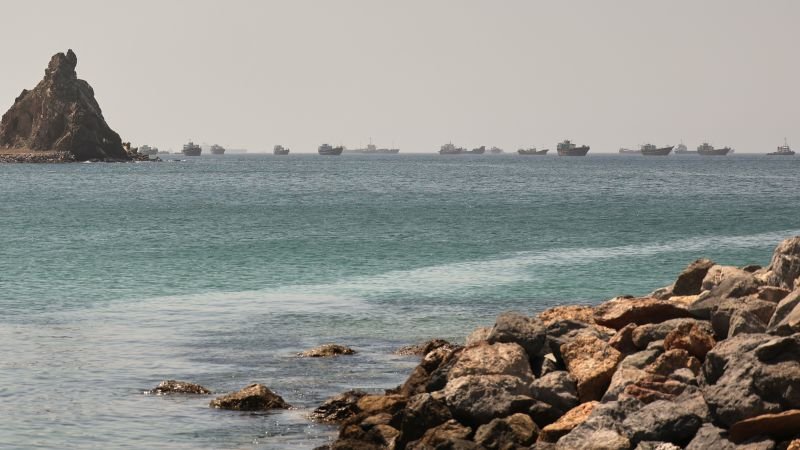
• Hostilities resume: The US military said it hit 140 Iranian military targets in its latest strikes, following an attack on a merchant ship passing through the Strait of Hormuz it blamed on Iran’s Islamic Revolutionary Guard Corps. It marks the third round of US strikes in a week and comes after both countries’ leaders issued public threats.
• Hormuz “closed”: Iran’s Revolutionary Guards declared the Strait of Hormuz “closed until further notice” and until “interference by the US ceases.” The US-led Joint Maritime Information Center said, however, that the “southern route” remains open.
• Regional turbulence: One Indian national is missing after the ship attack. And across the region, Iranian state media claimed its forces had retaliated by targeting US military sites and assets. Qatar said three people, including a child, were injured during interception operations.
• New proposal: Earlier Saturday, Oman drafted a tentative proposal for how to manage routes in the strait, a source told CNN. US officials previously said nuclear negotiations can’t progress until the strait is secure.
17 Posts
US Central Command has said that the Strait of Hormuz is “open to all vessels,” despite Iran’s Islamic Revolutionary Guard Corps (IRGC) announcing earlier today that it had closed the waterway.
“The Strait of Hormuz is open to all vessels seeking to lawfully transit the international waterway,” CENTCOM wrote in a post on X, adding: “US forces are positioned and prepared to ensure that freedom of navigation remains available despite unwarranted Iranian aggression, harassment, threats, and arbitrary declarations.”
Earlier today, the Joint Maritime Information Center (JMIC), which is overseen by the US Navy, said that the Omani “southern route” through the Strait of Hormuz remains available for two-way traffic. It also warned, however, that the security threat level in the waterway remains “severe.”
Traffic through the strait has once again dropped following Iran’s announcement, data from maritime tracking agency MarineTraffic showed this morning.
The US Embassy in Oman issued a “shelter in place” warning today for the Omani governorate of Musandam, which sits on the northeast tip of the Arabian Peninsula next to the Strait of Hormuz, as well as a port city on the Arabian Sea.
Iran targeted the Omani governorates of Musandam and Al Wusta – where the city of Duqm is located – in overnight drone attacks, according to Oman’s foreign ministry.
As a result, Muscat summoned Iran’s ambassador to the country to deliver a “formal note of protest,” the ministry said.
During the meeting, Sheikh Khalid bin Hashel Al Muslahi, Oman’s Undersecretary of the Ministry of Foreign Affairs for Administrative and Financial Affairs, expressed Muscat’s dissatisfaction with what he described as Iran’s “irresponsible acts,” the ministry added.
Early this morning local time in Iran, the Islamic Revolutionary Guard Corps (IRGC) announced that it had closed the Strait of Hormuz after firing a warning shot at a vessel it said was attempting to use an unauthorized route to cross the waterway.
However, the Joint Maritime Information Center, which is overseen by the US Navy, said the “southern route” through the Strait of Hormuz, which hugs the Omani coastline, remains open for two-way traffic.
The strait is the main route for shipping crude from oil-rich countries such as Saudi Arabia and Kuwait to the rest of the world.
Both Tehran and Muscat have Exclusive Economic Zones (EEZ) in the waterway.
According to the United Nations, a state has “sovereign rights” to explore, exploit, conserve and manage the natural resources of the waters in its EEZ.
However, under the United Nations Convention on the Law of the Sea (UNCLOS), “ships of all States, whether coastal or land-locked, enjoy the right of innocent passage through the territorial sea.”
A coastal state should not “hamper the innocent passage of foreign ships through the territorial sea,” it says, except in specific outlined scenarios. It may “take the necessary steps in its territorial sea to prevent passage which is not innocent,” UNCLOS outlines.
CNN’s Dalia Abdelwahab, Tim Lister and Billy Stockwell contributed to this reporting.
Traffic through the Strait of Hormuz has reduced to a trickle – yet again – after Iran claimed Sunday to have closed the critical waterway, tracking data shows.
Iran’s Islamic Revolutionary Guard Corps said early Sunday the Strait was closed after its forces fired a warning shot at a vessel it said was attempting to use an “unauthorized” route to cross the waterway.
Since then, very few vessels besides a handful of Iran-flagged ships have traversed the chokepoint, through which one-fifth of the world’s oil and liquefied natural gas supplies typically flow, according to data from maritime tracking agency MarineTraffic.
Meanwhile, a Bahamas-flagged laden oil/chemical tanker appears to be attempting to cross the channel using a route closer to the Iranian side of the Strait, MarineTraffic data shows.
Its destination is listed as the port city of Fujairah on the UAE’s eastern coast.
On Sunday, the Joint Maritime Information Center, which is overseen by the US Navy, said the “southern route” through the Strait of Hormuz, which hugs the Omani coastline, remains open for two-way traffic.
But movement remains muted despite the announcement, and Iran’s warning is already having knock-on effects across the region.
Qatar advised owners of maritime vessels earlier today to “temporarily suspend sailing and all forms of maritime activities,” including the use of leisure boats, fishing boats and jet skis, amid the latest flare-up in fighting near the waterway.
By now the pattern is familiar. An Iranian drone strikes a ship transiting the Strait of Hormuz without Tehran’s consent. The United States responds with air strikes against targets on the Iranian coast. Iran’s Islamic Revolutionary Guard Corps retaliates with missile and drone attacks on the US’ Gulf allies, claiming it is targeting American military facilities.
This sequence occurs even as Qatari and Pakistani mediators try to keep the diplomatic track alive. Qatar was targeted in the latest Iranian barrage. So was Oman, which on Saturday hosted Iranian Foreign Minister Abbas Araghchi for talks on navigation through the strait.
Hormuz offers Iran critical leverage. So long as it can limit passage through the strait, either through force or the threat of force, it can have an impact on global energy flows.
“This strategic waterway is one of the country’s deterrent assets,” said Mohsen Rezaei, military adviser to Iran’s Supreme Leader Mojtaba Khamenei, on Sunday.
Senior US officials said that Iranian negotiators had blamed an “errant part” of Iran’s system for attacks on three ships last week.
That “allows the regime to sustain talks and attempt to reap potential economic benefits while the IRGC continues to enforce Iran’s control over the strait,” the Washington-based Institute for the Study of War (ISW) said Saturday.
But “the differences between the negotiators and the IRGC are one of immediate tactical means – negotiations or military action – not strategic ends,” ISW added.
The US demands Iran publicly acknowledge that the strait is open to all commercial traffic and end attacks on vessels. Tehran has rejected any return to the pre-war situation, when there was unfettered freedom of navigation.
Squaring that circle seems beyond either side at present.
“US operations seem focused on imposing costs on Iran rather than fundamentally changing the strategic reality in the strait,” wrote Israeli analyst Danny Citrinowicz Sunday.
It’s difficult to see maritime traffic returning to normal unless “either Iran and Oman reach an arrangement that reduces tensions over navigation, or the United States abandons its effort to route tankers through the southern channel over Iran’s objections,” Citrinowicz said on X.
The Omani “southern route” through the Strait of Hormuz remains available for two-way traffic, despite Iran’s claim that the critical waterway is closed, according to the Joint Maritime Information Center (JMIC), which is overseen by the US Navy.
“US forces are prepared to maintain freedom of navigation and safeguard lawful commerce in accordance with international law. The southern route of the Strait remains open,” JMIC said in an advisory note published Sunday.
Despite this announcement, the security threat level in the waterway remains “severe,” JMIC added.
Earlier on Sunday local time, Iran’s Islamic Revolutionary Guard Corps said it had closed the Strait after firing a warning shot at a vessel attempting to use an unauthorized route to cross the waterway.
Missiles fired overnight did not reach the territory of the United Arab Emirates, according to a statement from the country’s National Emergency Crisis Authority (NCEMA.)
“Missile threats detected this morning were outside UAE borders,” the statement said, without mentioning their origin.
“The situation remains stable, with national systems maintaining the highest level of readiness,” NCEMA said.
Earlier Sunday, NCEMA said that “air defenses are now dealing with a missile threat. Please remain in a safe place and follow the warnings and updates on official websites.
One Indian national is missing after a commercial vessel was attacked near the Strait of Hormuz on Sunday, India’s Ministry of External Affairs said.
So far, ten other nationals have been rescued from the GFS Galaxy, the ministry said, after it was struck off the coast of Oman.
Earlier on Sunday, US Central Command said Iran’s Islamic Revolutionary Guard Corps had “blatantly attacked” the Cyprus-flagged GFS Galaxy container ship as it transited the Strait of Hormuz.
“A civilian crew member is missing and the vessel is unable to continue the journey due to an onboard fire and significant engineroom damage,” it said.
India’s external affairs ministry condemned the attack and called for “free and unimpeded navigation and commerce” through the waterway, in keeping with international law.
“The targeting of commercial shipping and civilian infrastructure in the region must end,” it said in a statement.
State media in Oman and Jordan reported drone and missile attacks on Sunday, as the US and Iran traded another round of strikes.
In Jordan, “three missiles coming from Iranian territory landed at a number of locations within the Kingdom early Sunday morning,” Jordan News Agency quoted a military source as saying.
“No human casualties were reported, and damage was limited to minor material losses,” it said.
Oman News Agency cited a security source as saying sites in Musandam Governorate “were targeted by drones.” It did not say where the drones had come from. The Musandam Governorate juts out into the Strait of Hormuz.
Earlier, Iranian state media reported that Iranian forces had targeted sites in Oman and Jordan in retaliation for the latest wave of US strikes.
Two adults and a child were injured by falling debris in Qatar as the country defended against Iranian attacks, its Ministry of Interior said Sunday.
“Three people, including one child, sustained injuries as a result of falling debris from interception operations,” it said in a statement. “The injured are receiving the necessary medical care.”
Iran targeted several US military sites across the Gulf early Sunday, Iranian state media reported, following the latest round of attacks launched by the US.
Iran’s Islamic Revolutionary Guard Corps (IRGC) launched ballistic missiles at the Al Udeid Air Base in Qatar, according to Iranian state broadcaster IRIB.
The last time Qatar’s Ministry of Interior reported such an incident was four months ago, when it said four people – including a child – were wounded by falling debris during the interception of Iranian missiles.
Iranian Foreign Minister Abbas Araghchi held a phone call with his Pakistani counterpart Mohammad Ishaq Dar on Sunday as tensions flared between Tehran and Washington.
“Both leaders exchanged views on the evolving regional situation,” according to a readout from Pakistan’s Ministry of Foreign Affairs. It added they agreed to remain in close contact.
Pakistan is a key mediator in negotiations between the US and Iran.
Araghchi traveled to Muscat on Saturday for a meeting with his Omani counterpart. According to a source, Oman has drafted a proposal to manage traffic in the Strait of Hormuz, a key sticking point in the conflict.
Mediators have been pushing to revive diplomacy between the US and Iran as they traded fire this week. The leaders of both countries also issued public threats this weekend.
And on Sunday, Iranian Parliament Speaker Mohammad Bagher Ghalibaf appeared to threaten the US on social media. Posting an excerpt of their 14-point agreement signed in June, he wrote: “The era of one-sided deals is OVER. We told you: keep your word or pay the price.”
The crew of a container vessel reported damaged near the Strait of Hormuz has been rescued after being forced to abandon ship, the UK Maritime Trade Operations said.
The crew was rescued by local authorities after escaping in a lifeboat, the vessel’s Company Security Officer (CSO) told the maritime organization Sunday morning local time.
Around five hours prior, the UKMTO reported a fire aboard the ship after damaged was sustained to its rear while it was sailing east of Oman.
It comes after Iran’s Islamic Revolutionary Guard Corps (IRGC) said it had fired a warning shot at a vessel trying to use an unauthorized route to cross the Strait of Hormuz, and declared the waterway closed.
Earlier, US Central Command said the IRGC had “blatantly attacked” a Cyprus-flagged container ship transiting the Strait of Hormuz, and that one crew member was missing. It is not known whether the two reports referred to the same vessel.
Both the United States and Iran are locked in a controlled conflict where both sides do not want to restart full hostilities, a CNN military analyst said Sunday.
Retired US Air Force Colonel Cedric Leighton described the recurring exchanges of fire as a “battle rhythm.”
For Iran, it has been attacking individual ships, Leighton said.
Meanwhile, the US does not want to commit “massive ground forces” or stop Iranian attacks with military means as it sticks to diplomacy, he added.
“This is kind of [what] we find ourselves in, diplomatic dance and military dance, and those synergies are the ones that they’re working through right now,” he said.
Iran targeted several US military sites across the Gulf early Sunday, Iranian state media reported, following the latest round of attacks launched by the US.
Iran’s Islamic Revolutionary Guard Corps (IRGC) launched ballistic missiles at the Al Udeid Air Base in Qatar, according to Iranian state broadcaster IRIB.
The IRGC also carried out what it said was a “heavy and surprise attack against logistics support facilities for naval vessels and refueling platforms used by US aircraft carriers at the Port of Duqm in Oman,” according to IRIB.
In Kuwait, Iran’s army said it had launched loitering drones against US military assets, including a Patriot air defense system. And in Bahrain, home to the US 5th Fleet, Iran’s army claimed it targeted a communications system and a radar installation belonging to US forces.
CNN was unable to verify the claims of attacks on US military sites. CNN has reached out to US Central Command.
Qatar and Kuwait both reported intercepting aerial attacks early Sunday local time. In Bahrain, sirens sounded and officials warned residents to proceed to the nearest safe location.
In Jordan, the IRGC claimed it destroyed military infrastructure including drone storage hangars at the Prince Hassan Air Base, Iranian media said.
CNN’s Eyad Kourdi contributed to this report.
Volatility in the Middle East continued on Sunday, as the US military launched fresh strikes against Iran following an attack on a ship in the Strait of Hormuz.
US forces said they hit about 140 Iranian military targets in their third round of strikes this week, a period in which both sides exchanged fire. The leaders of both countries also issued public threats this weekend.
Here’s what to know about recent developments.
US Central Command (CENTCOM) said Iran’s Islamic Revolutionary Guard Corps “blatantly attacked” a Cyprus-flagged container ship transiting the strait, and one crew member is missing.
The IRGC said it fired a warning shot at a vessel trying to use an unauthorized route to cross the waterway, and declared the strait closed. The IRGC also decried what it referred to as “outside interference from foreign powers” in the form of several shipping vessels attempting to cross the strait via such unauthorized routes.
Crew members of a container vessel reported damaged near the Strait of Hormuz were forced to abandon ship, the UK Maritime Trade Operations Center said in a separate statement. It did not give the name of the vessel.
Following CENTCOM’s statement, Iranian state media reported explosions in the south of the country, mainly along the coastal areas near the Strait of Hormuz. Blasts were heard in places including:
Bushehr province, where a nuclear plant is located on the outskirts of Bushehr city
Qeshm island, considered part of Iran’s “arch defense” near the Strait of Hormuz
Bandar Abbas, a port city directly facing the Strait of Hormuz
Meanwhile, several nations in the Middle East saw threats or attacks:
The IRGC said it launched “retaliatory strikes” on Prince Hassan Air Base in Jordan
UAE authorities said they were responding to missile and drone threats
Bahrain activated sirens and told residents to seek shelter
Qatar’s Ministry of Defense said it intercepted a missile attack targeting the country
Mediators had been pushing for diplomacy between the US and Iran after the two sides traded strikes earlier in the week and President Donald Trump declared the ceasefire “over.”
Meetings on Saturday between Iranian Foreign Minister Abbas Araghchi and his Omani counterpart focused sharply on the Strait of Hormuz. Oman has drafted a tentative proposal to manage traffic in the strait, a source told CNN.
US officials have said that talks with Tehran can’t progress until ships are assured safe passage in the strait.
Oman has drafted a proposal to manage traffic in the Strait of Hormuz through two separately controlled routes, a source with knowledge of the talks told CNN.
Under the agreement, which is yet to be finalized, both corridors would remain open. The Southern Corridor, through Omani territorial waters, would allow free navigation under pre-war conditions.
Vessels transiting the Northern Corridor, through Iranian territorial waters, would require prior approval from Iran, although no tolls would be imposed under the deal.
Iran’s Foreign Minister Abbas Araghchi met with his Omani counterpart, Sayyid Badr Albusaidi, in Muscat on Saturday, during which both officials discussed mechanisms to ensure the safe passage of vessels in the waterway.
Iran’s Supreme Leader Mojtaba Khamenei said that “revenge” must be taken for the killing of his father Ayatollah Ali Khamenei by the United States and Israel.
“Revenge is the demand of our nation and must certainly be carried out,” a statement carried by state-linked Fars news agency and attributed to him read.
The pledge will be fulfilled “soon” whether “we are present or not,” the statement read.
The warning came just hours after US President Donald Trump threatened to “decimate” Iran if it tries to kill him.
He added that “orders have already been given” and the US military is “ready, willing, and able, for a one year period of time, subject to extension, to completely decimate and destroy all areas of Iran.”
Israeli intelligence operatives recently told the Trump administration of alleged threats to assassinate the US leader. The threats, according to an Israeli source and a US official, reflect a desire among some factions of Tehran’s hardline leadership.
However, two US sources familiar with the matter said recent US intelligence assessments show no indication of a new, specific Iranian plot to kill Trump, but rather a steady drumbeat of chatter about various Iranian actors wanting to do so.
• Hostilities resume: The US military said it hit 140 Iranian military targets in its latest strikes, following an attack on a merchant ship passing through the Strait of Hormuz it blamed on Iran’s Islamic Revolutionary Guard Corps. It marks the third round of US strikes in a week and comes after both countries’ leaders issued public threats.
• Hormuz “closed”: Iran’s Revolutionary Guards declared the Strait of Hormuz “closed until further notice” and until “interference by the US ceases.” The US-led Joint Maritime Information Center said, however, that the “southern route” remains open.
• Regional turbulence: One Indian national is missing after the ship attack. And across the region, Iranian state media claimed its forces had retaliated by targeting US military sites and assets. Qatar said three people, including a child, were injured during interception operations.
• New proposal: Earlier Saturday, Oman drafted a tentative proposal for how to manage routes in the strait, a source told CNN. US officials previously said nuclear negotiations can’t progress until the strait is secure.
US Central Command has said that the Strait of Hormuz is “open to all vessels,” despite Iran’s Islamic Revolutionary Guard Corps (IRGC) announcing earlier today that it had closed the waterway.
“The Strait of Hormuz is open to all vessels seeking to lawfully transit the international waterway,” CENTCOM wrote in a post on X, adding: “US forces are positioned and prepared to ensure that freedom of navigation remains available despite unwarranted Iranian aggression, harassment, threats, and arbitrary declarations.”
Earlier today, the Joint Maritime Information Center (JMIC), which is overseen by the US Navy, said that the Omani “southern route” through the Strait of Hormuz remains available for two-way traffic. It also warned, however, that the security threat level in the waterway remains “severe.”
Traffic through the strait has once again dropped following Iran’s announcement, data from maritime tracking agency MarineTraffic showed this morning.
The US Embassy in Oman issued a “shelter in place” warning today for the Omani governorate of Musandam, which sits on the northeast tip of the Arabian Peninsula next to the Strait of Hormuz, as well as a port city on the Arabian Sea.
Iran targeted the Omani governorates of Musandam and Al Wusta – where the city of Duqm is located – in overnight drone attacks, according to Oman’s foreign ministry.
As a result, Muscat summoned Iran’s ambassador to the country to deliver a “formal note of protest,” the ministry said.
During the meeting, Sheikh Khalid bin Hashel Al Muslahi, Oman’s Undersecretary of the Ministry of Foreign Affairs for Administrative and Financial Affairs, expressed Muscat’s dissatisfaction with what he described as Iran’s “irresponsible acts,” the ministry added.
Early this morning local time in Iran, the Islamic Revolutionary Guard Corps (IRGC) announced that it had closed the Strait of Hormuz after firing a warning shot at a vessel it said was attempting to use an unauthorized route to cross the waterway.
However, the Joint Maritime Information Center, which is overseen by the US Navy, said the “southern route” through the Strait of Hormuz, which hugs the Omani coastline, remains open for two-way traffic.
The strait is the main route for shipping crude from oil-rich countries such as Saudi Arabia and Kuwait to the rest of the world.
Both Tehran and Muscat have Exclusive Economic Zones (EEZ) in the waterway.
According to the United Nations, a state has “sovereign rights” to explore, exploit, conserve and manage the natural resources of the waters in its EEZ.
However, under the United Nations Convention on the Law of the Sea (UNCLOS), “ships of all States, whether coastal or land-locked, enjoy the right of innocent passage through the territorial sea.”
A coastal state should not “hamper the innocent passage of foreign ships through the territorial sea,” it says, except in specific outlined scenarios. It may “take the necessary steps in its territorial sea to prevent passage which is not innocent,” UNCLOS outlines.
CNN’s Dalia Abdelwahab, Tim Lister and Billy Stockwell contributed to this reporting.
Traffic through the Strait of Hormuz has reduced to a trickle – yet again – after Iran claimed Sunday to have closed the critical waterway, tracking data shows.
Iran’s Islamic Revolutionary Guard Corps said early Sunday the Strait was closed after its forces fired a warning shot at a vessel it said was attempting to use an “unauthorized” route to cross the waterway.
Since then, very few vessels besides a handful of Iran-flagged ships have traversed the chokepoint, through which one-fifth of the world’s oil and liquefied natural gas supplies typically flow, according to data from maritime tracking agency MarineTraffic.
Meanwhile, a Bahamas-flagged laden oil/chemical tanker appears to be attempting to cross the channel using a route closer to the Iranian side of the Strait, MarineTraffic data shows.
Its destination is listed as the port city of Fujairah on the UAE’s eastern coast.
On Sunday, the Joint Maritime Information Center, which is overseen by the US Navy, said the “southern route” through the Strait of Hormuz, which hugs the Omani coastline, remains open for two-way traffic.
But movement remains muted despite the announcement, and Iran’s warning is already having knock-on effects across the region.
Qatar advised owners of maritime vessels earlier today to “temporarily suspend sailing and all forms of maritime activities,” including the use of leisure boats, fishing boats and jet skis, amid the latest flare-up in fighting near the waterway.
By now the pattern is familiar. An Iranian drone strikes a ship transiting the Strait of Hormuz without Tehran’s consent. The United States responds with air strikes against targets on the Iranian coast. Iran’s Islamic Revolutionary Guard Corps retaliates with missile and drone attacks on the US’ Gulf allies, claiming it is targeting American military facilities.
This sequence occurs even as Qatari and Pakistani mediators try to keep the diplomatic track alive. Qatar was targeted in the latest Iranian barrage. So was Oman, which on Saturday hosted Iranian Foreign Minister Abbas Araghchi for talks on navigation through the strait.
Hormuz offers Iran critical leverage. So long as it can limit passage through the strait, either through force or the threat of force, it can have an impact on global energy flows.
“This strategic waterway is one of the country’s deterrent assets,” said Mohsen Rezaei, military adviser to Iran’s Supreme Leader Mojtaba Khamenei, on Sunday.
Senior US officials said that Iranian negotiators had blamed an “errant part” of Iran’s system for attacks on three ships last week.
That “allows the regime to sustain talks and attempt to reap potential economic benefits while the IRGC continues to enforce Iran’s control over the strait,” the Washington-based Institute for the Study of War (ISW) said Saturday.
But “the differences between the negotiators and the IRGC are one of immediate tactical means – negotiations or military action – not strategic ends,” ISW added.
The US demands Iran publicly acknowledge that the strait is open to all commercial traffic and end attacks on vessels. Tehran has rejected any return to the pre-war situation, when there was unfettered freedom of navigation.
Squaring that circle seems beyond either side at present.
“US operations seem focused on imposing costs on Iran rather than fundamentally changing the strategic reality in the strait,” wrote Israeli analyst Danny Citrinowicz Sunday.
It’s difficult to see maritime traffic returning to normal unless “either Iran and Oman reach an arrangement that reduces tensions over navigation, or the United States abandons its effort to route tankers through the southern channel over Iran’s objections,” Citrinowicz said on X.
The Omani “southern route” through the Strait of Hormuz remains available for two-way traffic, despite Iran’s claim that the critical waterway is closed, according to the Joint Maritime Information Center (JMIC), which is overseen by the US Navy.
“US forces are prepared to maintain freedom of navigation and safeguard lawful commerce in accordance with international law. The southern route of the Strait remains open,” JMIC said in an advisory note published Sunday.
Despite this announcement, the security threat level in the waterway remains “severe,” JMIC added.
Earlier on Sunday local time, Iran’s Islamic Revolutionary Guard Corps said it had closed the Strait after firing a warning shot at a vessel attempting to use an unauthorized route to cross the waterway.
Missiles fired overnight did not reach the territory of the United Arab Emirates, according to a statement from the country’s National Emergency Crisis Authority (NCEMA.)
“Missile threats detected this morning were outside UAE borders,” the statement said, without mentioning their origin.
“The situation remains stable, with national systems maintaining the highest level of readiness,” NCEMA said.
Earlier Sunday, NCEMA said that “air defenses are now dealing with a missile threat. Please remain in a safe place and follow the warnings and updates on official websites.
One Indian national is missing after a commercial vessel was attacked near the Strait of Hormuz on Sunday, India’s Ministry of External Affairs said.
So far, ten other nationals have been rescued from the GFS Galaxy, the ministry said, after it was struck off the coast of Oman.
Earlier on Sunday, US Central Command said Iran’s Islamic Revolutionary Guard Corps had “blatantly attacked” the Cyprus-flagged GFS Galaxy container ship as it transited the Strait of Hormuz.
“A civilian crew member is missing and the vessel is unable to continue the journey due to an onboard fire and significant engineroom damage,” it said.
India’s external affairs ministry condemned the attack and called for “free and unimpeded navigation and commerce” through the waterway, in keeping with international law.
“The targeting of commercial shipping and civilian infrastructure in the region must end,” it said in a statement.
State media in Oman and Jordan reported drone and missile attacks on Sunday, as the US and Iran traded another round of strikes.
In Jordan, “three missiles coming from Iranian territory landed at a number of locations within the Kingdom early Sunday morning,” Jordan News Agency quoted a military source as saying.
“No human casualties were reported, and damage was limited to minor material losses,” it said.
Oman News Agency cited a security source as saying sites in Musandam Governorate “were targeted by drones.” It did not say where the drones had come from. The Musandam Governorate juts out into the Strait of Hormuz.
Earlier, Iranian state media reported that Iranian forces had targeted sites in Oman and Jordan in retaliation for the latest wave of US strikes.
Two adults and a child were injured by falling debris in Qatar as the country defended against Iranian attacks, its Ministry of Interior said Sunday.
“Three people, including one child, sustained injuries as a result of falling debris from interception operations,” it said in a statement. “The injured are receiving the necessary medical care.”
Iran targeted several US military sites across the Gulf early Sunday, Iranian state media reported, following the latest round of attacks launched by the US.
Iran’s Islamic Revolutionary Guard Corps (IRGC) launched ballistic missiles at the Al Udeid Air Base in Qatar, according to Iranian state broadcaster IRIB.
The last time Qatar’s Ministry of Interior reported such an incident was four months ago, when it said four people – including a child – were wounded by falling debris during the interception of Iranian missiles.
Iranian Foreign Minister Abbas Araghchi held a phone call with his Pakistani counterpart Mohammad Ishaq Dar on Sunday as tensions flared between Tehran and Washington.
“Both leaders exchanged views on the evolving regional situation,” according to a readout from Pakistan’s Ministry of Foreign Affairs. It added they agreed to remain in close contact.
Pakistan is a key mediator in negotiations between the US and Iran.
Araghchi traveled to Muscat on Saturday for a meeting with his Omani counterpart. According to a source, Oman has drafted a proposal to manage traffic in the Strait of Hormuz, a key sticking point in the conflict.
Mediators have been pushing to revive diplomacy between the US and Iran as they traded fire this week. The leaders of both countries also issued public threats this weekend.
And on Sunday, Iranian Parliament Speaker Mohammad Bagher Ghalibaf appeared to threaten the US on social media. Posting an excerpt of their 14-point agreement signed in June, he wrote: “The era of one-sided deals is OVER. We told you: keep your word or pay the price.”
The crew of a container vessel reported damaged near the Strait of Hormuz has been rescued after being forced to abandon ship, the UK Maritime Trade Operations said.
The crew was rescued by local authorities after escaping in a lifeboat, the vessel’s Company Security Officer (CSO) told the maritime organization Sunday morning local time.
Around five hours prior, the UKMTO reported a fire aboard the ship after damaged was sustained to its rear while it was sailing east of Oman.
It comes after Iran’s Islamic Revolutionary Guard Corps (IRGC) said it had fired a warning shot at a vessel trying to use an unauthorized route to cross the Strait of Hormuz, and declared the waterway closed.
Earlier, US Central Command said the IRGC had “blatantly attacked” a Cyprus-flagged container ship transiting the Strait of Hormuz, and that one crew member was missing. It is not known whether the two reports referred to the same vessel.
Both the United States and Iran are locked in a controlled conflict where both sides do not want to restart full hostilities, a CNN military analyst said Sunday.
Retired US Air Force Colonel Cedric Leighton described the recurring exchanges of fire as a “battle rhythm.”
For Iran, it has been attacking individual ships, Leighton said.
Meanwhile, the US does not want to commit “massive ground forces” or stop Iranian attacks with military means as it sticks to diplomacy, he added.
“This is kind of [what] we find ourselves in, diplomatic dance and military dance, and those synergies are the ones that they’re working through right now,” he said.
Iran targeted several US military sites across the Gulf early Sunday, Iranian state media reported, following the latest round of attacks launched by the US.
Iran’s Islamic Revolutionary Guard Corps (IRGC) launched ballistic missiles at the Al Udeid Air Base in Qatar, according to Iranian state broadcaster IRIB.
The IRGC also carried out what it said was a “heavy and surprise attack against logistics support facilities for naval vessels and refueling platforms used by US aircraft carriers at the Port of Duqm in Oman,” according to IRIB.
In Kuwait, Iran’s army said it had launched loitering drones against US military assets, including a Patriot air defense system. And in Bahrain, home to the US 5th Fleet, Iran’s army claimed it targeted a communications system and a radar installation belonging to US forces.
CNN was unable to verify the claims of attacks on US military sites. CNN has reached out to US Central Command.
Qatar and Kuwait both reported intercepting aerial attacks early Sunday local time. In Bahrain, sirens sounded and officials warned residents to proceed to the nearest safe location.
In Jordan, the IRGC claimed it destroyed military infrastructure including drone storage hangars at the Prince Hassan Air Base, Iranian media said.
CNN’s Eyad Kourdi contributed to this report.
Volatility in the Middle East continued on Sunday, as the US military launched fresh strikes against Iran following an attack on a ship in the Strait of Hormuz.
US forces said they hit about 140 Iranian military targets in their third round of strikes this week, a period in which both sides exchanged fire. The leaders of both countries also issued public threats this weekend.
Here’s what to know about recent developments.
US Central Command (CENTCOM) said Iran’s Islamic Revolutionary Guard Corps “blatantly attacked” a Cyprus-flagged container ship transiting the strait, and one crew member is missing.
The IRGC said it fired a warning shot at a vessel trying to use an unauthorized route to cross the waterway, and declared the strait closed. The IRGC also decried what it referred to as “outside interference from foreign powers” in the form of several shipping vessels attempting to cross the strait via such unauthorized routes.
Crew members of a container vessel reported damaged near the Strait of Hormuz were forced to abandon ship, the UK Maritime Trade Operations Center said in a separate statement. It did not give the name of the vessel.
Following CENTCOM’s statement, Iranian state media reported explosions in the south of the country, mainly along the coastal areas near the Strait of Hormuz. Blasts were heard in places including:
Bushehr province, where a nuclear plant is located on the outskirts of Bushehr city
Qeshm island, considered part of Iran’s “arch defense” near the Strait of Hormuz
Bandar Abbas, a port city directly facing the Strait of Hormuz
Meanwhile, several nations in the Middle East saw threats or attacks:
The IRGC said it launched “retaliatory strikes” on Prince Hassan Air Base in Jordan
UAE authorities said they were responding to missile and drone threats
Bahrain activated sirens and told residents to seek shelter
Qatar’s Ministry of Defense said it intercepted a missile attack targeting the country
Mediators had been pushing for diplomacy between the US and Iran after the two sides traded strikes earlier in the week and President Donald Trump declared the ceasefire “over.”
Meetings on Saturday between Iranian Foreign Minister Abbas Araghchi and his Omani counterpart focused sharply on the Strait of Hormuz. Oman has drafted a tentative proposal to manage traffic in the strait, a source told CNN.
US officials have said that talks with Tehran can’t progress until ships are assured safe passage in the strait.
Oman has drafted a proposal to manage traffic in the Strait of Hormuz through two separately controlled routes, a source with knowledge of the talks told CNN.
Under the agreement, which is yet to be finalized, both corridors would remain open. The Southern Corridor, through Omani territorial waters, would allow free navigation under pre-war conditions.
Vessels transiting the Northern Corridor, through Iranian territorial waters, would require prior approval from Iran, although no tolls would be imposed under the deal.
Iran’s Foreign Minister Abbas Araghchi met with his Omani counterpart, Sayyid Badr Albusaidi, in Muscat on Saturday, during which both officials discussed mechanisms to ensure the safe passage of vessels in the waterway.
Iran’s Supreme Leader Mojtaba Khamenei said that “revenge” must be taken for the killing of his father Ayatollah Ali Khamenei by the United States and Israel.
“Revenge is the demand of our nation and must certainly be carried out,” a statement carried by state-linked Fars news agency and attributed to him read.
The pledge will be fulfilled “soon” whether “we are present or not,” the statement read.
The warning came just hours after US President Donald Trump threatened to “decimate” Iran if it tries to kill him.
He added that “orders have already been given” and the US military is “ready, willing, and able, for a one year period of time, subject to extension, to completely decimate and destroy all areas of Iran.”
Israeli intelligence operatives recently told the Trump administration of alleged threats to assassinate the US leader. The threats, according to an Israeli source and a US official, reflect a desire among some factions of Tehran’s hardline leadership.
However, two US sources familiar with the matter said recent US intelligence assessments show no indication of a new, specific Iranian plot to kill Trump, but rather a steady drumbeat of chatter about various Iranian actors wanting to do so.





Responses