
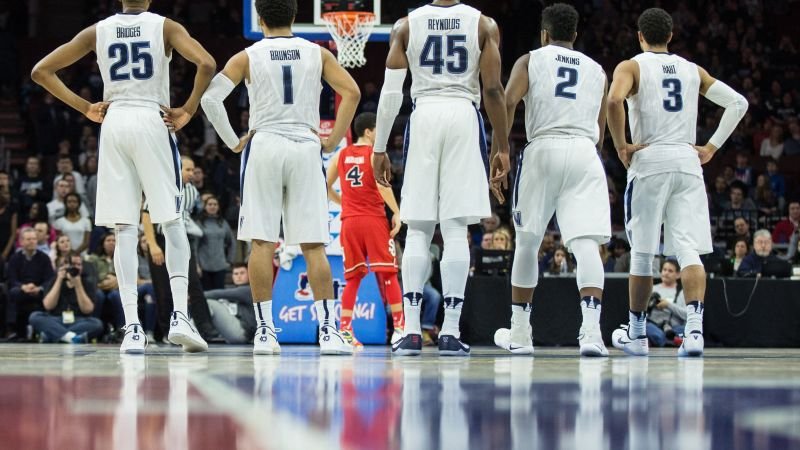
- Three former Villanova teammates who won the 2016 NCAA championship have led the New York Knicks to the NBA Finals.
- Jalen Brunson, Josh Hart and Mikal Bridges could become the first trio to win both college and NBA titles together.
- Their success stems from working through adversity at Villanova, where they pushed through setbacks.
AI-generated summary was reviewed by a CNN editor.
When the play ends, as Kris Jenkins bends over a bit at the waist to watch his work of art swish its way into history, Mikal Bridges dashes onto the court and Josh Hart full scale piggy backs onto Phil Booth. Somehow, Jalen Brunson ends up on the floor, the back of his jersey showing in the dogpile to celebrate Villanova’s 2016 national championship.
Now 10 years later, three of those guys could make history. Should Hart, Bridges and Brunson lead the New York Knicks to the NBA Championship, they will become the first trio of teammates to play on the same college and NBA title-winning teams.
Three guys from the same championship-winning college squads have won NBA crowns. In 1951, Frank Ramsey, Lou Tsioropoulos and Cliff Hagan won it all for Kentucky, and in 1960, Jerry Lucas, John Havlicek and Larry Siegfried were part of Ohio State’s title-winning team.
None have done both together. Ramsey and Tsioropoulous partnered for two titles with the Celtics, Hagan’s championship was with the Hawks. Meanwhile Lucas’ NBA crown with the Knicks came a full decade after Havlicek and Siegfried won it all in Boston.
That they could do it in New York, a city that bills itself as basketball’s playground and has nothing but five decades of empty sandlots to show for it, would only add to the legend of the so-called “Nova Knicks.”
Except if you unspool it, if you watch that 2016 shot, you’ll see that the Nova Knicks are more than a clever and convenient nickname. In those final 4.7 seconds, in a play designed to win a national championship, the three active players on that roster who are still in the NBA had little or nothing to do with the play called Nova.
Hart was well away from the action, setting a screen. Bridges and Brunson weren’t even in the game. They were on the bench watching.
It serves as an example of what college basketball used to be.
This week, with Kentucky signing Iowa State’s Milan Momcilovic for millions of dollars, the college basketball portal more or less closed. More than 4,000 guys entered, seeking to change location. Some sought playing time, others bigger opportunities. Most wanted extra cash and almost all with the same end game: finding the best route to get to the NBA.
Somehow adversity, that thing one used to overcome, has instead become the thing to avoid. Parents put pillows over potholes and kids learn how to navigate away from hard.
The Nova Knicks took a bumpier road – and still ended up in the desired location.
Mikal Bridges redshirted as a freshman and the following year, as Villanova went on to the title, still couldn’t crack the starting lineup. He played in 40 game and started none. A first-round draft pick in 2018, he has played eight years in the league and is in the first year of a four-year, $150 million deal.
In 2015, Josh Hart won both the Big East Tournament Most Valuable Player award and the league’s sixth man honors because he did not become a regular starter until he was a junior. Dylan Ennis, who went undrafted and has since played overseas, beat him out as a sophomore. A late first rounder, Hart is in his 11th NBA season and signed an $81 million extension three years ago.
Jalen Brunson, the lone McDonald’s All-American on the roster his freshman season, played 959 minutes that year. Ryan Arcidiacono, a senior, played 1,282. Brunson’s charity is called the Second Round Foundation because, despite being named the National Player of the Year his junior season, Brunson was only a second-round pick. He’s a three-time All-Star and, after taking less money to give the Knicks financial wiggle room to lure better players, is about to get paid.
Beyond their moniker, the Nova Knicks are, in fact, a proof in concept, an antidote, answer and solution to everything that is ailing college basketball.
If, that is, anyone wants to pay attention.
Tyneeha Rivers is crying on the other end of the phone. Sniffling more than sobbing because she doesn’t really want to cry. Her baby boy is now a 29-year-old man more than capable of taking care of himself but the trouble with motherhood is that you can never stop seeing the little boy who could barely see over the ball he was dribbling around the house.
Besides, she has been asked to consider her son’s resilience and she can’t help it – the tears are falling. “I am,” she tells CNN Sports with a deep sigh, “so incredibly proud of him.”
Rivers was away at college and just 19 when she learned she was pregnant. She heard all of the familiar refrains, that her life was over and her achievable goals had just shrunk. Equal parts stubborn and determined, Rivers instead took a job in a mailroom in suburban Philadelphia and enrolled in classes. She painstakingly chipped away at a degree all while raising her son, eventually earning both an undergrad and a master’s before embarking on a human resources career. Just this past year, she pivoted to small business owner, opening her own yoga studio in King of Prussia.
Despite being almost a kid herself, she did not raise Bridges with kid gloves. She was never the mom who let her boy win a foot race, and when Bridges decided basketball was his sport, she brokered a deal. Believing free throws were mind over matter, she insisted he do a push up for every one he missed. It became so ingrained in Bridges that he’d drop into a plank almost as soon as he walked in the door – for what it’s worth, Bridges is a career 84% free-throw shooter.
Bridges needed all of that armor. He arrived at Villanova with an obvious NBA build and all the tone of Flat Stanley.
“I remember that summer, Mikal was so skinny and Josh, in typical Josh fashion, he just went at him,” says former associate head coach George Halcovage, now the head coach at Buffalo, to CNN Sports. “I mean I don’t even remember there being a real discussion about redshirting. He needed it. It’s not easy. You have to buy into it, but he did.”
And yet the reward did not exactly fill up his cup. On a roster stuffed with upperclassmen, Bridges averaged just 20.3 minutes per game. In the title game, he took one shot in 15 minutes.
Rivers thought about all of that this season as she watched her son fight through the harsh criticism that only New York can deliver. In the first round of the NBA Playoffs this year, Bridges struggled to the point that head coach Mike Brown ostensibly benched him.
Some people questioned whether he was worth the investment ($150 million over four years) and wondered if a more permanent spot on the pine would help the team. Since that series, he’s shooting 60% from the field.
“It’s all part of being an NBA player; I know that and he’s fine with it,” Rivers says. “But that’s why I’m so proud of him. He fought through that, but that’s because he knew how to do it. He had to push through that adversity in college. He had to humble himself. If he didn’t go through that at Villanova, who knows how he handles it now?”
Josh Hart was not flunking out, but he wasn’t exactly passing, either. It was 2012 and Hart was a sophomore at Sidwell Friends, a school well known for its famous alumni (the Obama girls and Chelsea Clinton) if not exactly for its basketball.
It had never been his first choice. He hoped for a shot at one of the DC area basketball-first schools but none showed much interest, so he wound up at Sidwell. The whole thing didn’t quite jibe with his personality. He was (and is now) a harmless goofy kid, more happy jester than serious academic. Hart got in trouble for all sorts of infractions that didn’t seem like a big deal – showing up late to school, using his phone and eating in the hallways.
By the end of the school year, the headmaster sent a letter home suggesting Hart pursue his high school career elsewhere. Hart couldn’t agree more. He told his father, Moses Hart, that maybe the headmaster was right, that perhaps it was time he look at a basketball-first school. He even had a landing spot: Montrose Christian.
Moses Hart gave him an easy choice: play basketball at Sidwell or transfer and don’t play basketball.
“We live in a world where it’s the pleasure of the moment,” Moses told me back in 2016. “If it’s not working here, we’ll just go over there. He made a decision to go to Sidwell, and that meant he was going to stick with it. You don’t move when things get uncomfortable, when it’s not all roses. You have to see it through.”
Those words would prove ominous two years later when Hart still couldn’t make the starting lineup at Villanova. He was playing plenty but could not beat out Ennis. He struggled with it, wondering again if maybe the school wasn’t the right one for him.
“I remember Josh had a conversation with his dad, explaining his frustration,’’ says Father Rob Hagan, Villanova’s team chaplain, to CNN. “And his answer was great. He just said, ‘What do you mean? Work harder.’”
Hagan is, in many ways, Villanova’s soul. Before games, he regularly says a brief mass and uses his homily to tie the Scripture back not only to basketball, but to that particular game. His day job is bigger than his Nova one; he is the prior provincial, overseeing more than 150 Augustinians in the US and counts Pope Leo XIV among his peers.
He has watched the Nova Knicks this year with special fascination, feeling a real sense of déjà vu. Hagan often finds himself thinking about lines that Wright used to toss at his players – “actors play for the crowd; players play for each other” was a favorite – and is amazed at how history is repeating itself.
But as he searches for a way to describe why the Nova transferred into the Knicks, and why it still could work elsewhere, Hagan opts for more familiar person to quote.
“Saint Augustine has a line that we use all the time,” he says. “‘Do not be content with what are, if you want to become what you are not yet. If you’ve grown pleased with yourself, there you shall remain.’”
Last fall, Brunson and Hart returned to Villanova to host their “Roommates” podcast. They told war stories about Wright and made fun of each other. Hart even promised – and later, along with Brunson delivered – to pick up the tab at Kelly’s, a local watering hole down the street from campus. The duo invited Villanova guests on stage, including former Philadelphia Eagle Jason Kelce.
As he prepped for the show, Brunson handed over a Kelce jersey to a staffer, asking if they could get Kelce to sign it.
The realest thing about Jalen Brunson is that he is entirely real. No pretense. No airs and entirely unassuming. He has acted like a 40-year-old since he was 18, content to play what Illinois coach Brad Underwood once dubbed “booty ball” instead of slice his way to the rim.
His father, Rick, an NBA journeyman, used to school his son in the rigors of hoops. During Brunson’s junior high years, they regularly visited a hill that Brunson would run up while wearing a weighted vest. Rick’s message: making the NBA was a literal uphill battle.
It coalesced into a player who has never cared for the concept of “Me.” He wasn’t happy that it was Ryan Arcidiacono making that famous pass to Jenkins in 2016, but he also didn’t pout.
“He was the one guy with the credentials,” Halcovage, a former Villanova assistant coach, says of Brunson, who was a coveted five-star recruit. “And he grinded more than anyone. He didn’t care if the ball was in his hand non stop. He just wanted to find a way to win. That’s all that mattered to him.”
And yet despite mastering the art of winning – he left Villanova with two national titles and 96 victories to 18 losses in his three years – the NBA did not entirely see his value. Much like Jameer Nelson, another great point guard who starred in Philly, the league couldn’t get past his measurables to see his intangibles. Brunson was too small (6-foot-2), not long enough (with a 6-foot-4 wingspan) and too plodding.
He is now being hailed as the savior of New York, with more than a few talking heads posturing that, should Brunson deliver an NBA title to the Knicks, he will be the greatest player in the franchise’s history.
Halcovage has paid special attention to what is brewing in New York. As a college coach — he now leads the program at the University at Buffalo — he is enmeshed in the snake pit that is the current climate of college athletics. He does not fault the players for a system they didn’t create but wonders if maybe anyone might stop long enough to pay attention to a story he knows all too well.
He went to Game 1 of the opening round as his former players’ guest and then watched as the entire playoffs nearly unraveled against Atlanta. The Knicks were down 2-1 in that series and have bludgeoned their opponents ever since, not losing a game. Only three games have been decided by less than double digits.
It got Halcovage to thinking back to a decade ago. At the start of the 2016 season, Villanova went to Hawaii for the Pearl Harbor Invitational. Though 7-0 on the season, the Wildcats really hadn’t played anyone of high caliber. Oklahoma, ranked seventh in nation thanks largely to hot shooting Buddy Hield, would be their toughest test. The Sooners ran Villanova out of the gym, beating them by 23.
Four months later, the two played a rematch in the national semifinal. Villanova set a Final Four record, beating Oklahoma by 44.




Responses