
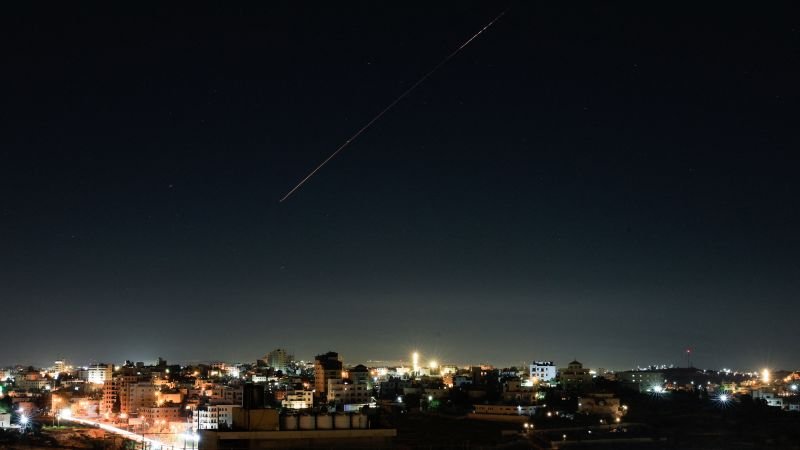
• New escalation: The Israeli military says it intercepted waves of missiles fired from Iran for the first time since early April, and Israeli sources vowed the country will deliver a “powerful” response. Tehran said it would launch further attacks if Israel continues its offensive in Lebanon, where a deadly Israeli strike hit Beirut on Sunday amid fighting with Iran-backed Hezbollah.
• Trump’s response: US President Donald Trump told Fox News the Iranian strikes are “certainly not going to help” negotiations on ending the war. Trump told Tehran to “get back to the table and make a deal.” The president also said he was “not happy” about the Israeli attack in Beirut, and told Axios he would urge Israel not to retaliate against Iran.
• 100 days of war: From catastrophic strikes to wars of words, read reflections from CNN reporters on the conflict’s inflection points so far.
36 Posts
Videos posted on the Islamic Revolutionary Guard Corps’ Telegram channel show street celebrations in Enqelab Square in Tehran on Sunday night. Demonstrators in the roundabout wave Iranian and Hezbollah flags, while an unseen performer leads chants over a microphone.
“Fire the ‘Khaybar Breaker’!” the performer calls out, referencing a variety of missile named after a 7th century battle between Muslims and Jews in the Arabian peninsula.
“Strike the final blow!” the crowd replies.
“Strike the yellow dog!” the performer adds, presumably referring to US President Donald Trump. “Strike the killer of the leader!”
Similar videos of celebrations in Enqelab Square were shared on Press TV, a state-run media channel in Iran.
Tehran has launched its first missile attack targeting Israel since an early April ceasefire, marking a fresh escalation after weeks of negotiations on a potential deal to end the US-Israeli war with Iran.
The Israeli military said its air defenses intercepted missiles from at least three barrages, with one source saying at least 10 ballistic missiles had been intercepted. Israeli sources told CNN that Israel will deliver a “powerful” response to the attack.
Iran has tied the strikes to Israel’s military offensive against Hezbollah in Lebanon, warning of “more crushing” attacks against Israel if it keeps striking southern Lebanon and Beirut, according to Iran’s state-run Press TV.
If you’re just joining us, here’s more on what we know:
Iran’s Islamic Revolutionary Guard Corps (IRGC) claimed it struck the Ramat David air base in northern Israel with ballistic missile fire. The Israeli military originally said it intercepted all of the missiles from at least three Iranian barrages, but in response to a question from CNN, it said the attack continued after its initial statement and that it could not yet provide information about the alleged air base hit.
US President Donald Trump told Fox News that Iran needs to “get back to the table and make a deal” in the wake of the missile attacks. “It’s certainly not going to help negotiations,” he said.
Trump also told Fox he was “not happy” about an earlier Israeli attack in Beirut. Trump and Israeli Prime Minister Benjamin Netanyahu spoke following the Iranian strikes, according to an Israeli source and a person familiar with the call. The US president told Axios beforehand that he would urge Netanyahu not to retaliate.
Israeli military spokesperson Effie Defrin said Israel will “intensify” its strikes on Hezbollah in response to the Iranian barrage.
Israel’s largest healthcare provider is moving hospital operations to “underground facilities and protected areas,” according to a statement from Clalit Health Services on Sunday.
Israel’s government also announced that schools would be closed across the country on Monday. Israel’s Home Front Command instructed people to remain near shelters.
Iraq has closed its airspace for the next 72 hours, according to its Civil Aviation Authority. Syria’s aviation officials announced a 12-hour closure until 11 a.m. local time on Monday.
CNN’s Tal Shalev, Oren Liebermann, Jeremy Diamond, Nechirvan Mando, Aileen Graef, Eyad Kourdi, Eugenia Yosef, Max Saltman, Zeena Saifi, Johnny Hallam and Tamar Michaelis contributed to this report.
Israel announced on Sunday night that it has closed the crossings into Gaza once again amid a renewed escalation with Iran.
The Coordinator of Government Activities in the Territories (COGAT) said the crossings were closed as part of “a number of necessary security measures.” The closure includes the Kerem Shalom crossing, which has been the primary site at which humanitarian aid enters Gaza.
COGAT said enough aid had already entered Gaza since the beginning of the ceasefire and claimed the closure “will not affect the humanitarian situation” in the devastated territory.
At the beginning of the war with Iran in February, Israel also closed the crossings into Gaza, citing security measures. But the crossings were opened days later.
Iran’s Islamic Revolutionary Guard Corps (IRGC) said it struck the Ramat David air base in northern Israel with ballistic missile fire on Sunday.
It released footage on state media of what it said was the moment the missiles were fired.
Following at least three initial barrages fired toward Israel, the Israeli military said it intercepted all Iranian ballistic missiles — at least 10 — “thus far.”
In response to a question about the IRGC claim, the Israel Defense Forces (IDF) told CNN there were more launches after it issued its initial statement and cannot provide any further information about the alleged hit.
Israel will “intensify” its strikes on Hezbollah in Lebanon in response to Iranian missile launches, Israeli military spokesperson Effie Defrin said Sunday in a recorded address.
“We struck in Dahieh following Hezbollah’s unceasing attacks against communities in northern Israel,” Defrin said, referring to a southern suburb of Beirut currently under heavy Israeli fire. “The IDF will continue to operate throughout Lebanon and will intensify its actions against the Hezbollah terrorist organization.”
Defrin added that the Israeli military chief Eyal Zamir “is conducting a situational assessment with the General Staff Forum and approving plans for the continuation of operations.”
According to a statement from the IDF, the Chief of Staff said the military will “strike the enemy with determination” when the order is issued.
“We are prepared for the possibility of additional attacks against us. Our defense systems are excellent, but defense is not airtight,” Defrin concluded.
The US Embassy in Jerusalem issued guidance Sunday night telling staff and their families in Israel to shelter in place “and be prepared to move to a protected shelter in the event of a red alert, until further notice.”
A red alert may follow “missile, rocket fire, or hostile aircraft intrusion,” the post on social media said.
The embassy and the US consulate in Tel Aviv will be closed Monday, the post added.
US President Donald Trump and Israeli Prime Minister Benjamin Netanyahu are speaking now, according to an Israeli source and a person familiar with the call.
Trump previously told Axios’ Barak Ravid that he was going to call Netanyahu and tell him not to attack Iran in response to Iran’s missile launches.
Israel’s largest healthcare provider is moving hospital operations to “underground facilities and protected areas” in the wake of Iranian missile launches on Israel, according to a statement from Clalit Health Services on Sunday night.
The statement said that the network’s 14 hospitals began the move in response to government directives.
“Clalit clinics nationwide will operate tomorrow from protected spaces, in accordance with the guidelines, and on a reduced-service basis,” the statement said.
Syrian and Iraqi authorities announced temporary airspace closures Sunday night as Iran launched ballistic missiles at Israel.
Iraq has closed its airspace for the next 72 hours, according to Iraq’s Civil Aviation Authority.
Syria’s aviation officials announced a 12-hour closure, including “the suspension of operational activities at Damascus International Airport” until 11 a.m. local time on Monday.
US President Donald Trump said Iran needs to “get back to the table and make a deal” in the wake of missile attacks on Israel.
“It’s certainly not going to help negotiations,” Trump told Fox News.
“We’re very close. I would say an agreement would be signed on Monday, Tuesday or Wednesday of this coming week. And now this takes place,” he said.
“You’ve shot your missiles, that’s enough. Get back to the table and make a deal,” he added.
Meanwhile, the president told Axios’ Barak Ravid that he’s going to call Israeli Prime Minister Benjamin Netanyahu and tell him not to attack Iran in response.
“I am going to call Bibi right now and tell him not to retaliate. Each of them had their fun. Israel had its strike and Iran had its strike. We don’t need another one,” Trump told Ravid.
Trump also told Fox News that he was “not happy about” Israel’s strikes on Beirut on Sunday.
This post has been updated with additional information.
Iran warned of “more crushing” attacks against Israel if what it called the “Zionist army” kept attacking southern Lebanon and Beirut, according to Iran’s state-run Press TV.
Iran accused Israel of acting “with the green light and support of criminal America” and said that it had “crossed all red lines” in the ongoing conflict with Hezbollah in Lebanon.
“The Zionist army must stop its attacks on southern Lebanon and Dahiyeh,” Iran’s military said, according to Press TV, which referenced a neighborhood in the Lebanese capital of Beirut that is considered a Hezbollah stronghold. “If it expands its attacks on that region or responds to Iran’s action, it will face even more crushing and regret-inducing blows, and devastating attacks will be launched.”
Iran’s Islamic Revolutionary Guard Corps (IRGC) claimed “a substantial number of Iranian missiles are ready for immediate launch if Israel responds to Iran,” in a separate statement shortly before midnight local time.
The IRGC also warned Israel that “a broader list of targets in Israeli territory could be hit.”
In an exclusive interview with CNN before Iran’s strikes toward Israel on Sunday, Iranian Foreign Ministry spokesperson Esmaeil Baghaei warned that Iran’s armed forces “are steadfast or resolute to respond to any attacks with all force.”
Editor’s Note: CNN operates in Iran only with the permission of the government but maintains full editorial control of its reports.
This post has been updated with the IRGC statement.
Israel will deliver a “powerful” response to Iranian ballistic missile fire, two Israeli sources told CNN on Sunday night.
The Israeli military said it intercepted all Iranian ballistic missiles “thus far” following at least three barrages fired toward Israel. One of the sources said at least 10 ballistic missiles had been intercepted.
The Israel Defense Forces (IDF) said in a statement that it is “currently identifying and intercepting threats.”
Israel’s government announced late Sunday that schools would be closed across the country on Monday after the Israeli military intercepted incoming ballistic missiles from Iran.
Israel’s Home Front Command also instructed people to remain near shelters and to obey any further instructions with the possibility of a severe escalation between Israel and Iran.
The Israeli military said it detected incoming ballistic missiles from Iran on Sunday night for what appears to be the first time since early April. The military sent alerts warning of incoming fire to residents of northern Israel.
The Israel Defense Forces (IDF) said they intercepted two incoming missiles.
A short time later, the IDF warned of “additional barrages” launched toward the State of Israel.
An Israeli source told CNN that Prime Minister Benjamin Netanyahu was convening a security consultation in response.
Last week, Iran threatened to attack Israel directly if Israel struck Beirut. Earlier Sunday, Israel struck the Lebanese capital in response to Hezbollah fire that targeted northern Israel.
Iranian lawmaker Ebrahim Rezaei said on X that there would be a “decisive and painful response” to the attack on the Dahiyeh neighborhood of Beirut, considered a Hezbollah stronghold.
Moments before the IDF issued the alert of incoming Iranian missile, the military had warned of “potential fire toward the State of Israel in the coming hours.”
US President Donald Trump said Iran has agreed it will not obtain nuclear weapons, offering a new insight into ongoing negotiations.
In an interview with NBC’s “Meet the Press,” taped Friday and aired Sunday morning, Trump said discussions with Iran centered on closing what he described as a loophole in proposed language governing the country’s nuclear program.
He continued: “I want to put the word, if they buy, or purchase, or acquire. You know, you’ve got to have that in there, too, because that’s not developing. So they don’t have the right to develop or purchase, acquire, or buy.”
Some key context: The comments provide more insight into the specific language being discussed, but the concession Trump highlighted is not new to nuclear agreements the US has had with Iran in the past.
In the opening paragraph of the 2015 Joint Comprehensive Plan of Action (JCPOA), the international nuclear deal negotiated under the Obama administration, it states that “Iran reaffirms that under no circumstances will Iran ever seek, develop or acquire any nuclear weapons.”
US President Donald Trump addressed the conflicts in the Middle East in a wide-ranging interview airing on NBC’s “Meet the Press” this morning.
The interview, which was prerecorded Friday, comes as the war with Iran reaches the 100-day mark.
Trump said he is not planning to withdraw the roughly 50,000 troops involved in the Iran war until “we have a completion” of the conflict. “I don’t consider (the troops) in danger,” he said.
Here’s what else we heard from Trump:
The president said he is open to sending US forces to retrieve Iran’s nuclear stockpile but hopes to instead destroy the material as part of an agreement with Iran.
Trump said he would like to see Israel make a more “surgical attack on Hezbollah” in Lebanon, where the death toll is rising from an expanded Israeli offensive targeting the Iran-backed militant group. Trump insisted he and Israeli Prime Minister Benjamin Netanyahu remain on the same page, despite some disagreements over the Lebanon conflict, which has complicated negotiations with Tehran.
Iranian Supreme Leader Mojtaba Khamenei is “more rational” than his predecessor, according to the US president, who added that Khamenei is “pretty badly injured” from the Israeli strike that killed his father, the former supreme leader.
Trump pushed back on the assertion he broke his campaign promise of keeping the United States out of any new military conflicts. “First of all, I didn’t guarantee no war,” he said, adding, “Why would I have built the strongest military in the world?”
Meanwhile, we’re tracking other Middle East developments:
US Secretary of Defense Pete Hegseth downplayed concerns on the status of the US-Iran ceasefire in light of back-and-forth military actions in the Persian Gulf and Strait of Hormuz.
Ships transiting the Strait of Hormuz with Iranian permission are being charged an average fee of $1.5 to $2 million, according to a senior member of Iran’s parliament.
Iran could issue a 30-day deadline for reopening the strait under Iranian management in light of recent US actions, a member of Iran’s negotiating team said in an interview with the country’s semi-official Fars news agency.
The Israeli military struck Beirut on Sunday for the first time since the latest ceasefire went into effect. The strike came after Hezbollah fire was intercepted over northern Israel. Israel also issued a renewed evacuation warning for the ancient Lebanese city of Tyre.
Iranian lawmaker Ebrahim Rezaei warned that Iran would deliver a “firm and painful response” to Israel’s strike on Beirut. “Watch the skies over the occupied territories tonight,” Rezaei, a spokesperson for the Iranian Parliament’s National Security Commission, wrote on X.
CNN’s Aida Karimi, Tim Lister, Billy Stockwell, Sophie Tanno, Tal Shalev, Aileen Graef and Dalia Abdelwahab contributed to this report.
President Donald Trump told NBC he is “open” to sending US forces to retrieve Iran’s nuclear stockpile but hopes it would be done as part of an agreement with Tehran.
The issue of Iran’s nuclear program and its stockpile of highly enriched uranium, which Trump called “nuclear dust,” is at the center of the conflict.
The US president said if a deal is reached, the two countries will destroy the stockpile together.
“If we make a deal, now (that) we’re friendly, we’ll all go together. It’ll be our equipment. We’ll take it out and destroy it, whether it’s onsite or whether we take it offsite,” Trump said in a prerecorded interview airing Sunday on “Meet the Press.”
Trump added that if a deal is not reached, he would take out Iran “militarily very harshly” before entering the country with US forces.
The president said he will wait until there is “safety either way” when retrieving the stockpile. “We will go with them, or without them. But we won’t have people shooting at us, OK?” he said.
Context: CNN has previously reported that recovering Iran’s highly enriched uranium stockpile, believed to be sitting in a storage facility underground, would require a significant number of US ground troops beyond a small special operations footprint, according to seven current and former officials familiar with the military planning.
The move would put a large number of troops in harm’s way as part of a complex mission to move or render safe tons of highly radioactive material.
President Donald Trump pushed back on the assertion he broke his campaign promise of keeping the United States out of any new military conflicts.
“Well, well. First of all, I didn’t guarantee no war,” he said in a pre-taped interview on NBC’s “Meet the Press,” out Sunday, adding, “Why would I have built the strongest military in the world?”
Trump defended his military efforts in Venezuela and Iran, saying they are not as lengthy as the US engagements in Iraq and Vietnam.
“We’re there for a few months,” Trump said. “And the threat is largely over. Soon, it will be over. But you cannot let Iran have a nuclear weapon, or they will blow you up.”
US Secretary of Defense Pete Hegseth downplayed concerns on the status of the US-Iran ceasefire, which was meant to act as a buffer while both sides negotiate a permanent peace deal.
“Of course it’s a ceasefire,” Hegseth told reporters prior to departing from France, where he had been participating in a World War II memorial ceremony.
Hegseth dismissed questions about recent military back-and-forths between the US military and Iran’s Islamic Revolutionary Guard Corps, saying US President Donald Trump was “very clear things can happen intermittently” during a ceasefire, but that Trump remains focused on negotiating a deal.
“We’re negotiating actively,” Hegseth said. “Things are happening, shipping is moving through. Iran shouldn’t be shooting at it. And when they do, we take care of that as you would expect. But ultimately, we think a deal, a great deal, is likely coming soon.”
From the start, CNN journalists have been tracking the defining moments of the US-Israeli war with Iran — the military escalations, devastating human toll, market shocks and political reckonings that altered the course of the conflict, moment by moment.
These are some of the war’s early defining moments, as told by our reporters:
US and Israel launch strikes on Iran, February 28: “I started to get a strong sense of what was coming by late afternoon on February 27, as multiple sources described an array of unusual activity across the US government that all pointed to a looming military operation.” – Zachary Cohen, senior reporter
First retaliatory strikes hit Israel, February 28: “Like millions across Israel, I awoke to the sound of sirens. It was about 8:15 a.m. local time and Israel’s Home Front Command was blasting a warning to residents, urging them to move near bomb shelters and prepare for incoming Iranian missile fire.” – Jeremy Diamond, Jerusalem correspondent
First US casualties, March 1: “I woke up to news from a source that US troops had been struck and several were believed to have been killed. Learning that kind of news never gets easier.” – Haley Britzky, national security reporter
On the ground in Tehran, March 8: “In the middle of night, we suddenly heard very loud explosions that shook our hotel. As we got to the roof, we saw massive plumes of black smoke to the east, south and west of the city.” – Fred Pleitgen, senior international correspondent
Israel expands strikes in Lebanon, March 23: “When Hezbollah openly announced it had fired projectiles into Israel to avenge the death of Iran’s supreme leader Ayatollah Ali Khamenei, it seemed a wildly erratic, almost suicidal move.” – Nick Paton Walsh, chief international security correspondent
Read more reflections from CNN reporters as the war reaches its 100th day.
• New escalation: The Israeli military says it intercepted waves of missiles fired from Iran for the first time since early April, and Israeli sources vowed the country will deliver a “powerful” response. Tehran said it would launch further attacks if Israel continues its offensive in Lebanon, where a deadly Israeli strike hit Beirut on Sunday amid fighting with Iran-backed Hezbollah.
• Trump’s response: US President Donald Trump told Fox News the Iranian strikes are “certainly not going to help” negotiations on ending the war. Trump told Tehran to “get back to the table and make a deal.” The president also said he was “not happy” about the Israeli attack in Beirut, and told Axios he would urge Israel not to retaliate against Iran.
• 100 days of war: From catastrophic strikes to wars of words, read reflections from CNN reporters on the conflict’s inflection points so far.
Videos posted on the Islamic Revolutionary Guard Corps’ Telegram channel show street celebrations in Enqelab Square in Tehran on Sunday night. Demonstrators in the roundabout wave Iranian and Hezbollah flags, while an unseen performer leads chants over a microphone.
“Fire the ‘Khaybar Breaker’!” the performer calls out, referencing a variety of missile named after a 7th century battle between Muslims and Jews in the Arabian peninsula.
“Strike the final blow!” the crowd replies.
“Strike the yellow dog!” the performer adds, presumably referring to US President Donald Trump. “Strike the killer of the leader!”
Similar videos of celebrations in Enqelab Square were shared on Press TV, a state-run media channel in Iran.
Tehran has launched its first missile attack targeting Israel since an early April ceasefire, marking a fresh escalation after weeks of negotiations on a potential deal to end the US-Israeli war with Iran.
The Israeli military said its air defenses intercepted missiles from at least three barrages, with one source saying at least 10 ballistic missiles had been intercepted. Israeli sources told CNN that Israel will deliver a “powerful” response to the attack.
Iran has tied the strikes to Israel’s military offensive against Hezbollah in Lebanon, warning of “more crushing” attacks against Israel if it keeps striking southern Lebanon and Beirut, according to Iran’s state-run Press TV.
If you’re just joining us, here’s more on what we know:
Iran’s Islamic Revolutionary Guard Corps (IRGC) claimed it struck the Ramat David air base in northern Israel with ballistic missile fire. The Israeli military originally said it intercepted all of the missiles from at least three Iranian barrages, but in response to a question from CNN, it said the attack continued after its initial statement and that it could not yet provide information about the alleged air base hit.
US President Donald Trump told Fox News that Iran needs to “get back to the table and make a deal” in the wake of the missile attacks. “It’s certainly not going to help negotiations,” he said.
Trump also told Fox he was “not happy” about an earlier Israeli attack in Beirut. Trump and Israeli Prime Minister Benjamin Netanyahu spoke following the Iranian strikes, according to an Israeli source and a person familiar with the call. The US president told Axios beforehand that he would urge Netanyahu not to retaliate.
Israeli military spokesperson Effie Defrin said Israel will “intensify” its strikes on Hezbollah in response to the Iranian barrage.
Israel’s largest healthcare provider is moving hospital operations to “underground facilities and protected areas,” according to a statement from Clalit Health Services on Sunday.
Israel’s government also announced that schools would be closed across the country on Monday. Israel’s Home Front Command instructed people to remain near shelters.
Iraq has closed its airspace for the next 72 hours, according to its Civil Aviation Authority. Syria’s aviation officials announced a 12-hour closure until 11 a.m. local time on Monday.
CNN’s Tal Shalev, Oren Liebermann, Jeremy Diamond, Nechirvan Mando, Aileen Graef, Eyad Kourdi, Eugenia Yosef, Max Saltman, Zeena Saifi, Johnny Hallam and Tamar Michaelis contributed to this report.
Israel announced on Sunday night that it has closed the crossings into Gaza once again amid a renewed escalation with Iran.
The Coordinator of Government Activities in the Territories (COGAT) said the crossings were closed as part of “a number of necessary security measures.” The closure includes the Kerem Shalom crossing, which has been the primary site at which humanitarian aid enters Gaza.
COGAT said enough aid had already entered Gaza since the beginning of the ceasefire and claimed the closure “will not affect the humanitarian situation” in the devastated territory.
At the beginning of the war with Iran in February, Israel also closed the crossings into Gaza, citing security measures. But the crossings were opened days later.
Iran’s Islamic Revolutionary Guard Corps (IRGC) said it struck the Ramat David air base in northern Israel with ballistic missile fire on Sunday.
It released footage on state media of what it said was the moment the missiles were fired.
Following at least three initial barrages fired toward Israel, the Israeli military said it intercepted all Iranian ballistic missiles — at least 10 — “thus far.”
In response to a question about the IRGC claim, the Israel Defense Forces (IDF) told CNN there were more launches after it issued its initial statement and cannot provide any further information about the alleged hit.
Israel will “intensify” its strikes on Hezbollah in Lebanon in response to Iranian missile launches, Israeli military spokesperson Effie Defrin said Sunday in a recorded address.
“We struck in Dahieh following Hezbollah’s unceasing attacks against communities in northern Israel,” Defrin said, referring to a southern suburb of Beirut currently under heavy Israeli fire. “The IDF will continue to operate throughout Lebanon and will intensify its actions against the Hezbollah terrorist organization.”
Defrin added that the Israeli military chief Eyal Zamir “is conducting a situational assessment with the General Staff Forum and approving plans for the continuation of operations.”
According to a statement from the IDF, the Chief of Staff said the military will “strike the enemy with determination” when the order is issued.
“We are prepared for the possibility of additional attacks against us. Our defense systems are excellent, but defense is not airtight,” Defrin concluded.
The US Embassy in Jerusalem issued guidance Sunday night telling staff and their families in Israel to shelter in place “and be prepared to move to a protected shelter in the event of a red alert, until further notice.”
A red alert may follow “missile, rocket fire, or hostile aircraft intrusion,” the post on social media said.
The embassy and the US consulate in Tel Aviv will be closed Monday, the post added.
US President Donald Trump and Israeli Prime Minister Benjamin Netanyahu are speaking now, according to an Israeli source and a person familiar with the call.
Trump previously told Axios’ Barak Ravid that he was going to call Netanyahu and tell him not to attack Iran in response to Iran’s missile launches.
Israel’s largest healthcare provider is moving hospital operations to “underground facilities and protected areas” in the wake of Iranian missile launches on Israel, according to a statement from Clalit Health Services on Sunday night.
The statement said that the network’s 14 hospitals began the move in response to government directives.
“Clalit clinics nationwide will operate tomorrow from protected spaces, in accordance with the guidelines, and on a reduced-service basis,” the statement said.
Syrian and Iraqi authorities announced temporary airspace closures Sunday night as Iran launched ballistic missiles at Israel.
Iraq has closed its airspace for the next 72 hours, according to Iraq’s Civil Aviation Authority.
Syria’s aviation officials announced a 12-hour closure, including “the suspension of operational activities at Damascus International Airport” until 11 a.m. local time on Monday.
US President Donald Trump said Iran needs to “get back to the table and make a deal” in the wake of missile attacks on Israel.
“It’s certainly not going to help negotiations,” Trump told Fox News.
“We’re very close. I would say an agreement would be signed on Monday, Tuesday or Wednesday of this coming week. And now this takes place,” he said.
“You’ve shot your missiles, that’s enough. Get back to the table and make a deal,” he added.
Meanwhile, the president told Axios’ Barak Ravid that he’s going to call Israeli Prime Minister Benjamin Netanyahu and tell him not to attack Iran in response.
“I am going to call Bibi right now and tell him not to retaliate. Each of them had their fun. Israel had its strike and Iran had its strike. We don’t need another one,” Trump told Ravid.
Trump also told Fox News that he was “not happy about” Israel’s strikes on Beirut on Sunday.
This post has been updated with additional information.
Iran warned of “more crushing” attacks against Israel if what it called the “Zionist army” kept attacking southern Lebanon and Beirut, according to Iran’s state-run Press TV.
Iran accused Israel of acting “with the green light and support of criminal America” and said that it had “crossed all red lines” in the ongoing conflict with Hezbollah in Lebanon.
“The Zionist army must stop its attacks on southern Lebanon and Dahiyeh,” Iran’s military said, according to Press TV, which referenced a neighborhood in the Lebanese capital of Beirut that is considered a Hezbollah stronghold. “If it expands its attacks on that region or responds to Iran’s action, it will face even more crushing and regret-inducing blows, and devastating attacks will be launched.”
Iran’s Islamic Revolutionary Guard Corps (IRGC) claimed “a substantial number of Iranian missiles are ready for immediate launch if Israel responds to Iran,” in a separate statement shortly before midnight local time.
The IRGC also warned Israel that “a broader list of targets in Israeli territory could be hit.”
In an exclusive interview with CNN before Iran’s strikes toward Israel on Sunday, Iranian Foreign Ministry spokesperson Esmaeil Baghaei warned that Iran’s armed forces “are steadfast or resolute to respond to any attacks with all force.”
Editor’s Note: CNN operates in Iran only with the permission of the government but maintains full editorial control of its reports.
This post has been updated with the IRGC statement.
Israel will deliver a “powerful” response to Iranian ballistic missile fire, two Israeli sources told CNN on Sunday night.
The Israeli military said it intercepted all Iranian ballistic missiles “thus far” following at least three barrages fired toward Israel. One of the sources said at least 10 ballistic missiles had been intercepted.
The Israel Defense Forces (IDF) said in a statement that it is “currently identifying and intercepting threats.”
Israel’s government announced late Sunday that schools would be closed across the country on Monday after the Israeli military intercepted incoming ballistic missiles from Iran.
Israel’s Home Front Command also instructed people to remain near shelters and to obey any further instructions with the possibility of a severe escalation between Israel and Iran.
The Israeli military said it detected incoming ballistic missiles from Iran on Sunday night for what appears to be the first time since early April. The military sent alerts warning of incoming fire to residents of northern Israel.
The Israel Defense Forces (IDF) said they intercepted two incoming missiles.
A short time later, the IDF warned of “additional barrages” launched toward the State of Israel.
An Israeli source told CNN that Prime Minister Benjamin Netanyahu was convening a security consultation in response.
Last week, Iran threatened to attack Israel directly if Israel struck Beirut. Earlier Sunday, Israel struck the Lebanese capital in response to Hezbollah fire that targeted northern Israel.
Iranian lawmaker Ebrahim Rezaei said on X that there would be a “decisive and painful response” to the attack on the Dahiyeh neighborhood of Beirut, considered a Hezbollah stronghold.
Moments before the IDF issued the alert of incoming Iranian missile, the military had warned of “potential fire toward the State of Israel in the coming hours.”
US President Donald Trump said Iran has agreed it will not obtain nuclear weapons, offering a new insight into ongoing negotiations.
In an interview with NBC’s “Meet the Press,” taped Friday and aired Sunday morning, Trump said discussions with Iran centered on closing what he described as a loophole in proposed language governing the country’s nuclear program.
He continued: “I want to put the word, if they buy, or purchase, or acquire. You know, you’ve got to have that in there, too, because that’s not developing. So they don’t have the right to develop or purchase, acquire, or buy.”
Some key context: The comments provide more insight into the specific language being discussed, but the concession Trump highlighted is not new to nuclear agreements the US has had with Iran in the past.
In the opening paragraph of the 2015 Joint Comprehensive Plan of Action (JCPOA), the international nuclear deal negotiated under the Obama administration, it states that “Iran reaffirms that under no circumstances will Iran ever seek, develop or acquire any nuclear weapons.”
US President Donald Trump addressed the conflicts in the Middle East in a wide-ranging interview airing on NBC’s “Meet the Press” this morning.
The interview, which was prerecorded Friday, comes as the war with Iran reaches the 100-day mark.
Trump said he is not planning to withdraw the roughly 50,000 troops involved in the Iran war until “we have a completion” of the conflict. “I don’t consider (the troops) in danger,” he said.
Here’s what else we heard from Trump:
The president said he is open to sending US forces to retrieve Iran’s nuclear stockpile but hopes to instead destroy the material as part of an agreement with Iran.
Trump said he would like to see Israel make a more “surgical attack on Hezbollah” in Lebanon, where the death toll is rising from an expanded Israeli offensive targeting the Iran-backed militant group. Trump insisted he and Israeli Prime Minister Benjamin Netanyahu remain on the same page, despite some disagreements over the Lebanon conflict, which has complicated negotiations with Tehran.
Iranian Supreme Leader Mojtaba Khamenei is “more rational” than his predecessor, according to the US president, who added that Khamenei is “pretty badly injured” from the Israeli strike that killed his father, the former supreme leader.
Trump pushed back on the assertion he broke his campaign promise of keeping the United States out of any new military conflicts. “First of all, I didn’t guarantee no war,” he said, adding, “Why would I have built the strongest military in the world?”
Meanwhile, we’re tracking other Middle East developments:
US Secretary of Defense Pete Hegseth downplayed concerns on the status of the US-Iran ceasefire in light of back-and-forth military actions in the Persian Gulf and Strait of Hormuz.
Ships transiting the Strait of Hormuz with Iranian permission are being charged an average fee of $1.5 to $2 million, according to a senior member of Iran’s parliament.
Iran could issue a 30-day deadline for reopening the strait under Iranian management in light of recent US actions, a member of Iran’s negotiating team said in an interview with the country’s semi-official Fars news agency.
The Israeli military struck Beirut on Sunday for the first time since the latest ceasefire went into effect. The strike came after Hezbollah fire was intercepted over northern Israel. Israel also issued a renewed evacuation warning for the ancient Lebanese city of Tyre.
Iranian lawmaker Ebrahim Rezaei warned that Iran would deliver a “firm and painful response” to Israel’s strike on Beirut. “Watch the skies over the occupied territories tonight,” Rezaei, a spokesperson for the Iranian Parliament’s National Security Commission, wrote on X.
CNN’s Aida Karimi, Tim Lister, Billy Stockwell, Sophie Tanno, Tal Shalev, Aileen Graef and Dalia Abdelwahab contributed to this report.
President Donald Trump told NBC he is “open” to sending US forces to retrieve Iran’s nuclear stockpile but hopes it would be done as part of an agreement with Tehran.
The issue of Iran’s nuclear program and its stockpile of highly enriched uranium, which Trump called “nuclear dust,” is at the center of the conflict.
The US president said if a deal is reached, the two countries will destroy the stockpile together.
“If we make a deal, now (that) we’re friendly, we’ll all go together. It’ll be our equipment. We’ll take it out and destroy it, whether it’s onsite or whether we take it offsite,” Trump said in a prerecorded interview airing Sunday on “Meet the Press.”
Trump added that if a deal is not reached, he would take out Iran “militarily very harshly” before entering the country with US forces.
The president said he will wait until there is “safety either way” when retrieving the stockpile. “We will go with them, or without them. But we won’t have people shooting at us, OK?” he said.
Context: CNN has previously reported that recovering Iran’s highly enriched uranium stockpile, believed to be sitting in a storage facility underground, would require a significant number of US ground troops beyond a small special operations footprint, according to seven current and former officials familiar with the military planning.
The move would put a large number of troops in harm’s way as part of a complex mission to move or render safe tons of highly radioactive material.
President Donald Trump pushed back on the assertion he broke his campaign promise of keeping the United States out of any new military conflicts.
“Well, well. First of all, I didn’t guarantee no war,” he said in a pre-taped interview on NBC’s “Meet the Press,” out Sunday, adding, “Why would I have built the strongest military in the world?”
Trump defended his military efforts in Venezuela and Iran, saying they are not as lengthy as the US engagements in Iraq and Vietnam.
“We’re there for a few months,” Trump said. “And the threat is largely over. Soon, it will be over. But you cannot let Iran have a nuclear weapon, or they will blow you up.”
US Secretary of Defense Pete Hegseth downplayed concerns on the status of the US-Iran ceasefire, which was meant to act as a buffer while both sides negotiate a permanent peace deal.
“Of course it’s a ceasefire,” Hegseth told reporters prior to departing from France, where he had been participating in a World War II memorial ceremony.
Hegseth dismissed questions about recent military back-and-forths between the US military and Iran’s Islamic Revolutionary Guard Corps, saying US President Donald Trump was “very clear things can happen intermittently” during a ceasefire, but that Trump remains focused on negotiating a deal.
“We’re negotiating actively,” Hegseth said. “Things are happening, shipping is moving through. Iran shouldn’t be shooting at it. And when they do, we take care of that as you would expect. But ultimately, we think a deal, a great deal, is likely coming soon.”
From the start, CNN journalists have been tracking the defining moments of the US-Israeli war with Iran — the military escalations, devastating human toll, market shocks and political reckonings that altered the course of the conflict, moment by moment.
These are some of the war’s early defining moments, as told by our reporters:
US and Israel launch strikes on Iran, February 28: “I started to get a strong sense of what was coming by late afternoon on February 27, as multiple sources described an array of unusual activity across the US government that all pointed to a looming military operation.” – Zachary Cohen, senior reporter
First retaliatory strikes hit Israel, February 28: “Like millions across Israel, I awoke to the sound of sirens. It was about 8:15 a.m. local time and Israel’s Home Front Command was blasting a warning to residents, urging them to move near bomb shelters and prepare for incoming Iranian missile fire.” – Jeremy Diamond, Jerusalem correspondent
First US casualties, March 1: “I woke up to news from a source that US troops had been struck and several were believed to have been killed. Learning that kind of news never gets easier.” – Haley Britzky, national security reporter
On the ground in Tehran, March 8: “In the middle of night, we suddenly heard very loud explosions that shook our hotel. As we got to the roof, we saw massive plumes of black smoke to the east, south and west of the city.” – Fred Pleitgen, senior international correspondent
Israel expands strikes in Lebanon, March 23: “When Hezbollah openly announced it had fired projectiles into Israel to avenge the death of Iran’s supreme leader Ayatollah Ali Khamenei, it seemed a wildly erratic, almost suicidal move.” – Nick Paton Walsh, chief international security correspondent
Read more reflections from CNN reporters as the war reaches its 100th day.





Responses