
• Get the latest updates on the war with Iran here.
27 Posts
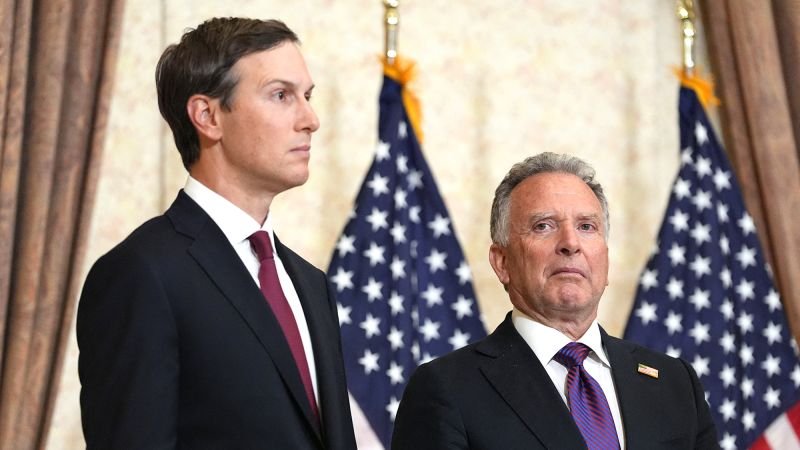
• US-Iran talks: US envoy Steve Witkoff and President Donald Trump’s son-in-law Jared Kushner met with the Qatari prime minister today to discuss ongoing US-Iran talks and regional developments, according to Qatar’s Foreign Ministry spokesperson. However, there are currently no high-level meetings between the US and Iran.
• Strait of Hormuz: Oman recently delivered a proposal to the US and other allies on the future of the Strait of Hormuz, according to a regional diplomat and a US source familiar. Even as commercial traffic remained steady, the security threat level for the critical strait has been raised to “substantial” due to the risk of mines and clearance operations, according to the Joint Maritime Information Center.
• Looking ahead: Iran-Qatar talks on Wednesday will cover the implementation of Tehran’s agreement with the US as well as its frozen assets, according to Iran’s Foreign Ministry.
Qatar’s Foreign Ministry said Tuesday that Sheikh Mohammed bin Abdulrahman bin Jassim Al Thani, the country’s prime minister, met with US envoys Steve Witkoff and Jared Kushner to discuss ongoing US-Iran talks and regional developments.
The meeting, according to the ministry, reviewed the latest developments in negotiations between the United States and Iran under the framework of the memorandum of understanding between both sides, as well as efforts to strengthen security and stability in the region through dialogue and diplomacy.
Here’s what else to know:
Tuesday’s meeting also addressed the ceasefire in Lebanon “and emphasized the importance of stabilizing it and building upon it to preserve Lebanon’s unity, sovereignty and stability,” the ministry said.
Qatar also said technical talks between Iran and the United States are continuing, but there are currently no high-level meetings between the two.
Meanwhile, Iran says Qatar talks, set for Wednesday, will cover the implementation of Tehran’s agreement with the US, as well as its frozen assets, Iranian Foreign Ministry spokesperson Esmaeil Baghaei said Tuesday.
In Lebanon: Despite a US-brokered agreement signed Friday between Israel and Lebanon, the Israeli military said it struck a Hezbollah operative in the Manzala area of southern Lebanon, near the “security zone” where Israeli forces were operating. The military said the individual posed a threat to its soldiers.
In the Strait of Hormuz: At least 32 vessels have transited the vital waterway over the past 24 hours, according to MarineTraffic data. Seventeen ships entered the Persian Gulf, including seven tankers and 10 cargo vessels, and an additional 15 ships exited the gulf.
Oman recently delivered a proposal to the US and other allies on the future of the strait, according to a regional diplomat and a US source familiar with the matter.
Iranian authorities plan to hold funeral ceremonies for slain Supreme Leader Ali Khamenei from July 4 to July 9 across Iran and Iraq, months after his death. The delay has raised questions about the condition of his son and successor, and criticism from detractors who say the state is trying to inflate attendance.
Mohammed Tawfeeq, Eyad Kourdi, Dana Karni, Hira Humayun Avery Schmitz, Zachary Cohen, Aileen Graef and Nic Robertson contributed reporting.
Iranian authorities plan to hold funeral ceremonies for slain Supreme Leader Ali Khamenei from July 4 to July 9 across Iran and Iraq, months after his death, in a delay that has raised questions about the condition of his son and successor and criticism from detractors who say the state is trying to inflate attendance.
Officials have laid out a multi-day schedule spanning Tehran, Qom and Mashhad in Iran and Najaf and Karbala in Iraq, turning the funeral into a national and regional event long after Khamenei was killed on February 28, the first day of the US-Israel war with Iran.
Iraq has confirmed that funeral processions for Khamenei will be held in Najaf and Karbala, two Shiite holy cities south of Baghdad. Iraq’s Popular Mobilization Units have invited local and foreign media to register for accreditation to cover the events.
According to a schedule published by Iran’s semi-official Fars News Agency, a tribute ceremony for foreign leaders and senior officials is planned in Tehran on July 3, with public farewell ceremonies set for July 4 and 5 at the capital’s Imam Khomeini Mosalla. A funeral procession in the capital is scheduled for July 6.
Further ceremonies are planned for July 7 in Qom, July 8 in Najaf and Karbala, and July 9 in Mashhad, which is considered Iran’s Shiite spiritual capital. The northeastern city is also Khamenei’s hometown, and he is to be buried there at the Shrine of Imam Reza, one of the holiest sites in Shiite Islam and a major pilgrimage destination.
Qatar’s Foreign Ministry said Tuesday that Sheikh Mohammed bin Abdulrahman bin Jassim Al Thani, the country’s prime minister and foreign minister, met with US envoys Steve Witkoff and Jared Kushner to discuss ongoing US-Iran talks and regional developments.
According to the ministry’s statement, the meeting reviewed the latest developments in negotiations between the United States and Iran under the framework of a memorandum of understanding between the two sides, as well as efforts to strengthen security and stability in the region through dialogue and diplomacy.
The Qatari foreign minister reaffirmed Doha’s continued mediation efforts and its support for dialogue stemming from the US-Iran memorandum of understanding.
The Israeli military said it struck a Hezbollah operative in the Manzala area of southern Lebanon, near the “security zone” where Israeli forces were operating.
The military said the individual posed a threat to its soldiers. The strike marks a continuation of fighting between the Israeli military and Hezbollah over the weekend amid a US-brokered agreement signed Friday between Israel and Lebanon.
At least 4,278 people have been killed in Israeli attacks in Lebanon since March 2, the Lebanese Health Ministry said Tuesday.
Earlier in the day, Israeli Prime Minister Benjamin Netanyahu visited the security zone, where he reiterated that Israeli troops will not leave southern Lebanon until the threat from Hezbollah has been removed.
Lebanon’s state-run National News Agency (NNA) reported Tuesday that Israeli forces conducted a “demolition operation” in the town of Markaba, fired artillery at the town of Beit Yahoun and “set fire to homes” there as well as in Aita al-Jabal, all in southern Lebanon.
CNN has reached out to the Israeli military for comment on the NNA report.
At least 32 vessels have transited the Strait of Hormuz over the past 24 hours, according to MarineTraffic data, as US envoys prepared for the next round of mediated talks in Qatar about a peace agreement with Iran.
Seventeen ships entered the Persian Gulf, including seven tankers and 10 cargo vessels. An additional 15 ships exited the gulf, made up of 10 tankers and five cargo vessels.
These figures align with the traffic flow observed in recent weeks. Before the war, roughly 110 vessels crossed the strait each day, on average.
Since a US-imposed blockade was officially lifted two weeks ago, Iran has exported roughly 50 million barrels of crude oil, according to an analysis by TankerTrackers, while other gulf countries have struggled to move their own exports.
The strait has also experienced months of GPS spoofing — a form of navigational interference that causes ships to appear in incorrect locations. Spoofing activity has declined noticeably in recent weeks.
Oman recently delivered a proposal to the US and other allies on the future of the Strait of Hormuz, according to a regional diplomat and a US source familiar with the matter.
The regional diplomat said the proposal, which has not been finalized, outlines a plan for shipping companies to pay service fees to use the strait, but they would not be called tolls. The diplomat did not elaborate on the difference between a service fee and a toll.
Significant disagreements remain over the proposal, the diplomat added, noting it is expected to be one of the topics discussed in Doha this week.
Another regional source with knowledge of the negotiations said Oman is not pushing for a fee-based system in the strait. The US source said American negotiators have concerns about the proposal that they intend to discuss with the Omanis, though the source added that Oman has maintained its commitment to no tolling and that the proposal does not include mandatory tolls.
White House spokesperson Anna Kelly told CNN, “President Trump has been clear that Iran cannot toll the strait, which is an international waterway.”
Trump’s special envoy Steve Witkoff and his son-in-law Jared Kushner were in Doha today with Qatari Prime Minister Sheikh Mohammed bin Abdulrahman bin Jassim Al Thani and other mediators, according to a White House official.
Delegations from the US and Iran are expected to participate separately tomorrow in technical talks with mediators from Qatar and Pakistan, the official added.
The ceasefire agreement unveiled earlier this month stipulates that Iran will make “arrangements using its best efforts” to ensure the safe passage of commercial vessels in the Strait of Hormuz, through which a fifth of the world’s oil and liquefied natural gas supplies travel.
A vaguely worded article in the agreement said Iran and Oman would work together to “define the future administration” of the waterway, effectively giving Tehran a formal role in managing it.
Qatar said Tuesday that technical talks between Iran and the United States are continuing, but there are currently no high-level meetings between the two sides under the existing negotiation mechanism.
Majed al-Ansari, an adviser to Qatar’s prime minister and spokesperson for the Foreign Ministry, said the visit to the capital, Doha, by US envoys Steve Witkoff and Jared Kushner was part of consultations with Qatari mediators and officials on a range of regional issues, including talks related to Iran and Lebanon.
“There are currently no high-level meetings between the Iranian and American parties under the adopted negotiation mechanism,” al-Ansari said during a media briefing as shared by the country’s Foreign Ministry.
He said technical-level contacts between the two sides have continued since earlier meetings in Switzerland, both directly and indirectly, with mediators working to maintain the process in Doha and elsewhere.
Al-Ansari said the Iranian and American technical delegations were “still in session,” adding that the meetings were taking place in different formats with mediator participation to ensure continuity.
US special envoy Steve Witkoff and President Donald Trump’s son-in-law Jared Kushner are in Doha, Qatar, today for talks on the conflict with Iran.
The pair will meet with Qatari mediators, as well as the country’s prime minister, but the US representatives will not be meeting with Iranian officials, Qatar’s Foreign Ministry spokesperson Majed al-Ansari has said.
Here’s the latest:
Iran’s delegation will meet with Qatari officials in Doha tomorrow, according to Iranian Foreign Ministry spokesperson Esmaeil Baghaei. The talks will cover the implementation of Tehran’s agreement with the US, as well as its frozen assets, Baghaei said, adding that Iran’s negotiating team had no plan to meet with the American delegation in the coming days.
The maritime security threat level for the Strait of Hormuz has been raised to “substantial,” even as commercial traffic through the waterway remained steady over the last 48 hours, according to the Joint Maritime Information Center (JMIC) in a security report.
Forty ships transited the waterway yesterday, according to data from maritime intelligence firm Kpler, a number still significantly lower than the average daily crossings before the war with Iran started.
A 20-year-old American citizen was arrested in Israel earlier this month on suspicion of spying for Iran, Israel’s police and internal security agency said today, accusing the suspect of offenses that included endangering Israel’s security.
Arab nations of the Persian Gulf added multiple Hezbollah-affiliated financial institutions and officials to their list of terrorism-related sanctions designations today, in coordination with the United States.
CNN’s Alayna Treene, Nadeen Ebrahim, Sarah Tamimi, Aida Karimi, Mohammed Tawfeeq, Sandi Sidhu, Ross Adkin, Dana Karni, Oren Liebermann, Eyad Kourdi and Lauren Kent contributed to this reporting.
Arab nations of the Persian Gulf, in coordination with the United States, on Tuesday added multiple Hezbollah-affiliated financial institutions and officials to their list of terrorism-related sanctions designations.
The joint actions, imposed against five entities and 16 individuals, were taken by member states of the Terrorist Financing Targeting Center (TFTC), which includes Bahrain, Kuwait, Oman, Qatar, Saudi Arabia, the United Arab Emirates and the United States.
The sanctions designations include al-Qard al-Hassan Association (AQAH), which is a Hezbollah-affiliated financial institution that was previously designated by the US in July 2007. Bayt al-Mal, a financial services entity that is often considered the Iranian-backed Lebanese militant group’s unofficial “treasury” department, was also designated. It was initially designated by the US in September 2006.
Senior officials including the head of Hezbollah’s Central Finance Unit, Ibrahim Ali Daher, and the financial director of al-Qard al-Hassan, Ahmad Mohammad Yazbek, were also added to the sanctions list.
“The networks designated by TFTC today threaten regional stability, international security, mutual interests, and global trade. By restricting Hizballah’s access to funding, TFTC members are working to protect the integrity of the international financial system, support the Lebanese people, and counter terror networks,” the statement added.
The maritime security threat level for the Strait of Hormuz has been raised to “substantial” even as commercial traffic through the waterway remained steady over the last 48 hours, according to the Joint Maritime Information Center (JMIC) in a security report.
In its advisory on Tuesday, it said vessels continued to transit the strait through both the southern Omani corridor and the northern Iranian-controlled route, while US-assisted commercial transits proceeded without interruption.
But the group warned that “the maritime security threat level for the Strait of Hormuz has been raised to SUBSTANTIAL, with additional mine risk persisting and clearance operations ongoing.”
The JMIC also said navigation interference, hailing by Iran’s Islamic Revolutionary Guard Corps, drone activity and surveillance all continued in the area.
No confirmed maritime security incidents were listed in the latest reporting period.
The US-led JMIC is a multinational naval advisory body based in Bahrain. Established in 2024, it assesses maritime risks and works closely with groups such as the United Kingdom Maritime Trade Operations (UKMTO) center.
An American citizen was arrested in Israel earlier this month on suspicion of spying for Iran, Israel’s police and internal security agency said Tuesday, accusing the suspect of offenses that included endangering Israel’s security.
In a statement, police said the 20-year-old suspect had been in touch with Iranian intelligence operatives over the past several months. The suspect photographed and documented sensitive sites in Israel, police said, and received payments of tens to hundreds of dollars per assignment.
Police did not identify the suspect, who was arrested on June 9. A spokesman for Israel Police declined to comment on whether the suspect was a resident of Israel or a tourist.
“We will continue to detect and expose offenses of this kind, arrest those responsible, and bring to justice anyone who endangers the security of the state and its citizens,” Chief Inspector Amichai Fanta said in a statement.
The investigation was conducted under a gag order, police said, and the suspect’s detention has been extended “in accordance with the needs of the investigation.” The suspect is set to be indicted in the coming days, police said.
CNN previously reported that Israel has been facing an unprecedented wave of domestic espionage since 2023. At least 60 Israelis have been indicted on charges of spying for Iran, but this appears to be the first time an American has been detained in Israel on similar suspicions. Several of the sites that prosecutors say were filmed by these alleged recruits have been targeted in Iranian missile attacks on Israel over the past year.
Safely evacuating more than 8,500 seafarers still stuck in the Strait of Hormuz requires Iranian guarantees that no vessels will be targeted, the head of the UN’s International Maritime Organization (IMO) said Tuesday.
Dominguez also highlighted the importance of urgently demining the strait in order to allow a gradual return to vessels flowing more normally through the vital waterway.
He commended countries, including France, for offering to assist in the demining process. However, Iran’s deputy foreign minister has said the country will remove all of the mines by itself.
Jared Kushner, the son-in-law of US President Donald Trump, is expected to meet with Qatari Prime Minister Sheikh Mohammed bin Abdulrahman bin Jassim Al Thani and other mediators in Doha today, a White House official told CNN.
Kushner served as a chief Middle East negotiator in Trump’s first presidential term and built deep relationships with leaders in the region, having informally advised administration officials on negotiations with Arab leaders, Trump administration officials and people close to Kushner told CNN last year.
Kushner helped lead Trump administration policies on the Middle East, including the Abraham Accords, which normalized ties between Israel and several Arab states.
After leaving the White House in 2021, Kushner launched a private equity firm, Affinity Partners, which received $2 billion from Saudi Arabia’s sovereign wealth fund. The United Arab Emirates and Qatar have also invested large amounts into his firm.
Kushner has previously denied these investments are a conflict of interest. In an interview with CBS News’ “60 Minutes” last year, Kushner said: “What people call conflicts of interests, Steve (Witkoff) and I call experience and trusted relationships that we have throughout the world.”
Delegations from the United States and Iran are arriving in Doha for “technical talks” discussing the implementation of the memorandum of understanding signed between both parties.
The talks are different to the ones held earlier this month in Switzerland, where high-level Iranian and American delegations met face-to-face behind closed doors.
The technical talks are not high-level talks, Qatar’s Foreign Ministry spokesman Majed al-Ansari said Tuesday.
The Switzerland meeting was headed by US Vice President JD Vance and Iran’s chief negotiator Mohammad Bagher Ghalibaf.
The Doha talks scheduled for Tuesday are on a lower level, headed by US Special Envoy Steve Witkoff and Iran’s deputy foreign minister, Kazem Gharibabadi. The delegations will not meet in person, instead negotiations will be mediated by Qatari officials.
The technical talks are designed to “produce documents that will be elevated to principles in the high-level meetings to agree upon,” al-Ansari said.
Topics to be discussed during technical talks include:
Financial restrictions and lifting of sanctions on Iran
How to establish the free flow of vessels through the Strait of Hormuz
The future of Iran’s nuclear program
The potential release of Iran’s frozen assets
Regional security
Iran-Qatar talks on Wednesday will cover the implementation of Tehran’s agreement with the US, as well as its frozen assets, Iranian Foreign Ministry spokesperson Esmaeil Baghaei said Tuesday.
He added that Iran’s negotiating team had no plan to meet with the American delegation in the coming days.
Qatar’s Foreign Ministry spokesman Majed al-Ansari said Tuesday that US envoy Steve Witkoff and President Donald Trump’s son-in-law Jared Kushner have arrived in Doha to meet Qatari mediators, but he stressed there will not be a meeting with Iranian officials.
He added that $6 billion of Iran’s frozen funds have not been transferred to Tehran, but he said this would happen “according to the advancement of negotiations.”
US envoy Steve Witkoff and President Donald Trump’s son-in-law Jared Kushner will be in Doha to meet Qatari mediators, but there will not be a meeting with Iranian officials, Qatar’s Foreign Ministry spokesman Majed al-Ansari has said.
The Qatari official added that the $6 billion in Iranian frozen funds has not been transferred to Tehran, adding this will happen “according to the advancement of negotiations.”
Regarding the Strait of Hormuz, he said Doha is coordinating with Oman on safe passage of ships through the waterway.
Talks on the US-Iran conflict are expected to take place in the Qatari capital of Doha today, though there will not be a high-level meeting between Washington and Tehran, Reuters reported, citing Qatar’s Foreign Ministry spokesperson Majed al-Ansari.
US President Donald Trump’s special envoy Steve Witkoff and his son-in-law Jared Kushner are expected to meet with Qatari Prime Minister Sheikh Mohammed bin Abdulrahman bin Jassim Al Thani and other mediators, a White House official told CNN.
Qatar, alongside Pakistan, has played a key role in mediating this conflict.
Pakistan, meanwhile, has emerged as a key diplomatic bridge between the US and Iran, having hosted face-to-face talks between delegations from both countries back in April. Pakistani officials have passed peace proposals and counterproposals between the warring sides and helped to negotiate and extend the current ceasefire.
The country is well-placed to act as mediator given its cordial ties with both Iran and the United States, with Pakistani army chief Asim Munir — whom US President Donald Trump has called his “favorite field marshal” — leading Islamabad’s efforts.
Pakistan is also home to the largest population of Shiite Muslims outside of Iran and, unlike Islamic countries in the Persian Gulf region, does not host any US military bases.
Officials from Qatar — a key US ally in the region — have also held talks in Tehran to help mediate an agreement, according to sources.
President Donald Trump’s special envoy Steve Witkoff and his son-in-law Jared Kushner are expected to meet today with Qatari Prime Minister Sheikh Mohammed bin Abdulrahman bin Jassim Al Thani and other mediators in Doha, a White House official told CNN.
Delegations from the US and Iran are expected to participate separately tomorrow in technical talks with mediators from Qatar and Pakistan, the official added.
The details of the negotiations come as Washington and Tehran have sent mixed signals about whether they will hold direct talks in the Persian Gulf state.
Iran said Monday that no negotiation meetings were scheduled with the United States at any level in the coming days, while Trump wrote in a social media post that the US would meet with Iran in Doha.
A senior US official had said over the weekend that technical talks regarding the memorandum of understanding were “on track” despite a recent exchange of fire.
What is the deal? It is two weeks since the US and Iran signed a memorandum of understanding that was supposed to offer a path toward permanently ending the war in the region.
Widely viewed as highly favorable to Tehran, it requires the US to unfreeze Iranian assets, terminate sanctions, allow Iranian oil exports, lift its blockade on Iranian ports and develop a reconstruction fund for Iran. In return, Tehran must guarantee safe passage for ships passing through the Strait of Hormuz and reaffirm its pledge to not develop nuclear weapons.
What’s happened in the past two weeks? There have been frequent reminders of this truce’s fragility. US and Iranian forces traded strikes over the weekend after the Islamic Republic attacked two ships transiting the strait.
That — again — impacted marine traffic in the narrow waterway, which had substantially increased last week, though it remains well below pre-war levels. Meanwhile, fighting between Hezbollah militants and Israeli forces has continued in southern Lebanon, despite agreements aimed at curbing the violence there.
What are the unresolved issues? The MOU basically kicked the can down the road, leaving most details to be sorted out later. But two weeks into the 60 days allocated for negotiating the final deal, there is little sign of progress on several of the most important issues.
One clause in the MOU has created the potential for a catch-22 situation. It stipulates that further negotiations will only start once the issues of Iran’s frozen assets, US sanctions on Iranian oil, Strait of Hormuz traffic, the US blockade of Iranian ports, and fighting between the two countries (and in Lebanon), have been dealt with. So even agreeing on a sequence remains difficult.
While Tehran said yesterday half of its frozen assets held in Qatar will be returned, US officials have said no such assets have yet been released. And Iran continues to insist ships must have its permission to transit the strait via designated routes, but a growing number of vessels are using an alternative route hugging the Omani coastline. Substantive talks discussing Iran’s nuclear program haven’t begun yet.
• US-Iran talks: US envoy Steve Witkoff and President Donald Trump’s son-in-law Jared Kushner met with the Qatari prime minister today to discuss ongoing US-Iran talks and regional developments, according to Qatar’s Foreign Ministry spokesperson. However, there are currently no high-level meetings between the US and Iran.
• Strait of Hormuz: Oman recently delivered a proposal to the US and other allies on the future of the Strait of Hormuz, according to a regional diplomat and a US source familiar. Even as commercial traffic remained steady, the security threat level for the critical strait has been raised to “substantial” due to the risk of mines and clearance operations, according to the Joint Maritime Information Center.
• Looking ahead: Iran-Qatar talks on Wednesday will cover the implementation of Tehran’s agreement with the US as well as its frozen assets, according to Iran’s Foreign Ministry.
Qatar’s Foreign Ministry said Tuesday that Sheikh Mohammed bin Abdulrahman bin Jassim Al Thani, the country’s prime minister, met with US envoys Steve Witkoff and Jared Kushner to discuss ongoing US-Iran talks and regional developments.
The meeting, according to the ministry, reviewed the latest developments in negotiations between the United States and Iran under the framework of the memorandum of understanding between both sides, as well as efforts to strengthen security and stability in the region through dialogue and diplomacy.
Here’s what else to know:
Tuesday’s meeting also addressed the ceasefire in Lebanon “and emphasized the importance of stabilizing it and building upon it to preserve Lebanon’s unity, sovereignty and stability,” the ministry said.
Qatar also said technical talks between Iran and the United States are continuing, but there are currently no high-level meetings between the two.
Meanwhile, Iran says Qatar talks, set for Wednesday, will cover the implementation of Tehran’s agreement with the US, as well as its frozen assets, Iranian Foreign Ministry spokesperson Esmaeil Baghaei said Tuesday.
In Lebanon: Despite a US-brokered agreement signed Friday between Israel and Lebanon, the Israeli military said it struck a Hezbollah operative in the Manzala area of southern Lebanon, near the “security zone” where Israeli forces were operating. The military said the individual posed a threat to its soldiers.
In the Strait of Hormuz: At least 32 vessels have transited the vital waterway over the past 24 hours, according to MarineTraffic data. Seventeen ships entered the Persian Gulf, including seven tankers and 10 cargo vessels, and an additional 15 ships exited the gulf.
Oman recently delivered a proposal to the US and other allies on the future of the strait, according to a regional diplomat and a US source familiar with the matter.
Iranian authorities plan to hold funeral ceremonies for slain Supreme Leader Ali Khamenei from July 4 to July 9 across Iran and Iraq, months after his death. The delay has raised questions about the condition of his son and successor, and criticism from detractors who say the state is trying to inflate attendance.
Mohammed Tawfeeq, Eyad Kourdi, Dana Karni, Hira Humayun Avery Schmitz, Zachary Cohen, Aileen Graef and Nic Robertson contributed reporting.
Iranian authorities plan to hold funeral ceremonies for slain Supreme Leader Ali Khamenei from July 4 to July 9 across Iran and Iraq, months after his death, in a delay that has raised questions about the condition of his son and successor and criticism from detractors who say the state is trying to inflate attendance.
Officials have laid out a multi-day schedule spanning Tehran, Qom and Mashhad in Iran and Najaf and Karbala in Iraq, turning the funeral into a national and regional event long after Khamenei was killed on February 28, the first day of the US-Israel war with Iran.
Iraq has confirmed that funeral processions for Khamenei will be held in Najaf and Karbala, two Shiite holy cities south of Baghdad. Iraq’s Popular Mobilization Units have invited local and foreign media to register for accreditation to cover the events.
According to a schedule published by Iran’s semi-official Fars News Agency, a tribute ceremony for foreign leaders and senior officials is planned in Tehran on July 3, with public farewell ceremonies set for July 4 and 5 at the capital’s Imam Khomeini Mosalla. A funeral procession in the capital is scheduled for July 6.
Further ceremonies are planned for July 7 in Qom, July 8 in Najaf and Karbala, and July 9 in Mashhad, which is considered Iran’s Shiite spiritual capital. The northeastern city is also Khamenei’s hometown, and he is to be buried there at the Shrine of Imam Reza, one of the holiest sites in Shiite Islam and a major pilgrimage destination.
Qatar’s Foreign Ministry said Tuesday that Sheikh Mohammed bin Abdulrahman bin Jassim Al Thani, the country’s prime minister and foreign minister, met with US envoys Steve Witkoff and Jared Kushner to discuss ongoing US-Iran talks and regional developments.
According to the ministry’s statement, the meeting reviewed the latest developments in negotiations between the United States and Iran under the framework of a memorandum of understanding between the two sides, as well as efforts to strengthen security and stability in the region through dialogue and diplomacy.
The Qatari foreign minister reaffirmed Doha’s continued mediation efforts and its support for dialogue stemming from the US-Iran memorandum of understanding.
The Israeli military said it struck a Hezbollah operative in the Manzala area of southern Lebanon, near the “security zone” where Israeli forces were operating.
The military said the individual posed a threat to its soldiers. The strike marks a continuation of fighting between the Israeli military and Hezbollah over the weekend amid a US-brokered agreement signed Friday between Israel and Lebanon.
At least 4,278 people have been killed in Israeli attacks in Lebanon since March 2, the Lebanese Health Ministry said Tuesday.
Earlier in the day, Israeli Prime Minister Benjamin Netanyahu visited the security zone, where he reiterated that Israeli troops will not leave southern Lebanon until the threat from Hezbollah has been removed.
Lebanon’s state-run National News Agency (NNA) reported Tuesday that Israeli forces conducted a “demolition operation” in the town of Markaba, fired artillery at the town of Beit Yahoun and “set fire to homes” there as well as in Aita al-Jabal, all in southern Lebanon.
CNN has reached out to the Israeli military for comment on the NNA report.
At least 32 vessels have transited the Strait of Hormuz over the past 24 hours, according to MarineTraffic data, as US envoys prepared for the next round of mediated talks in Qatar about a peace agreement with Iran.
Seventeen ships entered the Persian Gulf, including seven tankers and 10 cargo vessels. An additional 15 ships exited the gulf, made up of 10 tankers and five cargo vessels.
These figures align with the traffic flow observed in recent weeks. Before the war, roughly 110 vessels crossed the strait each day, on average.
Since a US-imposed blockade was officially lifted two weeks ago, Iran has exported roughly 50 million barrels of crude oil, according to an analysis by TankerTrackers, while other gulf countries have struggled to move their own exports.
The strait has also experienced months of GPS spoofing — a form of navigational interference that causes ships to appear in incorrect locations. Spoofing activity has declined noticeably in recent weeks.
Oman recently delivered a proposal to the US and other allies on the future of the Strait of Hormuz, according to a regional diplomat and a US source familiar with the matter.
The regional diplomat said the proposal, which has not been finalized, outlines a plan for shipping companies to pay service fees to use the strait, but they would not be called tolls. The diplomat did not elaborate on the difference between a service fee and a toll.
Significant disagreements remain over the proposal, the diplomat added, noting it is expected to be one of the topics discussed in Doha this week.
Another regional source with knowledge of the negotiations said Oman is not pushing for a fee-based system in the strait. The US source said American negotiators have concerns about the proposal that they intend to discuss with the Omanis, though the source added that Oman has maintained its commitment to no tolling and that the proposal does not include mandatory tolls.
White House spokesperson Anna Kelly told CNN, “President Trump has been clear that Iran cannot toll the strait, which is an international waterway.”
Trump’s special envoy Steve Witkoff and his son-in-law Jared Kushner were in Doha today with Qatari Prime Minister Sheikh Mohammed bin Abdulrahman bin Jassim Al Thani and other mediators, according to a White House official.
Delegations from the US and Iran are expected to participate separately tomorrow in technical talks with mediators from Qatar and Pakistan, the official added.
The ceasefire agreement unveiled earlier this month stipulates that Iran will make “arrangements using its best efforts” to ensure the safe passage of commercial vessels in the Strait of Hormuz, through which a fifth of the world’s oil and liquefied natural gas supplies travel.
A vaguely worded article in the agreement said Iran and Oman would work together to “define the future administration” of the waterway, effectively giving Tehran a formal role in managing it.
Qatar said Tuesday that technical talks between Iran and the United States are continuing, but there are currently no high-level meetings between the two sides under the existing negotiation mechanism.
Majed al-Ansari, an adviser to Qatar’s prime minister and spokesperson for the Foreign Ministry, said the visit to the capital, Doha, by US envoys Steve Witkoff and Jared Kushner was part of consultations with Qatari mediators and officials on a range of regional issues, including talks related to Iran and Lebanon.
“There are currently no high-level meetings between the Iranian and American parties under the adopted negotiation mechanism,” al-Ansari said during a media briefing as shared by the country’s Foreign Ministry.
He said technical-level contacts between the two sides have continued since earlier meetings in Switzerland, both directly and indirectly, with mediators working to maintain the process in Doha and elsewhere.
Al-Ansari said the Iranian and American technical delegations were “still in session,” adding that the meetings were taking place in different formats with mediator participation to ensure continuity.
US special envoy Steve Witkoff and President Donald Trump’s son-in-law Jared Kushner are in Doha, Qatar, today for talks on the conflict with Iran.
The pair will meet with Qatari mediators, as well as the country’s prime minister, but the US representatives will not be meeting with Iranian officials, Qatar’s Foreign Ministry spokesperson Majed al-Ansari has said.
Here’s the latest:
Iran’s delegation will meet with Qatari officials in Doha tomorrow, according to Iranian Foreign Ministry spokesperson Esmaeil Baghaei. The talks will cover the implementation of Tehran’s agreement with the US, as well as its frozen assets, Baghaei said, adding that Iran’s negotiating team had no plan to meet with the American delegation in the coming days.
The maritime security threat level for the Strait of Hormuz has been raised to “substantial,” even as commercial traffic through the waterway remained steady over the last 48 hours, according to the Joint Maritime Information Center (JMIC) in a security report.
Forty ships transited the waterway yesterday, according to data from maritime intelligence firm Kpler, a number still significantly lower than the average daily crossings before the war with Iran started.
A 20-year-old American citizen was arrested in Israel earlier this month on suspicion of spying for Iran, Israel’s police and internal security agency said today, accusing the suspect of offenses that included endangering Israel’s security.
Arab nations of the Persian Gulf added multiple Hezbollah-affiliated financial institutions and officials to their list of terrorism-related sanctions designations today, in coordination with the United States.
CNN’s Alayna Treene, Nadeen Ebrahim, Sarah Tamimi, Aida Karimi, Mohammed Tawfeeq, Sandi Sidhu, Ross Adkin, Dana Karni, Oren Liebermann, Eyad Kourdi and Lauren Kent contributed to this reporting.
Arab nations of the Persian Gulf, in coordination with the United States, on Tuesday added multiple Hezbollah-affiliated financial institutions and officials to their list of terrorism-related sanctions designations.
The joint actions, imposed against five entities and 16 individuals, were taken by member states of the Terrorist Financing Targeting Center (TFTC), which includes Bahrain, Kuwait, Oman, Qatar, Saudi Arabia, the United Arab Emirates and the United States.
The sanctions designations include al-Qard al-Hassan Association (AQAH), which is a Hezbollah-affiliated financial institution that was previously designated by the US in July 2007. Bayt al-Mal, a financial services entity that is often considered the Iranian-backed Lebanese militant group’s unofficial “treasury” department, was also designated. It was initially designated by the US in September 2006.
Senior officials including the head of Hezbollah’s Central Finance Unit, Ibrahim Ali Daher, and the financial director of al-Qard al-Hassan, Ahmad Mohammad Yazbek, were also added to the sanctions list.
“The networks designated by TFTC today threaten regional stability, international security, mutual interests, and global trade. By restricting Hizballah’s access to funding, TFTC members are working to protect the integrity of the international financial system, support the Lebanese people, and counter terror networks,” the statement added.
The maritime security threat level for the Strait of Hormuz has been raised to “substantial” even as commercial traffic through the waterway remained steady over the last 48 hours, according to the Joint Maritime Information Center (JMIC) in a security report.
In its advisory on Tuesday, it said vessels continued to transit the strait through both the southern Omani corridor and the northern Iranian-controlled route, while US-assisted commercial transits proceeded without interruption.
But the group warned that “the maritime security threat level for the Strait of Hormuz has been raised to SUBSTANTIAL, with additional mine risk persisting and clearance operations ongoing.”
The JMIC also said navigation interference, hailing by Iran’s Islamic Revolutionary Guard Corps, drone activity and surveillance all continued in the area.
No confirmed maritime security incidents were listed in the latest reporting period.
The US-led JMIC is a multinational naval advisory body based in Bahrain. Established in 2024, it assesses maritime risks and works closely with groups such as the United Kingdom Maritime Trade Operations (UKMTO) center.
An American citizen was arrested in Israel earlier this month on suspicion of spying for Iran, Israel’s police and internal security agency said Tuesday, accusing the suspect of offenses that included endangering Israel’s security.
In a statement, police said the 20-year-old suspect had been in touch with Iranian intelligence operatives over the past several months. The suspect photographed and documented sensitive sites in Israel, police said, and received payments of tens to hundreds of dollars per assignment.
Police did not identify the suspect, who was arrested on June 9. A spokesman for Israel Police declined to comment on whether the suspect was a resident of Israel or a tourist.
“We will continue to detect and expose offenses of this kind, arrest those responsible, and bring to justice anyone who endangers the security of the state and its citizens,” Chief Inspector Amichai Fanta said in a statement.
The investigation was conducted under a gag order, police said, and the suspect’s detention has been extended “in accordance with the needs of the investigation.” The suspect is set to be indicted in the coming days, police said.
CNN previously reported that Israel has been facing an unprecedented wave of domestic espionage since 2023. At least 60 Israelis have been indicted on charges of spying for Iran, but this appears to be the first time an American has been detained in Israel on similar suspicions. Several of the sites that prosecutors say were filmed by these alleged recruits have been targeted in Iranian missile attacks on Israel over the past year.
Safely evacuating more than 8,500 seafarers still stuck in the Strait of Hormuz requires Iranian guarantees that no vessels will be targeted, the head of the UN’s International Maritime Organization (IMO) said Tuesday.
Dominguez also highlighted the importance of urgently demining the strait in order to allow a gradual return to vessels flowing more normally through the vital waterway.
He commended countries, including France, for offering to assist in the demining process. However, Iran’s deputy foreign minister has said the country will remove all of the mines by itself.
Jared Kushner, the son-in-law of US President Donald Trump, is expected to meet with Qatari Prime Minister Sheikh Mohammed bin Abdulrahman bin Jassim Al Thani and other mediators in Doha today, a White House official told CNN.
Kushner served as a chief Middle East negotiator in Trump’s first presidential term and built deep relationships with leaders in the region, having informally advised administration officials on negotiations with Arab leaders, Trump administration officials and people close to Kushner told CNN last year.
Kushner helped lead Trump administration policies on the Middle East, including the Abraham Accords, which normalized ties between Israel and several Arab states.
After leaving the White House in 2021, Kushner launched a private equity firm, Affinity Partners, which received $2 billion from Saudi Arabia’s sovereign wealth fund. The United Arab Emirates and Qatar have also invested large amounts into his firm.
Kushner has previously denied these investments are a conflict of interest. In an interview with CBS News’ “60 Minutes” last year, Kushner said: “What people call conflicts of interests, Steve (Witkoff) and I call experience and trusted relationships that we have throughout the world.”
Delegations from the United States and Iran are arriving in Doha for “technical talks” discussing the implementation of the memorandum of understanding signed between both parties.
The talks are different to the ones held earlier this month in Switzerland, where high-level Iranian and American delegations met face-to-face behind closed doors.
The technical talks are not high-level talks, Qatar’s Foreign Ministry spokesman Majed al-Ansari said Tuesday.
The Switzerland meeting was headed by US Vice President JD Vance and Iran’s chief negotiator Mohammad Bagher Ghalibaf.
The Doha talks scheduled for Tuesday are on a lower level, headed by US Special Envoy Steve Witkoff and Iran’s deputy foreign minister, Kazem Gharibabadi. The delegations will not meet in person, instead negotiations will be mediated by Qatari officials.
The technical talks are designed to “produce documents that will be elevated to principles in the high-level meetings to agree upon,” al-Ansari said.
Topics to be discussed during technical talks include:
Financial restrictions and lifting of sanctions on Iran
How to establish the free flow of vessels through the Strait of Hormuz
The future of Iran’s nuclear program
The potential release of Iran’s frozen assets
Regional security
Iran-Qatar talks on Wednesday will cover the implementation of Tehran’s agreement with the US, as well as its frozen assets, Iranian Foreign Ministry spokesperson Esmaeil Baghaei said Tuesday.
He added that Iran’s negotiating team had no plan to meet with the American delegation in the coming days.
Qatar’s Foreign Ministry spokesman Majed al-Ansari said Tuesday that US envoy Steve Witkoff and President Donald Trump’s son-in-law Jared Kushner have arrived in Doha to meet Qatari mediators, but he stressed there will not be a meeting with Iranian officials.
He added that $6 billion of Iran’s frozen funds have not been transferred to Tehran, but he said this would happen “according to the advancement of negotiations.”
US envoy Steve Witkoff and President Donald Trump’s son-in-law Jared Kushner will be in Doha to meet Qatari mediators, but there will not be a meeting with Iranian officials, Qatar’s Foreign Ministry spokesman Majed al-Ansari has said.
The Qatari official added that the $6 billion in Iranian frozen funds has not been transferred to Tehran, adding this will happen “according to the advancement of negotiations.”
Regarding the Strait of Hormuz, he said Doha is coordinating with Oman on safe passage of ships through the waterway.
Talks on the US-Iran conflict are expected to take place in the Qatari capital of Doha today, though there will not be a high-level meeting between Washington and Tehran, Reuters reported, citing Qatar’s Foreign Ministry spokesperson Majed al-Ansari.
US President Donald Trump’s special envoy Steve Witkoff and his son-in-law Jared Kushner are expected to meet with Qatari Prime Minister Sheikh Mohammed bin Abdulrahman bin Jassim Al Thani and other mediators, a White House official told CNN.
Qatar, alongside Pakistan, has played a key role in mediating this conflict.
Pakistan, meanwhile, has emerged as a key diplomatic bridge between the US and Iran, having hosted face-to-face talks between delegations from both countries back in April. Pakistani officials have passed peace proposals and counterproposals between the warring sides and helped to negotiate and extend the current ceasefire.
The country is well-placed to act as mediator given its cordial ties with both Iran and the United States, with Pakistani army chief Asim Munir — whom US President Donald Trump has called his “favorite field marshal” — leading Islamabad’s efforts.
Pakistan is also home to the largest population of Shiite Muslims outside of Iran and, unlike Islamic countries in the Persian Gulf region, does not host any US military bases.
Officials from Qatar — a key US ally in the region — have also held talks in Tehran to help mediate an agreement, according to sources.
President Donald Trump’s special envoy Steve Witkoff and his son-in-law Jared Kushner are expected to meet today with Qatari Prime Minister Sheikh Mohammed bin Abdulrahman bin Jassim Al Thani and other mediators in Doha, a White House official told CNN.
Delegations from the US and Iran are expected to participate separately tomorrow in technical talks with mediators from Qatar and Pakistan, the official added.
The details of the negotiations come as Washington and Tehran have sent mixed signals about whether they will hold direct talks in the Persian Gulf state.
Iran said Monday that no negotiation meetings were scheduled with the United States at any level in the coming days, while Trump wrote in a social media post that the US would meet with Iran in Doha.
A senior US official had said over the weekend that technical talks regarding the memorandum of understanding were “on track” despite a recent exchange of fire.
What is the deal? It is two weeks since the US and Iran signed a memorandum of understanding that was supposed to offer a path toward permanently ending the war in the region.
Widely viewed as highly favorable to Tehran, it requires the US to unfreeze Iranian assets, terminate sanctions, allow Iranian oil exports, lift its blockade on Iranian ports and develop a reconstruction fund for Iran. In return, Tehran must guarantee safe passage for ships passing through the Strait of Hormuz and reaffirm its pledge to not develop nuclear weapons.
What’s happened in the past two weeks? There have been frequent reminders of this truce’s fragility. US and Iranian forces traded strikes over the weekend after the Islamic Republic attacked two ships transiting the strait.
That — again — impacted marine traffic in the narrow waterway, which had substantially increased last week, though it remains well below pre-war levels. Meanwhile, fighting between Hezbollah militants and Israeli forces has continued in southern Lebanon, despite agreements aimed at curbing the violence there.
What are the unresolved issues? The MOU basically kicked the can down the road, leaving most details to be sorted out later. But two weeks into the 60 days allocated for negotiating the final deal, there is little sign of progress on several of the most important issues.
One clause in the MOU has created the potential for a catch-22 situation. It stipulates that further negotiations will only start once the issues of Iran’s frozen assets, US sanctions on Iranian oil, Strait of Hormuz traffic, the US blockade of Iranian ports, and fighting between the two countries (and in Lebanon), have been dealt with. So even agreeing on a sequence remains difficult.
While Tehran said yesterday half of its frozen assets held in Qatar will be returned, US officials have said no such assets have yet been released. And Iran continues to insist ships must have its permission to transit the strait via designated routes, but a growing number of vessels are using an alternative route hugging the Omani coastline. Substantive talks discussing Iran’s nuclear program haven’t begun yet.




Responses